Duan Yongping "holds Moutai in one hand and Pop Mart in the other" — is spring coming for consumer stocks?
On July 10, 2026, a disclosure of interest filing from the Hong Kong Stock Exchange caught the market's attention — renowned investor Duan Yongping further increased his holdings in Pop Mart by 10.59 million shares, raising his stake to 7.65% and pushing the market value of his position beyond HK$15.3 billion.
With this move, the investor, famous for his "value investing" philosophy and who had long maintained a wait-and-see attitude toward Pop Mart, completed a stunning transformation from "not understanding the business" to a "multi-billion-dollar heavy position" in just over two months. Prior to this, Duan had also increased his holdings in Kweichow Moutai against the market trend.
Now, as the market fixates on the tech frenzy surrounding AI and semiconductors, what kind of signal does Duan Yongping's posture of "holding Moutai in one hand and Pop Mart in the other" represent?
Duan Yongping's "Consumer Bet"
Duan Yongping's shift in attitude toward Pop Mart began with an earnings report.
The full-year 2025 financial results showed that Pop Mart recorded total revenue of 37.12 billion yuan, a year-on-year increase of 184.7%. Its adjusted net profit reached 13.08 billion yuan, surging 284.5% year-on-year, with gross margin holding steady at 72.1% — a new all-time high for the company. Overseas business became its core growth engine, generating 16.268 billion yuan in annual revenue, skyrocketing 291.9% year-on-year, and pushing the overseas revenue share up to 43.8%.
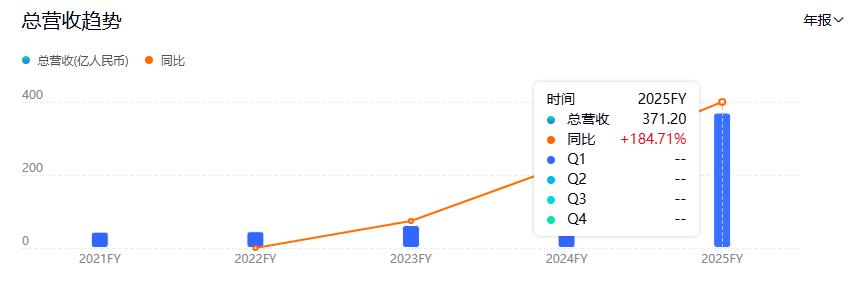
(Pop Mart's revenue, Source: Stock Market Pro)
This earnings report completely changed Duan Yongping's previous judgment that he "could not see the brand's 10-year development prospects clearly." On March 30, 2026, he posted on Xueqiu: "I spent time re-examining Pop Mart these past two days and decided to retract my earlier statement that I wouldn't invest." After that, he studied relevant interviews with founder Wang Ning and even made special trips to visit physical stores in multiple European and American countries.
The actual buying actions began in May. On May 25, Duan Yongping purchased 9.8232 million shares at an average price of approximately HK$150 per share, spending around HK$1.47 billion, which raised his stake to 5.69% and triggered the Hong Kong Stock Exchange's mandatory disclosure threshold for the first time. Just three days later, on May 28, he added another 4.66 million shares at an average price of HK$162.5, involving approximately HK$757 million in funds, bringing his stake to 6.04%. On July 6, he made his third move, buying 10.59 million shares at an average price of HK$150 per share, investing roughly HK$1.589 billion and increasing his stake to 7.65%.
It is reported that the three rounds of share purchases totaled over HK$3.8 billion in invested capital. To make this investment, Duan Yongping even liquidated his position in China Shenhua, which he had held for more than a decade.
But before placing his bet on Pop Mart, Duan Yongping had long been continuously increasing his position in another sector — Kweichow Moutai.
Since the start of 2026, despite the overall sluggish performance of the baijiu sector, Duan Yongping has repeatedly added to his Moutai holdings against the market trend. On January 27, he executed a large-scale transaction — buying approximately 77,200 A-shares of Kweichow Moutai through the Shanghai-Hong Kong Stock Connect at an average transaction price ranging from 1,329.72 to 1,331.00 yuan per share, investing around 103 million yuan.
On May 7, when a netizen asked Duan a question on the Xueqiu platform, stating that they had held a full position in Moutai for half a year and were hesitating whether to reallocate their investments, Duan replied bluntly: "I bought Moutai again today — would that confuse you?"
From Moutai to Pop Mart, Duan Yongping has deployed heavy positions simultaneously on two fronts in the consumer sector. When faced with the question "you can only choose one between Moutai and Pop Mart," his answer was thought-provoking: "From a 10-year perspective, Moutai is more stable, while Pop Mart has greater room for appreciation."
Data Doesn't Lie
Duan Yongping's buying spree took place at an extreme moment when the consumer sector was being "abandoned" by the market.
In 2021, consumer stocks were generally given high valuations of 50-60 times earnings, and the baijiu sector was even valued at 100 times; today, market pessimism toward consumption has evolved from tactical avoidance to strategic doubt. A large number of public fund institutions have even abandoned their core consumer holdings and turned to join the tech boom.
Since early April 2026, the A-share market's tech sector, led by AI and semiconductors, has continued to surge forward aggressively. Meanwhile, the consumer sector has fallen by more than 13% from its multi-year low, breaking below the "924" major bottom of 2024. Tech indices represented by TMT have rallied by over 130% cumulatively, and active equity funds have significantly increased their TMT allocations to 40%, with the over-weight ratios for the electronics and communications sectors hitting all-time highs.
Taking the food and beverage sector as an example, data from Wind shows that as of July 3, its valuation level was only 18.87 times, ranking higher than just about 3% of the 1,210 trading days in the past five years. Interpreted from another angle, this means that for 97% of the past five years, the sector's valuation was higher than it is now. In particular, its Price-to-Book ratio is at the 0.5th percentile, almost touching the lowest level in the past five years.

(AI-generated image)
The valuation of Hong Kong-listed consumer stocks is even more extreme — as of July 2, 2026, the PE-TTM of the CSI Hong Kong Stock Connect Consumer Theme Index is only 13 times, at an extremely undervalued 0.33th percentile since the index's launch.
In fact, since the fourth quarter of last year, amid the normal market cycle where tech and consumer sectors alternate between hot and cold, speculative capital has clearly retreated from the Hong Kong stock consumer sector. Taking Pop Mart, Laopu Gold, and Mixue Group — collectively known as the "Three Golden Flowers of Hong Kong Stocks" — as examples:
Mixue Group's share price began a significant correction after reaching its all-time high of HK$618.5 per share in June 2025; Laopu Gold's stock price entered a period of adjustment after hitting its historical peak of HK$1,065.17 per share in July 2025; and Pop Mart saw its overall share price correct after peaking at HK$333.9 per share in August 2025... Up to now, the share prices of all "Three Golden Flowers" have nearly halved from their highs.
When comparing major global markets horizontally, the consumer valuations of A-shares and Hong Kong stocks are still lower than the average of the world's major markets. Data from BofA further reveals this divergence: since the end of 2023, the MSCI China Index's valuation has risen from 9.3 times to 12.4 times, while over the same period, the valuation of China's consumer sector (Hong Kong stocks) has fallen from 14.2 times to 12.7 times.
More notably, the total size of consumer-themed funds has dropped from its peak of 1.1 trillion yuan to 515 billion yuan, and fund allocations to consumption have fallen to historical lows. When everyone starts to avoid the consumer sector, it often means opportunities are brewing.
Forced Shift and Strategic Pivot
The extreme undervaluation of consumer valuations is closely related to the sluggish macro consumption data.
Data from the National Bureau of Statistics shows that from January to May 2026, total retail sales of consumer goods reached 20.6031 trillion yuan, a year-on-year increase of 1.4%, compared with a 5% growth rate in the same period last year. In May alone, total retail sales of consumer goods stood at 4.109 trillion yuan, down 0.6% year-on-year, with the growth rate turning from positive to negative.
Wanlian Securities pointed out that weak aggregate data may force stimulus policies to be strengthened, and this is the core variable most worthy of attention in the consumer sector.
On July 13, 2026, the State Council officially approved the "15th Five-Year Plan for Expanding Consumption" (hereinafter referred to as the "Plan") via Guo Han [2026] No. 66 document. This is the first national-level five-year special plan in Chinese history specifically formulated for the consumer sector, marking the first time consumption has been independently designated as the subject of a five-year plan and issued in the form of a State Council official reply.
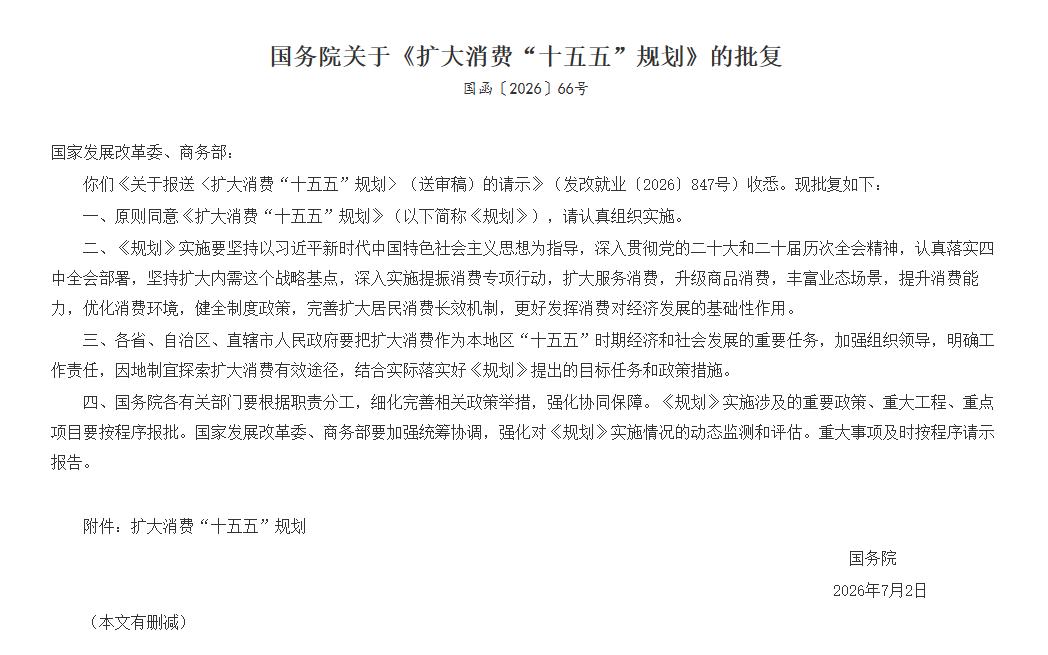
(Source: State Council)
It is reported that the Plan deploys 28 key tasks and measures around six aspects: promoting the quality improvement of service consumption to benefit the public, driving the expansion and upgrading of commodity consumption, cultivating new consumption formats, models and scenarios, striving to enhance consumption capacity, vigorously optimizing the consumption environment, and strengthening the improvement of systems and mechanisms for promoting consumption.
Notably, the Plan proposes that total retail sales of consumer goods will reach about 60 trillion yuan by 2030. Calculated based on the 50.12 trillion yuan retail sales base in 2025, this corresponds to an implied compound annual growth rate of approximately 3.7% for retail sales from 2026 to 2030.
Almost at the same time, capital market policies have also begun to shift, paving the way for consumer enterprises on the supply side. The most notable of these is the gradual relaxation of the "Red and Yellow Light" policy.
The so-called "Red and Yellow Light" is a market metaphor for the "differentiated treatment" of consumer and service enterprises in IPO reviews since 2023. On August 27, 2023, the China Securities Regulatory Commission (CSRC) issued the "CSRC Coordinates the Balance Between Primary and Secondary Markets to Optimize IPO and Refinancing Regulatory Arrangements", explicitly proposing to "phase in a tightening of IPO pace", with review priorities fully tilted toward technology innovation enterprises, significantly raising the listing thresholds for sectors such as consumer and traditional services.
The direct consequence of this policy tightening was that a large number of high-quality consumer enterprises were blocked from the A-share market. According to statistics, in 2023 alone, 31 consumer-related IPO applications were voluntarily withdrawn, including well-known brands such as Bama Tea, Dezhou Braised Chicken, Wolong Foods, Laoxiangji Catering, and Laoniangjiu Catering. In 2024, the IPO review situation for consumer enterprises became even more severe, with the annual meeting rate falling below 40%, far lower than the overall market average.
The turning point came in 2026. On March 6, CSRC Chairman Wu Qing signaled at an economic-themed press conference during the Fourth Session of the 14th National People's Congress: further deepening the reform of the ChiNext board, launching more precise and inclusive listing standards, and actively supporting high-quality innovative enterprises in new-type consumption and modern service industries to access the capital market. This statement was widely interpreted by the market as a clear signal that "the new consumer IPO gate has been opened."
On April 10, the CSRC issued the "Opinions on Deepening ChiNext Reform to Better Serve the Development of New Quality Productive Forces", explicitly proposing to "focus on supporting unprofitable innovative enterprises, new-type consumption and modern service industry enterprises to access the capital market", and adding a fourth set of listing standards.
On May 14, CSRC Chairman Wu Qing presided over a symposium on capital markets supporting the development of modern service industries and new-type consumer enterprises, conducting in-depth exchanges with representatives of domestic and foreign listed companies and enterprises in four major sectors: smart consumption, domestic fashion brands, modern logistics, and IP cultural and creative industries. The symposium clearly stated that it would deepen the inclusive reform of the capital market and support high-quality enterprises in relevant sectors to go public and grow. This symposium is regarded as the most significant adjustment to the A-share IPO review orientation since the August 27 New Deal.
The industrial significance of this policy shift cannot be underestimated. On the one hand, consumer enterprises now have a credible RMB exit expectation again, which will restructure project valuations, financing rhythms, and fund-raising narratives in the primary market; on the other hand, more high-quality consumer enterprises listing on A-shares will significantly enrich the pool of consumer sector targets in the capital market, attracting more medium- and long-term funds to allocate to consumption, and forming a positive cycle of "corporate financing — performance growth — valuation repair — attracting capital".
In fact, since the implementation of the ChiNext reform on April 10, a wave of consumer enterprises applying for A-share listings has emerged. As of June 9, the Shenzhen Stock Exchange's ChiNext board has newly accepted IPO applications from 20 enterprises, with new-type consumption and modern service enterprises appearing one after another. High-quality innovative enterprises in the new-type consumption and modern service sectors such as Leju Smart, Maijin Technology, and Yangteng Innovation have opened new listing channels, while running sports brand Bimai Sports (founded by former Li-Ning CEO Zhang Zhiyong) has officially knocked on the door of the A-share main board.
Summary
Consumption will never disappear, and people's pursuit of a better life will never stop. As Duan Yongping said, what he cares about is not short-term profit fluctuations, but the long-term value over the next 10 to 20 years. At a time when the entire consumer industry is deeply undervalued, perhaps we need to step out of short-term emotional fluctuations and re-examine this sector that has become incredibly "cheap" from a longer-term perspective.
In fact, multiple institutions have started to send positive signals: China International Capital Corporation maintains an "outperform" rating on Pop Mart, stating that it is "currently at a historically low valuation"; Guotai Haitong believes that the recovery trend of mass consumer goods is clear, and short-term fluctuations will not change the recovery trend; research reports from multiple brokerages point out that the consumer sector's valuation has fully reflected the market's low expectations, and valuation repair is expected to follow...
Duan Yongping's multi-billion-dollar heavy position may well be the prelude to the consumer pendulum starting to swing back.