The sales of lithography machines are booming. ASML says: The Chinese market is very stable, and Intel is No. 1
Reported by Chip Hot on July 16, yesterday, Dutch lithography giant ASML released its financial results for the second quarter of 2026. In this quarter, ASML's total revenue increased by 21% year-on-year to 9.33 billion euros (approximately 72.41 billion yuan), and increased by 6% quarter-on-quarter; net profit rose by 27% year-on-year to 2.92 billion euros (approximately 22.66 billion yuan), with a 6% quarter-on-quarter growth, all exceeding market expectations.
Roger Dassen, ASML's CFO, said: "The core driving force behind the better-than-expected performance comes from the installed base management business, which generated 2.8 billion euros in revenue (approximately 21.73 billion yuan), 300 million euros higher than the company's previous estimate (approximately 2.33 billion yuan). The underlying reason is that wafer fab customers are fully committed to improving production efficiency, leading to a sharp rise in demand for equipment upgrade services."
When talking about the operating conditions in the Chinese market, Dassen stated that the proportion of revenue from the Chinese market in total sales this year will remain at around 20%, with a growth rate synchronized with ASML's overall business, and the incremental demand mainly comes from equipment for mature process logic chips.
He added: "New demand in the Chinese market is mainly concentrated in the logic chip equipment track, supporting the independent development of the local industrial chain."
Christophe Fouquet, ASML's CEO, said that the company's 2026 production capacity for Low NA EUV (low numerical aperture extreme ultraviolet lithography systems) is about 65 units, and orders for these systems for the full year 2027 are largely finalized. ASML plans to increase its production capacity by 30% in 2027; customers have placed a large number of long-term related orders, prompting the company to evaluate the feasibility of a further 30% expansion of EUV production capacity in 2028.
At the same time, the expansion of EUV production will drive demand for DUV immersion (immersion deep ultraviolet lithography systems). The production capacity of the latter will be about 130 units in 2026, expand by 30% in 2027, and a plan to further increase production capacity by 30% in 2028 is under evaluation.
When discussing the implementation of High NA EUV (high numerical aperture extreme ultraviolet lithography systems), Fouquet said that yesterday morning the company officially announced a cooperation with Intel, where Intel Foundry will adopt ASML's High NA EUV at the Intel 18A process node to produce some Intel Core Ultra Series 3 processors. He said: "This milestone proves that High NA EUV is already capable of mass production adaptation, representing a key breakthrough."
Fouquet also revealed that 4 to 5 High NA EUV systems with confirmed full-year revenue recognition in 2026 will be delivered.
Regarding the room for pricing adjustments for EUV models, Dassen stated that ASML is continuously improving the production efficiency of Low NA EUV systems. The company adheres to value-based pricing and has reasonable room for upward price adjustments in the long run. He added: "However, constrained by the extremely long order delivery cycle, price adjustments will not take effect immediately."
Regarding the timing of pricing adjustments, he said that it depends on the order cycle signed with customers. The delivery cycles for different customers vary significantly, and the overall trend of strong demand is established, but no precise timing can be given.
As of the close of US stock trading today, ASML's share price rose 2.23% to $1815.27 per share (approximately 12,300 yuan per share), and its market capitalization is about $699.637 billion (approximately 4.74 trillion yuan).
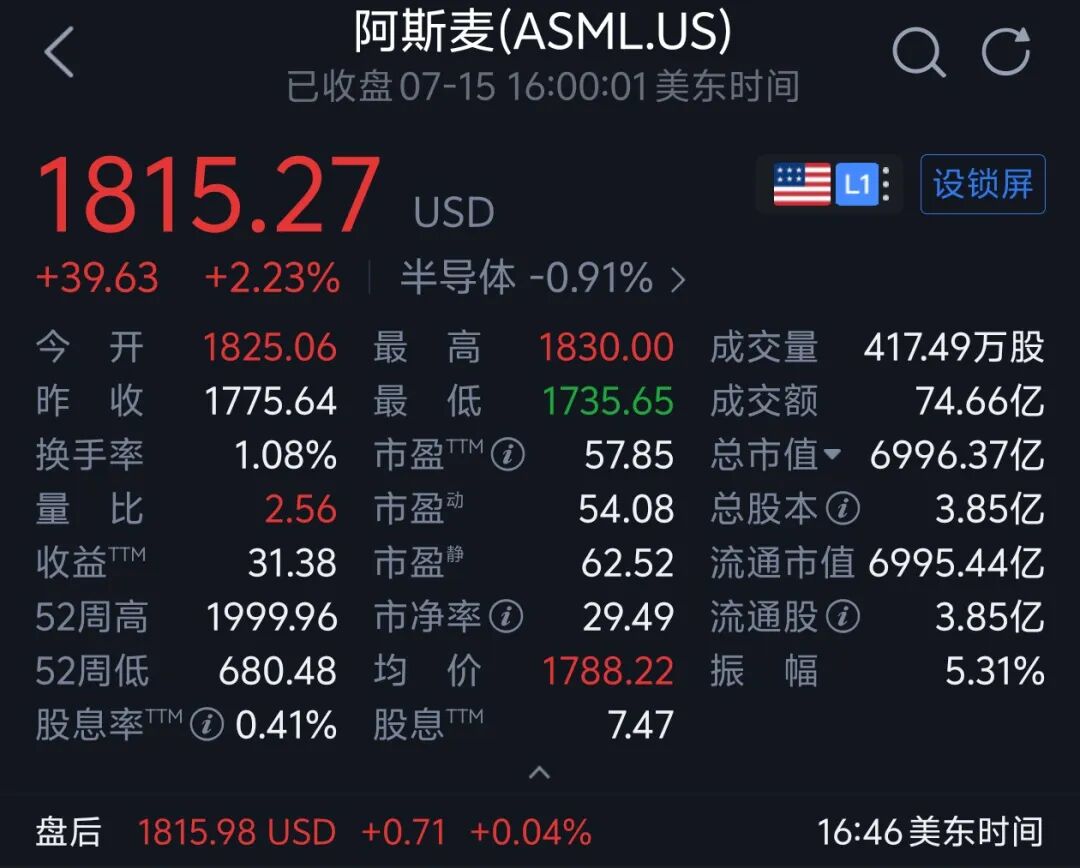
ASML share price chart (Source: Tencent Stock Select)
01. 91 lithography systems shipped, mainland China ranks third in revenue contribution
In this quarter, ASML achieved a total revenue of 9.33 billion euros, the detailed breakdown of which is shown in the figure below:
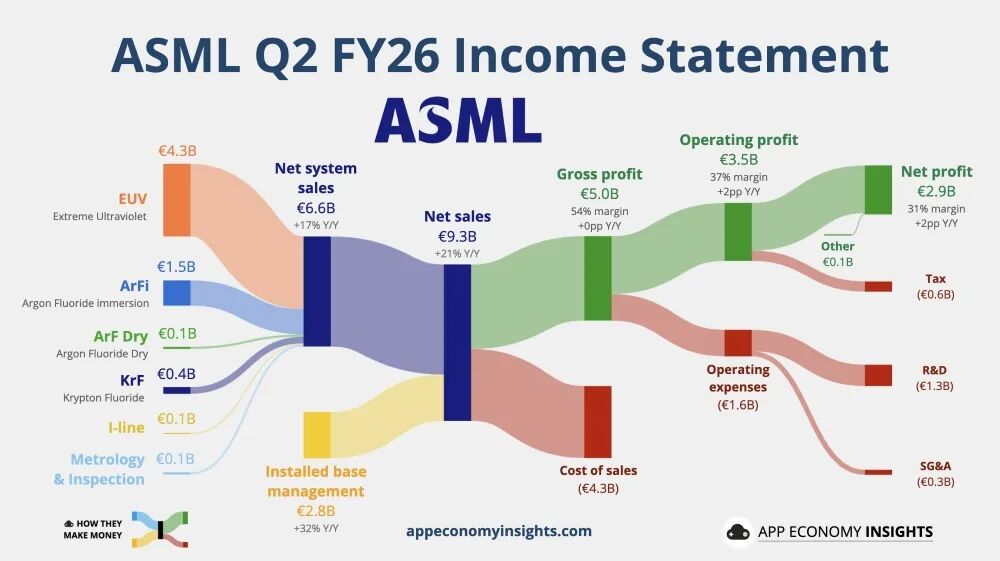
Visualization chart of ASML's revenue composition (Source: App Economy Insights)
In this quarter, the lithography system business segment contributed 6.56 billion euros (approximately 50.91 billion yuan) in revenue, with a 17% year-on-year increase and a roughly 5% quarter-on-quarter growth; the installed base management business recorded 2.76 billion euros (approximately 21.42 billion yuan) in revenue, rising 32% year-on-year and 11% quarter-on-quarter.
In detail, ASML shipped 86 brand-new lithography systems and sold 5 second-hand lithography systems in this quarter, with a total of 91 lithography systems shipped, representing a 20% year-on-year increase in total units.
Among them, 16 EUV systems were shipped, generating 3.74 billion euros in revenue, accounting for 57% of total lithography revenue, with an average selling price of 230 million euros (approximately 1.79 billion yuan); 23 ArFi (argon fluoride immersion DUV) systems were shipped, generating 1.9 billion euros in revenue, accounting for 29% of lithography revenue, with an average selling price of 82.71 million euros (approximately 640 million yuan); 8 ArF dry (argon fluoride dry DUV) systems were sold, generating approximately 260 million euros in revenue, accounting for 4% of lithography revenue, with an average selling price of 32.8 million euros (approximately 250 million yuan).
KrF (krypton fluoride DUV) systems had the highest shipment volume, totaling 35 units, generating 390 million euros in revenue, accounting for 6% of lithography revenue, with an average selling price of 11.25 million euros (approximately 87.31 million yuan); I-Line (i-line mercury lamp lithography systems) recorded the lowest revenue at 70 million euros, accounting for 1% of lithography revenue, with a total of 9 units shipped and an average selling price of 7.29 million euros (approximately 56.58 million yuan).
The metrology and inspection equipment business segment contributed approximately 200 million euros in revenue, accounting for 3%, a slight 1 percentage point increase from the previous quarter's proportion.
Fouquet said that the metrology and inspection equipment business segment has seen strong growth this year, mainly because the increasing complexity of process technologies has prompted customers to strengthen full-process process control, driving up demand for metrology and inspection equipment; at the same time, the penetration rate of ASML's optical metrology and electron beam inspection products is also rising rapidly. If immersion DUV systems and the metrology and inspection segment are combined for calculation, the total related revenue in 2026 will grow by approximately 25% year-on-year.
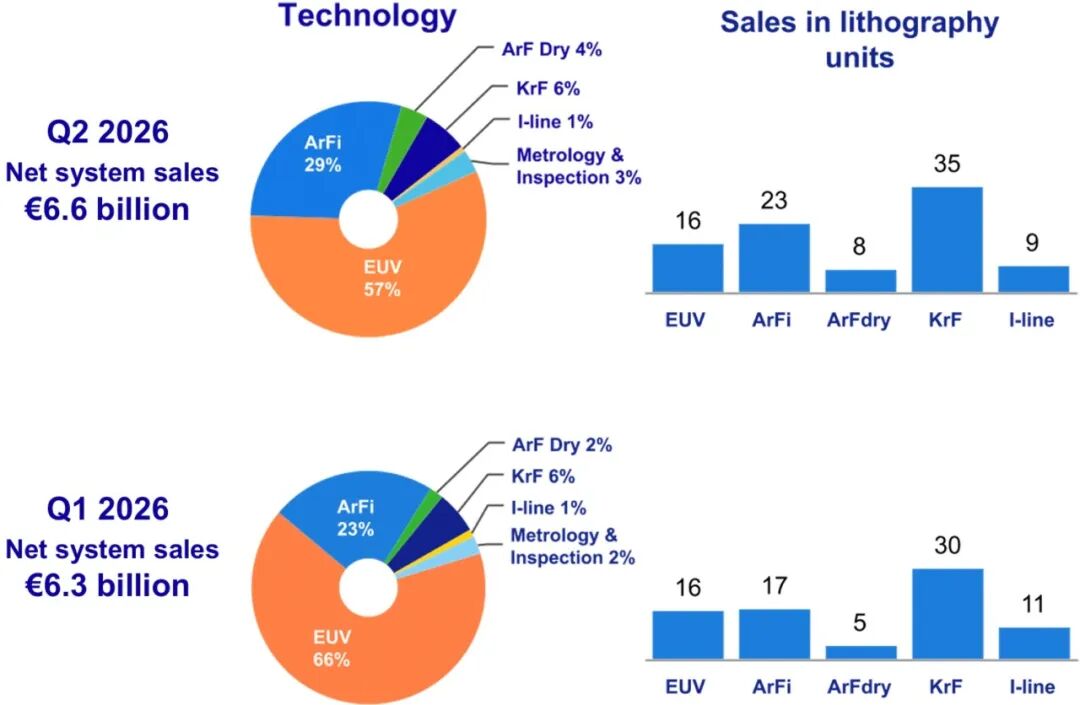
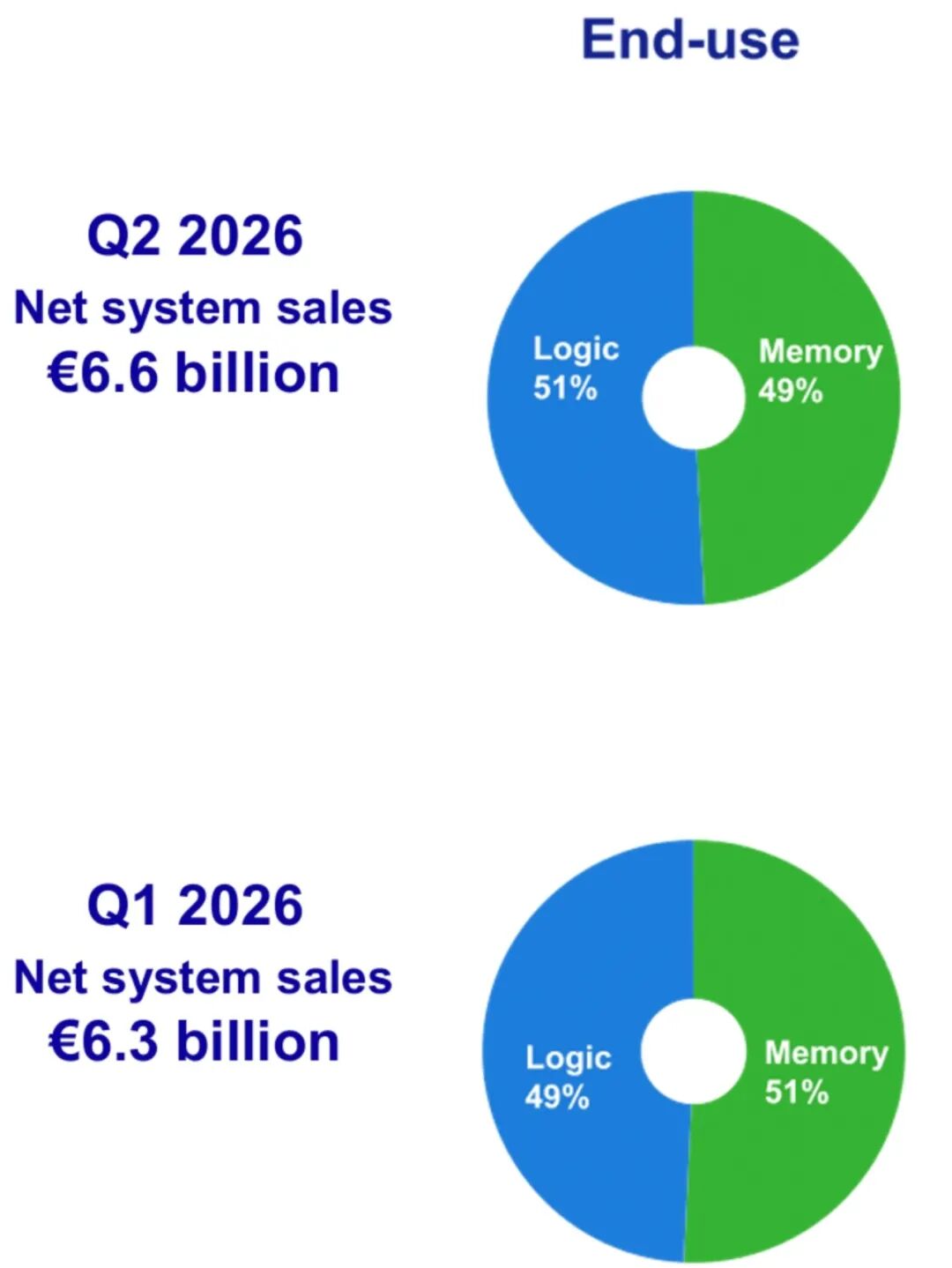
Broken down by downstream end application tracks, in this quarter, ASML's lithography system revenue from logic chip manufacturers accounted for 51% of the total lithography business revenue, while revenue from memory chip manufacturers accounted for 49%. In the previous fiscal quarter, revenue contributions from memory chip manufacturers were higher, but in this fiscal quarter, revenue from logic chip manufacturers surpassed that from memory.
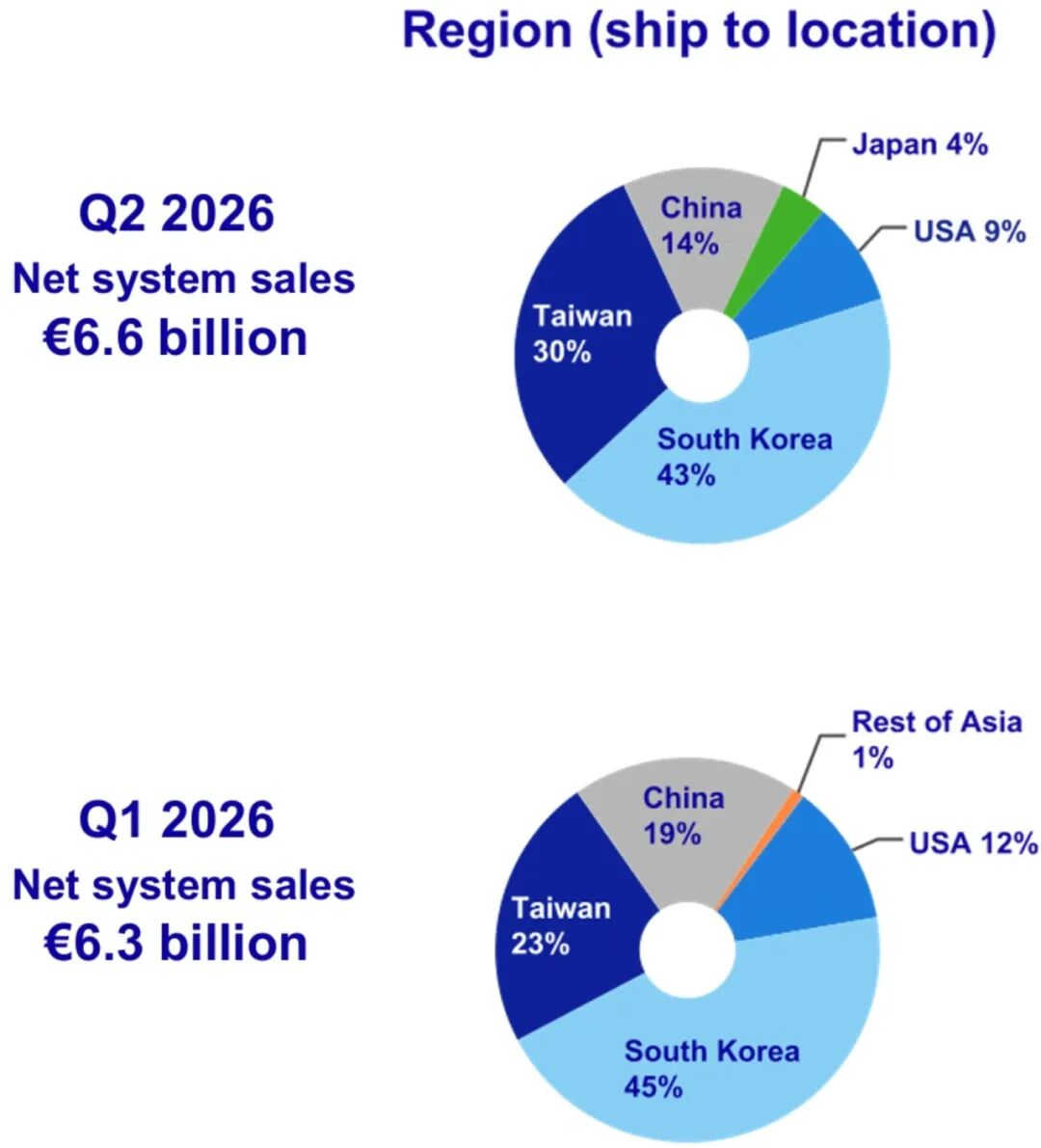
In the same quarter, broken down by shipment region, mainland China contributed approximately 900 million euros (approximately 6.99 billion yuan) in lithography revenue, with its share falling to 14% from 19% in the previous quarter; Taiwan, China contributed approximately 2 billion euros (approximately 15.52 billion yuan) in revenue, accounting for 30%, a 7 percentage point increase from the previous quarter, still holding the second position; South Korea contributed approximately 2.8 billion euros (approximately 21.73 billion yuan) in revenue, accounting for 43%, ranking first.
In this quarter, ASML's gross margin was 54%, up 0.3 percentage points year-on-year and 1 percentage point quarter-on-quarter.
In terms of cash flow, ASML's cash and cash equivalents balance stood at 6.67 billion euros, and operating cash flow was 1.7 billion euros, a significant increase from 750 million euros in the same period last year and negative 2.19 billion euros in the previous quarter.
In this quarter, ASML returned a total of 2.12 billion euros to shareholders through cash dividends and share repurchases.
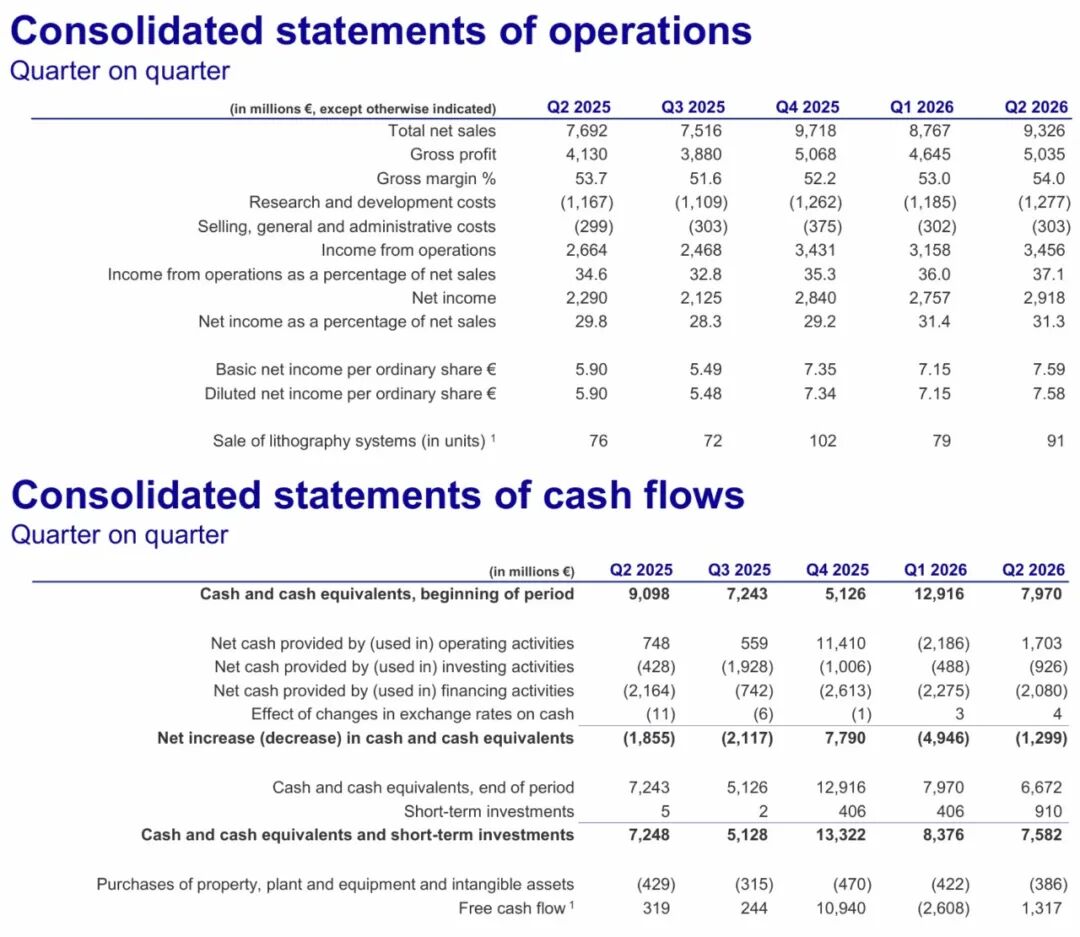
Looking ahead to the next quarter's performance, Dassen revealed that ASML's total revenue for the third quarter of 2026 is expected to be between 11 billion and 12 billion euros, with a gross margin of 55% to 57%; installed base supporting business revenue will be approximately 2.9 billion euros.
Looking at the full year, ASML's total annual revenue target has been raised to 43 billion to 45 billion euros, and the 45 billion euro figure has already surpassed the lower limit of ASML's previous 2030 revenue target of 44 billion to 60 billion euros. The company's gross margin next year is expected to remain in the range of 54% to 56%.
02. Memory supporting equipment revenue expected to rise 75%, full-year EUV business growth could reach 45%
During the earnings call, when discussing demand in the logic chip track, Fouquet said that manufacturers continue to expand 3nm production capacity to support mass production of new-generation AI accelerators, while simultaneously expanding 4nm and 5nm production lines to cover supporting chips for AI products; 2nm process scaling up is accelerating, targeting next-generation high-performance computing and mobile terminals.
He also said: "Some customers have already started 1.4nm process R&D and begun planning supporting equipment procurement. Lithography intensity for logic chips continues to rise, driving a sharp surge in demand for advanced lithography systems, and it is expected that this year's year-on-year growth rate of system sales for advanced logic wafer fabs will exceed 25%."
Fouquet said that rising DDR and HBM prices are forcing major memory manufacturers to expand wafer fabs on a large scale, with multiple manufacturers planning multiple mega-factories whose new production capacity will be put into operation in phases over the next few years. At the same time, memory manufacturers are iterating to advanced processes, and lithography process intensity continues to increase. Low NA EUV is gradually replacing multi-patterning DUV, gradually reducing production costs, and this trend will also continuously amplify ASML's growth elasticity.
Overall, he expects that this year's year-on-year growth in memory-related system sales will exceed 75%.
When discussing the EUV business, Dassen said that the full-year 2026 shipment volume of Low NA EUV systems will be about 65 units, and EUV system sales will grow by more than 45% year-on-year, with simultaneous explosive demand in both logic and memory tracks.
Regarding non-EUV equipment, he revealed that full-year immersion DUV shipments will be about 130 units, flat with the 2025 delivery scale; this year ASML has coordinated with supply chain partners to accelerate capacity ramp-up, and dry DUV system shipments have increased significantly year-on-year. Due to the higher process control accuracy requirements of advanced processes, the penetration rate of optical inspection and metrology equipment among industry-wide customers is rising rapidly.
He said: "Comprehensive judgment shows that full-year non-EUV system sales will grow by about 25% year-on-year."
When talking about the shipped EUV lithography system models, Dassen said that the equipment models ASML will ship next year will be Type E and Type F, with Type E accounting for the vast majority, while this year's shipments are a combination of Type D and Type E. He expects Type D inventory to be exhausted, or nearly exhausted, within this year, and all Type D units will be fully delivered this year.
He added that the average selling price of the Type E and Type F product mix will be higher than this year's product mix, and this mix will also bring higher production efficiency and a better gross margin structure. At the same time, converted by wafer processing throughput capacity, the actual effective production capacity of high-performance Type E and Type F models has increased by approximately 45%, far exceeding the 30% unit shipment growth rate next year.
Dassen revealed that immersion DUV shipments in the second half of this year will be significantly higher than in the first half. He also said: "There is a very strong correlation between equipment throughput improvement and average selling prices." Part of the support for EUV product pricing adjustments comes from the throughput improvement of such systems.
Fouquet added: "The all-new Type F is designed for next-generation 2nm and 1.4nm advanced processes. The Type F delivery timeline perfectly matches the R&D and mass production needs of the 1.4nm process; at the same time, the imaging and overlay performance standards of Type E and Type F are unified, allowing them to be mixed and matched for 2nm production lines. As long as 2nm capacity expansion demand continues, Type F will also serve