Can seizing market share from urban SUVs help the Tank 300 return to its sales peak?
Extended, Transformed. The Tank 300 PHEV, this time, has found its true identity.
The Tank 300 is about to undergo a comprehensive refresh, yet even as both variants carry the 300 badge, the treatment for the new gasoline-powered and new energy models is drastically different. The new energy variant has been renamed, lengthened, and launched for pre-sales with fanfare; the gasoline version, by contrast, has received almost no promotion, only visible to customers when clicking "Book Now" on the official website.
Does that mean the gasoline-powered Tank 300 has not been updated? The answer is no.
The reality is that the updated gasoline and new energy versions of the Tank 300 are no longer the same vehicle with different powertrains, but two distinct models with clearly separated positioning and target audiences. In the future, the two models will be deployed in a coordinated manner, helping the Tank 300 transform from an "off-road internet-famous icon" to an "all-scenario blockbuster".

New Energy Segment Drove Initial Growth, But Sales Decline Emerged Starting in 2025
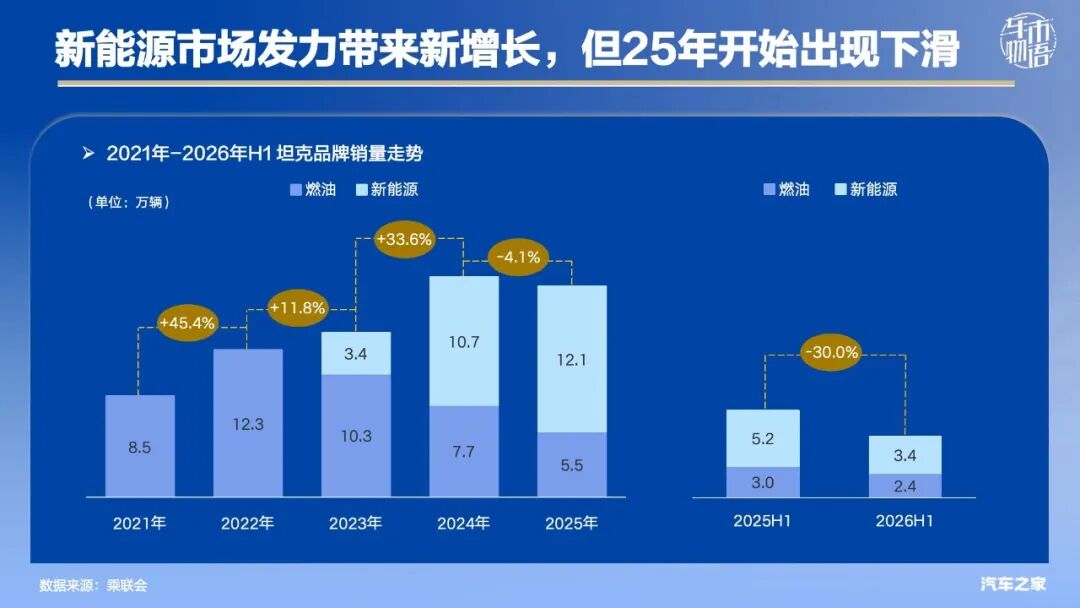
Prior to 2024, the Tank brand maintained high double-digit year-on-year sales growth every year, and this growth momentum never stalled even during its new energy transition phase. 2024 marked the brand's second year of expanding into the new energy market, with the penetration rate of new energy models climbing to 58%, and the brand's overall sales volume rising 33.5% year-on-year over the same period.
However, the brand experienced its first year-on-year sales decline in 2025, and the decline widened further in the first half of 2026, with the year-on-year drop expanding from 4.1% in 2025 to 30.0%. The core drag came from the new energy segment, whose market performance fell short of expectations.
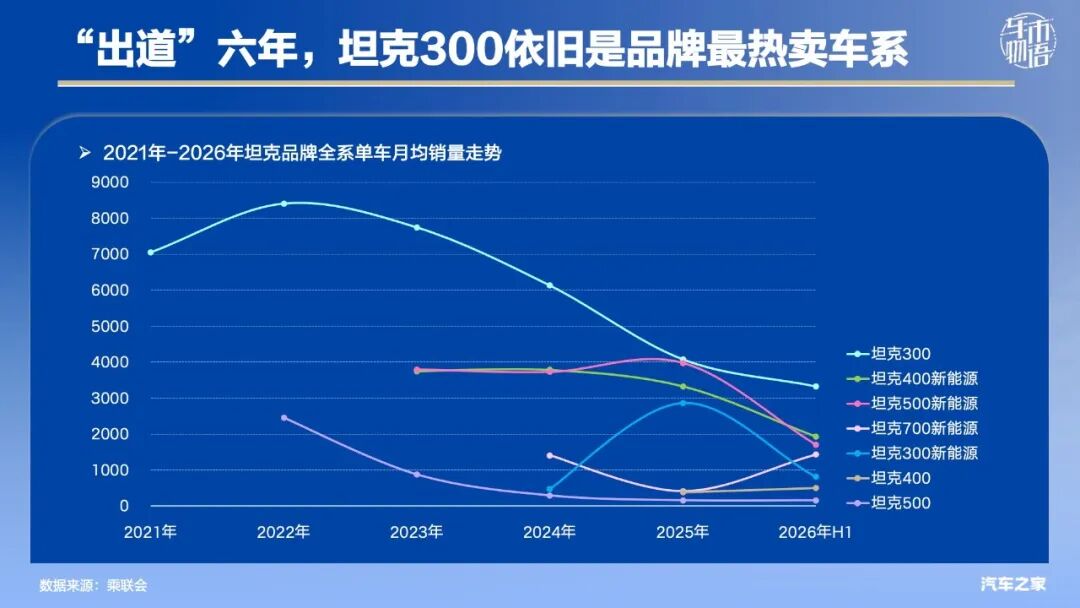
Looking at the performance of individual model lines, in the first half of 2026, only the Tank 700 PHEV across the entire Tank lineup saw its average monthly sales rebound from a trough, while the average monthly sales of all other models continued to decline. Among them, the Tank 300, which had long been the brand's core volume-driving model, posted average monthly sales exceeding 8,000 units at its peak, but now its sales are less than half of that peak figure.
The sibling model, the Tank 300 PHEV, also showed weak market performance: after its monthly sales surged to nearly 3,000 units in 2025, they quickly fell back. This phenomenon is caused by two factors: on one hand, it was dragged down by the overall downward trend of the automotive market, and on the other hand, the early exposure of news about the new model refresh greatly intensified consumers' wait-and-see sentiment.
Yet it is an undeniable fact that sales have declined. Who exactly has diverted and captured Tank's original market share?
Who Has Taken Tank's Market Share?
With the advancement of electrification and intelligent technology trends, the broad off-road aesthetic has continued to gain popularity. The classic rugged "boxy" silhouette is no longer an exclusive label for hard-core gasoline SUVs; it has become a popular design trend widely adopted by various new energy SUV models. New energy vehicles have broken free from the high fuel consumption constraints of traditional hard-core SUVs, no longer needing to over-worry about energy loss from wind resistance. This allows them to prioritize catering to public aesthetics, focusing on high-appeal, youthful designs.
In fact, hard-core off-road SUVs have extremely strong functional attributes, a niche positioning, and a relatively fixed, narrow audience circle much like sports cars. But once the market offers a compromise solution that balances good looks, off-road capability, and daily practicality, the vast majority of consumers who do not have strong off-road needs and prioritize overall practicality will decisively switch their choices. In addition, in China's auto consumer market, the proportion of multi-car households is relatively low, and most families only have one primary vehicle. The "all-rounder" with no obvious shortcomings is the mainstream demand for car purchases.
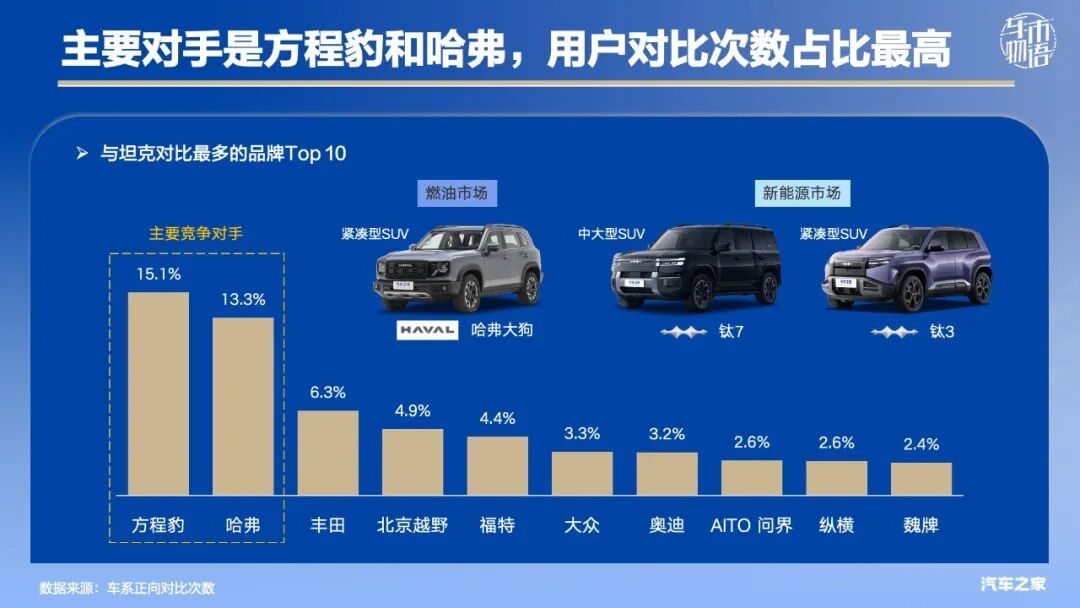
According to comparative data from Autohome users, among the brands most frequently compared with Tank vehicles, Fangchengbao ranks first with a 15.1% share, followed closely by Haval at 13.3%. The two best-selling models under the Fangchengbao brand are the Titanium 7 and Titanium 3, both featuring the boxy design style.
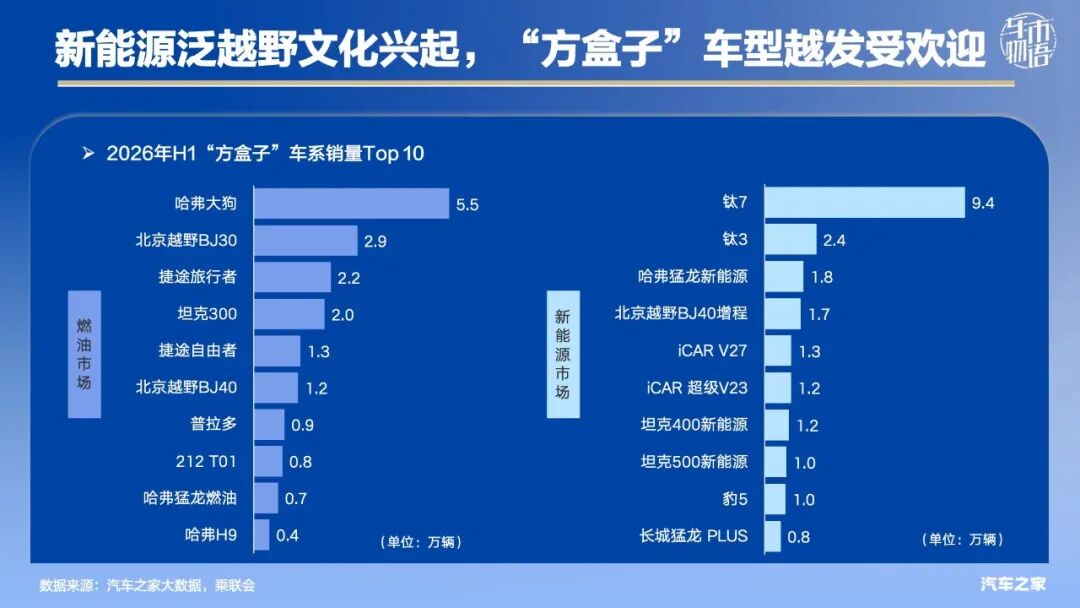
Looking at sales figures, in the top 10 best-selling "boxy" models in the first half of 2026, the gasoline segment is still dominated by traditional hard-core off-road SUVs, with sales of each model declining in a stepwise fashion. The new energy segment presents a different landscape, with the Fangchengbao Titanium 7 taking a clear lead in sales. Supported by its solid pure electric range performance, this vehicle can significantly reduce users' daily urban commuting costs, which is the key to its popularity.
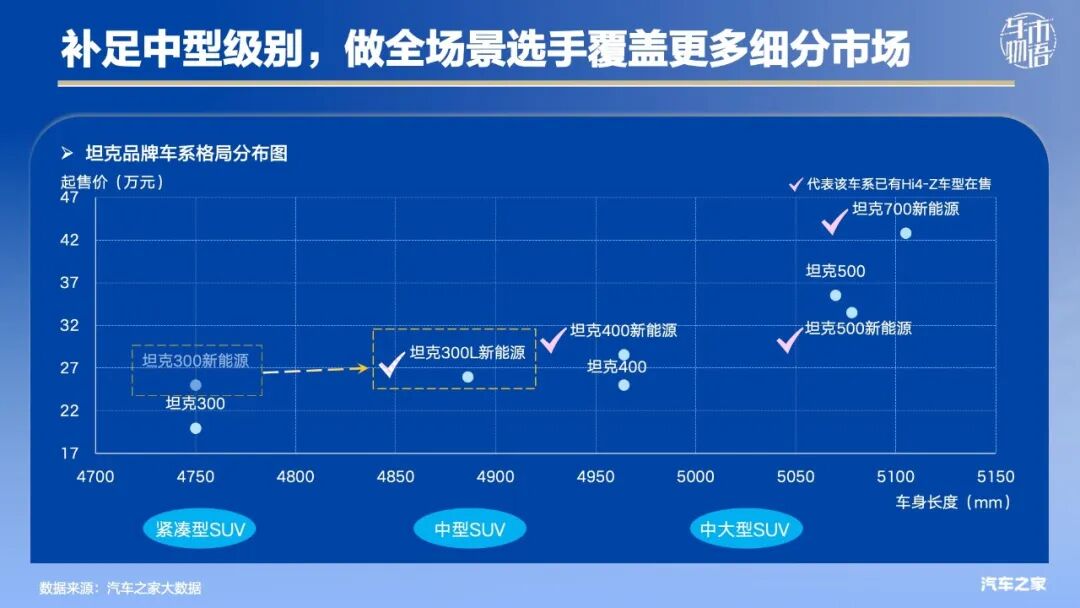
In fact, in the new energy market, Tank has long been working to address its range shortcomings. Starting in August 2025, the Tank 400, 500, and 700 PHEV models successively launched the Hi4-Z versions, all achieving around 200km of WLTC pure electric range. With the launch of the Tank 300L PHEV, the brand has completed the deployment of full-range models equipped with large-capacity batteries. However, the product planning strategy for the new Tank 300 PHEV differs from that of other models in the Tank family.
Initiating Self-Rescue, Comprehensive Transformation Helps Tank 300 Evolve Into an "All-Scenario Blockbuster"
As can be seen from the model lineup distribution, the Tank brand previously adopted a paired deployment strategy where a single model was offered in both gasoline and new energy variants.
The lengthened and restyled Tank 300 PHEV has been fully separated from the gasoline version, officially named the 300L PHEV, with its product positioning upgraded from a compact SUV to the midsize SUV segment.
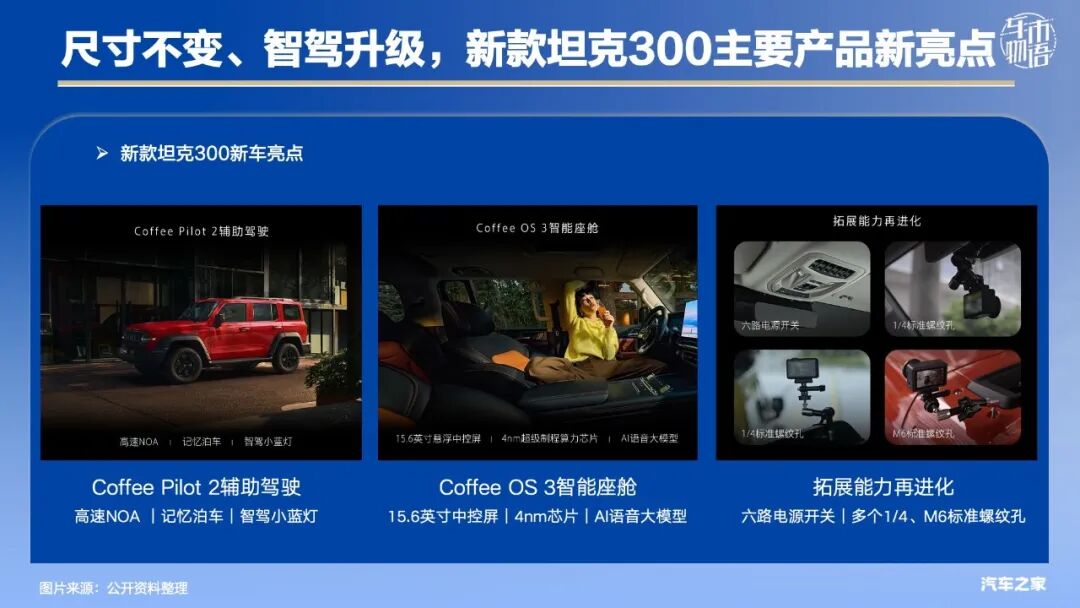
The new gasoline-powered model has been upgraded with intelligent features on the existing foundation, equipped with the Coffee Pilot 2 driving assistance system, Coffee OS 3 intelligent cockpit, and other technologies.
Its core positioning remains unchanged, still focusing on the rugged and bold hard-core off-road style, but its previous intelligent shortcomings have been addressed: it is fitted with a full set of features including a large central control screen, high-computing-power hardware, highway NOA (Navigate on Autopilot), and memory parking. At the same time, the vehicle's expandability has been further optimized, leaving more space for modifications and custom play for off-road enthusiasts.
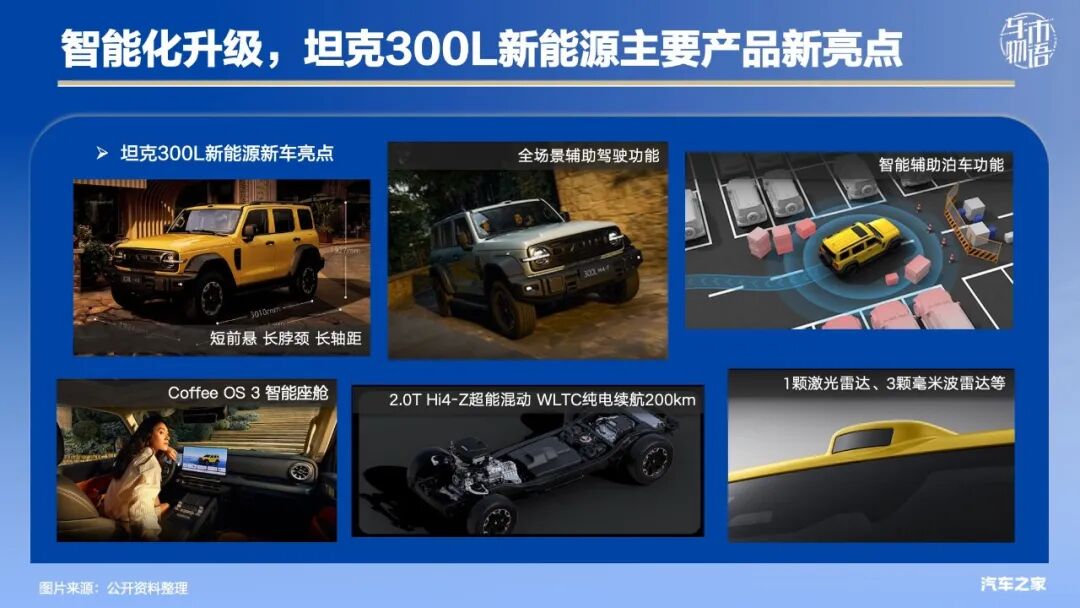
The new energy model, on the basis of comprehensive intelligent upgrades, features a lengthened wheelbase and the new Hi4-Z version, which significantly boosts pure electric range, further strengthens its urban commuting attributes, and greatly enhances its overall competitiveness in the new energy market.
The new model achieves the extended wheelbase by shifting the front axle forward. While this delivers limited improvement to interior space, it benefits off-road performance: the vehicle's center of gravity sits closer to the center of the body, improving driving stability. Meanwhile, the new energy variant has received a full intelligent configuration upgrade, fitted with LiDAR to enable full-scenario assisted driving, marking a comprehensive advancement in overall product capability.
The launch of this new Tank 300 is not just a regular facelift, but a full-scale transformation. As a core model that has long topped the brand's sales charts, it holds pivotal significance for the Tank brand.
The gasoline version upholds the hard-core off-road base, while also meeting the daily mobility needs of ordinary users, providing heavy off-road enthusiasts with a better intelligent experience. The new energy version, as the highlight of this brand refresh, further strengthens its urban commuting attributes while establishing its own unique positioning. In off-road scenarios, it has inherent hardware advantages, proven market reputation, and deep technical reserves; for urban daily commutes, its long pure electric range provides both strong power and effective control of usage costs.
The coordinated development of both the gasoline and new energy variants drives the classic Tank 300 to complete its transformation from a single "off-road internet-famous icon" to an all-capable, all-scenario blockbuster. However, whether the enhanced product strength can impress consumers and reverse the continuous sales decline will ultimately depend on the pricing of the new model after its launch. After all, in today's fiercely competitive market, pricing is the core point of competition.
Do you have high hopes for this new model? Do you recognize the current pre-sale prices announced for the Tank 300L PHEV? Feel free to share your thoughts in the comment section. (Written by Auto Market Story)
This article is republished with authorization from the WeChat public account "Auto Market Story" (ID: autostinger), written by Sun Ying, and authorized for distribution by 36Kr.