7 new models launched in a single day: Everyone says they don't want to engage in cutthroat competition, but no one is willing to slow down.
July 16 can be described as the "Crazy Thursday" in the automotive industry. Starting from 5:30 PM, push notifications for new car launches flooded social media feeds one after another. Six major brands — Li Auto, Xpeng, IM, Wuling, Leapmotor, and WEY — sequentially rolled out new models. In just two and a half hours, 7 new vehicles made their concentrated debuts, and the hashtag #July16CarLaunchSpree even climbed to the top of trending search rankings.
These 7 vehicles cover the full price range from 120,000 to 350,000 RMB. From Wuling Starlight L's 120,000-yuan range PHEV large 6-seater, to IM LS9 Hyper's 300,000-yuan flagship extended-range EV, to Leapmotor's 100,000-yuan pure electric twin models, every single one carries the label of "strong competitiveness", and each represents a major investment from its corresponding automaker in its target market segment.
Obviously, this phenomenon of dense new car launches is not a random carnival, but a real microcosm of the white-hot competition in the 2026 automotive market.
At the same time, this has completely made the entire industry and outsiders see through the reality: everyone keeps saying they don't want excessive internal competition, but no one has ever slowed down their pace. This kind of "backstabbing" is just like your classmate who keeps telling you not to study too hard and prioritize your health — only for you to lift their dorm bed blanket at midnight and find them cramming practice problems under a flashlight.
Does the market need so many new cars?
Launching 7 new cars in a single day is an undeniable microcosm of the entire automotive market.
In the first half of this year, the pace of new model releases in China's auto market was extremely intense. According to incomplete statistics, more than 600 new cars were launched in total in the first half of the year. If annual facelifts, configuration variants, and limited-edition exclusive models are all included, the average number exceeds 100 per month, with at least 3 new vehicles hitting the market every day. Such a high density is extremely rare in the history of the global automotive industry.
Although there have been voices within the industry calling for an end to excessive competition and extreme internal rivalry, automakers have continued to follow their own path without any slowdown in the pace of new car launches, making the market competition increasingly fierce.
Yet behind all this bustle lies a brutal market selection process.
Take the currently popular large 6-seater SUV segment as an example: dozens of models launched within a year may seem like a blooming diverse market, but in reality there are very few true winners.
According to industry sales data, only two models in this segment — NIO ES8 and AITO M9 — maintain monthly sales exceeding 10,000 units consistently. Only a handful of others, including Zeekr 9X, AITO M8, AITO M7, Leapmotor D19, and Huajing S, achieve monthly sales over 5,000 units and possess core competitive strength.
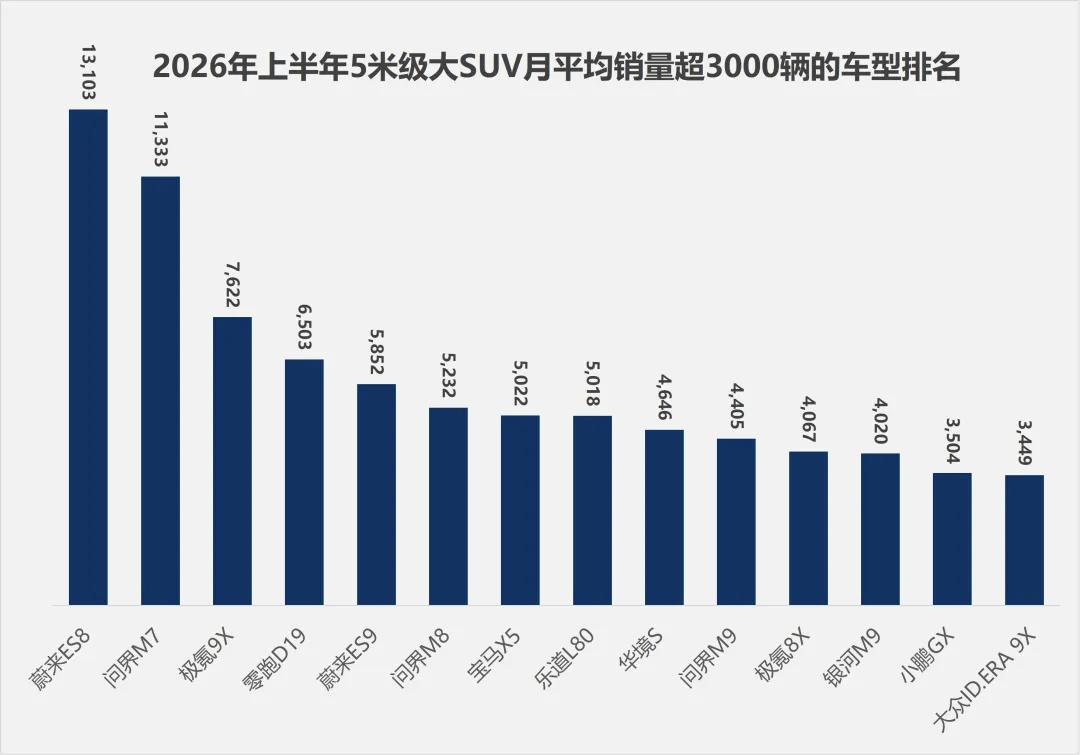
This means that over 80% or even more large 6-seater SUVs will eventually face the fate of "disappearing immediately after launch and ending in failure", becoming cannon fodder in market competition.
This scenario of "one hero's rise built on countless fallen lives" is not unique to large 6-seater SUVs — it permeates every single segment of the entire automotive market. From micro EVs to A-segment family sedans, from B-segment pure electric cars to all types of SUVs, and even to family MPVs, every track is crowded with competitors. Behind every best-selling model, dozens of other vehicles have quietly exited the market.
Statistics show that in the first half of 2026, total retail sales of passenger vehicles across China reached 8.701 million units, a 20.2% year-on-year decline. While more and more new cars are being launched, fewer people are buying vehicles. In this stock market, automakers' dense new model releases are largely aimed at seizing a share of the limited market pie — even if their success is only fleeting, they are unwilling to miss any opportunity.
However, high-frequency new car iterations not only fail to drive market growth, but instead cause massive resource waste, further worsening the already slim profit margins in the automotive industry.
Even with over 600 new models launched in the first half of the year, looking at the sales rankings, only a dozen of them such as Leapmotor A10, AITO M6, and Binguo Pro achieved sales exceeding 5,000 units, while the vast majority of new cars struggle to gain a foothold in the market.
The industry needs healthier development
What deserves more attention is that the market dividend period for new cars has been drastically shortened.
Industry analysis points out that currently, the market popularity of a new car can only last for around 3 months. 8 months after launch, sales are very likely to experience a cliff-like drop, making it difficult to build long-term stable competitiveness. This means that the huge R&D costs invested by automakers in the early stage often cannot be recovered.
Zhu Jiangming, Chairman of Leapmotor, once publicly stated that even in the most cost-effective way, developing a new model requires at least 1 billion RMB of investment. If a vehicle has a planned monthly production capacity of 10,000 units but only ends up selling 5,000, the factory will face idle capacity and waste. When R&D and production costs are amortized over low sales volume, overall costs will surge sharply, further squeezing corporate profits.
At the same time, the severe mismatch between the annual sales targets set by many automakers at the beginning of the year and the actual market conditions has further intensified internal rivalry and resource waste in the industry.
Previously, more than a dozen mainstream automakers announced their 2026 total annual passenger vehicle sales targets adding up to over 25 million units. But compared to the 8.701 million units sold in the first half of the year, the sales targets of leading automakers are far higher than the actual market carrying capacity. The huge gap between targets and real results not only undermines corporate market confidence, but also causes massive amounts of manpower, technology, and capital investment to fall into ineffective internal consumption.
Some automotive groups even launch dozens of new cars in a single year, with hundreds of R&D projects running in parallel internally — competing with each other and dispersing resources. This may seem to speed up iteration, but in reality it is a serious waste of industry resources.
Currently, the profit margin of the automotive industry is already lower than most manufacturing sectors, and the resource waste caused by clustered new car launches is one of the key contributing factors.
Yet automakers are caught in a dilemma: if they don't invest and don't participate in the competition, they won't even get a seat at the table. But if they go all in, they face the risk of losing everything.
Looking closely at the vehicles launched on July 16, their product strength is actually not weak.
For example, the top-trim Xpeng MONA L03 is priced at only around 150,000 RMB, bringing 1500 TOPS of intelligent driving computing power down to the 150,000-yuan segment, giving it excellent competitiveness. The IM LS9 Hyper comes standard with steer-by-wire across the entire lineup, bringing luxury car configurations to the 320,000-yuan price bracket. Wuling Starlight L even pushes the price of large 6-seater PHEV SUVs down to the 120,000-yuan range.
If these products had been released in the past, many of their configurations would have been exclusive to luxury vehicles — but now they have become the "standard features" for competing in the market.
At the end of the day, automakers' frantic new model launches are both an all-out scramble for the current market pie, and a deep-seated fear of future uncertainty.
Especially in the stock competition environment, no one dares to slow down, fearing that once they fall behind, they will never have a chance to recover. However, when new car launches turn into a mindless "pouring dumplings" rush, when iteration and upgrading become just a tool for internal rivalry, and when car owners end up paying for automakers' competitive strategies and suffer rapid vehicle depreciation, this kind of competition cannot be sustained forever.
What everyone must realize is that future automotive market competition should no longer be measured purely by the speed of new model releases. What truly matters are product reputation, technological leadership, and value stability — these are the issues that automakers need to focus on addressing.
This article is from the WeChat Official Account "Auto Community" (ID: iAUTO2010), written by Li Sijia, and published by 36Kr with authorization.