From a loss of 19.2 billion yuan to a profit of 7.1 billion yuan, Changxin Technology states that "the downward cycle remains a hidden risk"
The highly anticipated domestic DRAM (dynamic random-access memory, where data is lost when power is cut, a critical component for servers and smartphones) pioneer Changxin Technology is just one step away from landing on the capital market.
Since its STAR Market IPO application was accepted in December 2025, Changxin Technology has completed the review, registration, and issuance preparation in only about 7 months, and officially launched the online and offline subscription for its STAR Market IPO on July 16, marking a notably accelerated listing process.
This enterprise, which carries the hope of breakthroughs in domestic memory chips, has also delivered a distinctly different performance report on the eve of its listing.
According to the prospectus, its net profits from 2023 to 2025 were -19.225 billion yuan, -9.051 billion yuan, and 7.144 billion yuan respectively. For a memory chip enterprise that has long relied on capital investment to catch up with overseas giants, this may signal that its domestic DRAM business has entered the stage of commercial realization.
However, whether this round of profit growth can be sustained is the core focus of the market.
Zhu Yiming, Chairman of Changxin Technology, told Phoenix Weekly Finance at the investor communication meeting on July 15 that since the second half of 2025, the company's performance growth has benefited from the AI-driven explosion in DRAM demand and tight industry supply-demand. However, the DRAM industry features strong cyclicality and significant price fluctuations, and there is uncertainty in market demand brought by AI development. If adverse changes occur in the macroeconomy, AI demand falls short of expectations, or new production capacity is released in a concentrated manner, the industry may still slip back into a downward cycle.
"The industry cycle strikes the spark, but the company's capabilities turn that spark into profits," said Huang Lichong, President of Huasheng International Capital. To judge whether the profit change is sustainable, we cannot only look at memory prices this year, but also continue to observe unit costs, the revenue share of advanced products, and operating cash flow.
Having achieved profitability, can it break free from cyclical impacts?
The memory chip sector is a capital-intensive industry with extreme cyclicality. The DRAM market has long been dominated by oligopolies including Samsung, SK Hynix, and Micron. Industry profitability is highly dependent on supply-demand dynamics and product mix, with high-end DDR5 and HBM currently serving as the core profit drivers.
Changxin is the only domestic manufacturer that has realized mass production of DRAM. It started its domestic substitution journey relying on DDR4 in its early years, now focuses on producing DDR5 and LPDDR5X, simultaneously advances HBM research and development, and is gradually scaling down outdated DDR4 production.
Over the past few years, the global memory chip market has gone through a deep correction, with falling prices and high inventory being the common pressures the entire industry faced, and Changxin Technology was also affected.
The prospectus shows that as of December 31, 2025, its accumulated unrecovered losses reached 36.65 billion yuan. The reasons include the DRAM industry's clear scale orientation, which requires continuous expansion of production capacity, alongside high fixed asset investment and depreciation pressure brought by the construction of wafer fabs.
With the reversal of the memory industry cycle, Changxin Technology's profitability has recovered rapidly.
According to the prospectus, in 2025, its revenue growth mainly came from two sources: first, the price increase of DRAM products, and second, the expansion of production and sales scale and the optimization of product mix. Among them, the average selling price of Changxin Technology's main DRAM products rose by 33.69% year-on-year.
"The industry cycle is only an external factor for profit improvement. The company's own capability enhancement determines whether profits can be truly realized," Huang Lichong believes. If there is only a price increase without corresponding capabilities in products, production capacity, and cost control, profits would not have been released so quickly.
The prospectus reveals that in 2025, while the unit price of Changxin Technology's DDR products rose by 61%, their unit cost decreased by 26.26%; the unit price of LPDDR products increased by 24.46%, and their unit cost dropped by 22.85%. Changxin Technology's comprehensive gross profit margin has risen from -1.93% in 2023 to 40.99% in 2025, approaching the level of overseas manufacturers such as Samsung and Micron.
In Huang Lichong's view, this demonstrates that scale effects, yield improvement, lean production, and product mix upgrading are playing their roles. The rapid volume growth of high-margin DDR5 products is also a critical factor driving profit improvement.
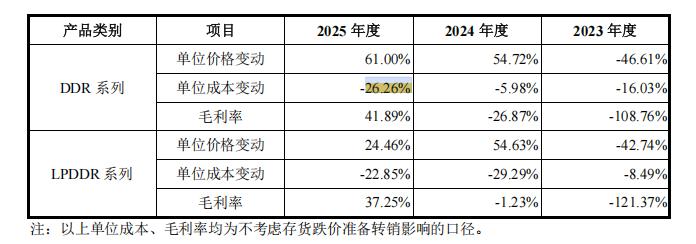
Screenshot of gross profit margin change analysis for main products
However, improved profitability does not mean Changxin Technology can completely get rid of cyclical influences.
The DRAM industry sees drastic price fluctuations, and enterprises have to face the pressure of high fixed costs. The prospectus shows that from 2023 to 2025, Changxin Technology's depreciation of fixed assets amounted to 10.555 billion yuan, 14.875 billion yuan, and 24.68 billion yuan respectively.
"Surviving cycles does not mean maintaining high profits every year. Instead, it means minimizing losses, avoiding cash exhaustion, and sustaining R&D investment during industry downturns, so that you can release profits faster than the previous round when the industry recovers," Huang Lichong stated.
Having crossed "from 0 to 1", gaps remain with Samsung and Micron
According to the prospectus, Changxin Technology plans to raise 29.5 billion yuan through its STAR Market IPO. Of the total funds, 7.5 billion yuan will be used for technical upgrading of wafer manufacturing production lines, 13 billion yuan for DRAM technology upgrading, and 9 billion yuan for forward-looking technology research and development.
This indicates that the listing is not merely a financing event, but a critical milestone for Changxin Technology to further catch up with overseas giants.
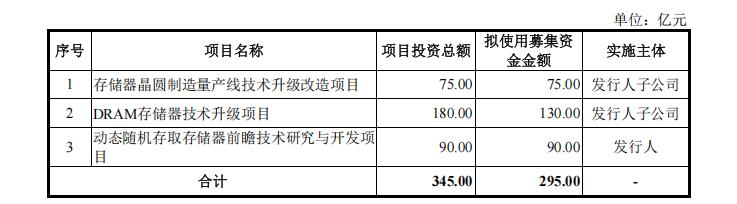
Screenshot of Changxin Technology's raised funds utilization plan
Zhu Yiming, Chairman of Changxin Technology, said at the July 15 investor communication meeting that Changxin Technology's production capacity ranks first in China and fourth globally, and it operates three 12-inch DRAM wafer fabs in Hefei and Beijing. As products including DDR5 and LPDDR5/5X are accelerating their penetration into downstream markets, and with the continuous development of servers, mobile devices, personal computers, smart vehicles, and other diverse application scenarios, DRAM market demand keeps growing, so the fund-raising projects hold promising development prospects.
Nevertheless, in the global market, Changxin Technology is still in the catch-up phase.
Statistics show that in the fourth quarter of 2025, Changxin Technology's global market share in DRAM sales was about 7.67%, while Samsung, SK Hynix, and Micron accounted for 33.96%, 34.48%, and 23.41% respectively.
Guolian Minsheng Securities believes that Changxin Technology plans to raise 29.5 billion yuan via the STAR Market IPO to launch large-scale capacity expansion. Currently, its production capacity has a notable gap with overseas giants, and its existing capacity is nearly fully utilized. With multi-site layout advancement in the medium and long term, Semianalysis predicts that the company's global market share will reach 17% by 2028. Compared with the production capacity scale of large overseas manufacturers, Changxin has huge room for subsequent capacity expansion.
Huang Lichong also pointed out that Changxin Technology has crossed the "from 0 to 1" stage for domestic DRAM, but there is still a gap before it becomes a top global manufacturer. "Possessing technology but lacking yield cannot generate commercial profits; having production capacity but with excessively high costs will lead to huge losses during industry downturns."
In Huang Lichong's view, what Changxin Technology most needs to make up for in the next phase is the capability of large-scale stable mass production of advanced processes, which is mainly reflected in yield and cost per bit (the cost required to produce 1 bit of data storage capacity). At the same time, Changxin Technology also needs to enhance its capabilities in high-end product portfolios, global customer resources, and advanced packaging.
Driven by AI, it needs to prove its high-end competitiveness
"Market share growth is not the only goal. What matters more is that market share growth is accompanied by technological generation upgrading," Huang Lichong stated.
With the rapid development of the AI industry, memory chips are becoming a new focal point of competition.
AI servers put higher requirements on memory capacity, bandwidth, and low-power performance, driving the growth in demand for DDR5, high-performance memory, and related memory products. For memory enterprises, AI not only brings incremental demand, but is also reshaping the industry's competitive landscape.
In fact, overseas memory giants have been laying out the AI market through high-value-added products such as HBM in recent years, to reduce the impacts brought by the cyclical fluctuations of traditional DRAM.
In contrast, Changxin Technology is in the phase of making breakthroughs towards high-end memory. The prospectus shows that the company's current AI-related revenue share is still relatively low, and it has not disclosed that HBM has generated scaled revenue. Huang Lichong believes that for some time in the future, Changxin Technology's growth will still mainly rely on the upgrade from DDR4 to DDR5, from LPDDR4X to LPDDR5/5X, and the increase in domestic localization rate.
"AI defines the industry's ceiling, while traditional DRAM upgrading, process yield, and cost capabilities determine whether Changxin can truly reach that ceiling," Huang Lichong noted. Changxin Technology needs to maintain its advantages in large-scale manufacturing while further enhancing the competitiveness of its high-end products, so as to obtain larger market space.
"The AI wave has significantly expanded the growth space of the memory industry and reshaped the industry's growth logic," Zhang Yi, CEO of iMedia Research Group, also said. In the future, Changxin Technology needs to rely on the "two-line layout" of traditional DRAM iteration and AI high-end memory R&D: in the short term, consolidate its basic market and improve profit quality through the upgrading of DDR5 product mix; in the medium and long term, promote the industrialization of high-value-added AI memory products such as HBM, which will become a key direction for the company to further narrow the gap with top international enterprises.
This article is from the WeChat Official Account "Phoenix Weekly Finance", author: Wang Han, editor: Cui Lupeng, published with authorization from 36Kr.