Just now, Nobel Laureate Doudna published a new study in Science: AI-designed proteins that outperform natural evolution
Nobel Laureate Jennifer Doudna's Team has published a new landmark study in the top journal Science.
They achieved AI-driven protein design that "surpasses natural evolution", creating a novel gene-editing protein SynTnpB, with some variants exhibiting activity equal to or even exceeding that of natural enzymes.
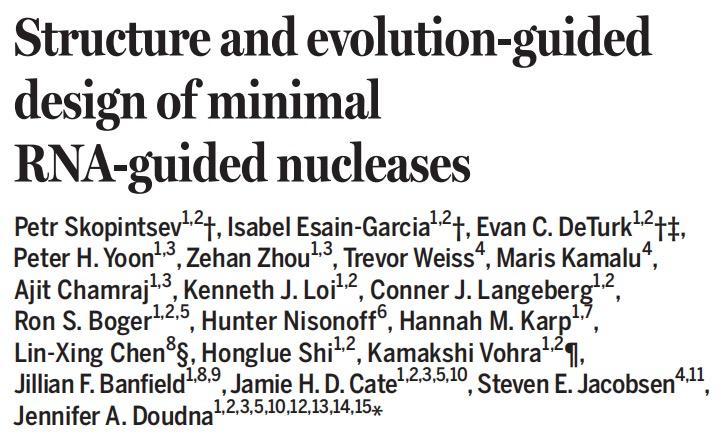
Paper link: http://www.science.org/doi/10.1126/science.aed6123
Further cryo-EM results revealed that these engineered proteins form new stable interactions at the RNA-DNA interface across different conformational states. This marks the first experimental determination of the structure of an AI-designed RNA-guided nuclease.
The research team stated that combining generative biology and de novo design approaches is expected to break through the boundaries of natural sequences in the future, expanding the functional and designable space of this class of proteins.
AI Protein Design That Surpasses Nature
Currently, CRISPR-Cas technology enables precise editing of DNA/RNA, but designing RNA-guided nucleases that do not exist in nature yet retain full activity is far from trivial. Enzymes generated by existing sequence models often closely resemble natural sequences; while structure-guided design can explore a larger sequence space, it still struggles to preserve activity after extensive sequence rewriting.
Unlike previous sequence-based biological language models, Doudna's team proposed an AI protein design strategy that integrates structural and evolutionary information to generate RNA-guided nucleases with highly divergent sequences that still retain functional activity.
To validate this strategy, they selected the small RNA-guided nuclease TnpB as their design target. The specific workflow is as follows:
1. Design Module: Generating Novel TnpB Sequences
They first used the ESM Inverse Folding Model (ESM-IF1) to generate candidate sequences based on the 3D structure of TnpB. The AI-generated sequences preserved the overall fold of TnpB and the DED catalytic triad of the RuvC domain, but introduced modifications to some RNA/DNA recognition residues.
To address this issue, they constructed sequence masks based on evolutionary information: residues with positional conservation (Ci) or co-evolutionary coupling strength (σi) with nucleic acid sequences above a set threshold were fixed as wild-type, while all other positions were re-designed by ESM-IF1.
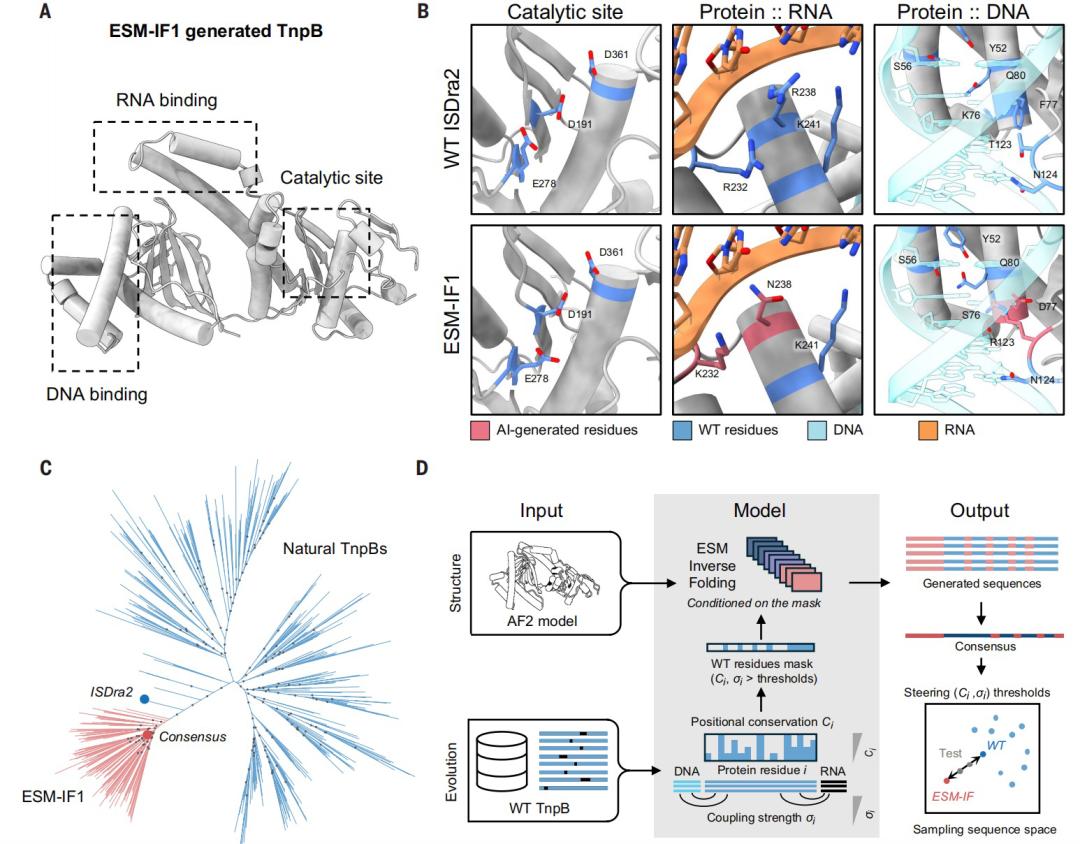
Figure | Strategy for designing the RNA-guided nuclease TnpB using the ESM Inverse Folding (ESM-IF1) model.
2. Screening Module: Identifying Functionally Active Variants
After completing sequence design, they used the bacterial ccdB toxin system to screen for active variants: TnpB variants capable of cleaving the toxin plasmid allowed bacteria to survive. Since full-length designs constrained only by Ci showed limited activity, they tested the two domains of TnpB separately: the REC domain is primarily involved in DNA recognition, while the NUC domain is associated with RNA binding and catalysis. The results showed that the NUC domain is more tolerant to sequence variations. Based on this finding, they applied combined Ci/σi dual-condition constraints to screen 9 highly active, highly diverse variants from 1980 REC-NUC combinations.
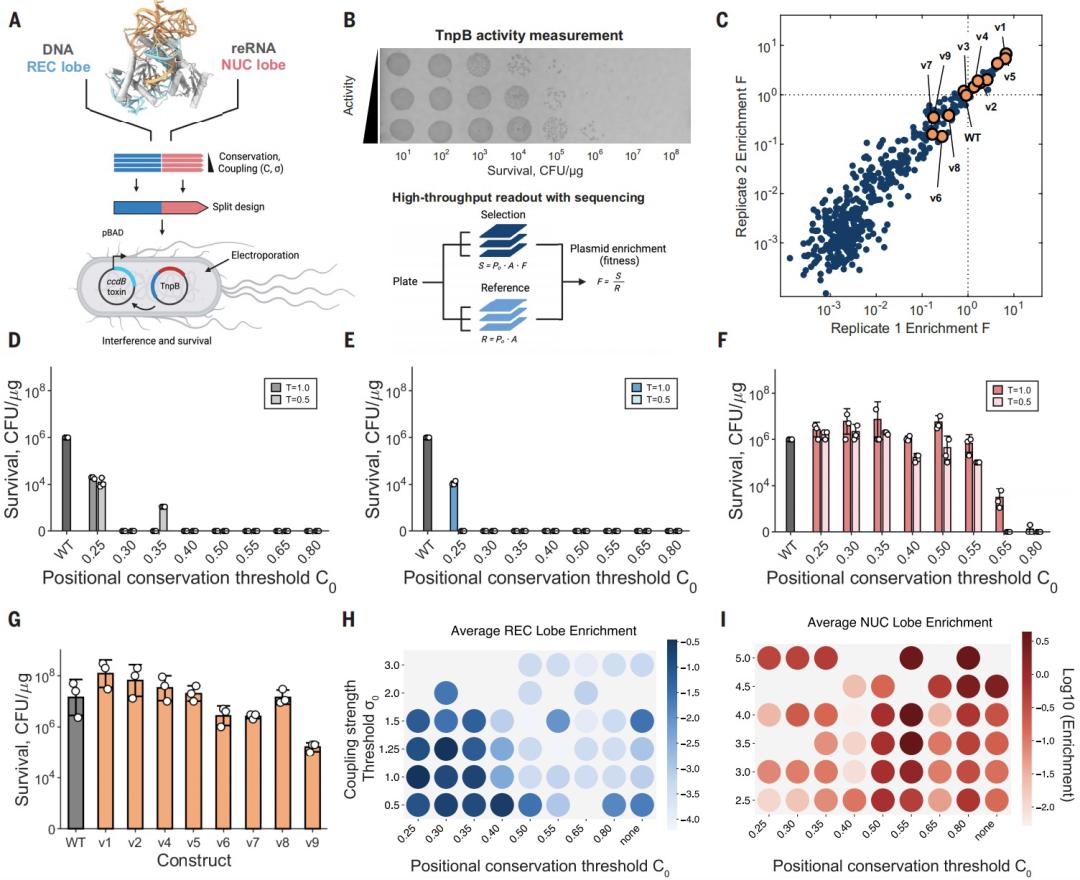
Figure | Screening of AI-generated SynTnpB variants conditioned on positional conservation (Ci) and coupling strength (σi) thresholds.
Activity Surpassing Natural Enzymes
Overall, the AI-designed SynTnpB variants retained activity in bacterial, plant, and human cells, even exceeding that of natural enzymes. Cryo-EM structures further revealed that these AI-designed variants can stabilize the RNA-DNA interface across different conformational states. The specific results are as follows:
1. Editing in Human and Plant Cells
The screened variants retained editing activity in both human and plant cells, with some outperforming the natural enzyme. They validated the 9 variants in HEK293T cells and Arabidopsis thaliana protoplasts. In human cells, most variants showed activity comparable to the wild type, with v1 and v5 performing best, achieving a maximum editing efficiency of 50% — approximately 1.8 times that of the wild type. In plant cell experiments, v1 also outperformed the wild type at most tested target sites.
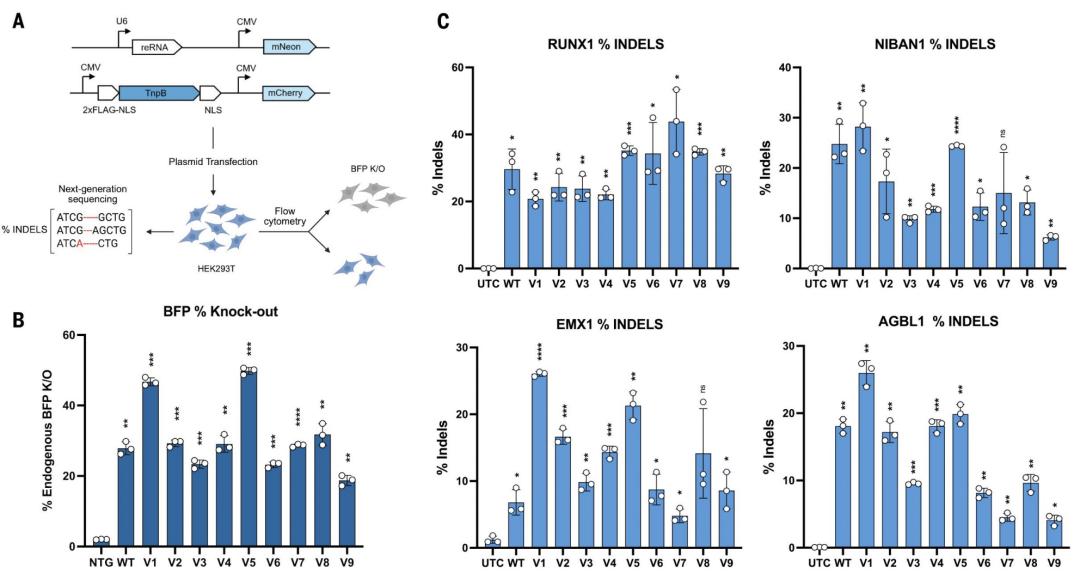
Figure | Genome editing of AI-generated TnpB in HEK293T cells.
2. Specificity and Biochemical Characterization
In terms of specificity, SynTnpB variants retained the typical TTGAT TAM preference, but off-target performance varied across variants. Genome-wide Tn5 tagmentation analysis showed that v1 had specificity comparable to the wild type, while more off-target sites were detected for v5 and v7.
From the perspective of expression and biochemical characterization, differences in editing activity cannot be simply attributed to expression levels. Western blot results showed that the expression level of each variant was not correlated with editing activity. Taking the v7 variant as an example, its thermal stability was comparable to the wild type, and it retained strong target strand cleavage activity, although the cleavage reaction proceeded slower than the wild type.
3. Cryo-EM Structure
The results showed that AI-generated residues formed new contacts with RNA-DNA across multiple domains, stabilizing the interface in different conformational states. In addition, they captured a previously unreported intermediate state of TAM-binding conformation in TnpB.
They selected v7, a variant with high sequence divergence, for cryo-EM analysis. This variant shares 77% sequence identity with the wild type and exhibits high editing efficiency at the RUNX1 locus. Experiments showed that the cryo-EM structure reached a resolution of 2.8 Å, capturing two distinct conformations: the TAM-binding state and the R-loop formation state.
In the TAM-binding state, the protein and RNA conformations resemble the binary complex of ISDra2 TnpB, while simultaneously binding DNA and forming a single base pair in the heteroduplex seed region. The AI-generated residue N4R, together with the conserved "phosphate lock" residue K84, stabilizes this pairing. This conformational intermediate has not been observed in TnpB previously.
In the R-loop formation state, the reRNA and target DNA have formed a relatively complete paired structure. At this stage, AI-generated residues are distributed across the REC, NUC, and lid regions, forming contacts with the RNA-DNA duplex; meanwhile, the bridging helix retains bending motions that facilitate duplex formation.
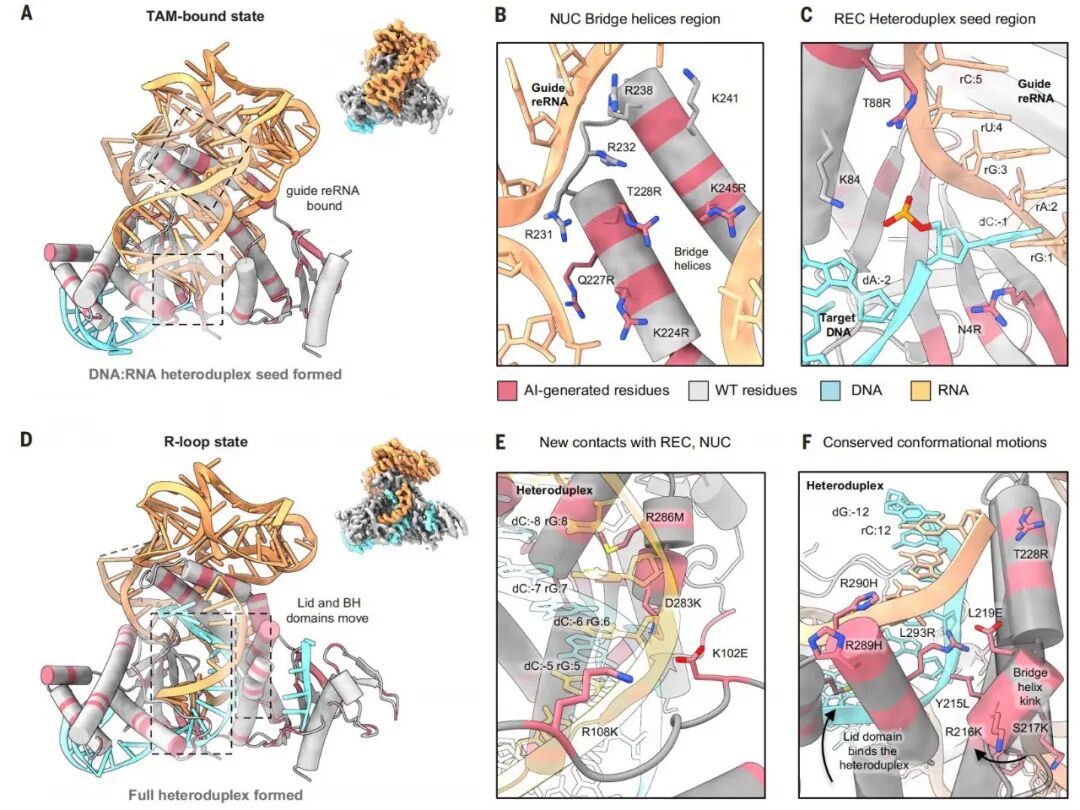
Figure | Cryo-EM structure of the AI-generated variant v7 reveals RNA-DNA interface residues and conserved conformational dynamics.
Limitations and Future Directions
However, the team noted that while the current approach shows promise for extension to more RNA-guided nucleases and other dynamic nucleic acid-binding proteins, several limitations remain.
For example, in terms of design objectives, different domains of TnpB exhibit varying tolerance to sequence alterations: the DNA recognition-associated REC domain is more sensitive to substitutions, while the RNA binding and catalysis-associated NUC domain is more tolerant to variations. In the future, they still need to further verify whether the modular design principle applies to other multi-domain proteins.
Meanwhile, in terms of data conditions, the sequence mask relies on sufficiently rich evolutionary information, placing high demands on the diversity and representativeness of sequences in the database. More abundant and balanced protein-nucleic acid pairing data will help extend this approach to other multi-state proteins or nucleic acid-binding proteins.
Additionally, in terms of mechanistic understanding, how AI-generated residues influence nucleic acid binding and conformational changes requires further investigation. They stated that the cryo-EM structures from this study captured a previously unreported TAM-binding state, which may represent a kinetic intermediate and set a precedent for future studies of transient conformations in RNA-guided nucleases.
More technical details can be found in the original paper.
This article is sourced from the WeChat public account "Academic Headlines" (ID: SciTouTiao), authored by Xia Qiansi, and published by 36Kr with authorization.