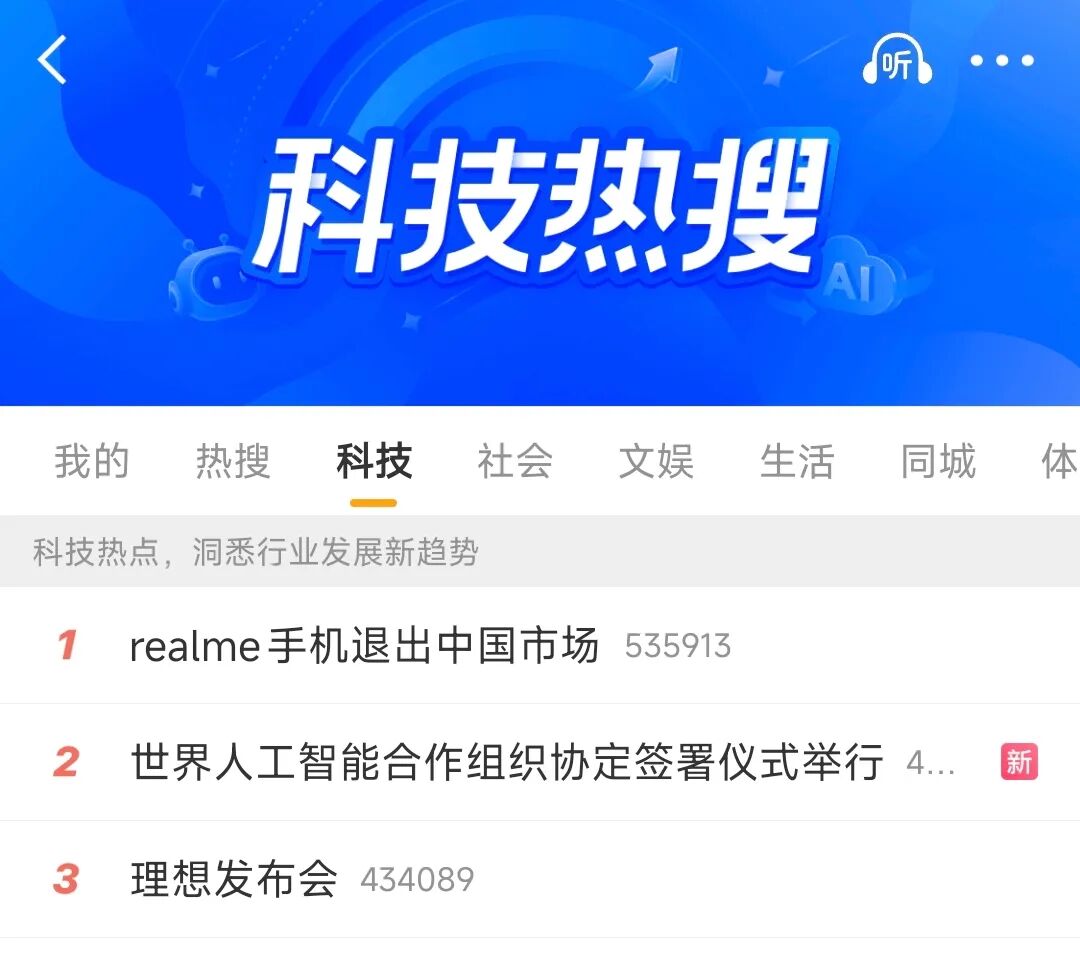
Hit the hot search list, realme smartphones withdraw from the Chinese market
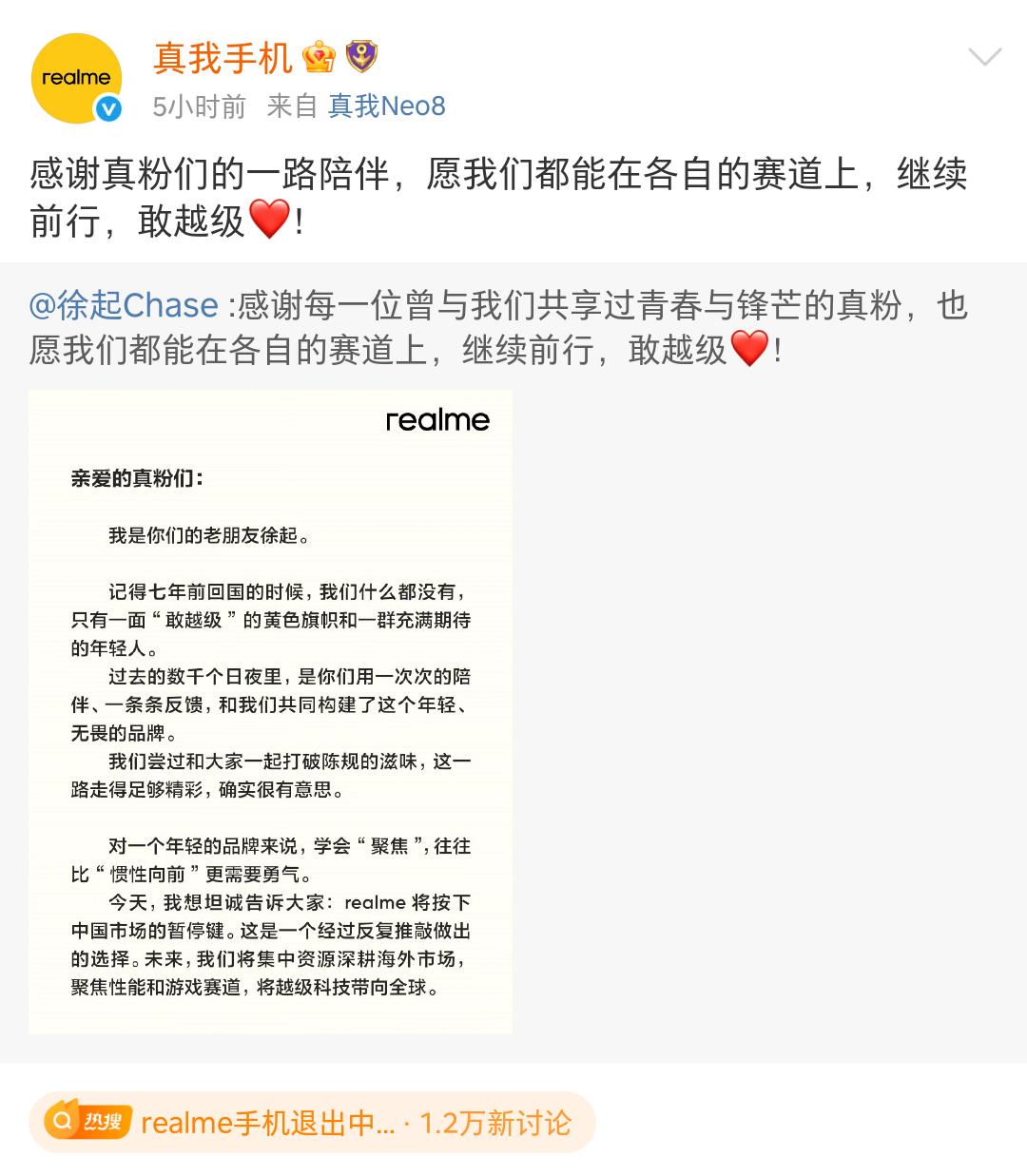
Just now (July 16), a thought-provoking piece of news emerged in the smartphone industry: realme officially announced its withdrawal from the domestic Chinese market.
I froze for two seconds after seeing the news, and suddenly recalled the 2019 launch of the realme X. It packed a pop-up full-screen display, a Sony 48MP main camera, and a Qualcomm Snapdragon 710 chip all into a budget phone under 1000 yuan, instantly setting the entire online market ablaze.
Back then, everyone thought a tough new competitor that could go head-to-head with Redmi had arrived, and its brand slogan "Dare to Leap" was shouted louder than any peer in the segment.
Seven years later, that banner still stands — but its main battlefield has shifted elsewhere.
What many people don't realize is that realme was never originally built for the domestic Chinese market.
In May 2018, realme was officially founded in India. While it was presented as an independent brand, its core operational backbone came entirely from OPPO's resources.

At that time, Xiaomi and its Redmi sub-brand were fiercely dominating the Indian smartphone market. OPPO's own main brand focused on mid-to-high-end offline sales and could not compete effectively in the budget phone segment, so it incubated this "light cavalry" brand: with an independent team, aggressive pricing, and a pure online operation model, specifically designed to compete with Redmi for overseas low-tier market share.
No one expected the results to be overwhelmingly successful.
Within half a year of its founding, realme swept across six Southeast Asian countries. Just one year after launch, it shipped 10 million units globally, directly breaking the growth speed record for any new smartphone brand. Back then, realme was OPPO's sharp spearhead for overseas expansion, penetrating every high-growth market it could find, with no initial plans to return to China at all.
2019 marked a turning point, as a gap opened up in China's online cost-performance smartphone market.
Huawei was fully focused on pushing into the high-end market, Honor was still following Huawei's strategic layout, and Redmi had just been spun off as an independent brand and was still in its adjustment phase. There was a clear lack of competitors that could aggressively stack premium configurations in the price range below 2000 yuan.
realme spotted this opportunity and immediately made a bold re-entry into the Chinese market.
Its debut product, the realme X, became an instant legend, delivering flagship-level specifications that were previously only seen on high-end phones at a budget 1000-yuan price point.
The brand's "Dare to Leap" slogan perfectly resonated with student users and young tech enthusiasts: people who had limited budgets but refused to compromise on device performance and specifications.

The rest of the story is well known: realme chased flagship performance by selling Snapdragon flagship chips for just over 2000 yuan, consistently offered faster charging speeds and larger memory capacities than its rivals, and poured almost all its costs into hardware specifications — a perfect embodiment of its "leapfrogging technology" philosophy.
But behind this glory, hidden risks had been planted from the very first day realme returned to the domestic market.
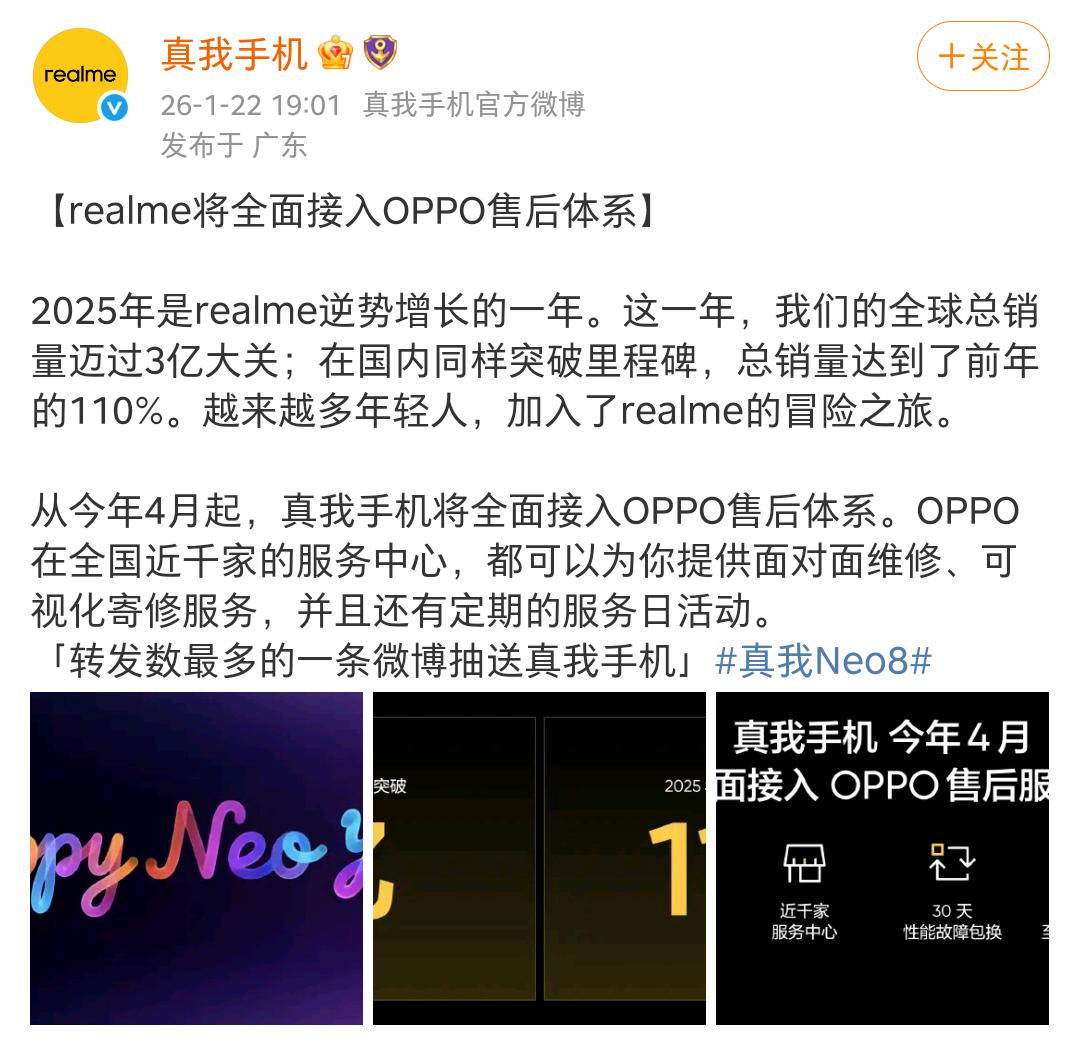
In early 2026, realme was formally integrated back into the OPPO group as a fully owned sub-brand. Many people thought this meant it would gain strong support for rapid growth, but in reality, it was the starting signal for a large-scale internal consolidation.
A simple cost calculation makes this clear: before the consolidation, within the 2000-4000 yuan mainstream price segment in China, the OPPO system had three overlapping product lines: OnePlus Ace focused on online performance and gaming, realme GT/Neo focused on extreme cost performance, and OPPO Reno focused on slim design and camera features for offline users.
Their target user groups were highly overlapping: all were young consumers with moderate budgets who prioritized performance and fast charging.
The end result was that the group spent triple the resources: each brand developed its own motherboard tuning separately, negotiated independent chip orders with the supply chain, and invested in separate marketing campaigns with different influencers, all while competing for the exact same pool of customers.
Simply put, it was a case of the left hand fighting the right hand: most resources were wasted on internal friction, leaving far less investment for actual product development and core technology upgrades.
Instead of continuing this inefficient resource drain, it made far more strategic sense to reposition realme to focus on expanding overseas market scale, while keeping OnePlus in China to drive profit growth. This complete separation of target markets eliminated internal resource conflicts, creating the most optimal operational outcome.

If internal consolidation was a gradual, long-term adjustment, the sharp price hike of storage chips in the first half of this year was the final decisive factor that pushed realme's domestic business to cease operations.
For high-end flagship phones, this price increase only meant slightly lower profit margins, which was manageable. But for a brand like realme that focused on budget phones with extremely thin per-unit gross margins, it directly shattered its operational viability.
The core survival logic of cost-performance smartphone brands is essentially to leverage sales volume to reduce component costs. Higher shipment volumes mean lower procurement prices from upstream suppliers, which allows for more competitive selling prices, in turn driving even larger shipment volumes to form a virtuous cycle.
But realme's core problem in China was that it could not achieve sufficient scale to gain bargaining power: its component procurement costs were higher than Redmi's, which made its pricing uncompetitive and prevented it from growing shipment volumes, trapping it in a vicious cycle. On top of that, OnePlus — another brand under the same group — was siphoning off market attention and component orders, meaning realme had already lost half its resources to internal friction before it could even fully compete in the open market.
Continuing to pour investment into this business meant continuous losses. It was far more reasonable to redirect capital away from this hopelessly saturated red ocean market and invest it in areas that could generate sustainable profits.
realme's temporary exit is not an isolated incident for one brand, but a microcosm of the entire domestic Chinese smartphone industry's current transformation.
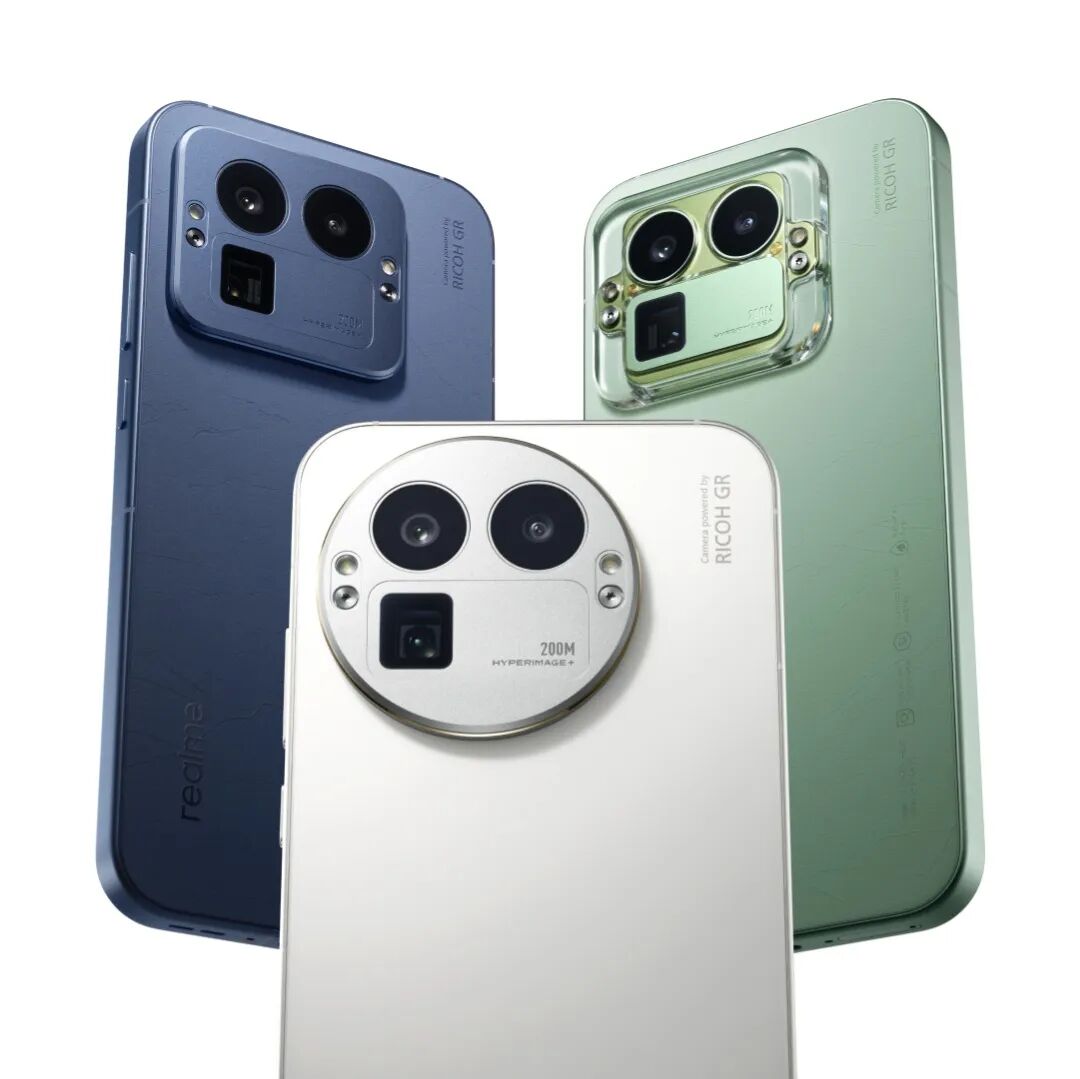
Over the past decade, major Chinese smartphone brands Huawei, Xiaomi, OPPO, and Vivo all aggressively expanded their multi-brand portfolios.
The underlying logic was simple: by using different brands with distinct positioning to cover every possible price segment, they could maximize overall shipment volume. In an era of rapid market growth, this strategy worked effectively — the more brands a group operated, the more market niches it could occupy, and the larger its total market share became.
However, once the market entered a saturated stock phase, with the average user replacement cycle extending from one year to two or three years and total market size steadily shrinking, all the flaws of the multi-brand strategy became exposed. Resources became scattered, internal friction intensified, and redundant investment was widespread. While the group appeared to have a broad market footprint, every individual brand under its umbrella was operating at an insufficient scale to thrive.
That's why over the past two years, the entire industry has been contracting its multi-brand strategies: Meizu's market influence has declined, Honor has cut redundant product lines, Xiaomi has streamlined its product series, and OPPO has consolidated realme and OnePlus under a more unified structure.
Everyone has finally realized that operating multiple brands is not inherently a strength. Concentrating resources to deeply develop a single brand with full market penetration is far more competitive in the long run.
Many people may feel regretful, believing that the era of the "Dare to Leap" spirit is over, and that there will no longer be intense competition pushing budget phones to deliver better value.
But from another perspective, realme is not disappearing — it is moving to a market where its value proposition is far more needed. There are still billions of users in high-growth overseas markets who are extremely enthusiastic about high-value, cost-effective smartphones, and that is the true battlefield where the "Dare to Leap" philosophy can fully shine.
Xu Qi, realme's CEO, wrote in his open letter: "Learning to focus often requires more courage than mindlessly moving forward along a familiar path."
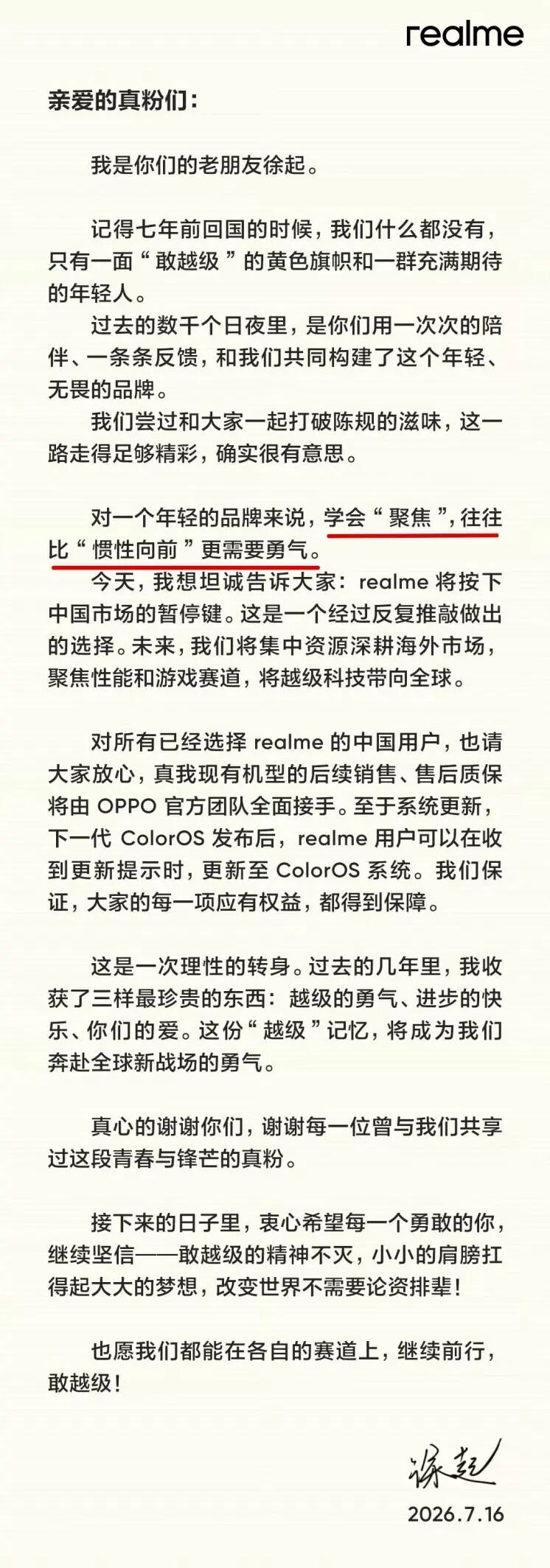
These words are very pragmatic. It took courage for realme to charge boldly into the Chinese market back in 2019, and it also takes courage to exit gracefully now, reposition itself, and fight for success in a new market.
After all, in an era where even the largest industry leaders are tightening their operational budgets, the ability to survive, stay focused, and invest resources in the most critical areas is far more important than clinging to a shrinking market just to maintain superficial prestige.
Seven years of pursuing a leapfrogging ambition, and now realme is temporarily stepping away from the Chinese domestic market. This is not surrender — it is simply moving to a new arena to keep winning.
This article is from the WeChat public account "Tech Fox" (ID: kejihutv), written by SC, and republished with authorization from 36Kr.