Chinese vehicles are closing in, yet none of Japan's seven major automakers is willing to make the first move to reform
All seven parties agreed, but no one was willing to make the first concession.
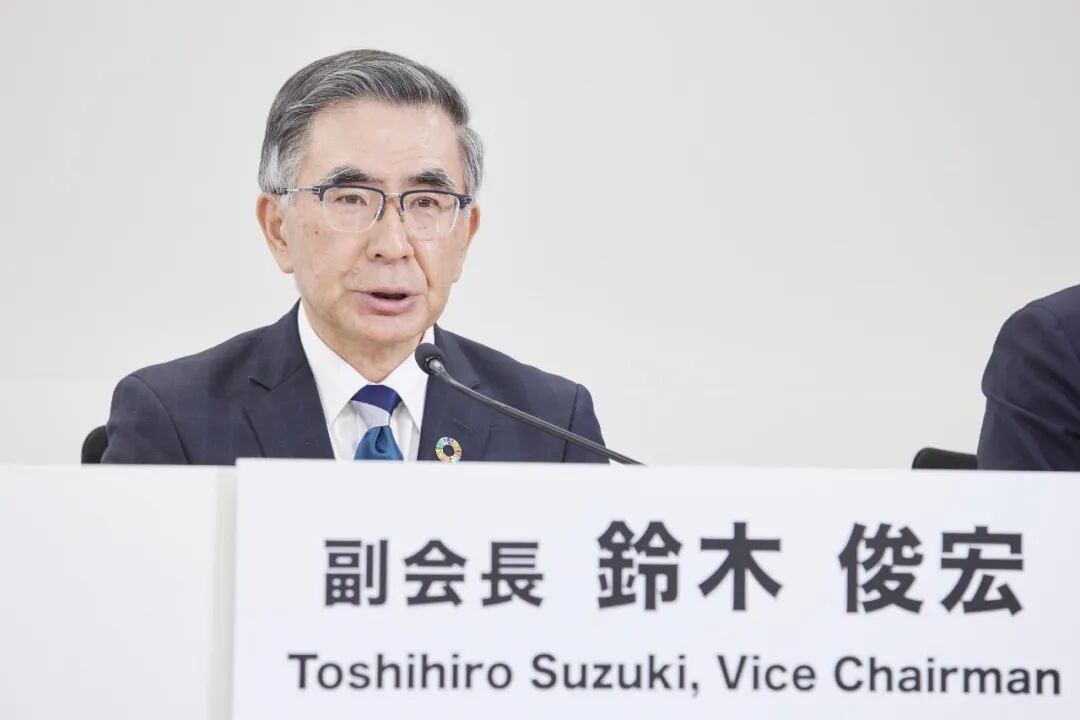
Half a year ago, after the board meeting of the Japan Automobile Manufacturers Association (JAMA), the seven presidents and vice presidents sat in a row. When Toshihiro Suzuki, President of Suzuki Motor, took the floor, he shared an old story.
Suzuki had previously collaborated with other companies on parts standardization. But in the end, the only item that was truly successfully unified was an ashtray.
He told this story to illustrate that "things can't go on like this anymore." This heavy responsibility fell to Koji Sato, who had just taken office as JAMA Chairman at that time.
Less than three months later, Sato stepped down as President of Toyota, became Vice President, and concurrently served as Toyota's newly appointed "Chief Industrial Officer" (CIO).
He was pushed into a more prominent position, tasked not only with finding a way forward for Toyota but also with buying time for the entire Japanese automotive industry.
What Sato aimed to promote was a set of common standards for the Japanese automotive industry, freeing up limited engineering resources for software, assisted driving, and areas that truly determine product differentiation.
Few people opposed this direction. Several automakers acknowledged that working in isolation was no longer sufficient to maintain the competitiveness of Japan's automotive sector.
But six months later, on July 14, Sato presented a striking figure: in the Japanese automakers' supply systems, there were still approximately 70,000 different specifications just for wiring harnesses.
The common standard that seemingly everyone agreed on remained at the principle level. The ashtray Suzuki mentioned instead became the most accurate footnote for the progress of standardization in Japan's automotive industry.
Cooperation was not entirely stagnant, but the first three parties to come together did not include Toyota.
A month ago, Japanese media revealed that Honda, Nissan, and Mitsubishi had entered the final coordination phase for standardizing the central computing unit of next-generation vehicles, with a formal agreement expected as early as this summer and a target for mass deployment in vehicles by 2029.
Facing Chinese vehicles with higher standardization and lower costs, Japan's automotive industry is paying the price for its incompatible supply systems across different manufacturers.
The three companies with a combined annual production of approximately 8.4 million units are starting to discuss sharing the "brain" of a vehicle.
Yet seven companies still cannot unify a single wiring harness.
Seven Parties in Consensus, Three in Action
Koji Sato assumed the position of JAMA Chairman on January 1, 2026. On February 6 of the same year, Toyota announced that he would step down as President on April 1, transitioning to Vice President while concurrently taking on the newly created CIO role.
Toyota's official explanation was that Sato would shift his focus to the broader industry including Toyota, while new President Kenta Tsutsui would concentrate on internal corporate operations.
For this personnel reshuffle, Toyota's board of directors used the term "duty" and cited the rationale of "contributing to the nation through industry."
His position as JAMA Chairman allowed him to drive collaboration among Japan's major automakers; the Toyota CIO role enabled him to push Japan's largest automaker to participate first and make concessions first. The two roles aligned toward the same mission.
What Sato inherited was a transformation task list compiled by JAMA for the Japanese automotive industry, named the "Seven New Challenges." The seventh item, which was also his top priority, was "enhancing the competitiveness of the entire supply chain."
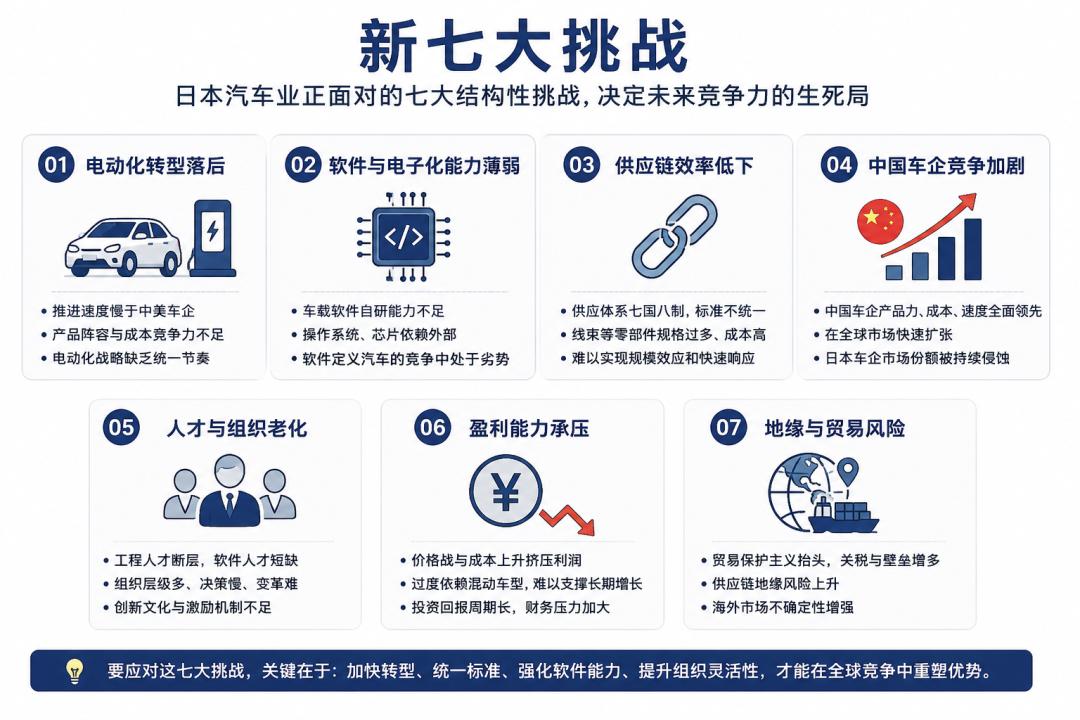
The first breakthrough he identified was eliminating redundant material specifications that did not create product differentiation but were repeatedly defined by the seven companies.
Specific targets included unifying steel grades, material specifications for resins and rubbers, wiring harnesses and connectors, certain general-purpose components and acceptance criteria, and logistics data.
This should have been the easiest level for the seven automakers to reach a consensus on, as it did not touch core interests. However, seven months later, only peripheral links had been effectively implemented.
Toyota's earliest SSA initiative had expanded to the industry level in 2025. This year, JAMA and component industry organizations released a joint declaration, publicizing a number of case studies for optimizing appearance quality standards, among which 50 appearance standards for wiring harness resin connectors have been recognized by relevant automakers.
Meanwhile, eight automakers and multiple suppliers are working to unify the basic specifications for 3D drawings of automotive stamping dies; the in-vehicle semiconductor data platform also launched operations in April as scheduled.
These projects share a common feature: they barely require modifications to vehicle designs and rarely disrupt existing supply chain interests.
But for areas that truly require "changing drawings," such as steel grades, resins, and wiring harnesses, there are still no clear timelines, let alone mature cost allocation plans.
At the regular meeting on May 21 this year, Sato reported on progress, expressing hope that peers would reduce redundant discussions and take more concrete actions. At the meeting in March, he had emphasized aligning their objectives.
Sato's plan to unite the seven Japanese automakers has remained in the preparation phase. But outside of Toyota, smaller-scale collaborations among other Japanese automakers are advancing rapidly.
In June 2026, Japanese media revealed that Honda and Nissan had entered final coordination for the joint development and standardization of the central domain control unit for next-generation vehicles, with Mitsubishi also likely to be included in this framework, targeting deployment in vehicles around 2029.

On the day the news was released, the stock prices of Honda, Nissan, and Mitsubishi Motors collectively rebounded.
The central computing unit is equivalent to the brain of a software-defined vehicle, responsible for aggregating full-vehicle data and coordinating functions that were previously distributed across multiple controllers.
The apparent reason why it is easier to implement than the "seven-party standardization" is that this is an unestablished new project, with no existing designs, production lines, or vehicle assets requiring modification. It does not touch upon equity or operational control, nor does it require any party to give up capabilities related to product differentiation.
Although Honda President Toshihiro Mibe supports expanding industry collaboration, he has clearly drawn a boundary: foundational rules and basic infrastructure can be built jointly, while core capabilities in AI and in-vehicle software should remain under the control of each individual company.
But more importantly, there are fewer participants, and the interest relationships are clearer. This boundary is pushing Japan's automotive industry toward two distinct paths.
Toyota has its Arene platform and maintains capital and technical ties of varying degrees with Subaru, Mazda, and Suzuki; Honda continues to advance the ASIMO OS while collaborating with Nissan and Mitsubishi.
Some Japanese media have begun to summarize the future technological landscape of Japanese automakers as the Toyota camp and the Honda camp.
This is the intractable problem with Sato's approach. Christopher Richter, a senior auto analyst at CLSA in Tokyo, judged that given Toyota's scale, the final JAMA specifications would likely be very close to Toyota's own standards.
But he doubts that other automakers will be willing to stand behind Toyota.
Seven Sets of Solutions, Seven Sets of Costs
In 1949, post-war Japan drastically tightened fiscal and credit policies. Banks became reluctant to lend, and enterprises and distributors defaulted on payments. Although Toyota sold its vehicles, it could not recover cash, and its capital chain quickly broke down. Through the mediation of the Bank of Japan, a consortium of 24 banks formed a joint loan group, which allowed Toyota to survive on the brink of bankruptcy.
In accordance with the Enterprise Reconstruction and Restructuring Act, Toyota had to divest some of its assets. Thus, on December 16, 1949, the electrical components and radiator divisions were separated to establish Nippon Denso. It, alongside Nippon Spinning, the predecessor of Toyota Boshoku, was explicitly included in the same reconstruction plan.
The first president of Denso, Toru Hayashi, was a textile machinery engineer who claimed to be "a layman in automotive components." Before the division, Kiichiro Toyoda gave him a message. He said that electrical components were demanding work that prioritized performance, and separating the business to operate independently meant that it would supply not only Toyota but also other Japanese automakers.
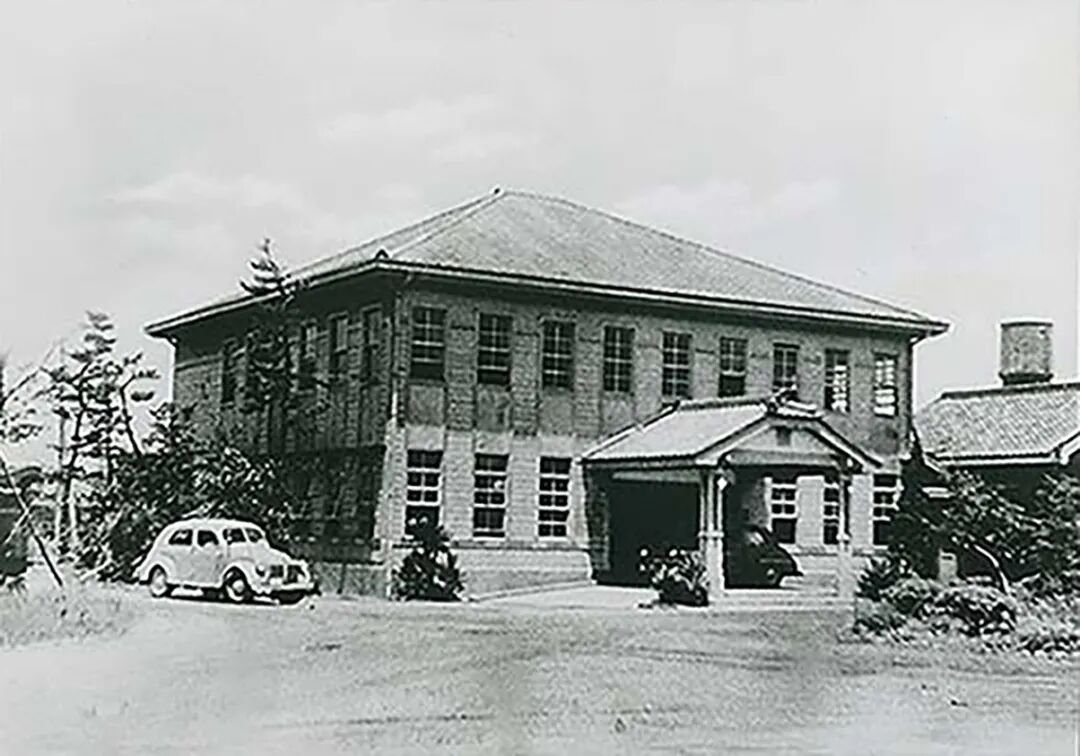
The headquarters building at the time of Denso's founding
Today, Denso has become the world's second-largest automotive component supplier after Bosch in terms of automotive business sales, with revenue of 7.54 trillion yen in the 2026 fiscal year.
This practice of splitting internal functions into specialized companies has repeatedly shaped the Toyota Group ever since. The vehicle body division became Toyota Auto Body, the machine tool division later became JTEKT, and the rubber research division grew into Toyoda Gosei.
While their starting points were not identical, their direction was consistent: spinning off a capability from within the automaker to let it stand the test of the market.
But Kiichiro's vision was only half realized. Toyota still accounts for 55.6% of Denso's sales, while all other automakers combined make up about 36%, with Honda, the second-largest Japanese automaker, contributing only 5.8% of Denso's sales.
Standing in the way are the long-standing barriers within Japan's automotive industry. Each automaker has built its own supply network around itself.
Take Honda for example. Its automotive business grew out of its motorcycle operations. Showa Manufacturing produced shock absorbers for it, Nissin Industry handled braking systems, and Keihin supplied carburetors.
These collaborations all began before Honda entered the four-wheeler market in 1963. When Honda started manufacturing automobiles, it brought in a set of supply relationships that had already been refined over years of cooperation.
Nissan took a different path. It kept key capabilities within the group, then gradually split them into specialized companies, such as Calsonic Kansei, Unisia Jecs, and JATCO.
Multiple closed systems of Japanese automakers developed in this way. Suppliers are nominally independent, but in reality, they are deeply embedded with their respective automakers in terms of capital, orders, technology, and personnel. Those hard-to-unify specifications, processes, and quality rules are precisely the institutional deposits left by decades of joint development.
Nevertheless, this closed vertical system did allow Japanese automakers to thrive for 30 years.
A key innovation in the Japanese production system was making multi-variety, small-batch production economically viable through rapid die changes and reduced setup times.
A critical reason why Japanese automakers later seized a large share of the U.S. market from Detroit's Big Three was that they could offer more vehicle models at lower costs, with faster update cycles, bearing the diversity that the U.S. mass production model could not afford.
In the era of internal combustion engine vehicles, this calculation made sense: seven closed systems yielded a lean manufacturing system that automakers around the world sought to emulate.
Decades later, the wiring harness that Sato repeatedly highlighted represents a negative byproduct of this system.
A vehicle model has a lifecycle of 6-7 years, and service parts still need to be supplied for 10 years after production ceases.
The 70,000 wiring harness specifications originated from decades of accumulation by Japanese automakers. Wiring harnesses are flexible components that are difficult to fully automate and are mostly assembled manually. Each additional specification often requires matching new molds, wiring boards, and work instructions.
These costs do not appear directly on the automakers' books; instead, they are dispersed among suppliers such as Yazaki and Sumitomo in the form of labor, inventory, and SKU management, quietly accumulating across the entire supply chain.
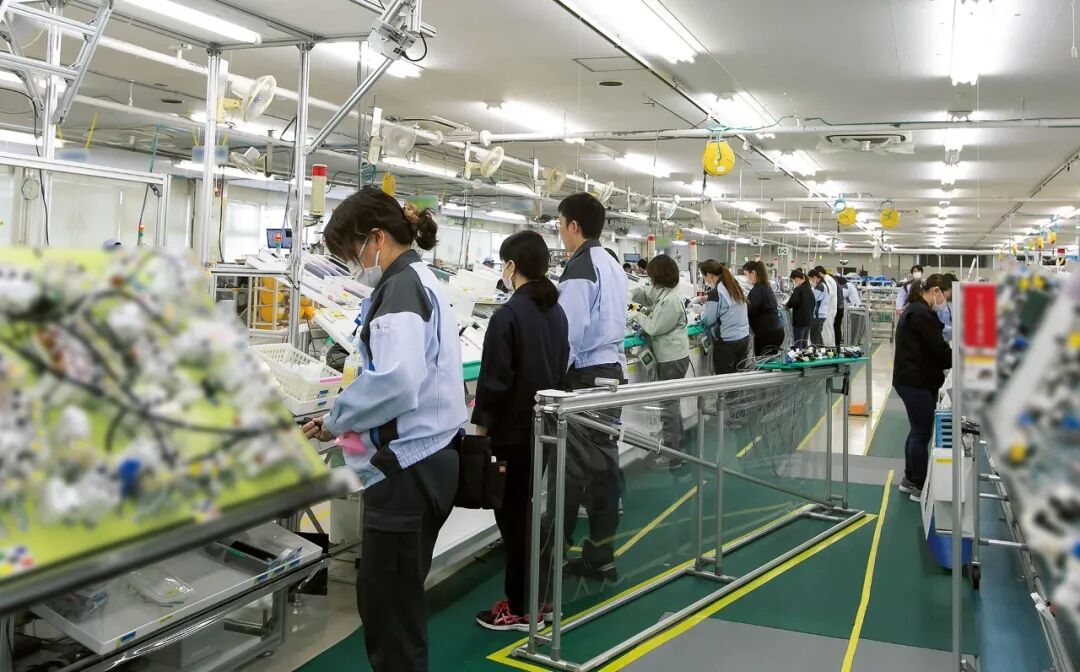
Sumitomo factory production line
There are many similar hidden wastes.
In 2017, Toyota dispatched personnel to station at suppliers, sorting through parts that had been deemed defective and marked for scrap to re-inspect them one by one. They found that three-quarters of the discarded items were usable.
The reason was that Toyota's standard stated "no harmful burrs or scratches allowed." This vague wording led suppliers to enforce the standards more strictly than Toyota intended, fearing rejection.
In the internal combustion engine era, these wastes could be masked by higher profit margins; in the new energy era, when facing Chinese automakers with higher standardization, lower costs, and faster iteration, they directly translate into competitiveness gaps.
This is where the problems Sato wants to address begin. What he truly needs to clean up are the hidden rules accumulated over decades in the vertical system and the systematic wastes created by these rules.
Hardware Depends on Time, Software Depends on Scale
The Japanese automakers' system remains solid today, still producing what they have been manufacturing for 30 years: assembly precision, NVH performance, and reliability.
The problem is that these capabilities no longer solely determine purchasing decisions. Consumers are shifting more attention to in-vehicle infotainment systems, assisted driving, energy replenishment efficiency, and software iteration.
In the SDV (Software-Defined Vehicle) era, the diversity of automotive products is no longer tied to the variety of hardware.
Identical chips, electrical/electronic architectures, and foundational components can deliver differentiated product experiences through software, feature configurations, and continuous iteration. The more unified the underlying layer is, the lower the cost becomes, and the faster software development proceeds.
But within the closed vertical systems of Japanese automakers, the tight "refinement-based development" across the seven vertical systems essentially requires an amortization strategy to sustain itself. The huge coordination costs invested in the early stage yield an optimal solution that others cannot replicate, and then the funds are recovered over the entire product lifecycle.
The vehicle lifecycle in Japan is 6-7 years, while Chinese vehicles now take only 18-24 months to develop, and software OTA updates can be released on a monthly basis.
More critically, the cost structure has reversed.
In the hardware era, the largest cost item was manufacturing. Therefore, as long as development was done well in the early stage and engineering was perfected, with minimal modifications and slow amortization in subsequent