From "Who is BYD" to the No.1 brand of pure electric vehicles in the UK, BYD's globalization is far more than just "selling cars"
On local time July 9, the 2026 Goodwood Festival of Speed in the United Kingdom kicked off.
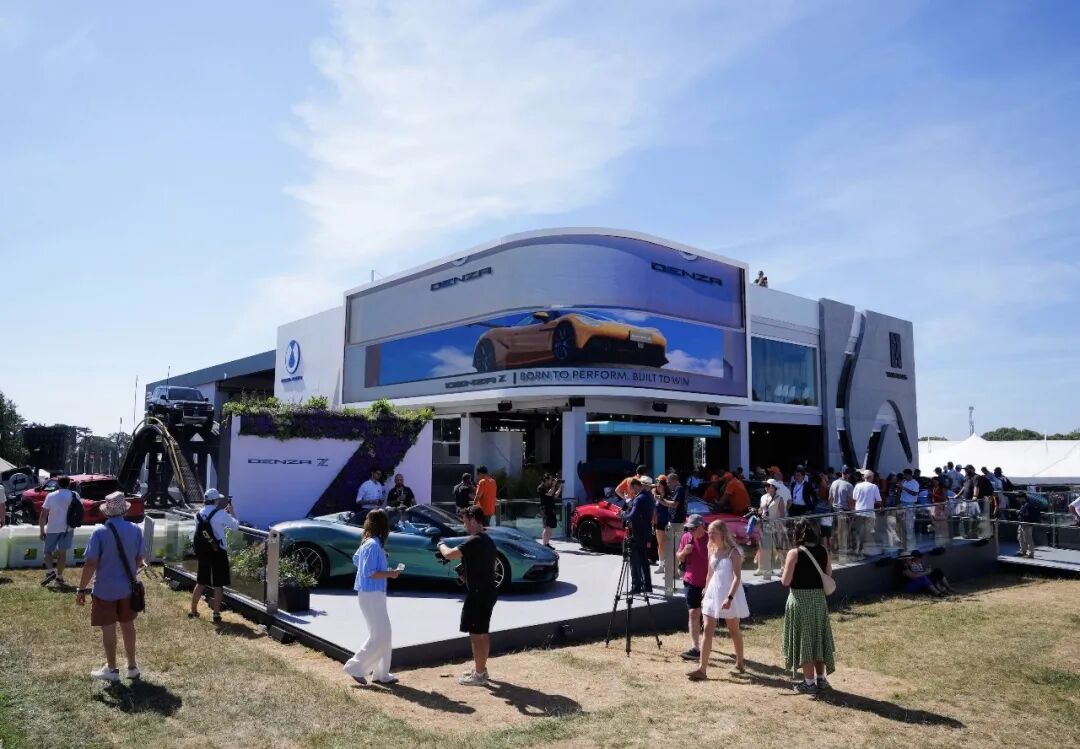
BYD set up the largest brand exhibition stand in the 33-year history of Goodwood here — spanning 2,016 square meters, bringing together its three core brands: BYD, DENZA, and YANGWANG, with the DENZA Z making its global debut.
This also marks BYD's third participation in the Goodwood Festival of Speed.
At the event site, Yiou witnessed that the unveiling guest for the DENZA Z was former F1 World Champion Jenson Button, who jointly completed the global premiere of the DENZA Z with Li Ke, Executive Vice President of BYD Group.
With a price tag of £142,900 for the hardtop version and £172,900 for the track version, the DENZA Z directly enters the core price territory of traditional supercars.
After the press conference, BYD UK Managing Director Giles Hutton revealed that some customers had canceled their orders for McLaren and Ferrari vehicles to switch to purchasing the DENZA Z track version.
The Duke of Richmond, the owner of the Goodwood Estate, himself expressed recognition of BYD's technology.
This is no longer the narrative of "Chinese brands seizing the market at low prices".
The latest sales figures released by BYD show that monthly overseas sales now account for more than 40% of total sales. Last year, 1.04 million units were sold overseas, this year's target is 1.5 million units, and 790,000 units have been completed in the first half of the year.
Li Yunfei, General Manager of Brand and Public Relations at BYD Group, stated at a media briefing that in the medium to long term, the company hopes that domestic and overseas sales will each account for half, and gradually increase the proportion of overseas sales.
As overseas sales approach half of total volume, BYD's globalization has long surpassed the stage of simply "selling cars abroad".
In the UK, it's far more complex than "Chinese cars are cheap"
The UK is a microcosm of BYD's globalization.
It is an open market with annual sales of 2 million to 2.2 million units, where the top-ranked Volkswagen holds only 8.5% market share (approximately 160,000 to 170,000 units), and the sales gap between the top five brands is no more than 10,000 to 20,000 units. Competition is fierce, but the entry threshold is not low.
Three years ago, BYD first came to the Goodwood Festival of Speed with its YANGWANG brand; in 2025, the DENZA brand joined; and in 2026, all of BYD's full brand lineup made an appearance at Goodwood.
It took BYD three years to reach the top of the UK's pure electric vehicle sales rankings. From January to June 2026, the cumulative number of UK customers exceeded 100,000, with brand awareness reaching 72%. BYD has 43 stores in the UK, and plans to expand to 160 to 170 stores by the end of the year.
In the UK market, BYD is not the only "Chinese automotive brand" performing well. Lotus Cars is owned by Geely, and MG is owned by SAIC, both of which have brand histories connected to the UK. In contrast, BYD is an original, authentic Chinese automotive brand.
What does this mean? Lotus Cars and MG inherently carry British heritage and brand legacy, giving consumers a naturally lower barrier to acceptance. BYD does not have this "birth advantage" and must build brand awareness from scratch.
In response, Li Yunfei summarized BYD's "three-step" methodology: "First be seen, then be experienced, and finally be recognized. We do not deliberately benchmark against traditional luxury cars, but create new experiences through technology while integrating into local high-end circles."
Being seen relies on top-tier IPs such as the UEFA European Championship, Manchester City Football Club, and the Goodwood Festival of Speed. Giles Hutton, BYD UK Managing Director, recalled that when the company first entered the UK, BYD was called "the biggest brand you haven't heard of". During the UEFA European Championship sponsorship, the final happened to be England vs. Spain, and Google searches for "Who is BYD" surged dramatically.
Being experienced relies on the "five-step experience method": NFC key unlocking, voice-activated rotating screen, in-car karaoke, and V2L external discharge for making coffee — the British, seemingly conservative, responded surprisingly positively to karaoke, with the conversion rate from test drive to purchase reaching 50%.
Being recognized relies on "good products + good technology + good service". In Giles Hutton's own words: customers know that buying a BYD is good value for money.
From selling cars to selling systems
If it were only about selling cars, BYD's story in the UK would not be told this way.
Its differentiation lies in providing an integrated solution of electric vehicles, energy storage, and charging stations.
Energy replenishment is a major pain point in the UK's pure electric vehicle market.
Highway charging costs approximately £0.79 to £0.89 per kWh (equivalent to about 8 RMB), while off-peak domestic electricity prices are only £0.07 per kWh. BYD's fast-charging solution comes with a built-in energy storage system that can store electricity at low cost during the night and discharge it during the day, offering users a more economical charging experience.
Li Yunfei revealed that this year, BYD plans to build 20,000 fast-charging stations in China; overseas, from March this year to the end of March next year, 6,000 stations are planned to be completed, including 3,000 in Europe, 2,000 in the Americas, 1,000 in the Asia-Pacific region, and at least 300 in the UK.
The energy storage business has also been launched. BYD has put a 2.5GWh large-scale energy storage project into operation in the UK, connected to the national grid. There are already 10,000 users for residential energy storage. This continues BYD's green vision logic of "photovoltaics + energy storage + new energy vehicles" — a model verified in China that is being replicated overseas.
In terms of production capacity, a large factory is already under construction in Hungary, which can cover the UK market. Li Yunfei stated that a second factory may be planned in the future, but the location has not yet been determined.
When asked about competitive advantages, Giles Hutton said: "Others sell cars, we sell integrated solutions." This is not a slogan, but a fact based on the product matrix and business layout.
The World Cup, old-money circles, and the identity of "Chinese automobiles"
Brand building is the most "soft" yet most difficult part of BYD's globalization. Li Yunfei reviewed the structure and journey of the brand's overseas expansion at the briefing.
In terms of brand architecture, to further facilitate resource concentration and channel integration, BYD has merged its Dynasty and Ocean series into the "BYD Brand" for overseas markets, DENZA and FANGCHENGBAO will operate in a consolidated manner, while the YANGWANG brand will operate independently.
In 2024, BYD became a strategic partner of the UEFA European Championship, and continued to deploy football marketing in the Americas and Asia-Pacific.
At this FIFA World Cup in the US, Canada, and Mexico, BYD sponsored relevant teams and events.
Once upon a time, the international influence of Chinese automobiles was far less than that of Chinese football. Times have changed — while Chinese football has not yet made its mark abroad, Chinese cars can be found everywhere around the globe.
The underlying implication of this statement is: Chinese automobiles do not need to rely on football or other carriers to prove their existence, but leveraging the globally universal language (football) to accelerate recognition remains a necessary path.
The path for high-end brands is more concrete. Li Yunfei summed it up as "being seen — being experienced — being recognized". The DENZA brand inherently carries high-end genes — it was co-founded by BYD and Mercedes-Benz. At this Goodwood Festival of Speed, the DENZA Z made its global debut (priced at £142,900 for the hardtop version, £159,900 for the convertible version, and £172,900 for the track version), with some customers canceling their McLaren/Ferrari orders to purchase the track version. The YANGWANG U9 Xtreme is priced at over 20 million RMB, with a global limited production of 30 units, and the Duke of Richmond, owner of the Goodwood Estate, personally expressed recognition of its technology.
At the Goodwood Festival of Speed site, when Li Yunfei "interviewed" Li Ke, Executive Vice President of BYD Group, he revealed a detail: shortly after the product was released, a customer directly placed an order for 22 units of the DENZA Z convertible, demonstrating full trust and affection for the BYD brand and its products.
Giles Hutton said when talking about high-end marketing: "Our goal is not to replace others, but to achieve common development." The strategy is divided into two steps:
First, achieve exposure in "old-money circles" through high-end events such as Goodwood and the Cannes Film Festival;
Second, private domain marketing — high-end users place greater emphasis on emotional recognition, where "what this car represents" is more important than "how much it costs".
Localization efforts: Not just transporting Chinese cars to the UK
Exporting products is easy, but exporting systems is difficult. Giles Hutton shared several details of the differences between the Chinese and UK markets at the briefing.
At the product level: Chinese users value rear-seat space and comfort (the rear-seat usage rate in Chinese families is ten times that of Europe), while European users place more emphasis on trunk space (to accommodate scenarios such as golf clubs and vacation luggage) and handling performance. Most new car buyers in Europe are over 45 years old, with a low utilization rate of intelligent features. BYD has addressed the issues of difficult parking and narrow parking spaces in Europe using its e-Platform 3.0 technology.
At the after-sales level: UK 4S stores only handle quick repairs and do not perform sheet metal work, so BYD has built a dedicated independent sheet metal repair network accordingly. Continuing the tradition of "spare parts first" from its bus business, dealers are required to stock sufficient parts in advance — "UK customers are willing to drive an hour to buy a car, but never to drive an hour for repairs."
Residual value management: This is a core issue unique to the UK market. 92% of UK customers purchase vehicles through financing, where monthly payments = (vehicle price - residual value) divided by the number of installments, so residual value directly determines the monthly payment amount. BYD stabilizes residual value through multiple measures such as an 8-year battery warranty (the industry standard is 3 years), official certified used car business, and 18 months of free charging benefits.
Giles Hutton repeatedly emphasized that customer satisfaction takes priority over sales targets. "Sales sell the first car, after-sales sells subsequent cars." In the UK market where financing penetration reaches 92%, users typically replace their vehicles after the 3-4 year contract period, and satisfaction directly determines repurchase.
From forming a chip team in 2002 to releasing the Xingji A3 in 2026, BYD spent 24 years demonstrating its determination: "If you can't buy it, build it yourself." From product export to system export, it took another three years to prove in the UK market that Chinese brands can achieve first place in an open competitive environment.
Overseas sales accounting for 40% is just a milestone. Li Yunfei revealed that BYD will continue to invest over 100 billion RMB in R&D, but the true test of globalization lies not in how much is invested, but in whether "being recognized" can be achieved through satisfaction and repurchase after "being seen" is completed.
From Southeast Asia to Europe, from Latin America to the Middle East, BYD is repeating the path it took in the UK market: First be seen, then be experienced, and finally be recognized.
Cultures, policies, and consumption habits vary greatly across different countries and regions, and every instance of "being recognized" requires re-proving oneself. At the Goodwood Festival of Speed, the taillights of the DENZA Z flickered beside the track, and local customers' applause has already sounded — but the true test of globalization is how to make this applause continue in more places around the world.
This article is from the WeChat public account "Yiou" (ID: i-yiou), written by Yiou EqualOcean, and published with authorization from 36Kr.