Important reminder: BYD's stock price surged by 20% against the trend in July, returning to a market value of 1 trillion yuan and potentially hitting new highs?
On July 16, Beijing time, BYD — a listed company with both A-share and H-share listings — saw its stocks close higher across the board. Its A-share rose 2.59% at closing, while its H-share gained 4.6%. BYD's A-share has rallied more than 20% from this cycle's low set on June 29, and its H-share has climbed roughly 25% from the corresponding low on June 30.
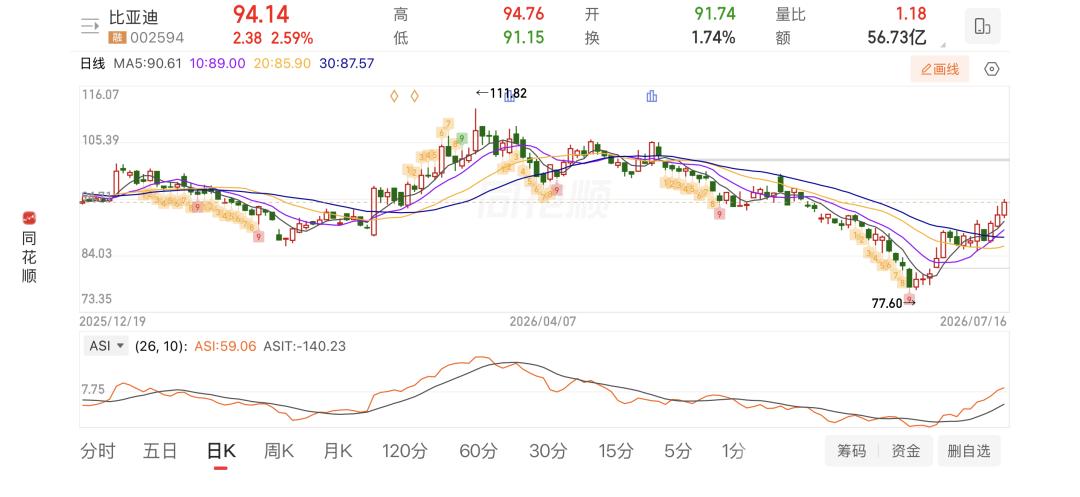
Against the backdrop of continuous market pullbacks, BYD's stocks have moved upward counter-trend this month, with a cumulative gain exceeding 20%. The latest closing market capitalization of BYD's A-share stands at 858.29 billion yuan, and that of its H-share is 829.21 billion yuan. The question arises: Will this round of rally push BYD's total market value back to 1 trillion yuan, or even higher?
A detailed breakdown reveals the core drivers behind this surge for BYD are the new product cycle and explosive overseas expansion (including shipments of new energy vehicles and energy storage products). Is this momentum enough to lift BYD's market capitalization back to 1 trillion yuan or beyond? Whether the market value can hit a new high will ultimately depend on the broader market environment.
The newly released June sales data of BYD shows that the company recorded total sales of 403,500 units in June, posting growth both year-over-year and month-over-month — with a 5.46% year-on-year increase and a 5.21% sequential rise. The core reason for this dual growth is the dramatic surge in overseas sales.
In June, BYD's overseas sales reached 174,900 units, up 95% year-over-year and 9.15% month-over-month. The cumulative overseas sales in the first half of 2026 hit 789,400 units, marking a 70.65% year-on-year growth. Even with this explosive overseas performance in the first half, BYD's total cumulative sales for the period stood at 1,808,500 units, down 15.72% year-over-year, dragged down by sluggish domestic sales.
If overseas sales are excluded, BYD's domestic sales in June amounted to 228,600 units, representing a steep 21.94% year-on-year decline. This slump is driven by factors including fierce domestic market competition, fading subsidy benefits, and an aging product portfolio.
With the arrival of BYD's new product cycle, its domestic sales are expected to recover and even enter a new phase of growth.
This year, BYD's biggest technological highlight is the launch of its ultra-fast charging technology. According to its roadmap, BYD will make ultra-fast charging optional for all its pure electric vehicle models within 2026. The mass production plan will roll out across the entire price range from top to bottom, covering entry-level commuter vehicles priced at 110,000 yuan to million-yuan luxury models.
Judging from the order performance of the newly launched BYD Tang EV equipped with ultra-fast charging technology, the combination of EV models and ultra-fast charging has won strong market favor and user recognition. Since its official launch on June 17, firm orders within 72 hours have exceeded 60,000 units, with some reports putting the figure at 100,000 units. The conversion rate from preliminary reservations to firm orders reached 43.3%, foot traffic at dealerships rose by 60%-70%, and replacement and additional purchase users accounted for 85% of total buyers.
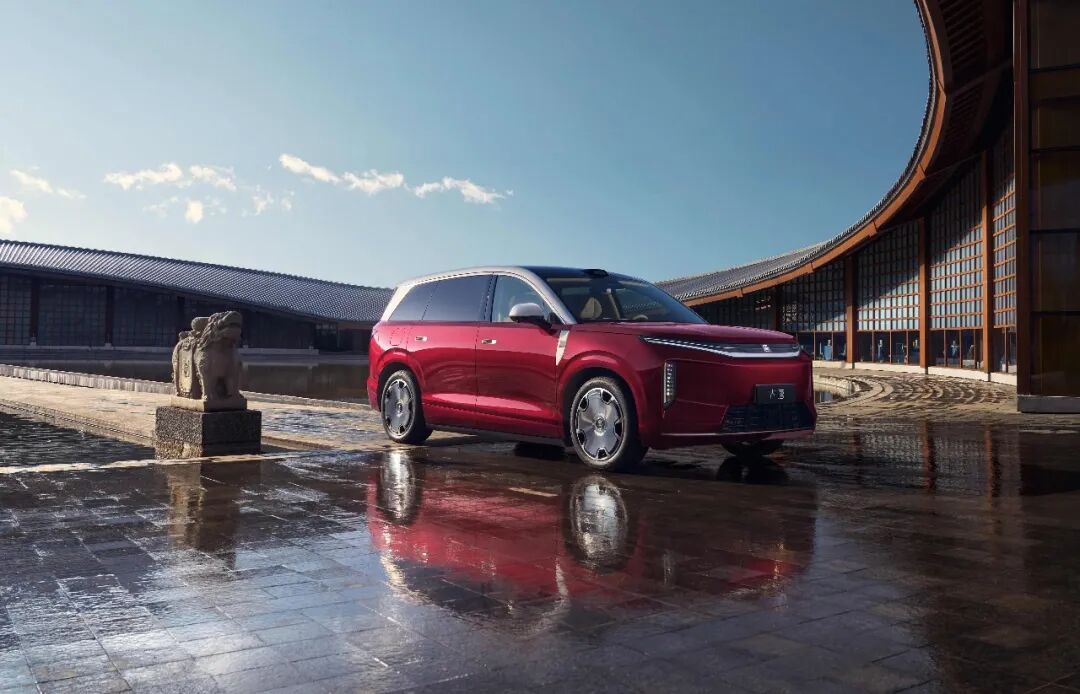
Currently, the delivery waiting period for the Tang EV is 2 to 3 months, mainly due to insufficient production capacity of the second-generation Blade Battery exclusive to the Tang series. At present, only a single production line in Shenzhen is ramping up output. As multiple new production lines for the second-generation Blade Battery go into operation, delivery speed will keep accelerating.
However, in 2026, the ultra-fast charging version will only be rolled out for pure electric models. Once the coverage of ultra-fast charging is completed across all pure electric models, the technology is likely to be popularized in plug-in hybrid models as early as 2027. Currently, only the Yangwang U8 hybrid model is equipped with the ultra-fast charging technology.
From this perspective, BYD still has solid technological advantages to leverage. That said, popularizing ultra-fast charging in hybrid models would be somewhat inefficient, as the technology delivers the most value for pure electric vehicles. A more logical next step would be to promote 1000V megawatt-level ultra-fast charging across all pure electric models, depending on how much the technology's cost can be reduced in the future.
Apart from the new product cycle, BYD's export business is seeing explosive growth this year.
According to its plan, BYD's 2026 export target is 1.8 million units. It has already achieved 789,400 cumulative exports in the first half, with June's overseas sales hitting 174,900 units. As long as the company maintains this monthly sales level in the second half, it will easily hit the 1.8 million target by the end of the year. If it can sustain month-on-month growth, it may even exceed the sales target.
Overseas markets have long been recognized as markets with relatively higher gross margins. Even after deducting tariffs and logistics costs, the pricing of BYD's overseas models is indeed significantly higher than their domestic counterparts. Thanks to the booming overseas sales, most institutions estimate that BYD's Q2 profits will reach 8-9 billion yuan. Foreign investment banks such as Citi, UBS, and Goldman Sachs predict that Q2 profits could hit 9.5-10.2 billion yuan.
UBS calculates that BYD's net profit per vehicle in Q2 will reach 8,728 yuan, a sharp sequential increase from Q1. This is driven by premium pricing per vehicle in overseas markets, better-than-expected energy storage shipments, and lower-than-anticipated exchange rate pressure (thanks to the relatively stable RMB exchange rate).
The energy storage business is also BYD's most important second growth curve this year. BYD Vice President Li Ke publicly stated that the company's full 2026 energy storage production capacity has already been fully booked out, with orders extending all the way to 2028. In the first half of 2026, energy storage system shipments are estimated to range from 68GWh to 75GWh, which has already surpassed the total shipments for the entire year of 2025. The gross margin of the energy storage business is around 26%, higher than that of the automotive business.
A company with such strong fundamentals like BYD deserves investors' full attention.
This article is sourced from the WeChat Official Account "AutoIntelli" (ID: invehc), authored by Michael Yuan, and published by 36Kr with authorization.