Upcoming Opening: Multiple New Embodied Intelligence and AI Infrastructure Products to Debut at WAIC 2026
On July 17, 2026 World Artificial Intelligence Conference (WAIC 2026) will kick off simultaneously across four venues in Shanghai: Expo Center, Zhangjiang, and West Bund. With the theme "Intelligent Partners, Co-Creating the Future", this year's conference has attracted over 200 enterprises to exhibit their latest achievements.
According to incomplete statistics, multiple new embodied intelligent hardware and software products will be released during WAIC, covering innovative breakthroughs from core components to complete machine applications. At the same time, many enterprises have replicated real-world operation scenarios on-site, demonstrating stability and reliability through non-stop live operations. Rather than relying on PPTs and videos, these companies clearly prefer to prove their capabilities with actual physical devices in action.
1. Honor: From Digital Screens to Embodied Intelligence
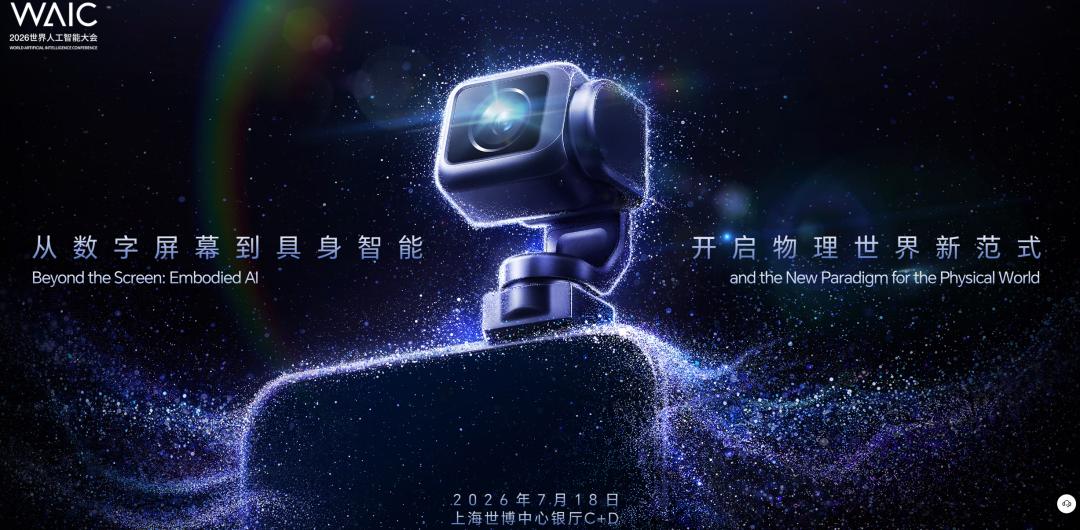
Honor is participating in WAIC for the first time. It showcases the Honor Robot Phone, the first flagship terminal powered by its next-generation operating system Agentic OS, presenting to the public for the first time a "living, natural interactive experience" with realistic sensory quality. The device will demonstrate its capabilities in environmental perception, dynamic scheduling, autonomous decision-making, and task execution on-site.
In addition, Honor will host the sub-forum "From Digital Screens to Embodied Intelligence: A New Paradigm for the Physical World", exploring the evolution path of the next-generation terminal operating system Agentic OS and the practical embodied interaction paradigm of the Robot Phone.
(Image source: Honor)
The solution of using a smartphone as the carrier for embodied intelligence is quite innovative. Honor's core idea is: instead of letting users remotely control robots through a mobile app, it is better to make the smartphone itself an embodied intelligent terminal. If this path proves feasible, the large-scale adoption threshold of end-side embodied intelligence may be significantly lowered.
2. Fourier Intelligence: "Embodied Home" and Full GR Series Lineup Unveiled
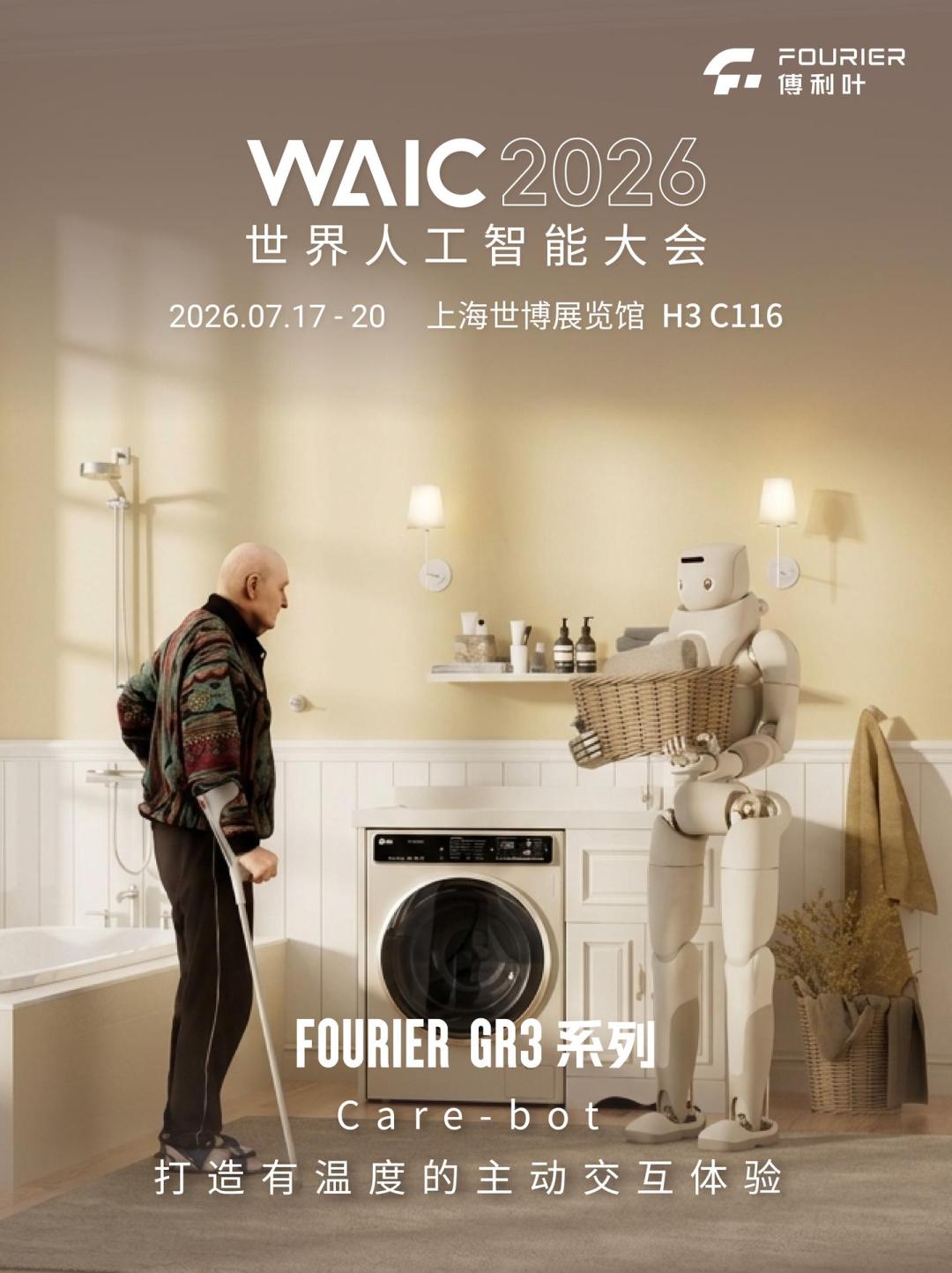
Fourier Intelligence will fully demonstrate a full-link embodied intelligent technology demo for home companion services, named "Embodied Home". Meanwhile, it will showcase three new products: the wheeled dual-arm robot GRW, the small biped humanoid robot GR Mini, and the desktop-level robot GR Nano.
(Image source: Fourier Intelligence)
The core breakthrough of "Embodied Home" lies in that it is not a simple voice-controlled navigation system, but a "semantic task execution hub" designed for humanoid robots. Traditional service robots can only execute single-point commands such as "go to coordinate A and grab object B", with all task paths pre-calibrated manually. However, the "Embodied Home" solution connects the full chain of natural language understanding, scene semantic cognition, intelligent task planning, control execution scheduling, and safety control, upgrading robots from "moving to designated points" to "understanding tasks and completing them".
For example, when you want to drink water, traditional solutions require you to tell the robot "go to the kitchen counter, pick up the water cup, and place it on the living room table", while "Embodied Home" only needs the command "I'm thirsty", and the robot can independently complete the entire process and bring the water to you.
Once this capability matures, it may redefine the role of robots in home scenarios, transforming them from tools that require precise programming into real home partners that can truly understand user needs.
3. Qiyuan T1: World's First Transformable Personal Robot Makes Its Debut
Shangwu New Materials will publicly exhibit the consumer-grade transformable robot Qiyuan T1 for the first time. This product adopts the industry's pioneering Transformer cross-form integrated architecture, enabling autonomous switching between wheel-foot humanoid and quadruped forms based on a single mechanical body.
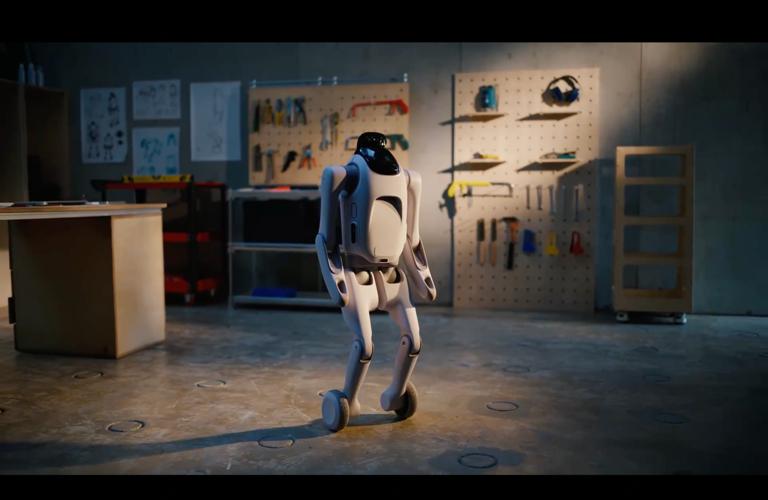
To put it simply, Qiyuan T1 solves a very practical problem: current personal robots with wheeled chassis move fast but cannot even cross a threshold, while legged robots can climb stairs but move slowly and consume high power on flat ground. Qiyuan T1's solution is not to choose one form over the other, but to integrate both. On flat ground, it uses the wheel-foot humanoid form to ensure fast movement, following, and interaction; when encountering obstacles, steps, or complex terrain, it switches to the quadruped form to cross barriers. With one body and two modes, at least from the product definition perspective, it is breaking the long-standing dilemma of consumer robots being limited to a single movement mode.
4. StepStar: Step Series Matrix and 6 Robots Collaborate to Build a Great Wall of Blocks
StepStar's exhibition at this conference fully covers core capabilities from cloud-side, end-side, to multi-modal understanding and generation. It also includes the world's first agent-native operating system Step AOS and the offline debut of the agent smartphone STEPX Neo, which has won the "Treasure of the Show" award at this WAIC.
In addition, StepStar will partner with ForceBot to launch an extreme challenge: 6 robots will collaborate continuously for 15 hours to assemble a Great Wall made of over 80,000 building blocks. This is not just an endurance test, but an extreme verification of multi-agent scheduling, task decomposition, and fault self-recovery capabilities, since any delay or error in one link may cause the entire project to halt.
5. Kepler Robotics: K3 Bumblebee Series and Heavy-Load Qilin Riding Experience
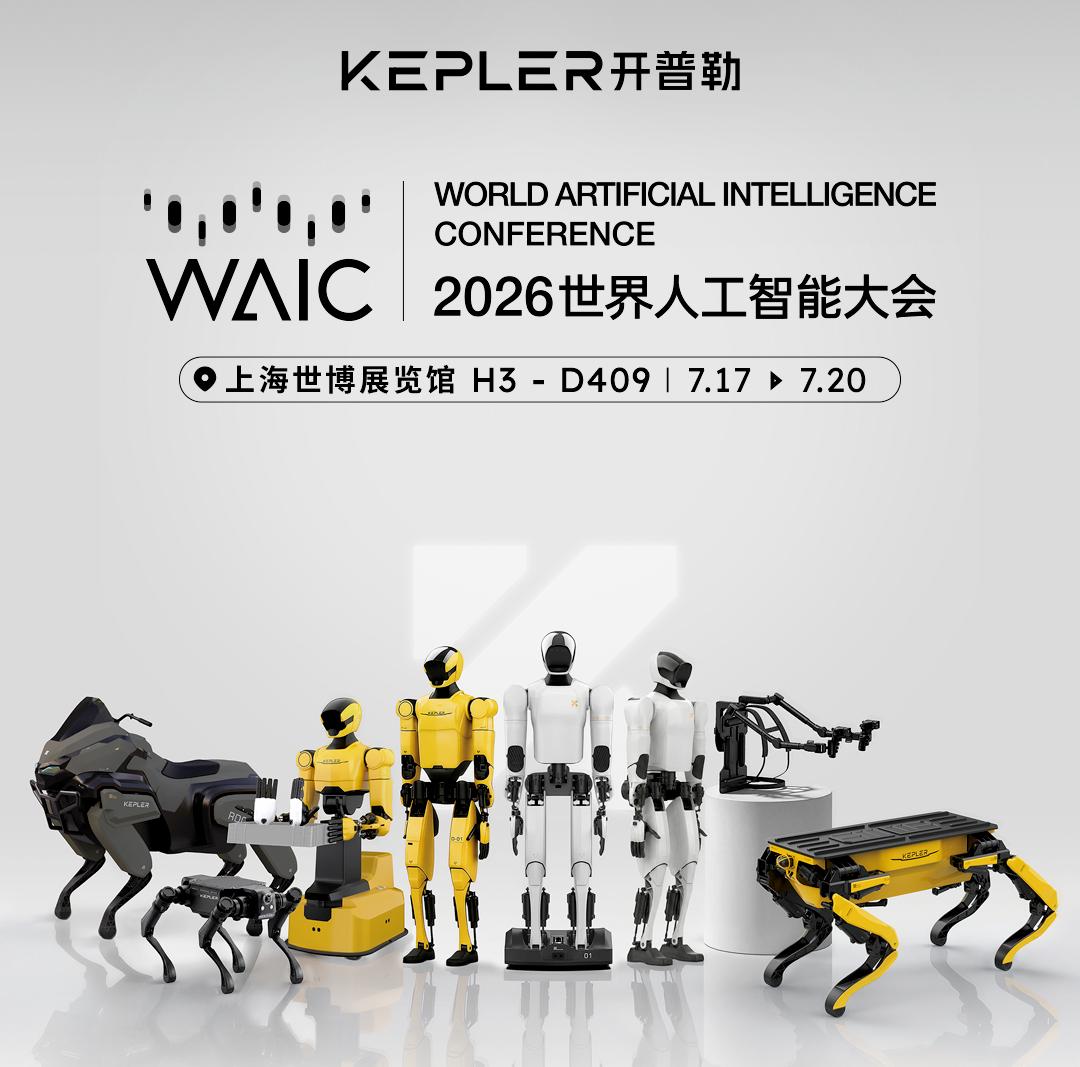
Kepler Robotics brings the brand-new K3 Bumblebee series, and will also hold the public debut of the Qilin series robots. The exhibition area is expected to open the heavy-load Qilin robot riding experience to visitors, using human body weight to directly test the stability of the robot's structure, joints, and control system under high-load conditions.
(Image source: Kepler Robotics)
Previously, most humanoid robot demonstrations were limited to light-load performances such as walking and dancing, but industrial scenarios have far higher requirements for robots: factories, warehouses, energy, and special operation scenarios require robots to carry materials, operate tools, and sustain continuous loads for long periods. By focusing on heavy-load capabilities as its core selling point, Kepler Robotics may be drawing a clear line: robots that can carry humans have truly crossed the threshold of industrial-grade applications.
6. Ant Spirit Wave: Embodied General Brain Full-Stack Technology 2.0
Ant Group's Ant Spirit Wave will showcase the Embodied General Brain Full-Stack Technology 2.0, along with its LingBot model matrix covering the spatial perception models LingBot-Depth and LingBot-Map, the embodied base model LingBot-VLA, the video-action world model LingBot-VA, and the world model LingBot-World.
All these models aim to achieve one goal: enabling the same embodied brain to migrate across different robot bodies and scenarios, without needing to train a completely independent system for each type of robot. On-site, Ant Spirit Wave has built a simulated smart robot pharmacy, demonstrating to visitors how robots of different configurations collaborate to complete the full workflow from order receipt, medicine picking, to delivery after a user places an order.
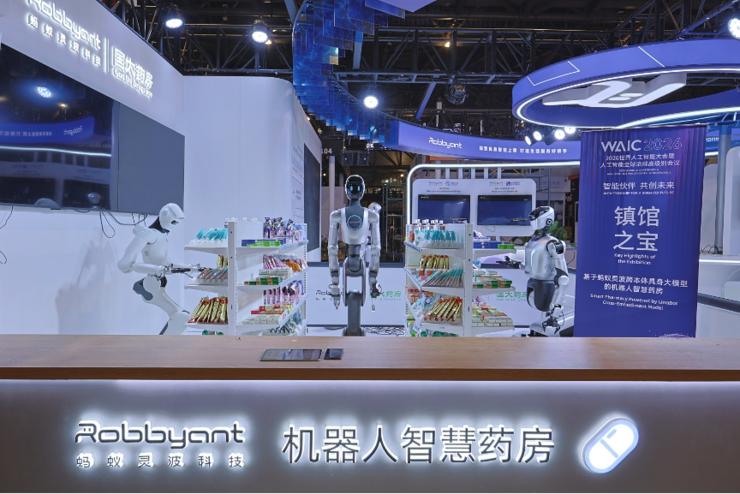
Once this "one brain, multiple robots" system is fully operational, model companies may become the "operating system" that connects different robot hardware.
7. Plex Robotics: Embodied Intelligence Extending to Counties and Rural Areas
It is reported that Plex Robotics will release its full-stack self-developed humanoid robot solution at the exhibition. The company aims to extend cutting-edge embodied intelligence technology to cover all scenarios of agricultural production, rural operation and maintenance, and cultural tourism services, creating a new model of human-machine collaborative digital villages.
In fact, current discussions about humanoid robots mostly focus on urban industrial and commercial service scenarios, while the county and rural markets have long been overlooked. By targeting scenarios such as agricultural picking, rural inspection, and scenic area guidance, Plex Robotics is proving that humanoid robots do not have to be confined to factories and exhibition halls, and the vast sinking market may also have strong demand for them.
8. Qianxun Intelligence: Embodied Intelligence Solution for Agricultural Scenarios
Qianxun Intelligence has also launched an embodied intelligence solution for agricultural production, extending robot operation capabilities to farm fields. Agricultural environments are far more complex than laboratories and exhibition halls, with challenges such as changing light conditions, undulating terrain, and diverse crop forms. These pose stricter tests for robot perception and adaptability than factory environments. Qianxun Intelligence's demonstration this time may prove that embodied intelligence can also operate reliably in "wild" outdoor settings.
9. Critical Point: OmniHand 3 Ultra-M Dexterous Hand
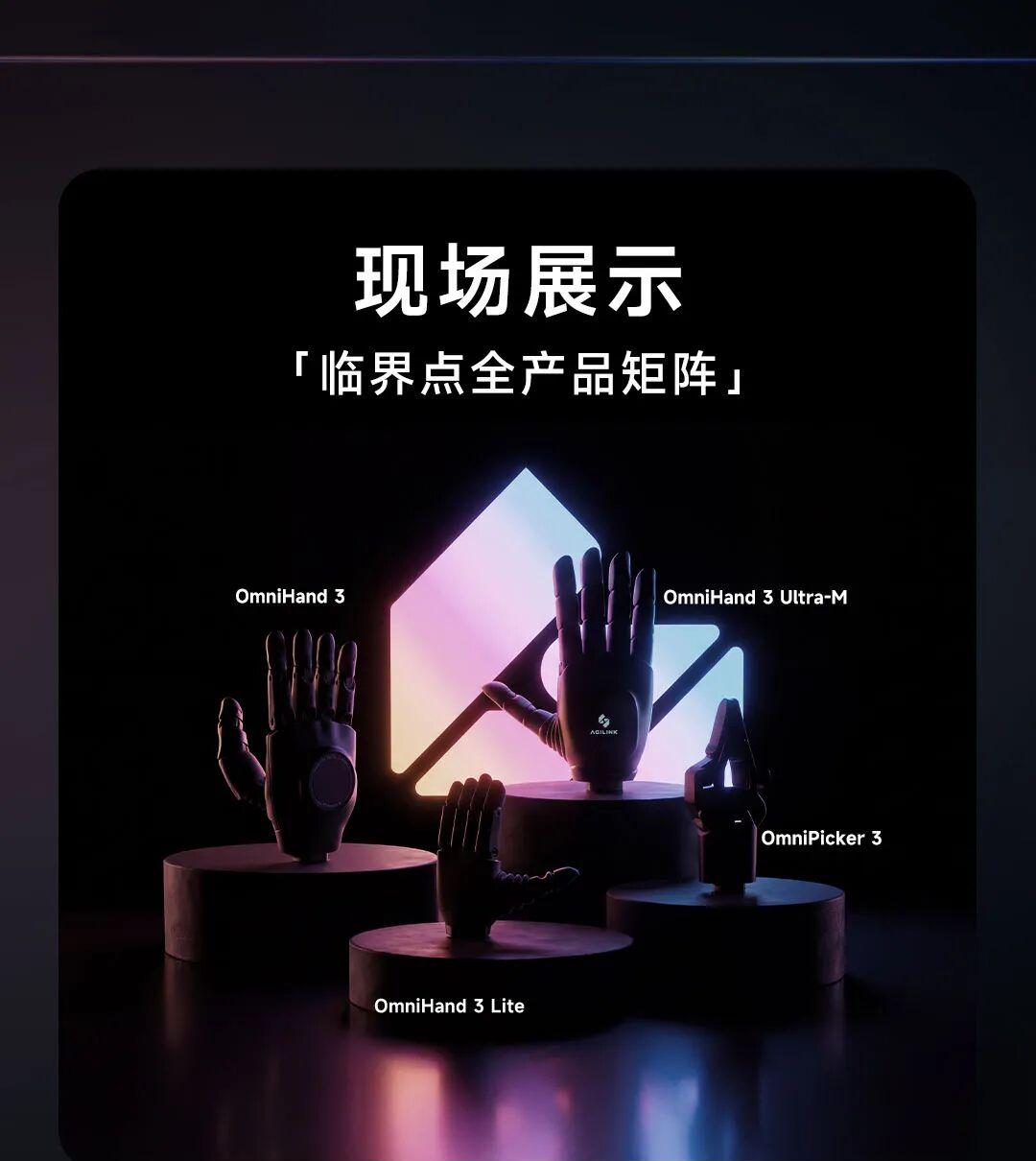
Critical Point showcases the OmniHand 3 Ultra-M, along with the OmniHand 3, OmniHand 3 Lite, and OmniPicker 3.
(Image source: Critical Point)
Among them, the OmniHand 3 Ultra-M has 20 active degrees of freedom, weighs about 630 grams, integrates a micro vision-tactile sensor at the fingertip, achieves a normal force resolution of 0.005N, and has over 300 3D tactile sensing points distributed on the palm. This means the dexterous hand no longer only executes commands from the robotic arm, but can perceive contact, pressure, and object deformation in real time. In precision assembly and flexible object manipulation, tactile feedback helps the robot judge whether the grasp is stable, and adjust movements promptly when the object slips or abnormal force occurs, achieving real-time response and adjustment. It can be said that competition in dexterous hands is shifting from "how many fingers can move" to "how subtle the tactile perception can be".
10. Vertiv: Fully Converged Physical Infrastructure Supporting AI Computing Power
Facing the continuous growth of AI computing power demand, the industry's competition in infrastructure is shifting from single equipment capability to more systematic and integrated capability competition. At this WAIC, Vertiv has built a 200-square-meter immersive exhibition area, focusing on "fully converged physical infrastructure", presenting a complete capability map supporting AI computing power development through innovative achievements covering power supply and distribution, thermal management, intelligent operation and maintenance, and service operations.
11. Moore Threads: "Cloud-Edge-End" Full-Scenario Intelligent Computing Matrix Debuts
With the theme "Intelligence of All Things in the Token Era", Moore Threads showcases its full-scenario intelligent computing product matrix and cutting-edge solutions that integrate cloud, edge, and end terminals, and for the first time realizes the linkage of two exhibition areas at Shanghai World Expo Exhibition and Convention Center and Zhangjiang Science Hall. At the same time, it will hold a high-standard thematic forum on July 18, systematically presenting its full-stack capabilities from computing power infrastructure to intelligent application implementation.
Overall, from "Embodied Home" to "one robot with two forms", and then to "one brain for multiple robots", the exhibitor lineup of this WAIC may reveal a signal: embodied intelligence is evolving from a competition of single hardware to a system-level competition that integrates "model, main body, and scenarios".
Of course, product release is only the first step. Whether these technologies can operate smoothly, stably, and achieve economic benefits in real scenarios remains to be seen. After all, between the stunning debut on the exhibition booth and the actual deployment in homes, factories, and farm fields, there are countless engineering problems that need to be solved. But at least from the exhibition booths of this year's WAIC, the development direction of this field is becoming increasingly clear.
This article is from the WeChat public account "AI Frontline", authored by AI-focused contributors, and published with authorization from 36Kr.