Seven fines of over 10 million yuan issued within the year, the payment industry is accelerating its cleanup
On July 15, Chengdu Mobao Network Technology Co., Ltd. (hereinafter referred to as "Mobao Technology") was warned and publicly criticized by the Sichuan Branch of the People's Bank of China for "violating account management regulations; violating clearing management regulations; violating merchant management regulations; and failing to fulfill the customer identity verification obligation as required". Its illegal gains of about 8.064 million yuan were confiscated, and a fine of 21.365 million yuan was imposed, with the total penalty and confiscation amounting to about 29.429 million yuan.
So far, 7 payment institutions have received penalties of over 10 million yuan in the year, namely Yinsheng Payment, KaiLianTong Payment, Xunhui Payment, Yipiaolian Payment, Huichao Payment, Hanyin Technology, and Mobao Technology.
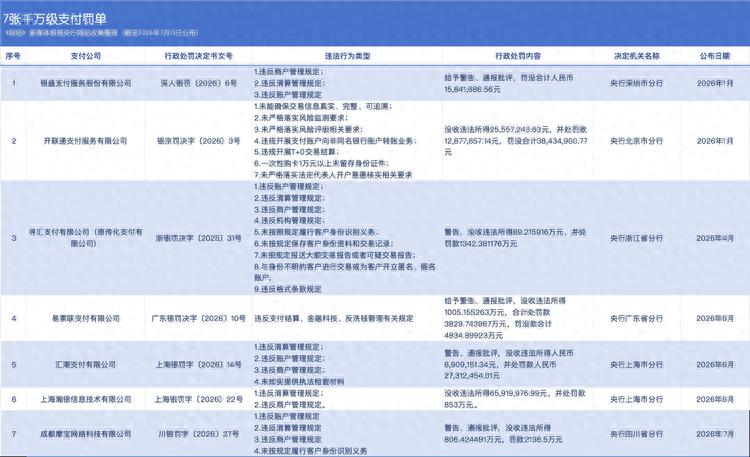
Among them, Hanyin Technology has the highest total penalty and confiscation amount. For violating the clearing management regulations and merchant management regulations, the Shanghai Branch of the People's Bank of China confiscated its illegal gains of about 65.92 million yuan and imposed a fine of 8.53 million yuan, with a total of about 74.45 million yuan.
According to the official website information, Hanyin Technology is positioned as a mobile payment and Internet payment operation company, providing payment solutions for the Internet finance, micro and small enterprises, insurance, e-commerce, distribution and other fields, with products including Shoufutong, Xiaofutong, Shangxuntong, Kalefu, AIRPOS, etc. Tianyancha shows that the company was established in January 2006, obtained a payment license in June 2012, and was invested by the Hailan Group in 2018, which currently holds 64.16% of its shares.
In accordance with the requirements of the "Regulations on the Supervision and Administration of Non-bank Payment Institutions" and relevant detailed rules, the name of a payment institution must bear the word "payment". However, at present, Mobao Technology and Hanyin Technology have not yet changed their names.
Among the 7 penalties of over 10 million yuan, Yipiaolian Payment and Huichao Payment also have a penalty amount of more than 20 million yuan.
In May 2026, Yipiaolian Payment was warned and publicly criticized by the Guangdong Branch of the People's Bank of China for violating the relevant regulations on payment and settlement, financial technology and anti-money laundering management. Its illegal gains of 10.0516 million yuan were confiscated, and a fine of 38.2974 million yuan was imposed, with a total penalty and confiscation amount of 48.3490 million yuan.
In June, Huichao Payment was warned and publicly criticized by the Shanghai Branch of the People's Bank of China for violating the clearing management regulations, account management regulations, merchant management regulations, and failing to truthfully provide law enforcement inspection materials. Its illegal gains of 6.9092 million yuan were confiscated, and a fine of 27.3125 million yuan was imposed, with a total penalty and confiscation amount of 34.2216 million yuan.
Complaint platforms show that both Yipiaolian Payment and Huichao Payment are involved in complaints about "ghost deductions". "Ghost deductions" refer to the situation where a user's bank card or payment account is inexplicably deducted without being notified or completely unaware of it.
Previously, internal employees of many payment companies revealed that regulatory authorities in multiple regions have provided window guidance, requiring the full clearance of loan-assisting payment accounts of "7+4" type local financial organizations, and the suspension of relevant automatic deduction services.
In addition to the high penalty amounts, the above 7 penalties have one thing in common: all involve "dual penalties" — penalizing both the institution and the individuals. Overall, the relevant responsible persons were fined between 220,000 yuan and 640,000 yuan. Among them, Chen, the then chairman of Yinsheng Payment, was warned and fined 610,000 yuan by the Shenzhen Branch of the People's Bank of China, and Tang Moudong of Mobao Technology was warned and fined 640,000 yuan by the Sichuan Branch of the People's Bank of China.
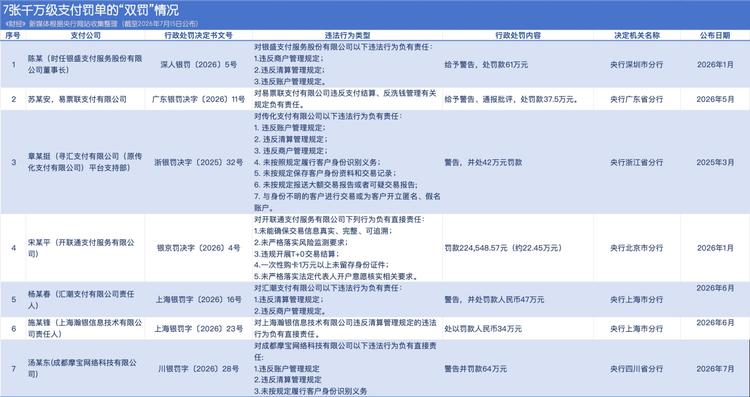
Statistics from Bocom Consulting show that 60% of payment penalties in 2025 involved dual penalties. According to incomplete statistics from the *Caijing* New Media, among the 26 payment penalties announced so far in 2026, 15 involve dual penalties.
Wang Pengbo, chief analyst at Bocom Consulting, pointed out that the normalization of the dual penalty system will further consolidate the compliance management responsibilities of institutional executives. The compliance pressure on payment institutions, especially regional ones, continues to increase, and compliance capability is gradually becoming the core survival threshold for payment institutions, while the industry's survival of the fittest will continue to advance.
It is worth noting that in June 2022, the public information on the renewal of the "Payment Business License" for non-bank payment institutions showed that 8 institutions including Huichao Payment and Hanyin Technology were suspended from the review of their renewal applications due to the circumstances specified in Article 24 of the "Measures for the Implementation of Administrative Licensing by the People's Bank of China". Up to now, the license renewal issues of Huichao Payment and Hanyin Technology have been pending for four years.
In Wang Pengbo's view, the issuance of high penalties to institutions such as Huichao whose license renewal has been suspended and which have long-standing compliance flaws sends a clear signal: licensed institutions cannot ignore compliance requirements just because of their existing licenses, and institutions under suspension cannot perfunctorily rectify or confront the supervision. This measure forces institutions to improve their compliance systems throughout the entire process from business operation to internal risk control and regulatory cooperation, and truly establish the business philosophy of putting compliance first.
In addition, information from the People's Bank of China shows that Mobao Technology obtained its "Payment Business License" on August 29, 2011, which is about to expire on August 28, 2026.
Among the 7 penalized institutions mentioned above, the outcome of KaiLianTong Payment is already settled — it has exited the market because its renewal application was not accepted.
In January 2026, KaiLianTong Payment had its illegal gains of 25.5572 million yuan confiscated and was imposed a fine of 12.8777 million yuan by the Beijing Branch of the People's Bank of China, totaling 38.4349 million yuan, for reasons such as failing to ensure the authenticity, completeness and traceability of transaction information, and failing to strictly implement the requirements for risk monitoring and risk rating. On May 9, the People's Bank of China officially revoked its payment license on the grounds that the renewal application was not accepted and the institution would exit upon expiration.
Wang Pengbo stated that the revocation of licenses reflects that the regulatory authorities are continuously clearing out non-compliant payment entities that cannot sustain their operations, and the stock rectification cycle of the payment industry is still continuing. At the same time, the regulatory authorities no longer simply rely on penalty and rectification measures. For licensed institutions that have long failed to meet operational standards and lack the ability to sustain compliant operations, they directly take the measure of revoking their licenses. The industry's access and operation thresholds are rising simultaneously, and existing institutions must fully meet the standards in aspects such as business compliance rectification, stable operating cash flow, and matching risk control systems to maintain their licensed qualifications.
This article is from "*Caijing* New Media", written by Wang Baiyun, edited by Jiang Shizhou, and published with authorization from 36Kr.