The first batch of active ETFs, with 18 fund companies assembling
Active Preparations with a Focus on Stability: 18 Public Fund Firms Obtain First Batch of Qualifications for Active ETFs
The most significant innovative product in the public fund industry this year is set to be officially submitted for registration!
Reporters from China Fund News have learned that the first batch of pilot active ETF programs has been confirmed to include 18 fund managers, who will formally submit product registration application documents to the China Securities Regulatory Commission (CSRC) in the near future.
Among the 18 fund managers submitting products, 9 will file applications with the Shanghai Stock Exchange, and the other 9 with the Shenzhen Stock Exchange. Specifically, E Fund Management, China Asset Management, Yongying Fund, JPMorgan Fund, HuaTai PineBridge Fund, China Merchants Fund, Harvest Fund, HuaAn Fund, and Ping An Fund have submitted active ETF application materials to the Shanghai Stock Exchange; while Nanfang Fund, Fullgoal Fund, Dacheng Fund, Penghua Fund, ICBC Credit Suisse Asset Management, Hwabao Fund, Guotai Fund, Tianhong Fund, and CCB Fund have submitted their applications to the Shenzhen Stock Exchange.
This means that just one month after the Shanghai and Shenzhen stock exchanges released supporting business guidelines, the innovative active ETF products are about to enter the registration application phase, marking the imminent arrival of the "active era" in the ETF market.
"Our company has listed active ETFs as a key annual performance target, and we are fully committed to ensuring smooth product operations," a fund firm representative stated.
Industry observers pointed out that the pilot program comprehensively considers factors including managers' active equity investment performance, ETF operational management capabilities, risk control levels, and compliance records. It covers both large and medium-sized fund companies, reflecting the broad representativeness and tiered arrangement of the pilot initiative.
The First Batch of 18 Pilots Prioritizes Stable Strategies
In June this year, CSRC Chairman Wu Qing stated at the 2026 Lujiazui Forum that launching actively managed ETFs aligns with global market development trends. The CSRC will adhere to the principles of pilot-first, gradual implementation, and strict risk prevention, supporting the launch of actively managed ETFs on the Shanghai and Shenzhen stock exchanges.
It is understood that the first batch of pilot lists has recently been finalized, covering 18 fund managers, with 9 managers submitting actively managed ETF registration application materials to each of the two stock exchanges.
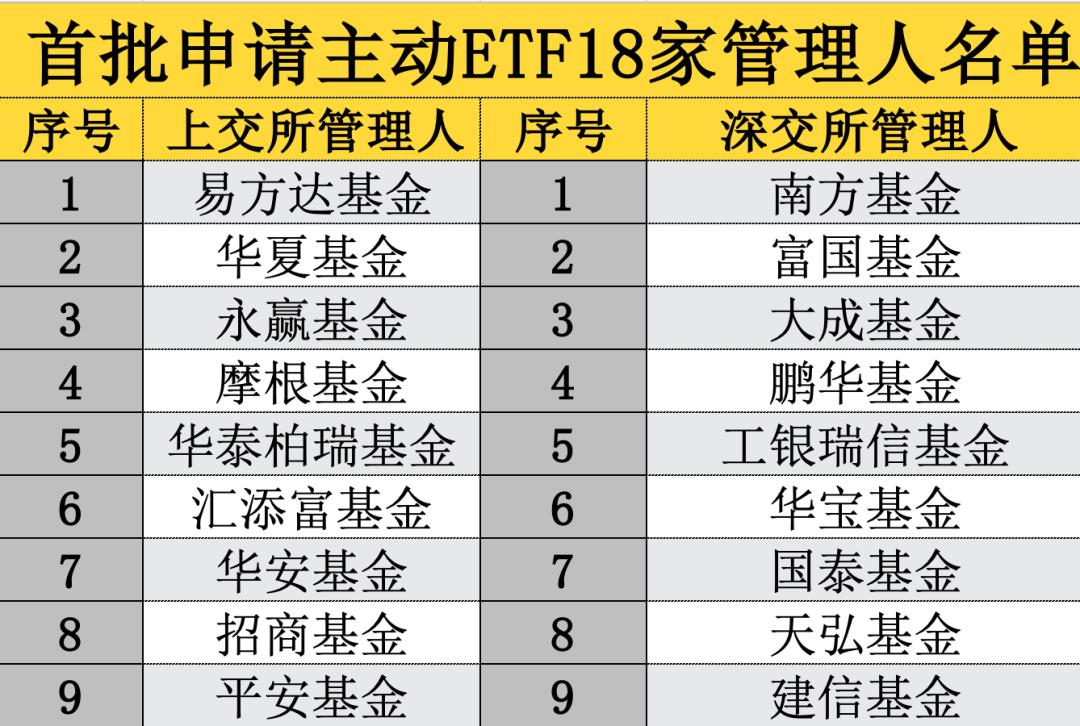
According to multiple sources contacted by reporters, most of the first batch of actively managed ETFs adopt high-capacity stable strategies, such as large-cap value and large-cap balanced approaches, with diversified holdings and low turnover rates to ensure a smooth initial launch.
These products will strictly comply with diversification requirements: holding no fewer than 30 stocks, with the top ten weighted positions accounting for no more than 60% of total assets, while reasonably controlling turnover rates to maintain consistency between investment style and performance benchmarks.
In terms of management models, industry insiders revealed that the first batch of actively managed ETFs features diverse operational frameworks. Some firms adopt a dual-track system of "active fund manager + ETF operation team", aiming to preserve the fund manager's flexibility in stock selection while strictly adhering to standardized ETF operational disciplines.
All participating fund managers have deployed elite teams as fund managers. For example, Yongying Fund appointed Xu Tuo, who specializes in cyclical growth investment, and Cai Leping, head of the index division, as co-fund managers, focusing on prosperity-driven strategies. JPMorgan Fund, the only foreign-owned public fund in this pilot, assigned Li Bo as fund manager, emphasizing large-cap growth styles. HuaTai PineBridge Fund selected Yang Jinghan, a representative of deep-value investment philosophy, while ICBC Credit Suisse Asset Management prioritizes dividend strategies with fund managers Jiao Wenlong and Li Ruimin leading the products.
Active Preparations to Improve Systems and Internal Mechanisms
Currently, pilot fund managers are in a state of active preparation, soon to submit product registration documents to regulatory authorities. The Shanghai and Shenzhen stock exchanges are urging fund managers to strictly align with the previously released actively managed ETF business guidelines, fulfill their primary responsibilities for standardized fund operations and risk prevention, improve information disclosure mechanisms, and actively advance the construction and testing of supporting business systems.
It is understood that all pilot fund managers possess extensive experience in equity fund management, proven long-term performance, and mature ETF operational capabilities, covering both domestic and foreign-funded firms of varying scales, to fully leverage their exemplary leading role.
In accordance with the active ETF business guidelines, active ETF fund managers must meet the following requirements: first, sound and stable corporate governance, compliant and robust operations, with no major illegal or non-compliant incidents in the past three years; second, over 5 years of experience in managing active equity public funds, with an average active equity public fund management scale of no less than 100 billion yuan in the past three years; third, effective investment operation and risk management systems, sufficient investment research personnel, and stable ETF operation teams and technical systems.
The Launch of Active ETFs Carries Multiple Positive Implications
Globally, actively managed ETFs have become one of the fastest-growing segments in the asset management industry. Data from ETFGI shows that by the end of April 2026, the total assets under management of global actively managed ETFs reached $2.33 trillion, hitting a record high; net inflows since the start of 2026 amounted to $311.66 billion, also a new all-time high for the same period.
Some fund firms noted that the global asset management industry is accelerating the trend of "transforming active products into ETFs". The CSRC's introduction of this innovative product at this time not only aligns with international development trends but also provides domestic investors with more diversified asset allocation tools.
Observers pointed out that active ETFs further enrich the on-exchange public fund product ecosystem, catering to the allocation needs of different types of investors and offering diversified instruments for medium- and long-term capital deployment in the capital market, which is conducive to guiding long-term funds into the market.
In actual operations, fund managers will have greater flexibility in industry allocation, individual stock selection, and portfolio adjustment, further enhancing the strategic diversity and differentiation of on-exchange equity products.
For the public fund industry, competition in the ETF sector will expand beyond index resources, product scale, distribution channels, and liquidity to encompass active investment research capabilities, portfolio management, product design, and on-exchange operational expertise. Continuous disclosure of subscription and redemption lists will subject the actual holdings and investment styles of products to more timely market scrutiny.
For the capital market, professional institutions' capabilities in research-driven pricing and value discovery can be further amplified through on-exchange products, guiding capital to allocate high-quality assets more efficiently. With their characteristics of transparency and instrumentization, actively managed ETFs also provide new allocation vehicles for medium- and long-term funds such as insurance capital and pension funds to participate in the equity market. This initiative helps direct long-term institutional capital into the market and represents a key measure to implement the "15th Five-Year Plan" for improving the functionality of the capital market.
This article originates from the WeChat Official Account "China Fund News" (ID: chinafundnews), authored by Yan Jun and Fang Li, published with authorization from 36Kr.