WAIC2026 Outlook: Unveiling Four Key Trends of China's AI at the Most Anticipated AI Conference in History
"Never has an AI conference been this hot." On July 17, the 2026 World Artificial Intelligence Conference (WAIC 2026) will officially kick off, with tickets selling out instantly. Countless business owners, investors, industry professionals, and even ordinary people are gathered at the threshold of this AI era, waiting eagerly for its arrival.
What exactly are they anticipating?
We still remember clearly that when the 2018 World Artificial Intelligence Conference opened in Shanghai, everything felt novel yet still niche. Over nine consecutive editions, the IT Times has observed Shanghai's industrial development through the lens of this AI conference, catching glimpses of the emerging light of AI.
As WAIC 2026 unfolds, we see several clear paths taking shape: Agents are evolving from being conversational to capable of completing real tasks and transactions; AI terminals are shifting from application-layer AI to full operating system-level reconstruction; Token operations are redefining the metrics of the AI economy; domestic computing power is advancing from being usable to highly reliable; embodied intelligence is moving out of laboratories into real commercial scenarios; and world models are progressing from content generation to understanding the physical world.
Agents: A City Builds a New Home to Welcome Its "Native Residents"
Agents are the undisputed "high-frequency keyword" at WAIC 2026. Unlike last year, when discussions focused solely on technical concepts, this year the spotlight for agents is on how to accomplish real-world tasks—with the prerequisite of creating a suitable living environment for agents to thrive.
Open a door for agents on an old system, and they will always be visitors. Build a dedicated home for agents, and they will become native residents.
The megacity of Shanghai began its self-reconstruction two years ago, building a cloud-native city designed for AI. Last year, China Telecom's "Intelligent Cloud Shanghai" fully articulated the vision of city-level AI infrastructure. This year, from the AI Store computing power supermarket and the Ontology Workshop agent production line to the AI Super Employee team, Shanghai Telecom has constructed a full-link AI supply system spanning "cloud-edge-end," making agents the "water, electricity, and gas" of the AI era—readily available on demand.
What remains unseen is the city's reconstruction; what is visible is the transformation of terminals.
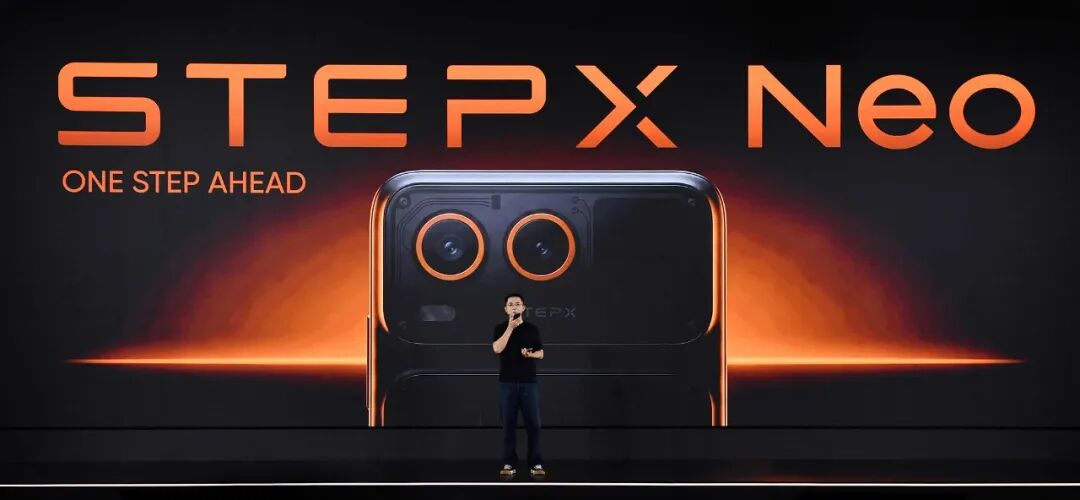
2026 marks the inaugural year of the agent-native smartphone. On the eve of WAIC, StepVerse released the STEPX Neo. The phone retains its familiar form factor, but its underlying architecture is completely different. StepVerse has developed the Step AOS, an agent-native operating system, which converts all capabilities of the hardware and original system into computing power, data, and atomic services that agents can directly invoke. This enables cross-application scheduling, end-cloud collaboration, and even seamless task handoff across multiple devices for agents.
Application developers cannot help but worry that agents will displace traditional Apps.
Rewriting themselves with AI is the answer put forward by national Apps with billions of users. In mid-June, the AI version of Alipay "Abao" and WeChat's exclusive AI card were launched one after another. As AI begins to reshape human shopping habits, AI-driven payments are bound to follow suit. Alipay's self-transformation follows two logics: first, starting from human needs, enabling users to access over 8,000 services with a single sentence; second, from the agent's perspective, building a framework that supports 95% of general-purpose agents.
While Alipay and WeChat adopt different rewriting approaches, both adhere to a strict security bottom line: AI only handles execution tasks, and the final decision-making authority over funds must remain in the hands of users.
This also reflects a deeper human concern: under the agent economy, how much power will humans need to relinquish?
Agents are undergoing a critical transition from "technical demonstrations" to "commercial production." As urban infrastructure and terminal operating systems are being reconstructed, whoever can provide a native operating environment for agents will define the interaction paradigm of the agent era.
Token Operations: From "Using Tokens" to "Managing Tokens"
2026 is becoming the inaugural year of "Token operations." Tokens are no longer just a technical concept, but are evolving into the measurement unit and operational entity of the AI economy.
The three major telecom operators are accelerating their transformation from data traffic operations to Token operations, yet unifying measurement standards remains a major challenge.
China Telecom has proposed a new approach: shifting from "using Tokens" to "managing Tokens." Through a Token security router, it achieves unified multi-model access, Token quota management, and departmental cost attribution, while performing data desensitization and guardrail protection before AI calls. This marks that Token operations have moved from purely pursuing efficiency to balancing efficiency and security.
Leading AI enterprises such as SenseTime are also targeting the Token economy. Most newly launched models are designed to be lightweight and efficient, with more controllable Token consumption under complex tasks, significantly improving deliverable output per unit cost. SenseTime has also introduced the "Token Plan" payment system, upgrading Tokens from a technical indicator to a commercially operable and measurable product.
PPIO launched the Agent Cloud at WAIC 2026, which automatically matches the optimal model through an intelligent model gateway to improve inference performance, thereby reducing Token costs by 60% to 80%. Yao Xin, Co-founder and CEO of PPIO, stated: "The primary customer of the cloud is no longer only humans, but Agents."
Tokens are evolving from a "byproduct" of models into an independent economic dimension of the AI industry. Whoever can provide lower-cost, higher-efficiency, more secure and controllable Token services will hold the foundational pricing power of the agent economy.
Domestic Computing Power: The Era of 100,000-Card Clusters Has Arrived
Domestic chips are blazing a new trail, undergoing a paradigm shift from traditional chip architectures to directions such as software-defined design, logical folding, and 3D stacking, thus breaking free from reliance on advanced manufacturing processes.
East China Core released its first near-memory computing 3D AI computing chip, while Zhonghao Xinying launched its second-generation TPU chip "Shuyu." Both share a common direction: AI chip competition is shifting from "who has the strongest GPU" to "who can deliver the lowest Token cost," breaking through bottlenecks such as the "memory wall," "bandwidth wall," and "power consumption wall," and opening an independent innovation path for domestic high-end computing chips that does not rely on advanced processes.
On July 10, Sugon announced that China's first fully domestic 100,000-card AI supercluster—Sugon 8000 (Dengfeng)—was officially completed in Zhengzhou, and simultaneously connected to the National Supercomputing Internet. This cluster has also become one of the top ten highlight exhibits of WAIC 2026.
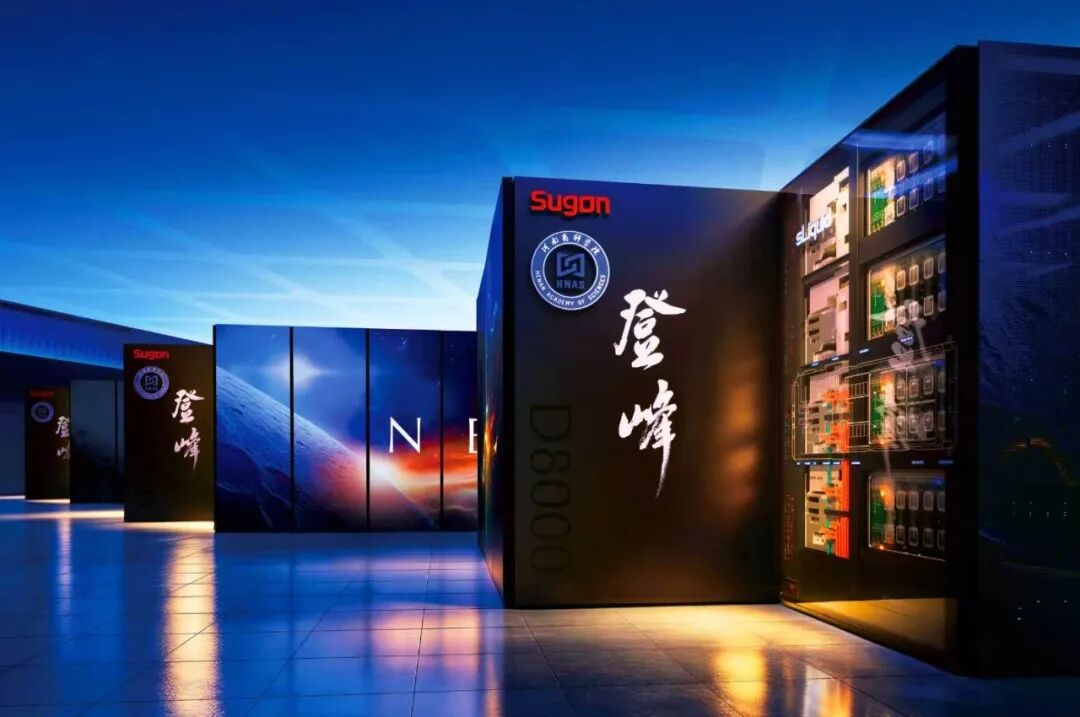
This is an epoch-making breakthrough: domestic computing power has ushered in the era of 100,000-card clusters.
Domestic chips are crossing the "usable" inflection point and advancing toward "highly usable." Competition in computing power has evolved from a simple comparison of scale to an all-around contest covering computing power scheduling efficiency, application adaptability, and ecosystem completeness.
Embodied Intelligence: The Brain Has Not Yet Reached the "GPT-1 Era"
A remark from Shen Yujun, Chief Scientist of Ant Group Lingbo, is thought-provoking: "Today's embodied brain has not yet reached the level of GPT-1." Yet it is precisely in this "pre-emergence" stage that exploration across various technical routes is most active, and the pace of industrial implementation is most resolute.
The Unitree humanoid robot Expedition A3 Ultra is one of the highlight exhibits of WAIC 2026. On the eve of the conference, multiple Unitree robots had just started working in factories. A growing number of embodied intelligence enterprises realize that only real-world data can drive robots to "perform tasks." Tactile data has become an extremely scarce resource, and only by entering real scenarios can the data flywheel keep spinning.
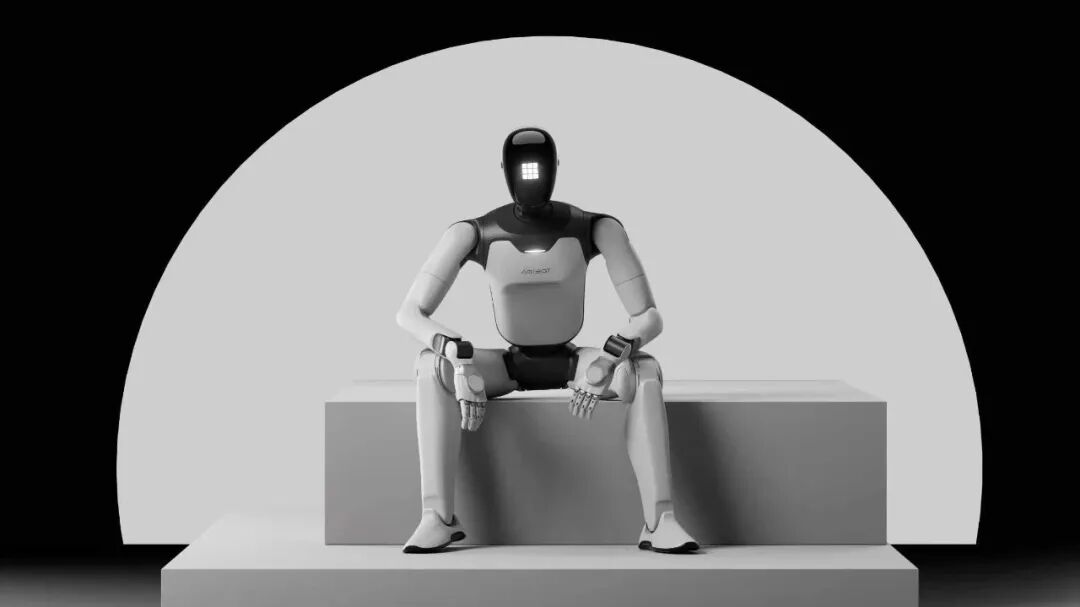
Over the past few years, robot hardware has flourished in diverse forms, but the next stage of industry competition lies in whether a single model can drive robots of different brands and configurations, and whether these robots can move out of laboratories and operate stably in real environments.
On the eve of WAIC 2026, Ant Group Lingbo released the "Full-Stack Brain 2.0." Instead of simply porting digital world models to robots, it is systematically designed around the perception, prediction, and execution requirements of the physical world. Its LingBot-VLA 2.0 integrated 60,000 hours of high-quality real-world data during the pre-training phase, and has adapted to over 20 robot configurations from 17 manufacturers.
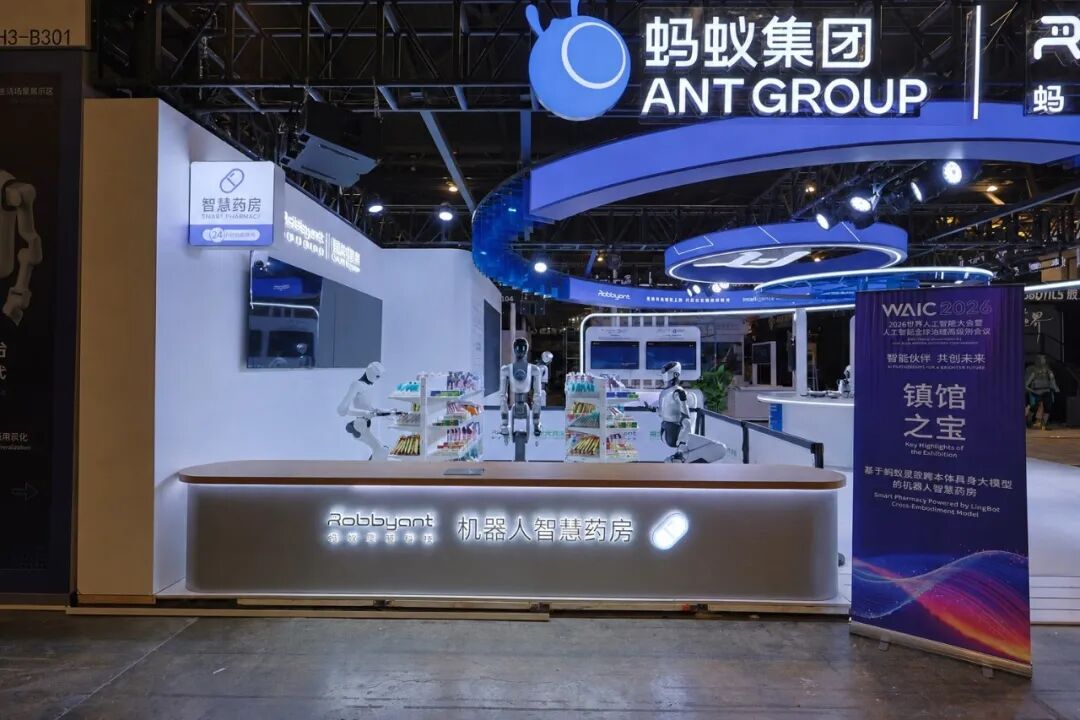
At the WAIC exhibition booth, three robots with different configurations share a single "general brain," achieving coexistence and non-isolated human-robot operation in the life service scenario of Guoda Pharmacy, making it one of the top ten highlight exhibits of WAIC 2026.
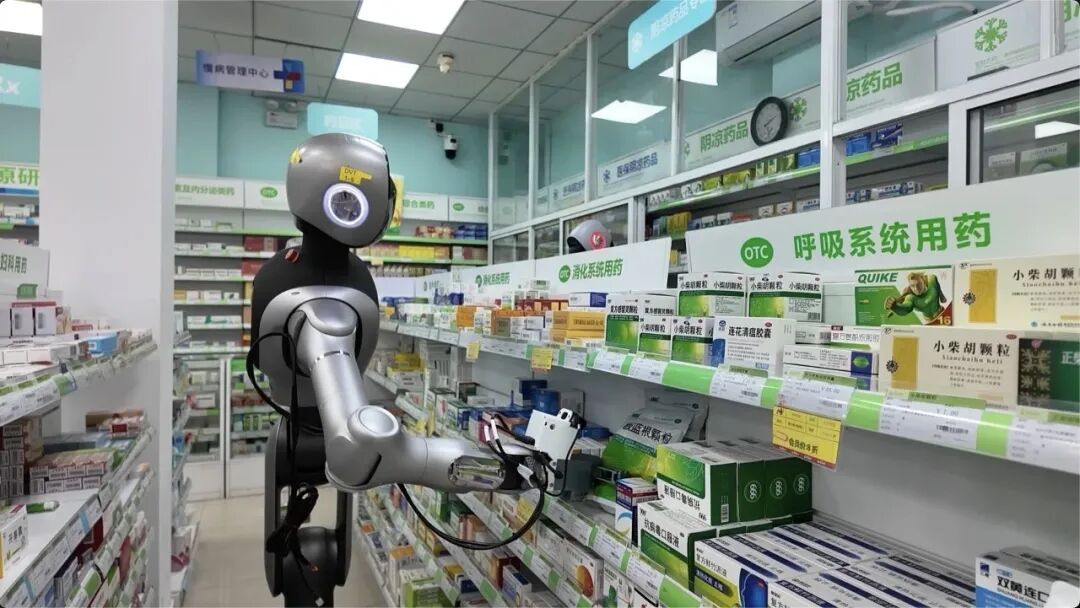
More practitioners have not yet realized that networks can solve robots' problems in the physical world. China Telecom's self-developed AI Flow network achieves millisecond-level low-latency teleoperation, allowing operators to remotely control on-site robots in real time, forming a closed loop of "remote control - on-site execution - perception feedback," and promoting communication networks to become the infrastructure for the large-scale implementation of embodied intelligence.
"The 'hundred-model war' will inevitably converge to a few foundational embodied brains. Only by letting the brain guide the hardware to perform tasks in the real physical world can we solve problems that can never be resolved in laboratories," said Zhu Xing, CEO of Ant Group Lingbo.
Embodied intelligence is undergoing a critical transition from "one machine with one brain" to "one brain for multiple machines," and from laboratory research to commercial implementation in real scenarios. Diversified technical routes are accelerating integration, world models are becoming a new development direction, and data closed-loop efficiency will become the key variable determining success or failure.
When Tokens can be operated, computing power is independently controllable, cities have built dedicated "homes" for agents, robots can "perform tasks proficiently" in real scenarios, and world models can understand physical laws—that will be the real "GPT moment." And that moment may arrive in the near future.
This article is from WeChat Official Account "IT Times" (ID: vittimes), author: Sun Yan, editor: Hao Junhui, published with authorization from 36Kr.