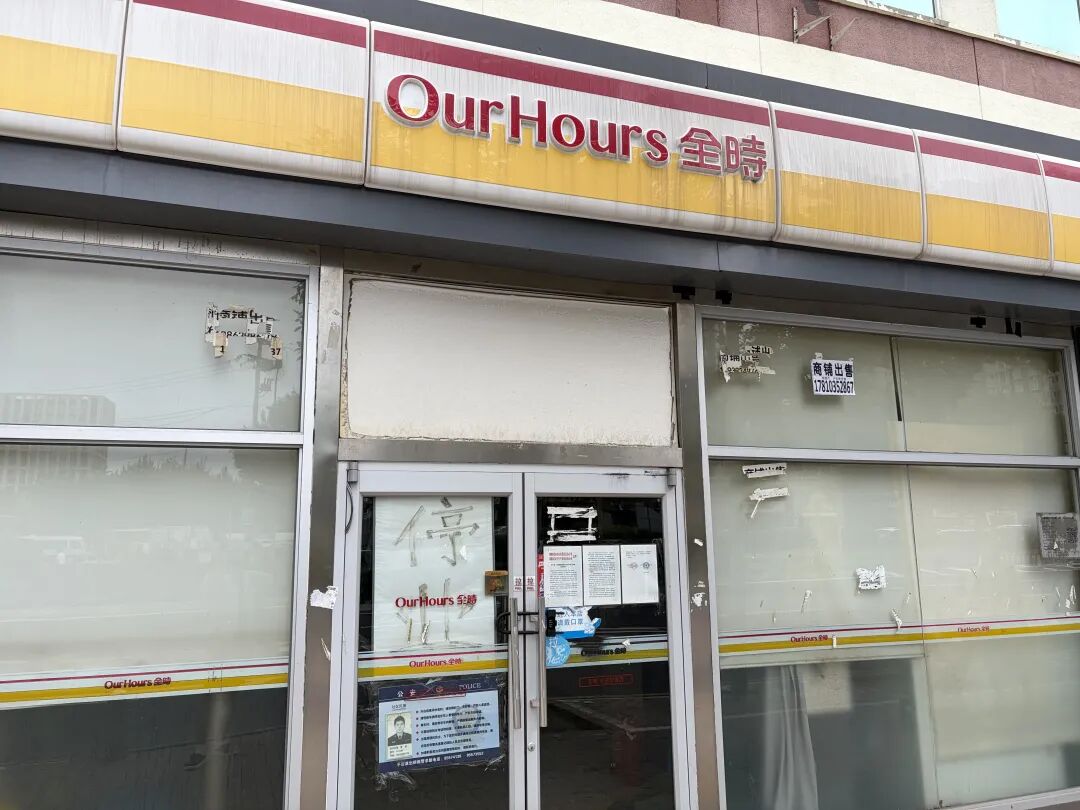
Convenience stores have ended up in the ICU.
Starting from April Fools' Day, the heartbroken Takeshi Kaneshiro walks into convenience stores again and again, buying one can of pineapple cans expiring on May 1st every day — May 1st is his birthday, and if his girlfriend May doesn't come back by then, this relationship will be expired.
The aesthetic filter arrived before the physical entities. *Chungking Express* was released in 1994, and two years later, Lawson opened its first store in Shanghai, becoming the earliest Japanese-funded convenience store chain to enter mainland China. More than a decade later, many people finally waited for the expected automatic doors of convenience stores in their own cities.
Pineapple cans expire, and so do convenience stores. While the total number of stores is still growing, the inflection point has arrived — the growth story of reaching "10,000 stores" can no longer be sustained, and single stores are continuously losing money. In 2025, the customer flow of sampled convenience store enterprises dropped by 8.7%, and the daily revenue per single store decreased by about 13% cumulatively over four years.
The traditional advantages of convenience stores are being dismantled by all kinds of new players.
The Fading Glory of Convenience Stores
"Taiyuan is actually a city disguised as a cluster of convenience stores. You can see a Tangju store every three steps, and a Jinhu store every five steps."
Wang Hao is a native of Taiyuan and works in Beijing. The hometown he describes is a "low-tier" city. Apart from its historical and cultural heritage, the only thing worth showing off is its convenience stores. In the "China Urban Convenience Store Development Index", Taiyuan has long ranked among the top three all year round, with one convenience store for an average of 2,565 people.
In 1998, Taiyuan opened its first convenience store. After that, convenience stores gradually grew into community service hubs that supported utilities bill payment, mobile top-up, and parcel delivery services. "Since the local commercial industry is not very developed, the only nightlife we have is hanging out in convenience stores," Wang Hao said. Opening a convenience store of his own is his ideal and a "fallback option" for him.
Wang Hao's biggest complaint about Beijing is that there are not many decent convenience stores. When he was on a long-term business trip in Shanghai, he would "revengefully" eat all three meals a day at convenience stores. He loves Lawson's desserts and anime co-branded products, and also enjoys FamilyMart's bento meals. FamilyMart's slogan is "FamilyMart is your home", and Wang Hao really treats those stores like his own home.
Compared with Taiyuan and Shanghai, Wang Hao thinks Beijing is truly a "convenience store desert", but his Beijing friends don't take it seriously: "Beijing is often called a food desert anyway, so what's the big deal about being a convenience store desert?"
When he returned home in recent years, Wang Hao found that Taiyuan also seemed to be turning into a desert of convenience stores. The number of pharmacies and discount snack stores is increasing, while convenience stores are getting fewer, and their business is getting more sluggish. His younger brother who stayed in Taiyuan now only walks into convenience stores to buy a pack of cigarettes.
Chen Xiang's aesthetic filter for convenience stores comes from Japanese TV dramas. She sees convenience stores as small urban lighthouses: rice balls are neatly arranged on shelves, the glass windows are fogged with white steam from the oden pot, and overworked office workers after overtime, heartbroken people, and those who missed the last subway will all push open the door late at night, greeted with a warm "Welcome".
After moving to Beijing, she walked into a real Japanese-style convenience store for the first time, and everything was as clean, bright and well-organized as in the dramas. As her admiration turned into daily routine, the filter of convenience stores gradually faded. On busy workdays, she would grab lunch at a convenience store; a short walk downstairs with colleagues to a nearby store counted as casual social interaction.
Her husband loves convenience stores even more than she does, especially their snacks. Sometimes after a quarrel, her husband would storm out of the house, not checking into a hotel or lingering on the street getting bitten by mosquitoes — most likely he would sit in a convenience store sulking, and that warm light there is an unspoken buffer zone in their marriage.
In recent years, amid the sluggish economy, Chen Xiang has not stopped consuming, but she visits convenience stores less often. She can no longer accept the premium prices at convenience stores. Not long ago, the Bianlifeng store under her office quietly closed down. She feels a little regretful that she no longer has a place to hang out during the afternoon work breaks around 4 or 5 p.m.

Figure | *Love in the Buff*
Different people have poured different emotions into convenience stores, but in the past two years, the stories of convenience store franchisees are mostly similar.
Some people quit their 996 jobs to take over convenience stores, only to end up going back to work as office workers to minimize losses, running their stores on the side while slogging through their day jobs. Some invested over 10 million yuan to franchise more than 20 Japanese-brand stores, only to find that their monthly profit is even lower than the interest they could earn by simply depositing that money in a bank.
It's not easy to quit the business either. Closing a store means hundreds of thousands of yuan in initial investment and deposit going down the drain. Transfer notices are posted every day in store owner groups, but almost no store can be successfully transferred. Some people choose to stick it out until their 5-year franchise contract expires, just to get their deposit back, not opening the store for a single extra day.
No Longer Sought After
Convenience stores are actually one of the few formats in China's retail industry that have always maintained positive growth. The total number of stores increased from 98,000 in 2016 to 208,000 by the end of 2025, and the total industry sales exceeded 400 billion yuan.
However, when you zoom in on each individual store, the picture is completely different. A report released by the China Chain Store & Franchise Association (CCFA) and KPMG shows that in 2025, the customer flow of sampled convenience store enterprises dropped by 8.7%, and the daily revenue per single store fell to 4,453 yuan, down 3.9% year-on-year, with a cumulative decrease of about 13% over four years.
At the China Convenience Store Conference hosted by CCFA, almost all industry practitioners talked about the mounting pressure.
Wu Haibin, General Manager of FamilyMart China, said that the convenience store industry is facing three major challenges: negative population growth, the rise of rational consumption, and the explosion of instant retail. Miyake Shishu, President of Lawson China, warned that if the industry cannot adapt to changing consumer demands, it will be replaced by formats with greater convenience advantages.
Zhang Li, Chairman of Jianfu Convenience Stores, stated, "We need to break away from the pride in our past successes, clearly recognize our real market position, and the real challenges we face." Yang Changbao, Chairman of Fujian Wanjia, admitted that more than 300 stores have been closed since 2020, "To get through this cycle, we must prioritize stability and reduce burdens in time."
Convenience stores were once wildly sought after.
After Jack Ma proposed the concept of "New Retail" in 2016, convenience stores, which aim to "eliminate the last mile of inconvenience", were widely recognized as the most certain track in offline retail. Tens of billions of yuan in capital flooded into the sector, and e-commerce giants launched aggressive expansion campaigns. Liu Qiangdong even shouted the slogan of building "one million JD convenience stores".
Leading brands began to penetrate lower-tier markets through regional franchising, and rebrand traditional family-owned mom-and-pop stores. Lawson's entry into Nanjing sparked a phenomenal queue craze, with "Nanjing residents visiting Lawson stores like they are visiting Disneyland". From 2018 to 2020, every time 7-ELEVEn entered a new city, it almost broke the first-day sales record of its new opening, with a single store in Yantai achieving daily sales of over 750,000 yuan.
During the pandemic, convenience stores also enjoyed their highlight moments. A Lawson store manager in Shanghai stayed in the store for 23 consecutive days, "convenience store healing literature" went viral online, and phenomenal products and gameplay emerged: viral desserts sold out, grape ice cubes paired with empty ice cups launched the DIY mixed drink trend, and convenience store review content also became a high-traffic formula for creators.
Then the tide receded. The macroeconomic downturn and consumption downgrade are factors contributing to the growth inflection point of convenience stores, and the traditional value of convenience stores is also being replaced by other retail formats.
The essence of convenience store business is to "eliminate inconveniences". They sell customers convenience in time, space, product access and service, and customers pay a premium for that. But now, there are players who are making "convenience even more convenient", and at a lower price.
Food delivery platforms cover all dining options within a 3-kilometer radius, making convenience store fresh food bento no longer the most convenient choice for office workers and industrial park employees. More than 400,000 freshly made beverage stores, through frequent new product launches and 9.9-yuan price wars, have stripped the magic from the beverages and freshly ground coffee in convenience store refrigerators.
New retail formats, upgraded supermarkets, fresh e-commerce, social e-commerce, and soft discount stores have provided new consumer brands with different channels to launch new products, gradually eroding the fun of "browsing" in convenience stores.
Discount snack stores have rapidly expanded to 38,000 locations, occupying prime street corner spots. With lower price tags and higher SKU density, they are siphoning off the packaged food business of convenience stores. Instant retail represented by "lightning warehouses" can meet almost all daily necessities demands and emergency scenarios, outperforming convenience stores in both product variety and cost-effectiveness.
However, external economic cycles and competition from peer formats are only superficial phenomena. To quote the most famous saying from the late Toshifumi Suzuki, the founder of 7-ELEVEn: "Our real competitors are not our peers, but the ever-changing needs of customers."
Where Should the Industry Head?
Amid the crisis, the first industry consensus is that the era of pursuing sheer scale is over.
The goal of reaching 10,000 stores has long been a curse for the industry. Quanshi Convenience Stores once had a "10,000 stores in 5 years" plan, but eventually collapsed due to its capital backer's crisis. Bianlifeng also had its own "10,000 stores plan", but announced a "hibernation" during the pandemic and has not fully recovered since.
As the market shifts from the incremental era of aggressive expansion to a stock competition era, sheer scale is no longer a solution. Lawson China has postponed its target of reaching 10,000 stores from the end of 2025 to 2031, with a revised target of 12,000 stores. Meiyijia, which operates more than 40,000 stores and has been troubled by counterfeit tobacco and food safety issues, has stated that it "no longer pursues scale expansion".
Since scale is no longer the answer, the industry is now faced with a simple, practical question: what exactly can make a single store profitable?
Xinjia Yi proactively closed some stores during the industry's aggressive expansion phase, concentrating resources to build a cold chain industrial park, ice cup factory and fresh food factory, investing hundreds of millions of yuan in total, to achieve daily cold and frozen distribution for all its stores. As a result, the chain achieved outstanding performance with single-store daily sales exceeding 8,000 yuan, and same-store revenue growing by 5% year-on-year for three consecutive years.
Zhang Xinzhao from Chengtou Capital shares a similar judgment: the real efficiency gap between convenience stores does not lie in customer traffic, but in the combined system strength of "single-store efficiency + regional fresh food supply chain". Scale, in essence, is a process where your operational capabilities get either diluted or amplified.
Private label products, represented by fresh food, are a key indicator of a convenience store's product competitiveness. According to data from NielsenIQ, 83% of consumers in 2025 purchased convenience store private label products in the past year, and 45% purchased fresh food from convenience stores.
Almost every player is developing private labels, but the real gap lies in the depth of development. Lawson China has achieved a 40%-50% private label product ratio, with all its private label brands independently developed by Lawson. However, most other enterprises cannot keep up their product development pace with changing consumer demands, and there is widespread mutual imitation, leading to severe product homogenization.
Building on the foundation of fresh food, the next step is to transform towards a food service-oriented model.
Yan Qian, General Manager of 7-ELEVEn China, believes that compared with Japan, China has a highly developed food delivery industry and denser physical food service outlets, making fresh food business more challenging. But fresh food remains a core driver of customer traffic for Chinese convenience stores, and the industry should focus more on meeting "lightweight, high-frequency, scenario-based" consumer demands.
The 7-ELEVEn Mini Canteen uses a "freshly ordered and freshly baked" model to redefine convenience store fresh food. The on-site food preparation process not only directly stimulates consumption, but also builds an experiential moat that cannot be replaced by online services. So far, 340 such stores have opened in Guangdong Province.
FamilyMart has gone even further. It is comprehensively upgrading its sub-brands under the "five meals a day" strategy, with brands like Hot Stove, Honey Bakery, Café Pai, and EMO Late Night Canteen, to meet diverse instant consumer demands at different time periods.
Wu Haibin, General Manager of FamilyMart China, stated that convenience stores need to evolve from an "efficiency-focused space" to a "stay-worthy space", and eventually become an "irreplaceable part of daily life". In the second half of this year, the chain will launch its 6th-generation store model centered on enhanced experience, warm daily atmosphere, and new AI technologies, to strengthen the sense of "self-determination" and "relaxed comfort" for customers.
Cross-industry cooperation is also a viable option. Zhang Li, Chairman of Xiamen Jianfu Convenience Stores, said that the industry should abandon the old way of working alone, and move towards symbiosis and shared prosperity. "Eating alone is like eating poison": redundant construction and internal friction are draining the industry. Promoting joint procurement among peers to share logistics resources, and launching cross-industry cooperation, can turn zero-sum competition into platform-based win-win ecosystem development.
Taiwan's convenience stores call coffee a "black gold product", selling more than 500 million cups a year. But in mainland China, coffee is not just a product category business, but a brand-driven business. Because the consumer education for freshly made coffee is completed by specialized brands, convenience stores without strong brand support will fall into low-price competition, and cannot develop diversified product lines.
Nowwa Coffee has established in-store "shop-in-shop" cooperation with more than 100 convenience store brands, including leading and regional chains such as Lawson, 7-Eleven, Meiyijia, and Hubei Today. It not only supplies coffee products, but also exports core capabilities including brand assets, product R&D, supply chain infrastructure, and refined operations.
On the path of food service transformation, Shizu Convenience Stores has launched a pilot cooperation with JD's Fresh Kitchen. For convenience stores, the addition of freshly cooked meals adds a "high daily necessity" category to their original product mix, giving the format that has always been labeled "fast" and "fresh" an extra touch of warm, steaming temperature.
The golden age of convenience stores has ended, but in reality, it is only the era of extensive expansion and quick profit chasing that has come to an end. The convenience store, a format that keeps evolving endlessly, may never be truly replaced.
Toshifumi Suzuki, the man who almost invented everything that defines modern convenience stores, believed all his life that there is no