Alibaba's $7.6 Billion Bet on Changxin Marks a Shift in Its Investment Strategy
The largest A-share IPO of the year has a particularly prominent winner behind it.
On July 16th, Changxin Technology (688825.SH) launched new share subscriptions on the STAR Market. Its offering price stands at 8.66 yuan per share, with planned fundraising of approximately 58 billion yuan, making it the largest IPO in the history of the STAR Market.
The industrial investor holding its largest stake is Alibaba — through two entities, Alibaba collectively holds nearly 5% of Changxin Technology's shares, with a total investment of around 7.6 billion yuan. This figure even exceeds the direct equity stake held by Zhu Yiming, Changxin's founder and chairman. (Zhu Yiming indirectly holds approximately 2.65% to 2.68% of Changxin Technology's shares in total.)
Alibaba's investment pace is also noteworthy: it first acquired a stake in Changxin in December 2021, and after dilution from multiple rounds of financing, its shareholding stood at only around 1% — a typical small-scale "strategic positioning" investment. For the subsequent three and a half years, Alibaba held its ground without further action. It was not until June 2025, the final window before Changxin's IPO, that Alibaba suddenly made a massive additional investment, raising its stake to roughly 5% in one go and becoming its largest industrial investor.
Calculated based on post-listing valuation projections, the equity stake Alibaba holds in Changxin is valued at approximately 130 billion yuan, with an expected total return multiple of 17x.
Why would a company that started its business in e-commerce dare to place its largest pre-IPO industrial bet on a memory chip manufacturer that once suffered huge annual losses year after year?
Just a few years ago, Changxin was mired in brutal industry price wars. Today, tech giants including Apple are queuing up to lock in its production capacity. Multiple industry insiders shared a common viewpoint with Tencent Technology: Alibaba's heavy investment in Changxin forms a complementary pairing of underlying computing power hardware with T-Head's self-developed chips, and the two together solidify the storage and computing foundation for Alibaba Cloud. This move is preparing the company to eliminate hardware supply bottlenecks as it becomes more active in AI application layers in the future.
Behind this investment, Alibaba's investment arm has almost completely transformed itself over the past three years — focusing on AI, it has actively deployed across chips, large models, embodied intelligence, and AI applications; it invests in early-stage, small-scale, and cutting-edge projects; it does not exert excessive control over invested enterprises and pursues win-win outcomes. According to incomplete statistics, Alibaba has invested approximately 36 billion yuan in AI externally over the past three years, with current floating profits exceeding 210 billion yuan.
Ten years ago, however, the key descriptors for Alibaba's investments were: aggressive, controlling, and integrative.
01 Selling the Past, Buying the Future
Let's first take a look at what Alibaba has sold off.
On December 17, 2024, Alibaba announced that it would sell its entire stake in Intime Department Store to a consortium formed by Youngor Group and Intime's management team for approximately 7.4 billion yuan, with an estimated recorded loss of around 9.3 billion yuan. Half a month later, on January 1, 2025, Alibaba issued another announcement, selling its entire stake in Sun Art Retail to DCP Capital for up to approximately 13.138 billion Hong Kong dollars — having first invested in the company in 2017 and increased its stake in 2020, Alibaba had poured roughly 50.4 billion Hong Kong dollars into the parent company of RT-Mart. This sale is expected to generate a loss attributable to shareholders of approximately 13.177 billion yuan RMB.
Over half a month, two transactions resulted in around 22.4 billion yuan in book losses. Prior to this, Alibaba had already transferred its shares in seven listed companies including YTO Express, Macalline, and Focus Media to Hangzhou Haoyue, and successively reduced its holdings in Xpeng Motors and Bilibili.
Intime and Sun Art were the two most critical chess pieces during Alibaba's "New Retail" era. At the Yunqi Conference in October 2016, Jack Ma declared, "In the next 10 to 20 years, there will be no such concept as e-commerce anymore — only New Retail." Shortly after, Alibaba privatized Intime, took controlling stakes in Sun Art, and acquired Ele.me. Each of these moves involved massive capital injections and was accompanied by deep organizational restructuring. This was the fixed path for Alibaba's investments in that era: first acquire a stake, then increase holdings, then take controlling interest, and finally achieve full ownership — UC, AutoNavi, and Youku Tudou all followed this rule without exception; Ele.me went from an initial $125 million investment to a full $9.5 billion acquisition in just two years.
At that time, Alibaba's investments typically targeted three things: traffic, users, and technology. With shifts in business cycles and profitability, this logic has now been completely overturned.
The turning point came in September 2023. Wu Yongming took office as CEO of the Alibaba Group, and immediately released an all-staff letter establishing "User-Centric, AI-Driven" as the two core strategic priorities. During the analyst call in November of that year, he stated, "The driving force that will push the industry forward in the future will be technological innovation represented by AI."
This engineer-turned-CEO has a distinctly different temperament from his predecessors. Alibaba's strategic investments during the internet era followed a typical investment banking-style approach — excelling at valuation analysis and skilled at crafting deal terms.
Wu Yongming, by contrast, is the technical partner among Alibaba's "18 Founding Partners". He wrote the earliest code for Taobao, and led the development of Alimama and Etao. He is also highly experienced in investments. Before returning to Alibaba's management, Yuanjing Capital, which he founded in a personal capacity, had systematically invested in a cohort of AI companies. For example, when Alibaba led the Series Pre-A round funding for Starward Dynamics, Yuanjing Capital was the co-lead investor. Multiple Alibaba employees believe Wu Yongming's return marked the starting point for the transformation of Alibaba's investment strategy.
02 Two Logics: Playing a Chessboard vs. Developing Mines
One investor commented that if Alibaba's investments during the mobile internet era resembled a Go board — with clear top-level design, the board serving as the foundation, and the goal of collaboratively capturing as many opponent's stones as possible — then Alibaba's investments in the AI era are more like a battery manufacturer investing in lithium mines.
"The development of AI will face a chain of challenges: first, there will be a shortage of computing power, then a shortage of storage, and later on, possibly a shortage of power supply," analyzed an investor familiar with Alibaba. "To ensure the security of the entire industrial chain, it is necessary to lock in upstream resources through investments — just like battery manufacturers investing in lithium mines."
There is one key difference between the two logics: Go is about gaining control, while mining is about establishing deep partnerships.
Take Alibaba's investments in the "Six Young Dragons" of large models as an example. Starting from the second half of 2023, Alibaba went on a buying spree across China's top large model startups: in September 2023, it invested in Zhipu AI, with Alibaba Cloud putting in 1.2 billion yuan in the Series B round. Together with Ant Group's 440 million yuan investment, this directly propelled Zhipu into the unicorn ranks. In October, it participated in the funding round for Baichuan Intelligence; in November, Alibaba Cloud led the investment in 01.AI; in February 2024, it led the funding for Moonshot AI; and in March, it led the investment in MiniMax with at least $600 million.
Alibaba invested in five out of the six "Young Dragons". At the time, the investment community joked that Alibaba was pursuing a "stamp-collecting" strategy.
Looking closely at the structure of these investments:
First, Alibaba does not seek controlling stakes. Even with a roughly 36% stake in Moonshot AI, Alibaba holds preferred shares, does not interfere in the company's governance, and has not dispatched management teams or restructured the organization as it did with Ele.me back then.
Second, Alibaba does not impose exclusivity requirements. Behind these five companies stand Tencent, Meituan, Xiaomi, Sequoia, and Hillhouse. Alibaba never demanded that they "choose sides" between competing platforms.
Third, Alibaba adopts the form of "computing power equity contribution".
Insiders revealed to Tencent Technology that part of Alibaba's investments came in the form of "computing power credits", meaning this portion of the investment was paid out in computing power resources, requiring the invested companies to use Alibaba Cloud's computing services.
This model is not unique in the industry: overseas, Microsoft's investment in OpenAI and Amazon's investment in Anthropic were partially fulfilled by providing computing power resources. Beyond financial returns, both parties gained strategic benefits: the invested companies obtained the most scarce training resources, while cloud providers locked in their largest computing power customers and secured top-tier tickets in the large model era.
An individual close to Alibaba's investment team also told Tencent Technology that in his view, computing power equity contribution "is just a different form of investment structure. In the internet era, large tech companies investing in apps often included a portion of 'traffic credits'; in the AI era, this has evolved into 'computing power credits'."
Among these three principles, the "no exclusivity" rule best illustrates how dramatically times have changed.
Exclusivity used to be the default prerequisite for Alibaba's strategic investments. In 2014, Alibaba demanded that Meituan remove WeChat Pay from its payment channels and only retain Alipay, which Wang Xing refused. Alibaba then liquidated its roughly 7% stake in Meituan for about $900 million between 2015 and 2016 — if this stake had been held until Meituan reached its peak market capitalization, it would have been worth more than 150 billion yuan.
Today, take Moonshot AI as an example: in February 2024, Alibaba became its largest institutional shareholder; half a year later, Tencent acquired a stake in its Series B round; in the subsequent Series C and Series C+ rounds, Alibaba and Tencent invested side by side for three consecutive rounds. Numerous media reports stated that Tencent's investment in Dianping was the trigger that prompted Alibaba to divest from Meituan back in the day, but now Alibaba has placed no obstacles in Tencent's path of entry. In May 2026, the same scenario played out at Zhipu AI — Alibaba, Tencent, Meituan, and Xiaomi all appeared simultaneously on its shareholder list. In the Series C round of Unitree Robotics, Alibaba, Tencent, China Mobile, and Geely entered the deal together. In MiniMax's prospectus, Alibaba indirectly holds a 13.66% stake, alongside Tencent and miHoYo as fellow shareholders.
One investor commented on this shift, saying: "In the internet era, WeChat and Alipay defined the era itself, so investments were meant to bring target companies into your own chessboard. But AI is different. In the AI era, you have to align with the direction of technological evolution, use capital and computing power to empower and establish partnerships, and shift your stance from 'shaping the era' to 'adapting to the era'."
Another factor is that the market environment for investments has also changed. An investor told Tencent Technology, "The primary market now features consensus-driven investments, with high-quality projects being scarce and fiercely competed for. Large tech companies no longer have the leverage to force these startups to 'choose sides'."
At the same time, he also believes that high-value investment opportunities now largely lie in hard tech projects. Given the broad business boundaries of large tech companies, almost all hard tech projects can be justified from a synergy perspective.
This logic also has its boundaries and costs. Among the five companies Alibaba invested in, some have faced selling pressure after their post-listing lock-up periods expired. MiniMax's stock price plummeted for consecutive days when its first large-scale lock-up expiration hit the Hong Kong stock market. Meanwhile, DeepSeek, which never took a single cent from Alibaba, single-handedly disrupted the global AI landscape in early 2025. Rumors once spread widely that Alibaba subscribed to a 10% stake in DeepSeek at a $100 billion valuation, which Alibaba officially denied.
The stamp-collecting investment strategy ensures you won't miss top-tier players, but it cannot guarantee you will capture the next game-changing variable.
03 Invest in What You Lack: Foundation, Models, Applications
In March 2026, Alibaba established the ATH (Alibaba Token Hub) business group, with Wu Yongming taking direct leadership. Its core strategy is summarized in three key actions: Generate Tokens, Deliver Tokens, and Apply Tokens.
In the AI era, Tokens are regarded as fundamental resources akin to electricity. Alibaba's investment landscape spans the entire chain of production, delivery, and consumption of this new resource, which can be broken down into three layers: the computing power foundation layer, the model ecosystem layer, and the application and embodied intelligence layer.
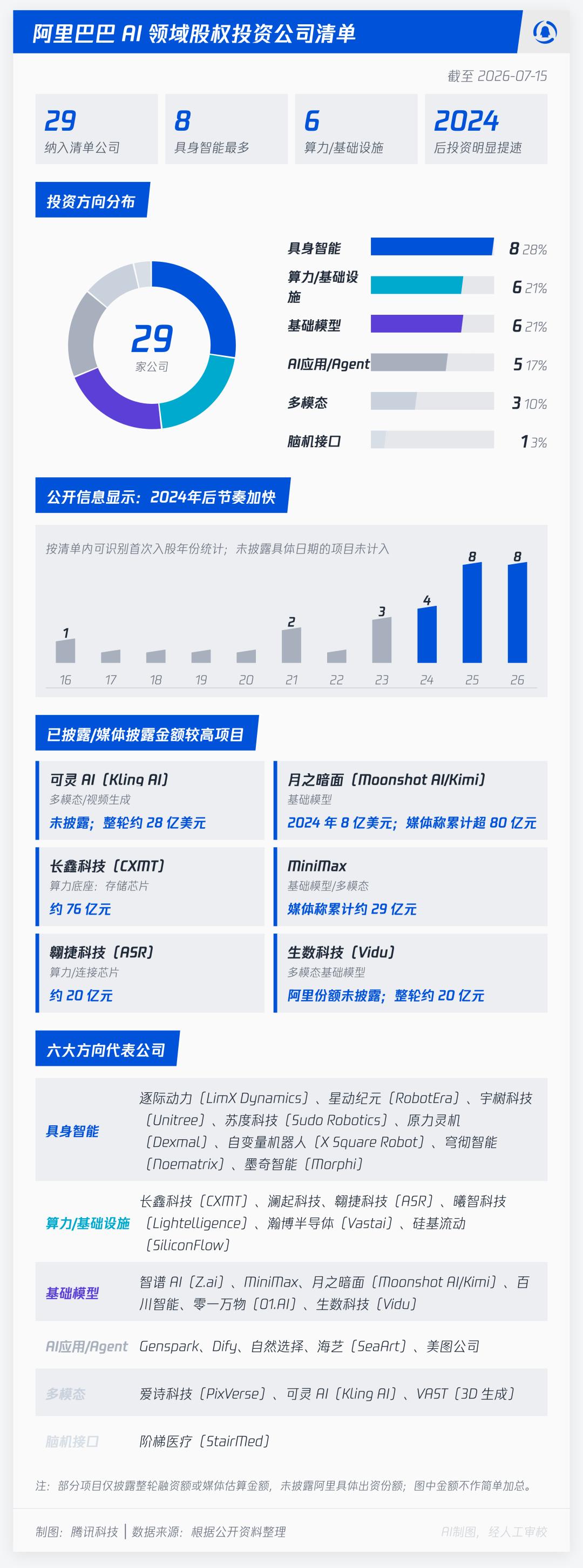
The computing power foundation layer is the main battlefield. In early 2025, Alibaba announced that it would invest at least 380 billion yuan over the next three years to build AI and cloud computing infrastructure — the largest investment plan ever made by a private Chinese enterprise in this field. In fiscal year 2026, Alibaba's capital expenditures reached 126.063 billion yuan.
This figure puts Alibaba in the top tier domestically. Industry sources indicate that ByteDance's preliminary 2026 AI capital expenditure plan stands at around 160 billion yuan RMB, roughly on par with Alibaba's. However, on a global scale, the gap remains substantial: in 2026, Amazon's capital expenditure guidance is approximately $200 billion, Google's ranges from $175 billion to $185 billion, Meta's from $115 billion to $135 billion, and Microsoft's annual expenditure is projected to exceed $105 billion.
Apart from in-house R&D, Alibaba has also invested in upstream chip companies. Alibaba's Alisoft China participated as a cornerstone investor in Montage Technology's Hong Kong IPO with $55 million, ranking among the top cornerstone investors. Montage's product portfolio includes memory interface chips, PCIe/CXL Retimers, and CXL memory expansion controllers. Alibaba has also invested in Unisoc, Horizon Robotics, and Biren Technology, covering areas such as radio frequency baseband chips, silicon photonic computing, and AI inference chips.
In the storage sector, Alibaba is simultaneously advancing self-development and industrial investments. T-Head launched its SSD controller chip Zhenyue 510 in 2023, which has already been deployed in Alibaba Cloud data centers. Across the industrial chain, Changxin provides DRAM, Yangtze Memory supplies NAND, Montage delivers interconnection chips, while Alibaba Cloud is responsible for system integration and business applications.
Changxin is currently developing HBM, which may also form a complementary pairing with T-Head's AI chips in the future. According to IDC data, T-Head's AI chip shipments in 2025 ranked second domestically only after Huawei. Individuals close to T-Head revealed to Tencent Technology that T-Head's IPO process is accelerating.
During the earnings call in August 2025, management disclosed that Alibaba has prepared "backup plans" for potential disruptions to global AI chip supply and policy changes. By collaborating with diverse partners to build a diversified supply chain reserve, Alibaba is "ensuring that its 380 billion yuan investment plan can proceed as scheduled".
The middle layer is the model ecosystem. At this layer, Alibaba not only sells "shovels" to miners but also mines for gold itself, while holding stakes in nearly every other miner in the market.
Alibaba develops its own large model, Tongyi Qianwen. At the same time, the five large model companies Alibaba holds stakes in are all potential competitors to Tongyi Qianwen, and all of them are computing power customers of Alibaba Cloud.
Competition at this layer is also the most intense. According to an Omdia report, Alibaba Cloud's market share in China's AI cloud market rose from 35.8% in the first half of 2025 to 38.1% — exceeding the sum of the second to fourth-ranked players. Revenue from AI-related products maintained triple-digit growth for 11 consecutive quarters. However, calculated based on the public cloud large model invocation volume statistics from IDC, Volcano Engine captured nearly half of the market with a 49.5% share in 2025 — nearly one out of every two Tokens running on China's public cloud is processed on Volcano Engine, while