South Korea's memory chip duo takes a hit: Who is behind the slump?
Recently, the South Korean stock market has seen frequent sharp declines, triggering circuit breakers on a regular basis. On Thursday, led by the "two memory giants", the South Korean stock market repeated its familiar pattern, tumbling downward to trigger a trading halt.
South Korea's KOSPI index opened 4.4% lower on Thursday, and as of press time, the decline has expanded to nearly 7%. At around 8:10 a.m. Beijing time, the Korea Exchange launched a temporary trading suspension mechanism for the KOSPI index.
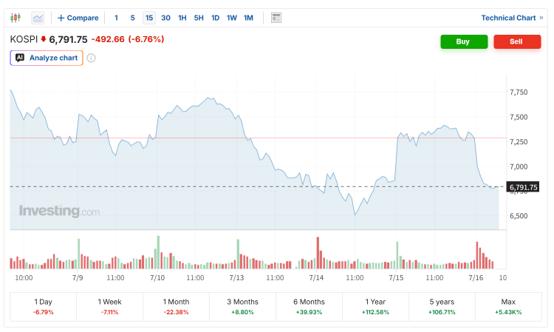
The "two memory giants" led the broader market down. As of press time, Samsung Electronics' share price has fallen by more than 9%, and SK Hynix's share price has dropped by nearly 12%.
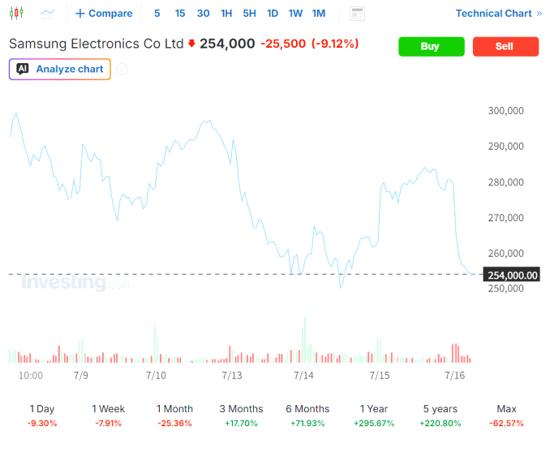
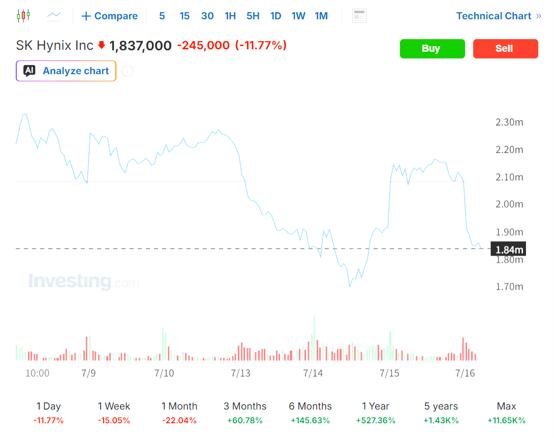
The performance of these two memory giants is enough to sway the overall trend of the South Korean stock market, as they together account for more than half of the total market capitalization of the South Korean stock market, and the existence of related leveraged ETFs has further exacerbated market volatility.
The sharp drops in the share prices of Samsung and SK Hynix followed the trend of related sectors in the US stock market overnight.
On Wednesday, as the latest inflation data continued to show signs of cooling, coupled with a strong start to the second-quarter earnings season, investors' risk appetite picked up, and the three major US stock indexes closed slightly higher.
But US-listed memory concept stocks plummeted against the trend: SanDisk fell 8.12%, SK Hynix dropped 9%, Western Digital declined by more than 8.7%, Micron Technology slipped 8%, and Seagate Technology lost 5.7%. Even though chip equipment manufacturer ASML released impressive earnings that day, indicating strong market demand for logic chips and DRAM chips, it failed to boost market sentiment.
Profit-taking is the main cause
The latest drop in memory stocks does not appear to have an obvious trigger. There is no new bad news on memory demand, no company has lowered its performance forecast, and the AI memory shortage remains severe.
Related analysis suggests that the main reason is profit-taking after a substantial rally.
On Tuesday, IBM, one of the world's largest information technology and business solutions companies, issued a warning that its customers are shifting spending away from software businesses to invest in memory chips and servers, a piece of news that shocked the market. Affected by this announcement, IBM's share price plummeted 25% that day.
However, this is good news for memory manufacturers. The share prices of SK Hynix, Micron, and SanDisk all rose sharply, with investors flocking to this sector. On Tuesday in the US stock market, SK Hynix's share price surged by as much as 27%; while on Wednesday in the South Korean stock market, SK Hynix's share price closed up nearly 9%.
Other catalysts
In terms of macro policies, the Bank of Korea announced on Thursday that it will raise interest rates by 25 basis points to 2.75%, its first rate hike since January 2023, which is in line with market expectations. A rate hike is generally seen as unfavorable to risk assets.
In terms of geopolitics, as the United States launched new strikes against Iran on Wednesday, tensions in the Middle East continue to escalate, dampening investors' risk appetite.
At the same time, although the latest CPI data showed that US inflation has cooled somewhat, prompting traders to reduce their rate hike bets, Federal Reserve Chair Walsh repeatedly downplayed the significance of a single month's CPI data during his congressional testimony, stating that he does not want to overinterpret any single data point. This has also dented investor optimism to a certain extent.
In addition, semiconductor ETFs are regarded as the main culprit amplifying stock market volatility.
Since the beginning of this year, the Korea Exchange has launched the "temporary trading suspension" measure 36 times, and the full-market circuit breaker mechanism has been triggered 7 times due to the KOSPI's sharp plunge. The frequent "roller-coaster" movements in the South Korean stock market have aroused vigilance from multiple parties, including regulatory authorities, who have pointed the finger at semiconductor ETFs.
South Korean President Lee Jae-myung urged the Korea Exchange on Thursday to formulate ETF risk prevention measures as soon as possible. A day earlier, Lee Jae-myung stated at a government briefing that the domestic South Korean stock market had seen drastic surges in a short period of time and is now quite unstable, and it will still take some time for the market to return to stability.
It is reported that a high-level coordination mechanism of four major economic departments of the South Korean government will hold a meeting today to study countermeasures against the impact of single-stock leveraged ETFs on the stock market, marking the first time this issue has been formally included in the mechanism for discussion. This mechanism is the highest-level economic coordination platform jointly participated by the Ministry of Economy and Finance, the Financial Services Commission, the Bank of Korea, and the Financial Supervisory Service.
The Korea Financial Investment Association recently revealed that the chief executives of 10 large domestic asset management companies have discussed investor protection arrangements for single-stock leveraged ETFs, including raising the minimum deposit threshold and diversifying the timing of daily rebalancing transactions.
This article is from the WeChat official account "CLS", author: Bian Chun, published by 36Kr with authorization.