How intense is the competition in Southeast Asia's energy storage market? Frontline sales staff: The truth lies in low prices and relentless talent poaching.
"Online hype says the Southeast Asian energy storage market is about to take off, but in reality, it's far from easy to operate." While saying this, Xiao Wang was developing new clients on overseas social media platforms.
Xiao Wang is the overseas business director of a small and medium-sized domestic distributed PV enterprise. After facing performance pressure in the PV sector in recent years, the company expanded its energy storage business, focusing on overseas markets, with Southeast Asia as its first stop for global expansion.
A few years ago, Southeast Asia was an unremarkable niche market.
Although its annual average electricity demand growth is around 6%, making it one of the fastest-growing regions globally, most countries still lack complete grid connection rules for energy storage, capacity compensation mechanisms, ancillary service markets, and revenue frameworks for independent energy storage projects.
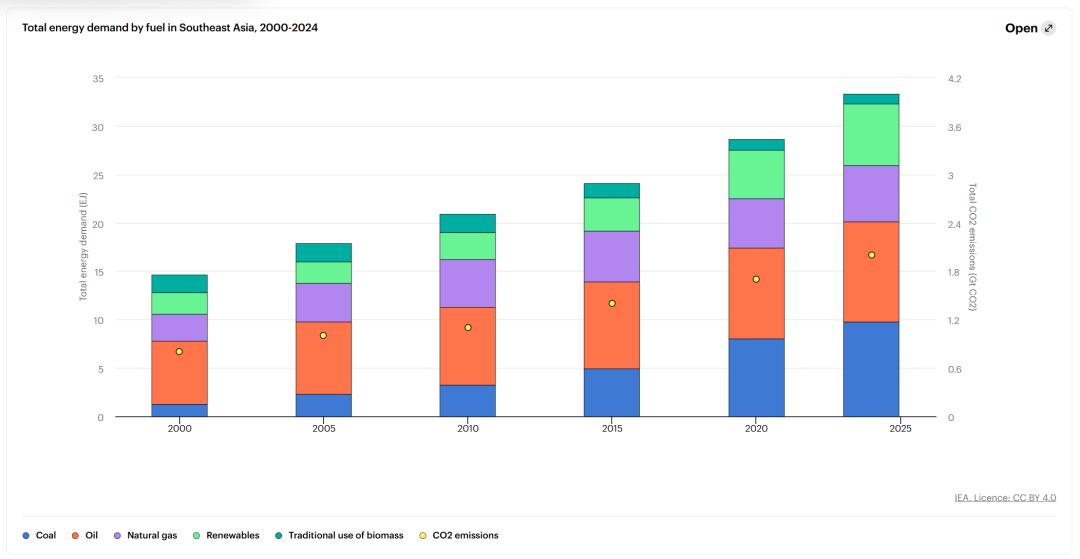
Total energy demand in Southeast Asia (2000-2024), Source: International Energy Agency
This market was once a last resort for small enterprises to avoid fierce competition in core mainstream markets. By 2025, the Southeast Asian market has clearly become booming.
The Philippine Department of Energy has set a target of 50% renewable energy power generation by 2040, with supporting plans for over 10GW of energy storage installations, requiring energy storage capacity to reach at least 20% of the power station's installed capacity, attracting continuous global capital inflows;
Indonesia has launched a 100GW solar energy plan, of which 80GW will be implemented in the form of village-level distributed systems, supported by 320GWh of energy storage to cover 80,000 villages, with a standard configuration of 1MW PV + 4MWh energy storage per village;
After revising the PDP8, Vietnam has significantly raised its BESS target: the 2030 battery energy storage installation target is 10GW-16.3GW, which will approach 96GW by 2050.
For a time, Southeast Asia has become a blue ocean for the energy storage industry.
But for frontline PV and energy storage salespeople operating in Southeast Asia, the waters of this market are far deeper than imagined.
01 The "Shortcut" to Global Expansion for Small and Medium Manufacturers
According to KPMG statistics, from 2019 to 2023, the annual compound growth rate of China's battery exports to Southeast Asia reached 25.7%, and the export value climbed to 35.321 billion RMB in 2023.
The rapidly expanding market has attracted a large number of small and medium-sized energy storage players to enter in clusters.
The reason why this market is so attractive to small and medium manufacturers lies in its distinct market characteristics that are completely different from mature markets in Europe and the United States.
First of all, it is easier to reach clients.
"Most of our business is with local Chinese communities, and more than half of our orders come from Chinese clients, since there are many Chinese entrepreneurs there," Xiao Wang said.
The Chinese community in various Southeast Asian countries is deeply involved in the local private economy: in Singapore, over 70% of the population is of Chinese descent; Chinese business groups have strong influence in Malaysia, Thailand, Myanmar and other countries; even in the Philippines, where the pure Chinese population accounts for less than 2%, industrial and commercial groups with Chinese ancestry form the core of the local private economy.
For Chinese energy storage enterprises, the communication cost with such clients is relatively low, and trust relationships are easier to establish.
"Many business owners themselves came from Fujian or Chaoshan regions of China, fully aware of the price advantages of the domestic supply chain, so trust is established very quickly."
Secondly, the market access threshold is relatively low.
Compared with the CE certification in the European Union, UL safety standards in the United States, and strict grid connection requirements in Australia, the energy storage market access in most Southeast Asian countries is almost "starting from scratch".
For example, to sell a residential energy storage battery to the Philippines, the procedures basically only involve handling hazardous material transportation and customs clearance.
But for the same product sold to Germany, in addition to transportation and customs clearance, enterprises also need to obtain CE certification, establish a recycling system, and comply with the compliance framework for the upcoming battery passport.
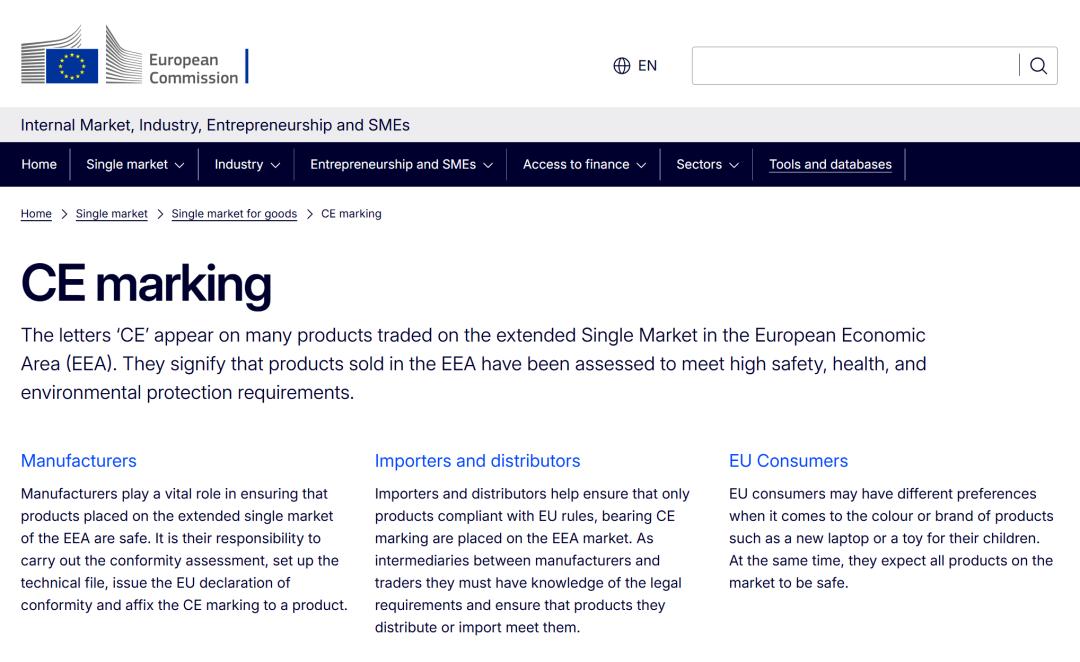
Scope of EU CE certification, Source: Official website of the European Union
This means that in the Southeast Asian market, enterprises do not need to invest heavily in multi-country certifications, nor do they need to build a complex local compliance team. They can sell their products through traders and local Chinese partners.
"We don't even need to set up a local office, and can operate entirely through online communication," Xiao Wang said.
Third, the demand logic for energy storage in the Southeast Asian market is simpler.
Power grids in Southeast Asia are generally weak, and power outages are a common occurrence.
In recent years, the Luzon and Visayas power grids in the Philippines have issued multiple red alerts, and a multi-day massive blackout once occurred on Panay Island; power supply interruptions in remote islands and rural areas of Indonesia are even more frequent.

Source: Reuters
This makes the core demand of local clients focus on power supply reliability, rather than arbitrage returns.
Many clients Xiao Wang has contacted will directly specify grid-forming solutions, repeatedly emphasizing capabilities such as black start and off-grid load duration.
Clients are more accessible, rules are more lenient, and demand scenarios are more rigid. As long as enterprises can find distribution channels, they have the opportunity to close deals.
For small and medium energy storage manufacturers that cannot compete in the saturated domestic market and cannot enter the European and American markets, Southeast Asia seems to be a low-threshold shortcut for overseas expansion.
But the lower the threshold, the more competitors there will be.
02 The Harsh Reality of Survival Beneath the Blue Ocean
"The Southeast Asian market is full of Chinese enterprises," Xiao Wang said while shaking his head. "Not to mention Southeast Asia, even the African market is almost saturated with domestic enterprises."
The direct consequence of player clustering is a brutal price war. Coupled with the large wealth gap in Southeast Asia, end clients are highly price-sensitive, and profit margins have been compressed again and again.
Xiao Wang did the math for us: a 16kWh residential energy storage system can only be sold for about 5500 yuan in Southeast Asia, equivalent to less than 0.35 yuan per Wh.
In the European market, the price of products of the same specification is 2-3 times that of Southeast Asia. Even in the American market where competition has intensified, the unit price is much higher.
"To cut costs, now the Southeast Asian market is flooded with disassembled second-hand battery cells, whose prices are more than 30% lower than brand new ones."
If low prices only mean thin profits, the ubiquitous customized demands are the truly exhausting "hidden costs".
"Low prices just mean less earnings. The trouble is that local clients always come up with various customized requirements."
Recently, Xiao Wang received an order for portable power stations, and the client sent a long list of customized requirements, with clear specifications covering everything from interface standards to appearance and functions.
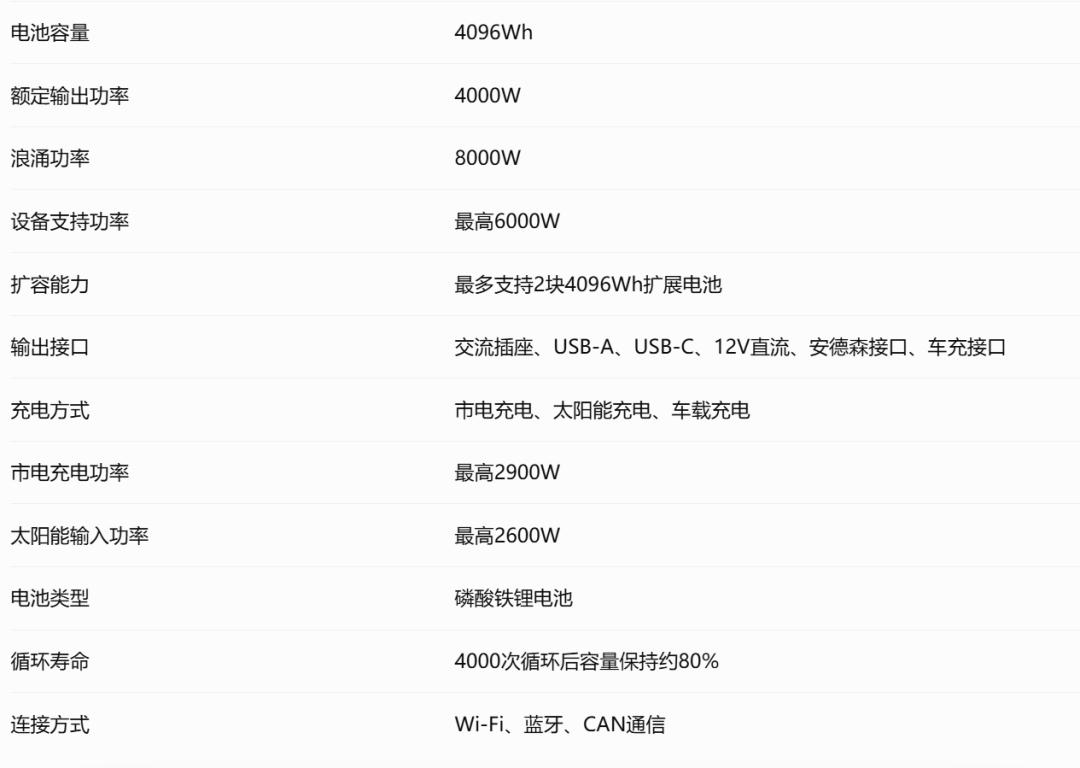
"We have to meet all these requirements and source the corresponding products for them. The key problem is that those clients are unwilling to pay development fees, and just ask us to find ready-made solutions that are exactly what they want."
Orders in Southeast Asia are generally small in scale and scattered. Many customized demands correspond to orders of only tens of kWh, and the largest ones are no more than a few MWh, which makes the average customized cost even higher.
"Customization for large projects still has profit margins, while customization for small orders is purely a favor: you lose money if you take the order, but you are afraid of losing the client if you reject it."
For large enterprises, such orders are not worth investing in. For small enterprises, they cannot afford to turn down these orders.
As a result, salespeople act like product managers, product managers act like customer service staff, and engineers act as emergency response teams.
A small project may require revising more than a dozen versions of the solution from quotation to delivery, but the gross profit is not enough to cover the communication costs.
03 Conclusion
From the perspective of paper data, Southeast Asian energy storage is undoubtedly an incremental market full of imagination. The energy transition targets of various countries, continuously growing power demand, and weak power grid foundations are all paving the way for the long-term growth of energy storage.
But for current overseas operators, this is far from a blue ocean where they can make easy money with no effort.
Leading enterprises are eyeing GW-level large projects, leveraging their capital and brand advantages to capture government and utility orders; while small and medium manufacturers are crowded in the scattered distributed market, having to compete on prices and cope with endless non-standard demands, earning meager profits in a tight corner.
"Everyone online talks about the market taking off, but in reality, only big capital players can really take off. Small enterprises like us can only trot on the ground at most." Xiao Wang closed the client development page on social media, preparing for a video meeting with a Thai Chinese client in the afternoon.
The story of Southeast Asian energy storage has just begun. The dividends are real, but they do not belong to everyone.
Before the grand industrial goals are fully implemented, small and medium-sized overseas operators must first learn how to survive among scattered small orders.
This article is from the WeChat public account "New Energy Industrialist", written by Huang Pingting, and published with authorization from 36Kr.