Official data has been released, and four signs of stabilization in the real estate market have been confirmed.
On the morning of July 15, the National Bureau of Statistics released the macroeconomic and real estate data for the first half of 2026.
The data clearly sends four structural stabilization and recovery signals for the property market:
First, the number of cities where new home prices rose month-on-month across the 70 major cities hit a new high. The sales prices of commercial residential buildings in first-tier cities have risen month-on-month for four consecutive months, while second-tier cities have seen their home prices stop falling and level off, marking the first halt in decline in nearly a year.
Second, the nationwide inventory of unsold commercial properties has declined for four consecutive months, significantly alleviating inventory pressure.
The Deputy Director of the National Bureau of Statistics also affirmed the positive changes in the real estate market at the press conference. In addition to the positive shifts in home prices and inventory, two other points are worth noting:
First, second-hand home transactions are relatively active. The online signing area of second-hand homes in the first half of the year increased by 10.2% year-on-year, and the total transaction volume of new and second-hand homes has recorded consecutive positive growth for three recent months.
Second, real estate market expectations have improved to some extent. A housing price questionnaire survey conducted by the National Bureau of Statistics across 70 large and medium-sized cities shows that in June, the proportion of real estate market practitioners who expected the sales prices of new commercial residential buildings to remain stable or rise in the coming six months reached 63.1%, staying above 60% for four consecutive months.
01
Let's start with the most intuitive data from the sales side.
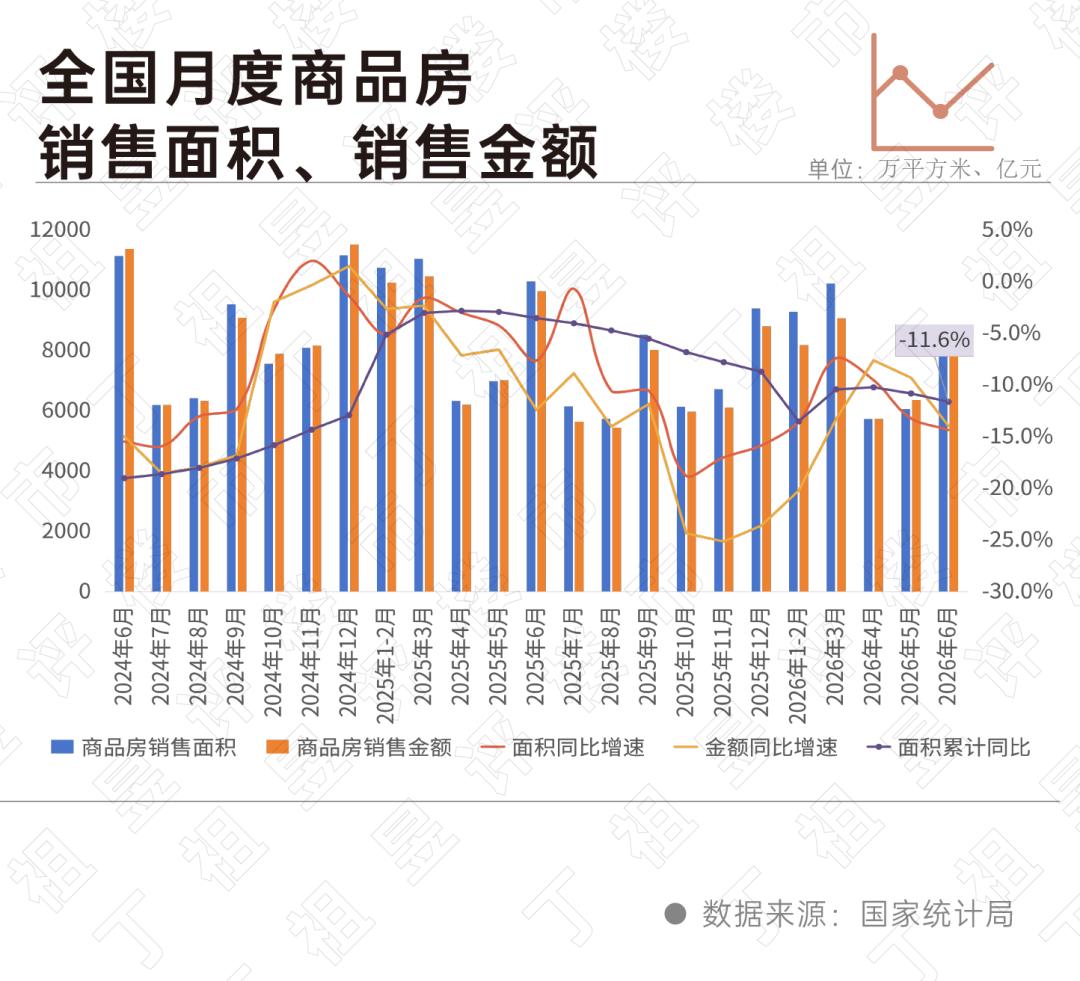
Calculated based on data disclosed by the National Bureau of Statistics, the transaction volume of new commercial properties across the country in June reached 88.2 million square meters, a 45% increase month-on-month.
The mid-year cyclical peak arrived as scheduled. However, no full reversal has yet occurred on the sales front, with the monthly figure still down 13.9% year-on-year, and the year-on-year decline widening by 4.6 percentage points.
Looking at the first half of the year as a whole, the cumulative decline in the national new home sales amount has narrowed for six consecutive months.
Specific figures: From January to June, the total sales of new commercial properties nationwide stood at 3.8 trillion yuan, down 13.6%, with the decline narrowing by 0.1 percentage points. The sales area of new homes reached 400 million square meters, down 11.6% year-on-year, and the decline expanded by 1.9 percentage points.
In addition, the Deputy Director of the National Bureau of Statistics revealed the transaction status of second-hand homes at the press conference.
Data from relevant authorities shows that the current transaction area of second-hand homes is now comparable to the sales area of new homes. In the first half of the year, the online signing area of second-hand homes increased by 10.2% year-on-year, and the growth rate was 2.5 percentage points faster than that from January to May.
The effectiveness of the current market stabilization efforts can also be clearly seen from the second-hand home transaction data in Beijing and Shanghai. According to data from the Beijing Municipal Commission of Housing and Urban-Rural Development, 16,600 second-hand homes were signed online across the city in June, hitting a five-year high and representing a 9.8% year-on-year increase, with the monthly online signing volume leading the same period of the past five years for three consecutive months. Data from the Shanghai official property transaction platform shows that the cumulative transaction volume of second-hand homes in the first half of the year reached 147,000 units, also reaching a high level for the same period in nearly five years, of which 25,000 units were signed online in June, up 21% year-on-year.
Behind the active second-hand home transactions, profound changes are taking place in the structure and total scale of China's real estate transactions, and the market has entered a pattern where new homes and second-hand homes develop in parallel.
A highly referenceable key point: combining the online signing volumes of new and second-hand homes, the total transaction volume has recorded consecutive positive growth in the last three months.
The genuine residential demand in the property market has not disappeared; it is only the demand logic that has changed.
02
Industry inventory pressure continues to decline.
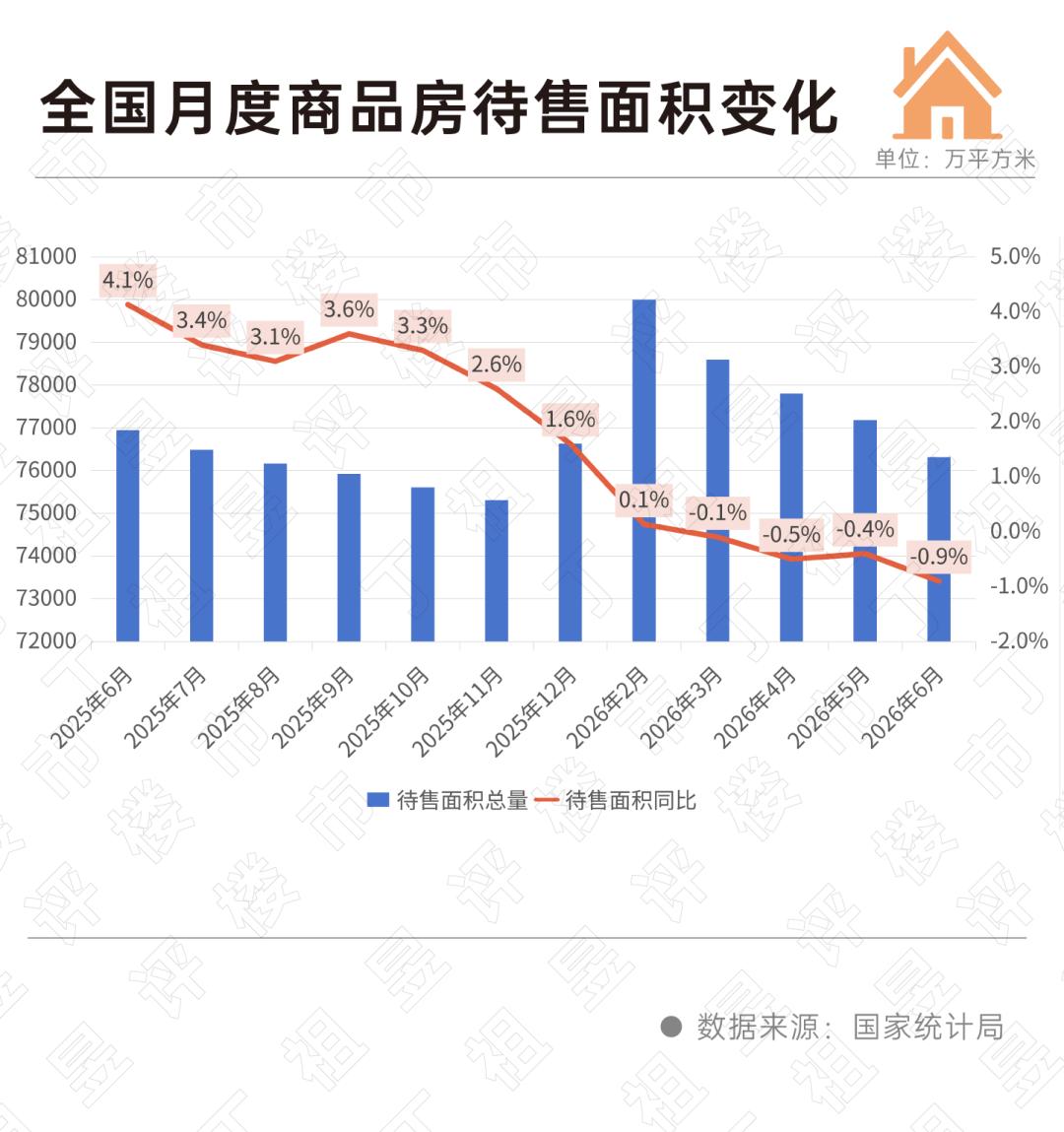
At the end of June, the unsold area of commercial properties nationwide reached 760 million square meters, down 0.9% year-on-year, with the decline further expanding.
In fact, after the year-on-year growth of the national unsold commercial property area began in July 2021, it recorded its first decline of 0.1% at the end of March this year after 51 months, sending a signal of inventory cycle transition.
By the end of June, the unsold area of commercial properties had declined year-on-year for four consecutive months, marking the largest decline in the past four months.
Critically, the decline in the unsold area of properties held for less than three years, which accounts for over 70% of the total unsold commercial property area, is even more pronounced. It fell by 3.5% at the end of June, with the decline widening by 0.7 percentage points compared to the end of May, indicating accelerated destocking of core inventory.
The year 2026 marks the first year after the industry confirmed its cyclical bottom. With the further release of market demand and the peak of "guaranteed delivery" having passed, the new supply of completed but unsold existing homes from real estate enterprises has slowed down significantly. In the first half of the year, the completed residential area fell by 25.3% year-on-year, with the decline remaining above 20%. There will be no sharp increase in unsold area in the future.
03
Housing prices in June also sent more positive signals simultaneously.
The sales prices of commercial residential buildings in first-tier cities have risen for four consecutive months month-on-month, with a 0.1% month-on-month increase in June.
The sales prices of new homes in second-tier cities recorded their first month-on-month halt in decline in nearly a year, shifting from a 0.1% drop in the previous month to a flat level.
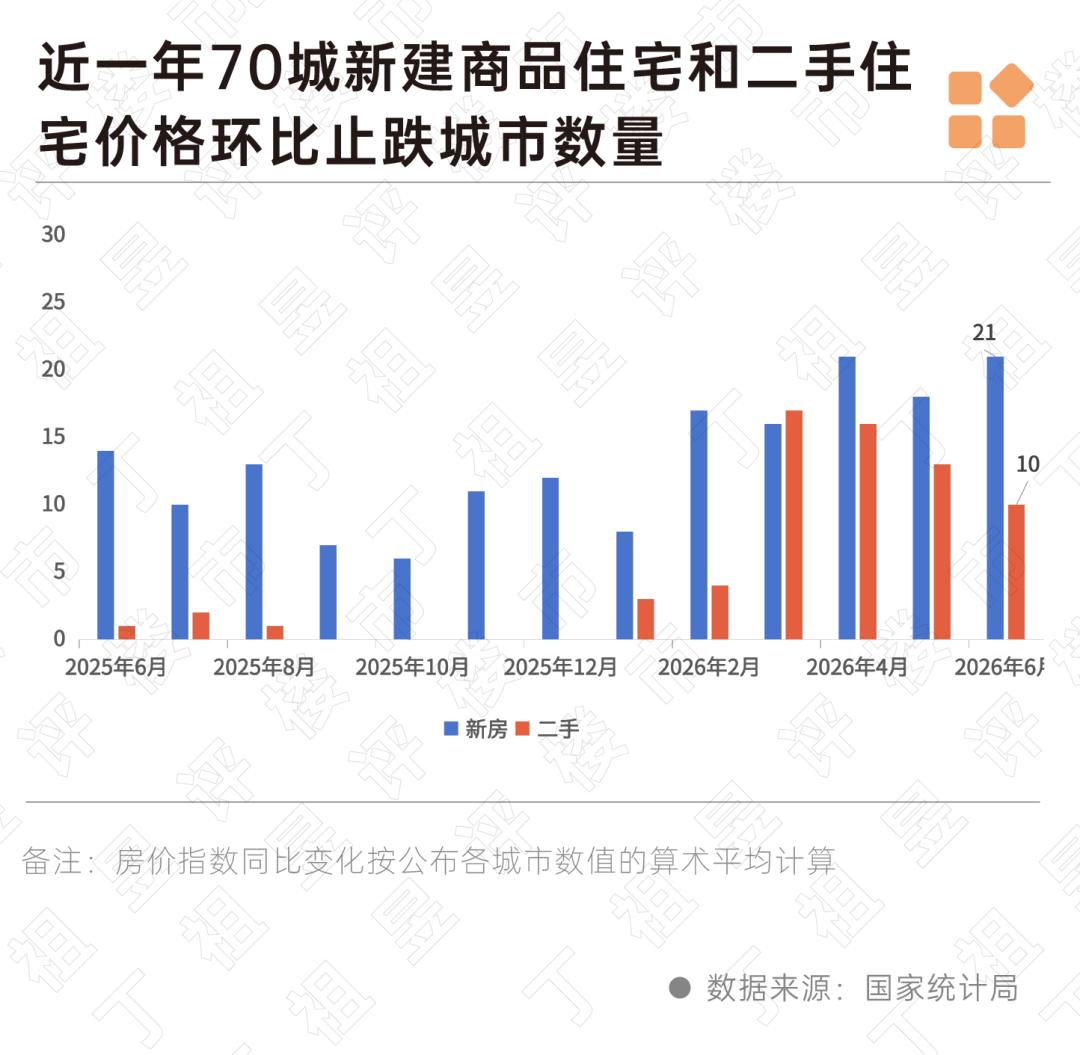
The number of cities where the sales prices of new commercial residential buildings rose month-on-month continued to increase compared to the previous month, reaching 20 in June, 4 more than the previous month. The number of rising cities is the largest in nearly a year.
Among them, housing prices in 7 cities including Shanghai, Guangzhou, Shenzhen, Hangzhou, Ningbo, and Yinchuan have risen month-on-month for more than four consecutive months.
New home prices in 5 cities including Nanjing, Urumqi, Huizhou, Sanya, and Dali have turned from decline to increase.
In terms of second-hand home prices, the sales prices of second-hand residential buildings in all first-tier cities rose month-on-month, with Beijing, Shanghai, Guangzhou, and Shenzhen recording increases of 0.1%, 0.4%, 0.4%, and 0.3% respectively.
Looking at the number of rising cities, 10 cities saw the sales prices of second-hand residential buildings rise or remain flat month-on-month, and the number of cities where second-hand home prices stopped falling month-on-month has been no less than 10 for four consecutive months.
Among them, second-hand home prices in these 10 cities including Beijing, Shanghai, Guangzhou, Shenzhen, Shenyang, Ningbo, Hefei, Chongqing, Wuxi, and Xuzhou have stabilized, with no further month-on-month declines in the past four months.
It is worth noting that the housing price questionnaire survey conducted by the National Bureau of Statistics across 70 large and medium-sized cities shows that after the Spring Festival, real estate market practitioners' expectations for the price trends of new and second-hand homes have improved. In June, the proportion of real estate market practitioners who expected the sales prices of new commercial residential buildings to remain stable or rise in the coming six months reached 63.1%, staying above 60% for four consecutive months, and rising 20 percentage points from last year's low point.
On July 13, the "15th Five-Year Plan for Expanding Consumption" clearly stated in the chapter "Promoting Residents' Income Growth through Multiple Channels": We will promote the sustained and healthy development of the real estate market, continuously consolidate the stable and positive development trend of the capital market, and increase the property income of urban and rural residents through multiple channels.
This also indicates that stabilizing housing prices will become the focus of the subsequent property market stabilization work, which will help accelerate the repair of residents' balance sheets and boost market confidence on the demand side.
In addition, the second-quarter regular meeting of the People's Bank of China's Monetary Policy Committee held on July 4 clearly continued the general tone of moderately loose monetary policy, coordinated the dual goals of stabilizing growth and reasonably rising prices, and listed "strengthening the guidance of central bank policy interest rates and improving the market-oriented interest rate formation and transmission mechanism" as a key work direction for the next stage.
Immediately after that, at the State Council Information Office press conference on July 15, the People's Bank of China simultaneously interpreted the first-half 2026 monetary policy implementation and financial statistics data, making it clear that it will strengthen counter-cyclical and cross-cyclical regulation, and guide and regulate the interest rate level according to the macroeconomic operation, price trends, and macro-control needs.
This policy combination sends a clear signal: The continuous optimization of interest rate transmission efficiency and the maintenance of market interest rates at a low level will not only continuously reduce the financing cost for residents to purchase and replace homes, activate second-hand home replacement demand, but also effectively repair market sentiment and further stabilize housing price expectations.
The year 2026 is the year when the industry confirms its cyclical bottom, and positive signals have been continuously released in the first half of the year: The demand side shows mid-year cyclical recovery, the price side presents a clear trend of differentiated stabilization, the decline on the investment side has narrowed, the monthly development investment has rebounded by nearly 30% month-on-month, and the land auction popularity has hit a new high in nearly a year.
Multiple policies are working in synergy, and the foundation for industry recovery continues to be consolidated. With the mutual support of the three main policy lines of stabilizing asset prices, promoting stock investment, and supporting people's livelihood demand, the industry will be steadily pushed to transform to a new mechanism that matches supply and demand and keeps risks under control.
This article is from the WeChat Official Account "Ding Zuyi Comments on the Property Market", authored by the Editorial Department and Purui Research, and published by 36Kr with authorization.