Just now, SineDrive officially announced a RMB 300 million financing, and this time it's not about technology but about business.
New funding has arrived in the autonomous driving track.
On July 16, SineAuto announced that it has closed a RMB 300 million Series C financing round, co-invested by Xingzheng Capital and Yidao Capital. Against the backdrop of an overall slowdown in financing pace across the autonomous driving sector, the significance of this funding speaks for itself.
What deserves more attention than the financing itself is that this autonomous heavy-duty truck company, which originated from port operations, has completed the critical leap from "technology validation" to "commercial realization".
Breaking down SineAuto's Series C story, three main threads stand out clearly: product capabilities have upgraded from single-vehicle intelligence to a systematic decision-making platform driven by a world model; business scenarios have expanded from enclosed ports to the full scope of open roads; and the business logic has shifted from selling solutions to empowering transport capacity.
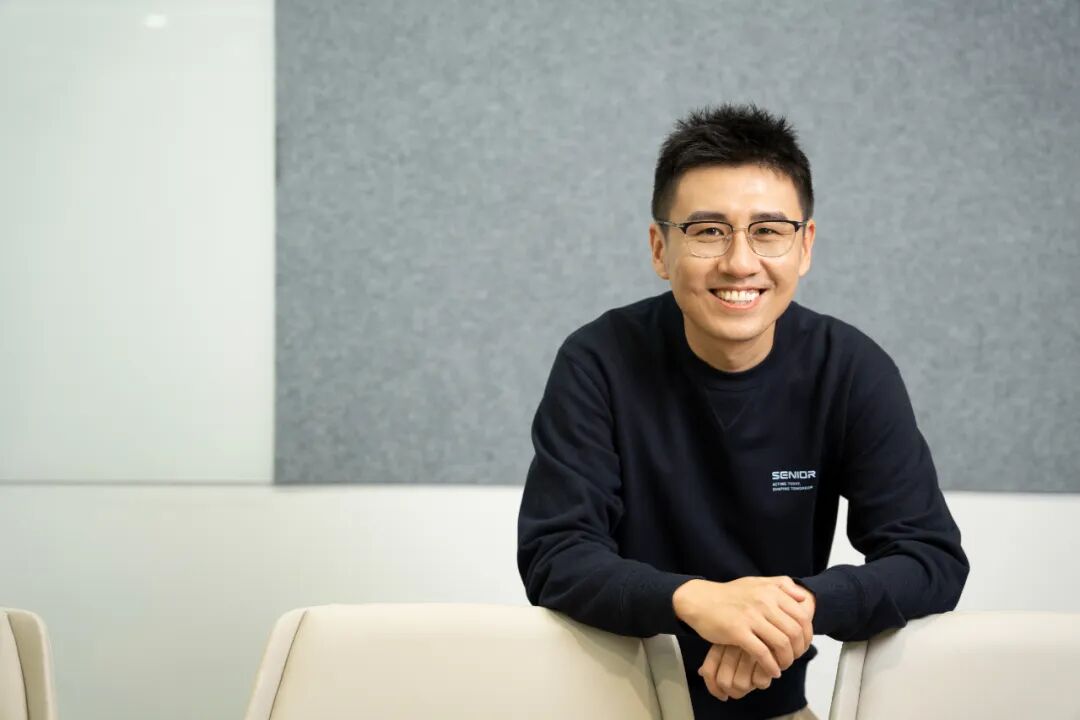
He Bei, Founder of SineAuto
In the view of He Bei, Founder of SineAuto, "Autonomous driving has moved past the era of debates over technical routes." Going forward, what companies compete on is no longer just isolated algorithms, but three systematic capabilities: brand trust, cross-scenario data accumulation, and the data closed loop and flywheel efficiency driven by a computing power platform. What ultimately determines whether a customer will pay is whether an enterprise can first make its own business model viable, and convert profitability into replicable customer value.
From "Algorithms That Can Drive" to "Systems That Can Manage Transport Capacity"
"In recent years, customers' acceptance of autonomous heavy-duty trucks has continued to rise, and their demands are also changing." According to SineAuto, "Customers are no longer satisfied with single-vehicle intelligence; they increasingly demand integrated transport capacity solutions covering the vehicle end, roadside side, and cloud side."
Behind this shift is an upgrade in customer awareness.
In the early days, customers' expectations for autonomous driving were limited to "whether the vehicle can be driven", with testing and validation as their main pursuit. Today, after several years of pilot operations, decision-makers at ports and logistics parks have begun to calculate a more precise metric: exactly how much efficiency can autonomous driving help improve, and how much cost can it reduce?
To answer this question, a single set of "driving-capable" algorithms is far from sufficient. In a typical port scenario, automated guided vehicles must not only operate stably on their own, but also achieve precise docking with gantry cranes, perform collision avoidance while sharing roads with human-driven external trucks, and synchronize in real time with the cloud dispatching system...
If any link breaks down, overall efficiency will suffer. Single-vehicle intelligence can maximize transportation costs reduction under the premise of ensuring safety, but its efficiency will hit a bottleneck in mixed traffic scenarios.
SineAuto's solution is the integration of "vehicle-road-cloud". The vehicle acts as the execution subject, the roadside as the perception extension, and the cloud as the decision-making center, covering the complete chain of algorithms, software, vehicle-grade domain controllers, drive-by-wire chassis, V2X devices, cloud dispatching, and simulation platforms. On top of this architecture, SineAuto has introduced a key technical variable: the world model.
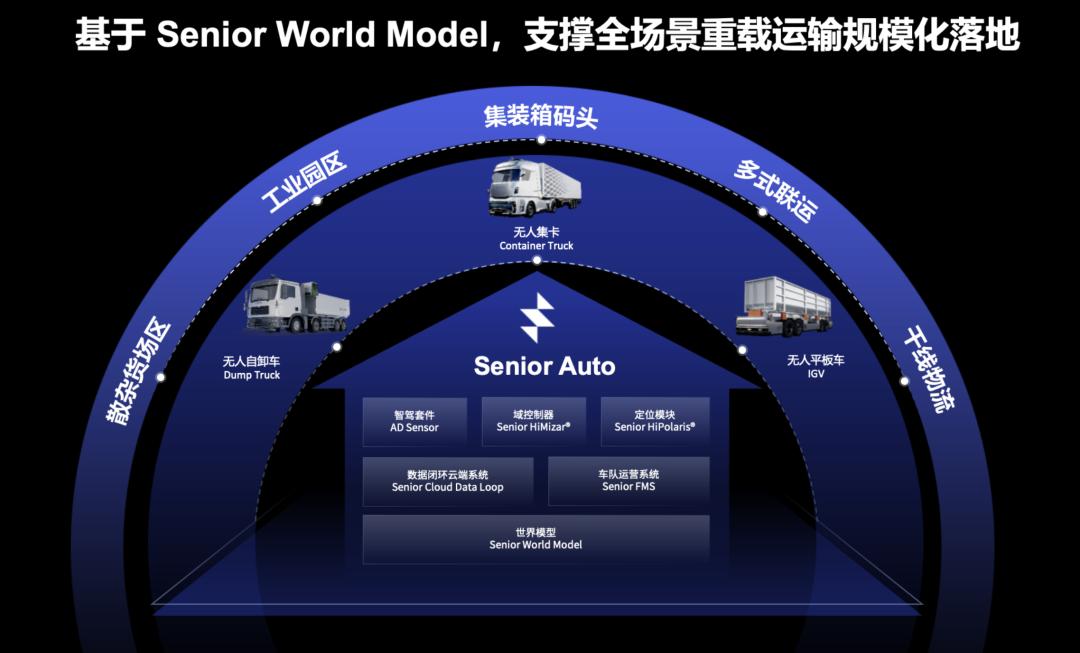
Traditional autonomous driving systems "process what they see", while the world model endows the system with the ability to "understand scenarios and predict evolution", shifting from passive perception to active anticipation. This is precisely the core link that enables "vehicle-road-cloud" to evolve from hardware serial connection to intelligent collaboration.
"The advantage of vehicle-road-cloud integration built on the world model is that it can respond quickly to special working conditions, equivalent to giving the vehicle a 'god's-eye view'", SineAuto explains. "Roadside perception devices and cloud dispatching systems allow vehicles to avoid congested and temporarily closed sections in advance, further improving operational efficiency."
This is exactly what customers truly want: not a "drivable system", but a "system that can help me get the job done well". SineAuto believes that this product-oriented advancement marks the company's completion of the critical transition from "providing functions" to "empowering transport capacity".
With the product definition changed, the next question is very practical: how to mass-produce vehicles and put them on the road for operation?
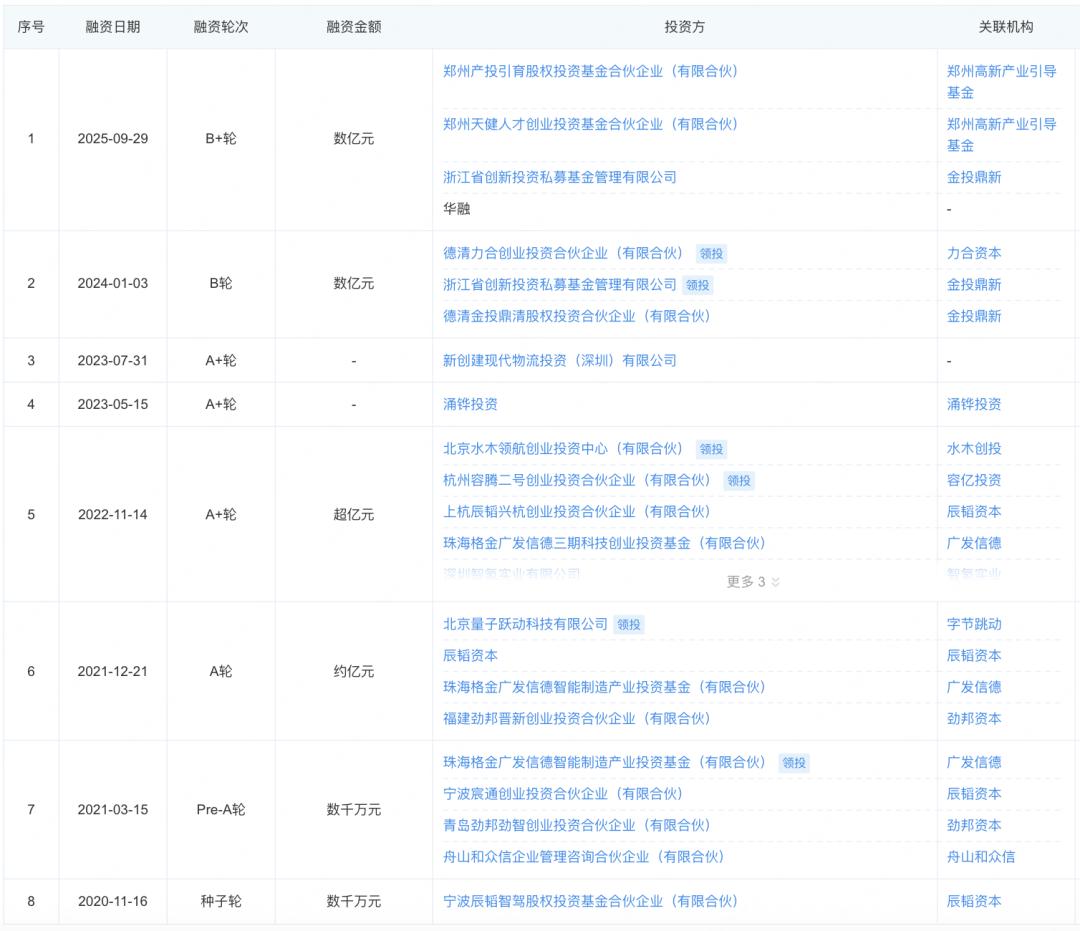
SineAuto's financing history. Source: Qichacha
The answer points to the core investment direction of this round of financing — "a new generation of vehicle-grade autonomous driving solutions".
"Vehicles operating in enclosed areas can originally be regarded as production and operation equipment, for which vehicle-grade compliance was not a necessary condition as long as they were stable and safe", SineAuto states. "But when moving to open roads, all sensors, wiring harnesses, interfaces, and algorithms must meet vehicle-grade requirements. Vehicle-grade compliance is the only way for us to achieve mass production for open-road scenarios."
This means SineAuto is fully transitioning from the "retrofitted vehicle" model to the "front-loaded mass production" model: deep cooperation with OEMs, joint application for MIIT announcements, and passing vehicle-grade certifications. Without crossing this threshold, large-scale operations are impossible; crossing it means obtaining the "admission ticket" for open-road operations.
Starting from Ports, to Full Scenarios and Global Replicability
If vehicle-grade compliance is the "hardware threshold" for moving to open roads, then the accumulation SineAuto has gained in port scenarios over the past few years has provided the "soft power" to cross this threshold.
Data shows that SineAuto has built an industry-leading self-driving fleet scale in port scenarios, with the total fleet size ranking first globally. For SineAuto, however, ports are far more than just a business scenario — they are a "training ground".
The value of enclosed scenarios lies in that they provide a test environment of "high pressure, high density, and high complexity". Inside ports, automated guided vehicles must achieve centimeter-level precise docking with gantry cranes, safely navigate complex roads shared by pedestrians and vehicles, and operate nonstop 24 hours a day.
"In the vertical loading/unloading stage of the operation cycle, gantry cranes have very limited displacement flexibility and can only move straight up and down when handling cargo. Our autonomous vehicles will achieve centimeter-level precise docking with the gantry cranes to compensate for their limitations in reverse." The system stability forged in these extreme working conditions cannot be replicated by any simulation environment.
With the technical foundation in place, the next step is expansion: from ports to railway yards, then to trunk lines — growing outward step by step.
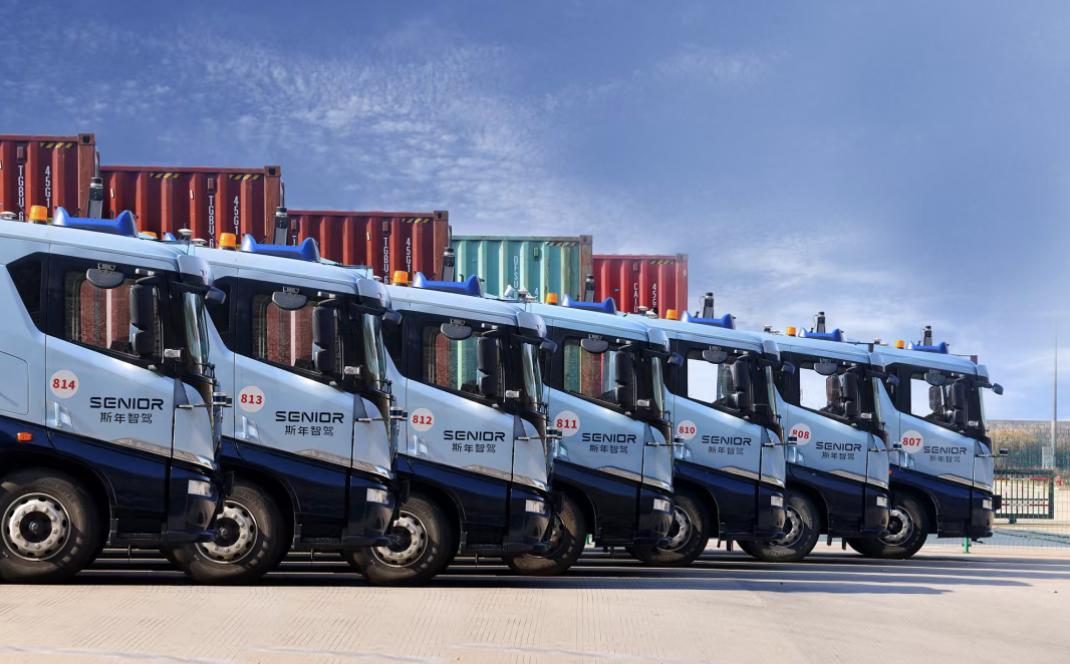
SineAuto's automated guided vehicle fleet at the Daxie Terminal of Ningbo Port
The Yiwu-Ningbo-Zhoushan Open Corridor is a typical case. Three nodes — Ningbo Zhoushan Port, Yiwu Suxi Railway Yard, and Yongjin Expressway — are connected in a line, fully integrating port collection and distribution, yard transfer, and trunk transportation. "Multimodal transport is essentially an expansion of port transportation. If the complex port system can operate smoothly, the problems in yards and trunk lines will not be that difficult."
As scenarios change, the technical architecture does not need to be rebuilt from scratch. Enclosed and open scenarios share a unified technical framework, with the logic unified into map-less navigation and one-stage end-to-end driving. SineAuto points out, "Our original intention in building the world model technical foundation is to achieve full lifecycle product coverage for heavy-duty truck transport capacity operations."
As for NOA (Navigation on Autopilot) advanced driver assistance systems, SineAuto believes that this is, in fact, the product form with larger market scale and higher demand in current open scenarios. "The pace of L4 implementation will not be too fast, as it is affected by policies and regulations. However, the labor shortage for heavy-duty truck drivers is growing larger. NOA products perfectly fit the market demand in this transition phase, with lower costs and higher acceptability."
In the expansion of overseas scenarios, the advantage of "one single foundation" is also evident. "There is no need for additional localized adaptation in software and hardware technologies; domestic architectures, data, and models can all be reused. Overseas road signs and regulations are different, but we only need to add some targeted data training — and once such problems are solved, the solution can be applied permanently."
In SineAuto's view, the common characteristic of overseas clients is that negotiation periods are longer, but contract amounts are large. Therefore, after maturing the products in the domestic market, rapid overseas delivery and monetization is the most appropriate current model, rather than taking premature actions.
Selling Solutions vs. Selling Transport Capacity: Essentially the Same Thing
With products and scenarios both ready, the last question is how to achieve profitability.
There are currently two mainstream cooperation models: one is sales, where vehicle-centered solutions are sold to clients; the other is operation, where the company owns fleet assets and charges based on actual transport capacity usage.
SineAuto believes that "there is no absolute boundary between sales and operations: sales are nothing more than collecting all operational fees upfront, while operations are equivalent to amortizing sales fees on a monthly basis. The key is not what the model is called, but what the customer needs."
For To B clients, SineAuto adopts a differentiated strategy: large B clients are few in number but have many individual cases, making them suitable as demonstration projects that require full-package solutions; small B clients are large in number and widely dispersed, making them more suitable for centralized management models.
"We remain customer-demand-oriented." Behind this logic is SineAuto's repositioning of its own role — not as a "supplier selling autonomous driving boxes", but as an "empowerer of transport capacity services". Selling solutions or selling transport capacity are just different charging methods, with the core goal of helping customers reduce costs and improve efficiency.
At present, SineAuto's stably operating fleet has exceeded 1,000 vehicles. "What truly tests us is our generalization and replication capability. When the fleet size grows from one vehicle to 100, and the number of customers increases from 1 to 100, it puts the product standardization and the individual operational capabilities of our engineering team to a severe test." Interestingly, in the process of large-scale expansion, every project forces the company to "unlock" new skills. "Similar modules and skill sets are continuously connected, forming a capability that can extend insights from one case to ten."
Regarding profitability, SineAuto gave a positive response: "Some yards have achieved obvious economies of scale and are close to breaking even." This confidence comes from continuous customer repurchases. "In recent years, we have received multiple renewal and supplementary procurement orders from existing customers, which represents their recognition of our solutions."
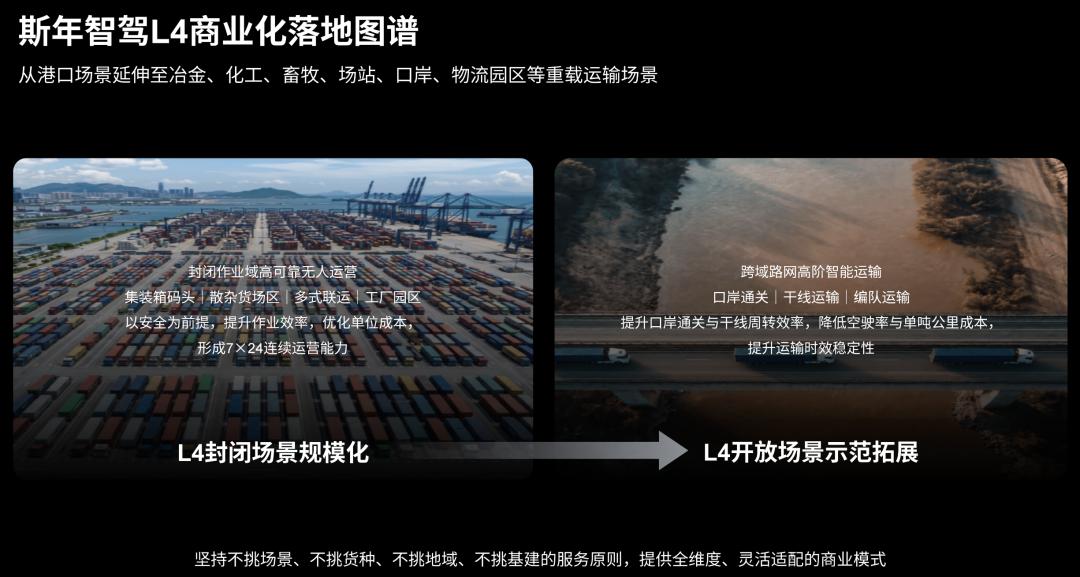
SineAuto positions itself as an "autonomous heavy-duty transport capacity solution provider". "We estimate that the market size in the logistics sector is around RMB 5 trillion. As an enterprise, we will advance step by step instead of making massive direct investments. If we can achieve the formation of L4 vehicle fleets and open-area operation arrays within 5 years, and then spend another 5 to 10 years, we are expected to gradually convert more logistics scenarios to unmanned operations. This will not be an overnight achievement, but a long-term endeavor."
In this long-term process, SineAuto's capability boundaries continue to expand. It has obtained a designated domain controller project from a leading overseas enterprise, exporting its autonomous driving experience to the broader embodied intelligence industry. "In terms of methodology and architecture, embodied intelligence and autonomous heavy-duty trucks are highly similar. SineAuto does not produce chassis; what we have always delivered is the 'brain'."
This is perhaps the most notable signal from SineAuto's Series C story: an autonomous driving company that started in enclosed port scenarios is gradually replicating its "brain" capabilities outward from one vertical scenario. From "being able to drive" to "being able to operate", what lies in between is not just algorithm iteration, but a complete systematic engineering chain covering products, scenarios, and business models.
Once this engineering system is proven viable, its potential will extend far beyond heavy-duty trucks.
This article is from the WeChat public account "Cyber Car" (ID: Cyber-car), written by Zhang Lianyi, edited by Qiu Kaijun, and published with authorization from 36Kr.