Giants are vying for "national-level AI applications"
Taking the lead in building a "national-level AI application" is becoming the core focus of competition among domestic tech giants.
ByteDance aims to build "Big Doubao".
The Doubao App started as a chatbot. By integrating sectors including Douyin short videos/e-commerce, Feishu, Qishui Music, and Doubao Learning, it has gathered several of ByteDance's most competitive products with the largest user bases, greatly expanding its functional boundaries.
Tencent is developing the "WeChat Agent".
As early as last November, Tencent announced that WeChat would launch an AI agent. Recently, the WeChat Agent has accelerated its development, and widespread external speculation suggests it will be fully rolled out in the second half of the year.
Alibaba and Ant Group have presented a "full suite of national-level applications".
The native AI App Qianwen serves as Alibaba's core carrier for C-end AI usage scenarios. Meanwhile, its established applications, including Taobao, DingTalk, and Quark, are also undergoing comprehensive AI transformation.
Ant Group has also taken significant steps. In June, the AI version of Alipay launched "Abao", using a straightforward conversational agent as the unified interaction entrance to traverse its massive matrix of functions and services, restructuring user experience and usage habits. Recently regarded by the market as an application with national-level potential, Ant's Afu is a surprise force that Ant is making great efforts to cultivate.
On paper, all major giants have made considerable achievements in this competition for "national-level AI applications".
Yet the problem they face is: high DAU applications do not equal "national-level applications".
In the first half of the "national-level AI application" race, giants have already sown their seeds. Next, the competitive focus will shift to user mindset and ecosystem influence — the very stage that truly widens gaps and builds moats.
A
A true national-level application must not only have a sufficiently large user base, but also possess the following characteristics:
On one hand, it needs to embed itself in users' mindset and become the "default option" for a specific category of user needs.
The "national-level applications" of the mobile internet era all have this trait: people open WeChat for chatting, Taobao for shopping, Alipay for wealth management, Douyin for short videos, and so on.
This preference rooted in the underlying logic of user decision-making gives these applications moats that others cannot match or easily shake. Compared to fluctuating user volumes, user mindset is far more stable and significantly more important.
On the other hand, it needs to form ecosystem influence that can attract and gather upstream and downstream services.
Both WeChat and Alipay have built comprehensive mini-program ecosystems. The participation of millions of merchants and institutions allows the platforms to infinitely extend their service capabilities without having to develop every service on their own.
Driven by the mini-program ecosystem, users scattered across niche, long-tail scenarios are gradually drawn to the platforms, forming the habit of opening mini-programs first rather than third-party apps. This grants national-level applications sustainable organic growth capabilities.

Among the three core metrics of national-level applications, user volume is the most visible and the easiest to achieve — simply increasing traffic investment and leveraging internal diversion can immediately drive up the growth curve.
In contrast, user mindset and ecosystem influence require long-term, consistent effort, which greatly tests the giants' patience and comprehensive strength.
User mindset is the "foundation" of a national-level application, determining users' instinctive choices. Compared to the mobile internet era, cultivating user mindset in the AI era is more difficult, and forming a "default option" is less straightforward.
This is because AI applications have very clear tool attributes: users tend to "use whichever works better", and there is no cross-app migration cost. At the same time, the lack of social attributes means AI applications cannot lock users through social connections.
During last year's chatbot battle, AI apps under major corporations took turns leading the download rankings in app stores. Yet to this day, no single AI app can claim "it is the equivalent of chatbot"; when AI apps with smaller user bases launch new models and features, they can still attract a large number of users.
It can be said that building ecosystem influence for AI applications is far more difficult than it was for the previous generation of applications.
B
Nevertheless, some AI applications have found feasible paths forward.
One key insight is to first identify a "national-level scenario" and concentrate resources to achieve breakthroughs relying on professional capabilities.
Afu, Ant Group's AI health-focused application, is a notable case worth observing.
There is no shortage of health applications on the market, many of which are backed by major tech firms. But overall, these applications do not have large scales; even with concepts like AI medical consultation, they have failed to attract broader public attention.
Afu has taken a different approach: targeting universal, essential needs such as health checkups and weight management, striving to conquer the most core and common scenarios.
According to public data, there are approximately 300 million obese people in China, who widely care about how to lose weight and manage their weight, and are willing to invest time, energy, and money in it.
To address this need, Afu launched the "Scientific Weight Loss of 100 Million Jin" campaign in early June. Users can not only view their own "contribution value", but also see the total weight lost by all users nationwide, and receive red envelope rewards for continuous check-ins.
Afu also launched the "Get a Body Fat Scale for 1 Cent" campaign. After purchasing a body fat scale for a few dozen yuan, users bind it to Afu and receive a full cash rebate, effectively paying only 1 cent — making the cost of participating in the national weight loss effort nearly zero. In less than a week, over 1 million body fat scales were claimed.

On the other hand, Afu has also introduced a series of partners to achieve deep integration with them.
In early July, Ant Group acquired a stake in Bohee Health, holding over 28% to become its largest external shareholder. Founded in 2008, Bohee Health primarily provides services including food logging, weight management, and scientific weight loss plans, having served a total of 200 million users.
Through deep collaboration between the two parties, Afu users can take a photo of their food, let the AI estimate calorie content and evaluate its healthiness, and obtain more scientific and precise weight management plans; meanwhile, Bohee Health can leverage Afu as its AI health platform to extend its capabilities to a broader C-end user group.
This means that the value of AI applications to third parties is no longer just about driving traffic. By focusing on high-frequency scenarios and providing personalized plans for C-end users, and attracting more partners through deep collaboration on the B-end, Afu has gradually built up its reputation, with almost no comparable competitors in sight.
Another key insight is to leverage existing ecosystem advantages.
Alipay, Ant Group's other AI-powered national-level application, is following this path. The fully updated AI version of Alipay (nicknamed "Abao") launched in June has now completed intelligent adaptation for over 100,000 services and more than 500 industry categories within its ecosystem, with full intelligent coverage of over 8,000 scenarios ranging from daily life services to fund management. Users can access a huge number of services through Abao.
Not long after, on July 7, Alipay capitalized on this momentum by officially launching its AI Open Platform, opening up AI integration capabilities to ecosystem partners including merchants, institutions, service providers, smart terminals, and large model platforms, further advancing toward intelligent business infrastructure.
Of course, this is also the direction that "WeChat Agent" is moving toward.
C
The strategies giants use to build national-level applications in the AI era still carry some inertia from the mobile internet era.
ByteDance's "Big Doubao" and Tencent's "WeChat Agent" differ in that one represents "toolization of AI" while the other represents "AI transformation of tools" — but essentially, both are super apps being upgraded for the AI era.
The giants are fully leveraging their strengths, still aiming to create a super entrance that covers all AI needs.
Currently, Doubao's user scale temporarily leads its competitors; the WeChat Agent, even before its official launch, has become the focus of widespread attention; Alibaba's launch of the "full suite of national-level AI applications" is consistent with its philosophy of full-stack deployment and group-wide collaborative operations.
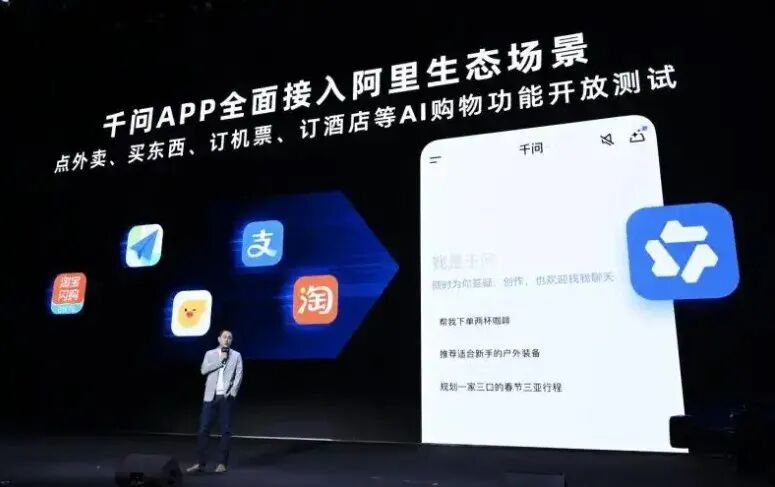
Under the unified industry challenge, creating diverse business segments with aligned directions, and integrating them at the group and capital levels to generate synergistic effects has always been Alibaba's development path.
In the mobile internet era, its core theme was "consumption", which led to the construction of the Taobao e-commerce ecosystem, and the subsequent horizontal expansion into many sectors including payments, travel, local life services, mobility, and entertainment. In the AI era, the focus has shifted to vertical deployment, with the goal of becoming China's only full-stack AI company.
Previously, external attention to Alibaba's AI efforts mainly focused on infrastructure and model layers, such as self-developed chips, cloud computing power, open-source large models, and MaaS platforms. Now, with the outstanding performance of AI apps including Qianwen, Afu, and Abao, Alibaba's national-level AI application matrix has gradually taken shape — something other giants have not yet achieved for now.
However, the giants' AI progress has not been fully reflected in their corporate valuations.
Affected by multiple factors, the capital market has been very strict with these Chinese internet tech companies in recent years. But the success of new AI applications like Afu proves that these large corporations still retain strong AI innovation capabilities, and have every opportunity to define the form and growth path of the next generation of national-level applications. They will not be left behind in the AI era; instead, they are more likely to be the first to secure their "tickets" for the new era.
This is essentially a repeat of the mobile internet era story: when the era of mobile internet access dawned, emerging startups thrived, while large companies born in the PC internet era that moved slightly slower faced widespread skepticism. But a few years later, after the industry's competitive chaos settled and it entered a mature development phase, the leaders of the entire industry may still be those familiar names.
This article originates from the WeChat public account "LetterHub" (ID: wujicaijing), authored by Yan Fei, and published with authorization from 36Kr.