Post-90s Professor Builds Rockets with AI, and the Angel Round Becomes a Sensation
The market excitement over the sea-based net recovery of the Long March 10B rocket has barely faded, and a new angel round financing deal has emerged in the commercial aerospace sector.
It was learned from PEdaily that LegendSpace (Beijing) Intelligent Technology Co., Ltd. (hereafter referred to as "LegendSpace") has officially completed a 200 million-yuan angel round financing. The investment consortium includes multiple top-tier VCs: Oasis Capital, Source Code Dynamic, Shanshi Capital, Qingliu Capital, Oriental Fortune Capital, etc., who jointly participated in the investment, with Gaohe Capital acting as the exclusive financial advisor.
At this point, it has only been half a year since LegendSpace was founded. This young company located in Zhongguancun, Beijing, inherently carries AI entrepreneurship genes. It is a domestic R&D and manufacturer of a new generation of liquid rocket engines, founded by Chen Zhi, a post-90s professor with an impressive resume. Chen Zhi graduated from Huazhong University of Science and Technology in his early years, then went to the UK to pursue his doctorate at the University of Cambridge and stayed there to teach. Later, he returned to China to join Peking University full-time, where the prototype of LegendSpace was born.
It wasn't until early this year that Chen Zhi made up his mind to promote industrial transformation and embarked on the path of AI for Science (AI4S) disrupting the traditional aerospace paradigm. Through this development, we can see that an AI-driven revolution in aerospace manufacturing is kicking off.
From Cambridge PhD Supervisor to Peking University Professor: He Devotes Himself to AI4S + Aerospace
Chen Zhi is undoubtedly the core figure of LegendSpace.
Born in Hunan Province in 1991, Chen Zhi's academic journey began at Huazhong University of Science and Technology, where he was admitted to the School of Energy and Power Engineering at the age of 17. In 2010, he went to the UK to study mechanical engineering at the University of Birmingham, and two years later obtained dual bachelor's degrees from Huazhong University of Science and Technology and the University of Birmingham.
After graduation, Chen Zhi continued his studies at the University of Cambridge to pursue a doctorate in engineering. During this period, he established a multi-physics computational system adapted to the extreme operating conditions of aerospace power. After obtaining his doctorate in 2016, he successively engaged in postdoctoral research and worked as an independent senior researcher and PhD supervisor in the Department of Engineering and Robinson College of the University of Cambridge.

Chen Zhi, Founder of LegendSpace
Due to his outstanding research contributions in combustion theory and modeling, Chen Zhi was awarded the Bernard Lewis Prize by The Combustion Institute in 2020. This award is presented every two years to no more than 6 young scholars globally each time, representing the highest honor for young researchers in the international combustion field. In addition, Chen Zhi will be invited to attend the 41st International Symposium on Combustion held in Kyoto, Japan at the end of this month and deliver a plenary review lecture, making him the youngest and first speaker under 35 years old in the century-long history of the conference.
Apart from his remarkable academic achievements, Chen Zhi also has a little-known experience in top-tier international engineering projects: since 2016, he has deeply participated in tackling the unstable combustion problem of Mitsubishi Heavy Industries' new-generation heavy-duty gas turbines; in 2018, he went to the Combustion Research Center of Lockheed Martin - Sandia National Laboratories in the United States as a visiting scholar for academic exchanges; the following year, he carried out collaborative research as a visiting scientist at the Institute of Combustion Technology of the German Aerospace Center (DLR).
It wasn't until 2021 that, inspired by a series of breakthroughs achieved by DeepMind, which also originated from Cambridge, Chen Zhi accurately predicted that AI would bring disruptive impacts to scientific research. With full enthusiasm, he decided to return to China to teach at the School of Engineering, Peking University, serving as an assistant professor, researcher, and PhD supervisor.
Meanwhile, starting from 2022, he, together with Academician E Weinan (who proposed the concept of AI4S) and Zhang Linfeng (founder of Deep Potential), promoted the establishment of the Beijing Academy of Artificial Intelligence for Science, and served as its academic vice dean. This academy is a new type of R&D institution deployed by Beijing for AI4S, and it is also the world's first research institute named after "AI for Science".
Notably, Chen Zhi led the establishment of the Intelligent Thermal-Fluid Physics Laboratory at Peking University, which focuses on tackling the underlying methodology for the forward design of power systems. A large number of research results directly support the R&D and optimization of core components such as liquid engine combustion chambers, injectors, and thrust chambers. At the same time, his team developed DeepFlame, the world's first open-source platform for reactive flow simulation coupled with an AI framework, which won the "CCF HPC China 2025 Annual Best Supercomputing Application" award. This award is one of the most authoritative and influential honors in China's high-performance computing field, widely recognized domestically as a prestigious award comparable to the Gordon Bell Prize.
Over the past decade, Chen Zhi has been deeply engaged in the fundamental mechanism research of rocket propulsion, working on the front line of interdisciplinary scientific research covering combustion fluid dynamics, power structures, extreme condition tests, and high-performance numerical computing. Thanks to this, he has received numerous prestigious honors, the most notable of which is the "Honorary Life Fellowship of Robinson College, University of Cambridge", making him the only Chinese Life Fellow in the college's nearly 100-year history. In addition, at the age of 28, Chen Zhi was selected for the Special Distinguished Talent Program of the Royal Academy of Engineering, UK, and was also the only young scholar in the engineering field of Peking University selected for the Central Organization Department's Youth Top-notch Talent Program that year.
Through years of observation and research, Chen Zhi found that the core bottleneck restricting the development of China's commercial rocket industry still lies in the propulsion system. Traditional engine R&D relies on a large number of physical iterative tests, resulting in long R&D cycles and high manufacturing and experimental costs. Simply relying on repeated trial and error cannot support the industrial demands of the reusable rocket era and high-frequency launch scenarios. "Our team's years of accumulated underlying research capabilities in multi-physics coupling and intelligent optimization are fundamentally aimed at enabling efficient forward development of physical engine products."
Therefore, at the beginning of 2026, Chen Zhi decided to step out of the laboratory and co-founded LegendSpace with Mao Runze, his first PhD graduate. The company focuses on AI-driven full-process independent R&D of liquid rocket engines, providing standardized and mass-producible propulsion system deliveries for all stages of commercial launch vehicles and power units for aerospace vehicles.
At the Zhongguancun Forum in March this year, the "Prime Yihang" rocket engine R&D intelligent platform, jointly released by LegendSpace and the Beijing Academy of Artificial Intelligence for Science, made its debut. It realizes a complete closed loop of "precise design - physical simulation - precise manufacturing - test verification", compressing the full-cycle iteration of rocket engines from concept to physical verification to a scale of "two weeks", while the traditional model usually takes years to complete this process.
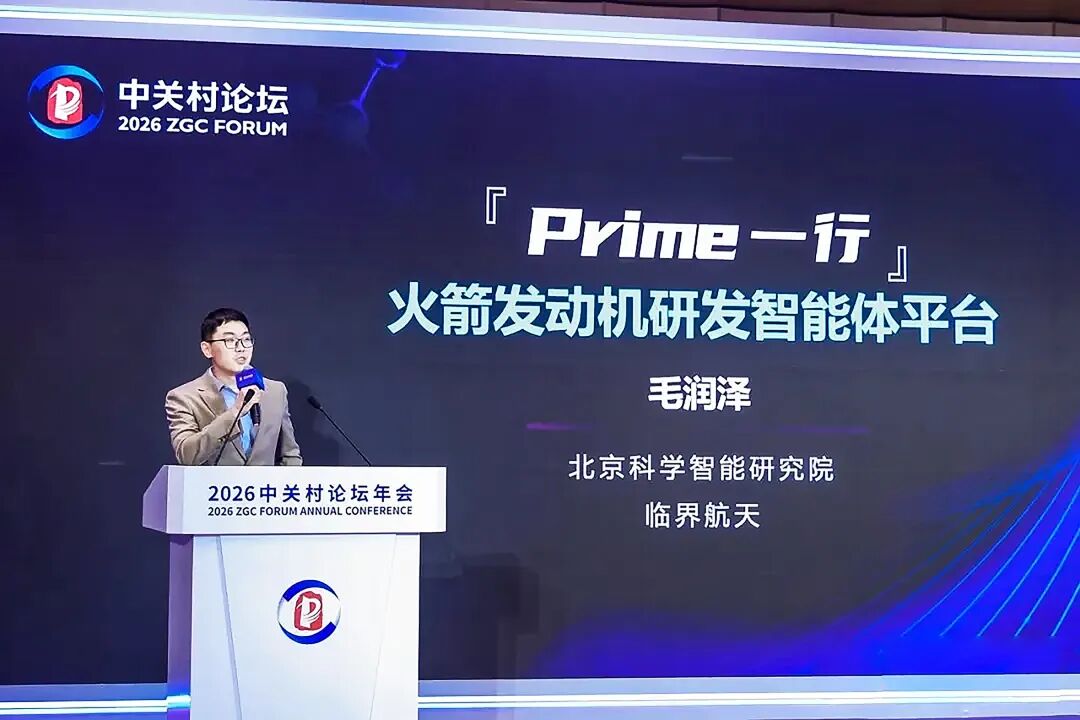
LegendSpace Co-founder Mao Runze Launches the Platform On-site
This means that the "Prime Yihang" platform not only avoids repeatedly "burning money" on physical tests, but also transforms R&D from "trial and error using materials and luck" to "solving problems using data and algorithms". More importantly, it significantly lowers the technical threshold for China's commercial aerospace, and the long-standing bottleneck in the propulsion sector is expected to be completely resolved.
As Chen Zhi stated: "AI algorithms, numerical computing, and intelligent optimization are just our means to deliver better engine products. The core positioning of LegendSpace is an aerospace propulsion equipment manufacturer. All our underlying technical research and computing system construction ultimately aim to develop self-developed rocket engines with controllable costs, leading performance, and scalable mass production capabilities, filling the gap in independent propulsion supply for China's commercial aerospace."
Leading VCs Group Up to Back a Stellar Angel Round
With its first financing closed, LegendSpace has left a deep impression on the venture capital circle.
As we can see, all investors in this round are top-tier domestic market-oriented VC institutions. It is quite rare for them to collectively participate in an angel round to heavily invest in the core hardware manufacturing track of the upstream aerospace sector. This sends a clear signal - it not only confirms the long-term value of the AI + commercial aerospace track, but also reflects that the judgment logic of the primary market is undergoing profound changes.
After communicating with PEdaily, multiple investors participating in this round share the same consensus. They generally believe that after more than a decade of development, China's commercial aerospace industry has bid farewell to the era of concept hype and entered a practical implementation phase featuring equipment mass production and high-frequency launches. As the core essential hardware of launch vehicles, the market demand for rocket engines continues to expand.
Meanwhile, the current global competitive landscape of commercial aerospace has led to an exponential surge in China's launch capacity demands and pressure. To catch up with or even surpass the world's leading launch capabilities, we must break away from the traditional technical framework and achieve "curve overtaking" relying on new paradigms, new tools, and new systems. A hardware team led by top young academic leaders, using AI to drive forward design and full-process lean manufacturing, is currently the most certain breakthrough path. As a result, LegendSpace has naturally come into the common vision of investors and become a consensus investment target.
Zhang Jinjian, Founding Partner of Oasis Capital, said: "In the past, domestic commercial aerospace capital mostly focused on downstream launch vehicles and satellite constellations, while high-quality targets in the upstream core propulsion manufacturing sector were extremely scarce. Global giants have built high barriers through engineering accumulation. To break through these barriers, we must rely on the new technical paradigm led by AI for Science and intelligent manufacturing. We believe that the LegendSpace team, with both underlying theoretical innovation and engineering mass production capabilities, can continuously demonstrate resilience that survives market cycles."
Huang Yungang, Managing Partner of Source Code Dynamic, also believes that the current gap between domestic and international commercial aerospace is no longer just a difference in individual parameters, but a generational gap in R&D systems and iteration efficiency. "The core advantage of LegendSpace is not just simple software technology, but the ability to deliver physical engine products using a complete closed-loop AI R&D paradigm. This is almost the only and most promising new path to break the technical generation gap, solve launch capacity pain points, and achieve curve overtaking, with extremely high scarcity."
From the perspective of the investment team of Shanshi Capital, China's commercial aerospace has entered a critical period of scaled mass production and low-cost competition, and the propulsion system is the core bottleneck of the entire industry. To achieve the leap from "following" to "leading" in domestic aerospace propulsion, we must break through traditional R&D mindsets and reconstruct the manufacturing system through digitalization and intelligence. LegendSpace's technical path perfectly aligns with the core demand for the industry's curve overtaking, representing a key direction for domestic aerospace propulsion to reach the world's leading level in the future.
The project team of Oriental Fortune Capital also stated that commercial aerospace is moving towards the 2.0 era of extreme cost reduction and high-frequency launches. Although the Long March 10B has achieved recovery, there is still much room for iteration for its core engines, and there is still a certain gap compared with international advanced levels. The LegendSpace team combines top-tier algorithm capabilities and front-line engineering experience. Based on first principles, they deeply integrate AI for Science with additive manufacturing, and successfully developed a brand-new rocket engine in just a few months. Their large-scale simulation significantly reduces test costs and breaks the physical boundaries of R&D. "We believe that LegendSpace is expected to rapidly narrow the gap with SpaceX through innovation in the new aerospace paradigm, and become a benchmark leading the new generation of aerospace manufacturing paradigm."
As we all know, compared with the downstream segments of commercial aerospace such as satellite applications and launch services, the upstream rocket propulsion hardware manufacturing sector has larger gaps in localization and intelligence, broader substitution space, and more prominent long-term investment value. The primary market has clearly captured this industrial trend and is voting with real money.
The deeper significance behind LegendSpace's ability to quickly complete 200 million yuan of financing shortly after its establishment is that the primary market's judgment logic for early-stage commercial aerospace projects has shifted from simple "track positioning" to in-depth evaluation of "technical paradigm reconstruction capabilities".
Following this logic, the AI for Science path represented by LegendSpace is a typical target under this new evaluation framework: it is not a simple copy of the mature international path, but fundamentally reconstructs the R&D method of rocket engines from the underlying logic.
The concentrated layout of multiple top-tier institutions at the angel round is essentially a strategic bet on this "curve overtaking" logic, and it further confirms an industry consensus - AI-empowered high-end physical manufacturing will become the core driver for China's commercial aerospace to break through technical blockades, narrow the gap in major-country competition, and achieve leapfrog development.
To some extent, this financing will set a typical benchmark for early-stage commercial aerospace projects, and also indicates that a new era of investment in AI-empowered aerospace manufacturing is coming.
China's Commercial Aerospace Achieves Curve Overtaking
At present, China's commercial aerospace is reaching an inflection point.
From an industry perspective, the strategic positioning of commercial aerospace is undergoing a historic rise. As we remember at the end of last year, the Shanghai Stock Exchange announced that commercial rocket enterprises are eligible for the fifth set of listing standards on the Sci-Tech Innovation Board, which shocked the entire venture capital circle; this year, commercial aerospace was officially included in the key tasks of the "15th Five-Year Plan", and a dedicated Commercial Aerospace Regulatory Bureau was established. All these measures have built a complete system covering top-level planning, industry regulation, and capital markets. The Long March 10B launch vehicle also successfully completed its maiden flight, verifying the world's first "sea-based net recovery" technology.
At the same time, market demand is experiencing explosive growth. Across the country, multiple regions are accelerating the construction of aerospace industrial clusters, striving to form a complete industrial ecosystem integrating R&D, manufacturing, testing, and application; a number of reusable launch vehicles and low-orbit satellite constellation projects are also being intensively promoted.
The rapidly expanding market demand puts forward new requirements for rocket propulsion systems. Traditional propulsion products with high costs, long cycles, and low reusability can no longer adapt to large-scale commercial launch scenarios. The market is in greater need of highly reliable, low-cost commercial aerospace launch capacity and propulsion systems.
For LegendSpace, this is a historic window of opportunity that cannot be missed.
If we broaden our vision to the global market, we can see that leading international aerospace enterprises have already completed the deep integration of AI and aerospace manufacturing. Relying on intelligent systems, they have achieved rapid iteration, extreme cost reduction, and scaled mass production of propulsion products, continuously consolidating their technical leading advantages.
For example, SpaceX, which recently completed the largest IPO in history, not only leads the industry in rocket recovery technology, but also widely applies AI technology in engine design and manufacturing. According to public information, SpaceX integrates AI tools from the early design stage, significantly shortening development time and material costs, and achieving rapid iteration without a large number of physical tests. The thrust of its Raptor 3 engine has almost doubled, while the cost has been reduced to a quarter of the original, which is the most intuitive embodiment of the "AI-driven manufacturing revolution".
SpaceX's practice proves that it is impossible for domestic enterprises to break through by simply copying the traditional international R&D path. Intelligent manufacturing empowered by AI has become the core trend of the commercial aerospace propulsion industry's upgrading, and it is also the key to breaking technical bottlenecks and realizing scaled commercialization. Only by relying on the new paradigm of AI intelligent manufacturing to reconstruct the full-process system of rocket propulsion R&D, manufacturing, and testing can we break the long-standing technical generation gap and achieve the transformation from passive following to active surpassing.
Chen Zhi has a deep understanding of this. He judges that the space economy is a long-term track with extremely high certainty in the coming decades, and propulsion equipment is the foundation of the entire industry's development. The barriers of international aerospace propulsion are essentially the barriers accumulated through traditional engineering iterations, making it difficult for latecomers to catch up linearly.
"AI intelligent manufacturing is a brand-new opportunity for China's commercial aerospace. Our long-term goal is to build a domestically leading and globally competitive independent R&D and manufacturing platform for liquid rocket engines, using the new intelligent paradigm to develop cost-effective and mass-producible domestic rocket engines, helping China's commercial aerospace achieve curve overtaking, and supporting the implementation of major industrial projects such as low-orbit constellation