Is Meizu completely emptied out after its "soul" was sold off and its core veterans left the company?
The sudden resignation of Meizu's CMO in China has broken the recent lull of the company, and shattered the last glimmer of hope for Meizu fans that the brand could make a comeback in the mobile phone market...
The full story of the Meizu veteran's "lightning resignation"
At exactly 10 a.m. on July 15, Wan Zhiqiang — a long-serving Meizu veteran, CMO of the China region, and brand director of PANDAER — suddenly updated his Weibo account after a long period of inactivity, officially announcing his departure from Meizu after 20 years of service. The news immediately sparked widespread discussion across the industry and the public.
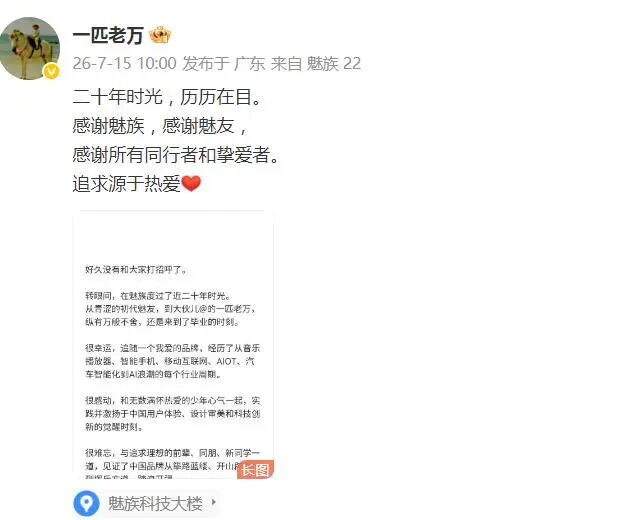
Wan Zhiqiang (affectionately known as "Lao Wan" among Meizu fans) has spent a full 20 years working at Meizu. After the departure of the "Three Musketeers of Meizu", he was essentially the only remaining veteran executive with the highest public influence online. As a core figure in building the "Meizu fan culture" system, he long served as the spiritual pillar for the brand's loyal supporters.
He led Meizu's brand marketing efforts for many years, personally overseeing the go-to-market strategies for multiple flagship smartphones, the Flyme AIOS, and Flyme Auto. He was also deeply involved in building brands like Blue Charm and Lipro from scratch, and founded PANDAER — a trendy tech brand beloved by young consumers.
From marketing operations in the MP3 era, to ecosystem development in the smartphone era, to brand storytelling during the AIoT and intelligent vehicle phase... his hardworking presence could be seen behind all these major strategic transformations, earning him the labels of passion, dedication, and strong sense of responsibility.
Previously, Meizu had weathered countless storms big and small, and he had always stood firmly by the company. Yet now, this executive who seemed the least likely to leave has finally stepped down. Why?
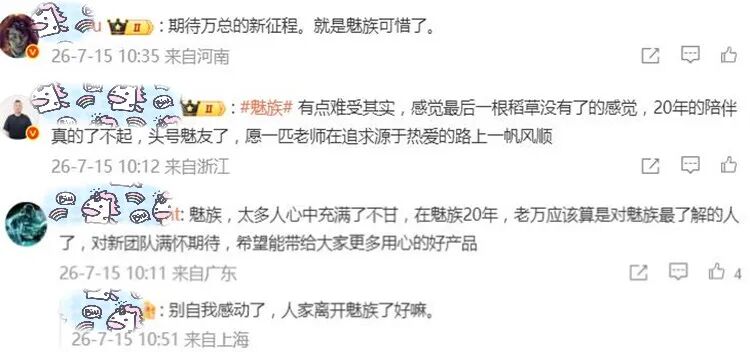
If we trace the timeline back a few months, it is not hard to find that Wan Zhiqiang's departure did not happen without warning:
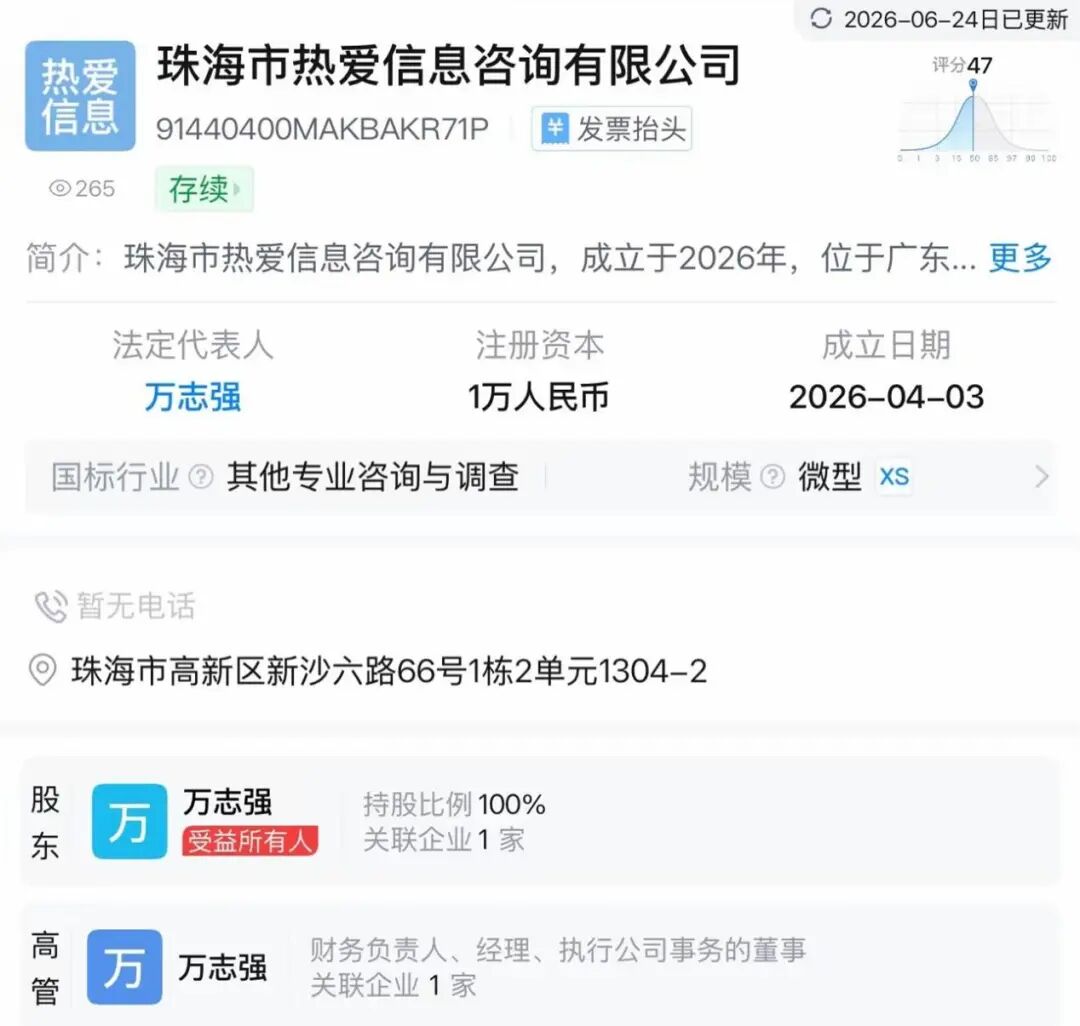
On April 3, 2026, Zhuhai Passion Information Consulting Co., Ltd. was registered, with a registered capital of 10,000 yuan. Wan Zhiqiang serves as its legal representative and actual controller. The company is speculated to be a new entity focused on continuing marketing PR and promotional services, which is seen as a clear sign that Wan Zhiqiang was preparing to leave Meizu to start his own business;
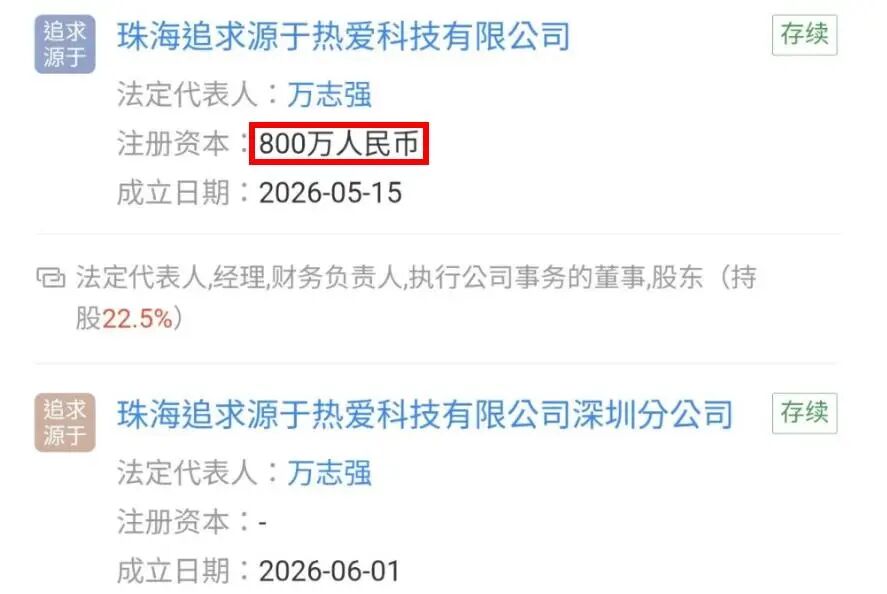
On May 15, 2026, Zhuhai Pursuit Born of Passion Technology Co., Ltd. was established, with a registered capital of 8 million yuan, and Wan Zhiqiang still as its legal representative. Shortly after, on June 1, the company's Shenzhen branch was also founded. According to its business scope, the company mainly engages in sales of electronic products, wearable devices, and mobile terminal equipment.
Moreover, in the Zhuhai Passion Partners Management Consulting Partnership, where Wan holds a 77.5% stake, a large number of long-time former Meizu employees are listed as founding shareholders. Judging from the business scope of these newly registered companies, it is reasonable to conclude that Wan Zhiqiang, together with a group of veteran Meizu staff, has broken away from the original Meizu system to launch their independent entrepreneurial venture.
This raises a question: Zhuhai Meizu already has ready-made office parks, distribution channels, and supply chain resources. If they wanted to continue developing projects and selling products, why not just keep working within the existing framework? Why go through all the trouble of resigning to start a completely new operation from scratch?
As of press time, no media has published an in-depth analysis of this. Exclusive analysis from *Internet Happenings* suggests this may be related to the difficulties and potential risks that Zhuhai Meizu is currently facing. The decision for Lao Wan to resign from Meizu and partner with former colleagues to launch new projects could theoretically be a necessary move for "risk isolation" and to protect the outcomes of the new startup.
Because not long ago, an official announcement from Tianyin Holdings indirectly exposed Meizu's harsh reality:
In Tianyin Holdings' 2022 annual report, the "other equity instrument investments" item showed changes: the closing balance for Meizu Technology was 0 yuan, while the closing balance for Xingji Meizu was 43.9769 million yuan. In recent years, this investment has apparently not generated any returns.
In early June, according to Tianyin Holdings' latest announcement, Xingji Meizu recorded revenues of 2.319 billion yuan and 1.474 billion yuan in 2024 and 2025 respectively; its net profits were -1.238 billion yuan and -2.183 billion yuan, with a total net loss of over 3.4 billion yuan across the two years.
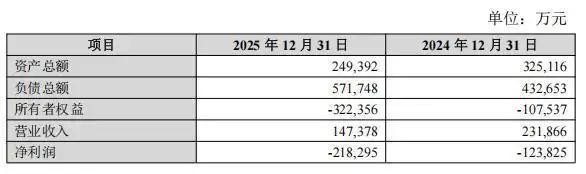
By the end of 2025, Xingji Meizu's owner's equity stood at -3.224 billion yuan, indicating a severe state of insolvency.
It is thus easy to understand why Tianyin Holdings plans to transfer its 1.65% stake in Wuhan Xingji Meizu Technology Co., Ltd. via public listing on the Shenzhen United Property and Equity Exchange, with the listing price set at 77 million yuan. If the transaction is completed smoothly, Tianyin Holdings will fully divest all its shares in Xingji Meizu.
On the evening of June 22, ECARX Technology Holdings officially announced that it had signed a definitive acquisition agreement to purchase the Flyme software business, including the two core products: the Flyme Auto intelligent cockpit operating system and the cross-terminal Flyme operating system. The total value of this transaction is 1.8 billion RMB (approximately 266 million USD).
Public information shows that Flyme OS has developed capabilities covering a wide range of smart terminals including vehicles, smartphones, and smart wearables. Flyme Auto is already installed in over 2 million mass-produced vehicles. Its partnership with Geely Group targets reaching 3 million vehicle installations by 2026.
As the "soul" behind Meizu's smartphones and vehicle infotainment systems, Flyme is undoubtedly Meizu's most valuable core asset. This 1.8 billion yuan sale means Meizu has played its final card, and there will likely be no more high-value assets left to put on the market in the future.
...
Looking through public records, the change of ownership for Flyme was foreshadowed long ago:
In January of this year, Wan Zhiqiang announced with reluctance at a public Meizu event: due to a sharp increase in memory chip costs that disrupted the business plan, the originally scheduled launch of the Meizu 22 Air was canceled.
In February, Meizu issued a major announcement stating it would suspend domestic self-developed mobile hardware projects, shifting its focus from hardware manufacturing to AI-driven software development, dedicated to building an open Flyme ecosystem.
In April, ECARX already stated its intention to take over the entire Flyme asset package, and by the end of June, Flyme had been fully separated from Meizu.
During the period of intensive major moves from April to June, Wan Zhiqiang quietly set up his new business. To some extent, this brings new hope that he will carry forward Meizu's "legacy", but the products have not been released yet. What the future holds remains entirely uncertain.
The predicament Meizu finds itself in today has its roots in the day it was acquired by Geely, with subtle clues laid out long in advance...
"Tears of the era"
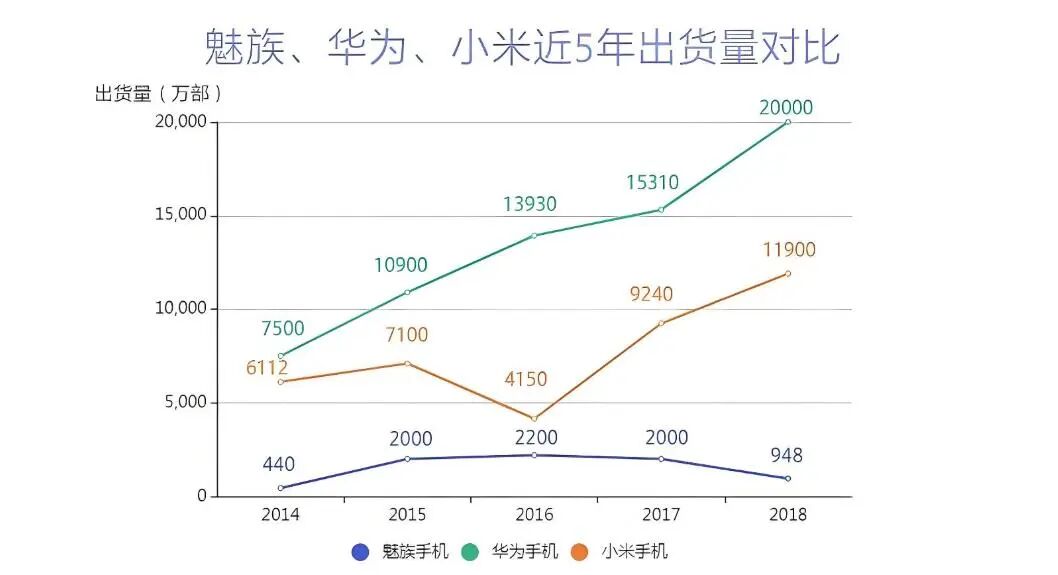
Back in 2018, Meizu's smartphone shipments plummeted by half to 9.48 million units, completely losing the ability to compete with Huawei and Xiaomi. At that time, Meizu was plagued by a host of internal and external crises, standing at a critical moment of life and death. In this hour of need, Huang Zhang sought help from Zhuhai's "white knight" — Honghua Fund.
Source: 21 Data News Lab
However, the two parties agreed on a precondition. Article 16 of Meizu's 2019 company articles of association stipulated that "if Meizu fails to complete a qualified IPO by June 30, 2025, Honghua Fund has the right to transfer its equity in the company to a third party". From that moment on, the obsession of aligning all efforts toward an IPO began to take root.
Later, an internal letter circulated publicly stated: "The 2020 financial metrics show sustained profitability, while our position in the high-end market is growing increasingly stable. This long-awaited positive feedback has created a genuine passport for the company's healthy development and the realization of our IPO strategy."
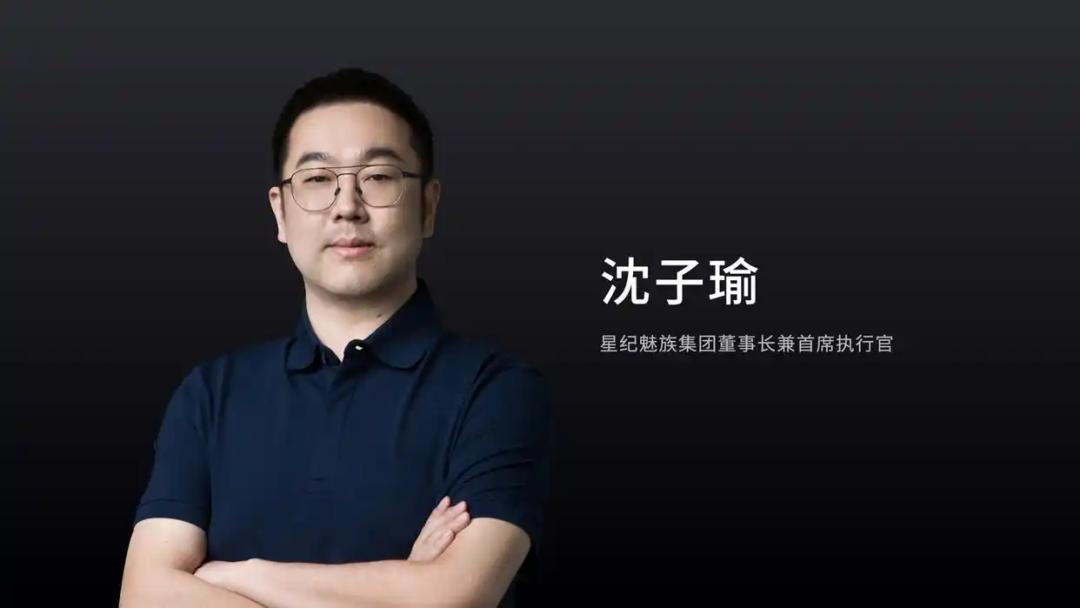
Two years later, the hope for Meizu's IPO reached its peak. On July 4, 2022, Geely-backed Xingji Times acquired 79.09% of Meizu's equity and established the Xingji Meizu Group. This major move was widely interpreted by the market as a sign that with Li Shufu's backing, Meizu was entering its second golden era.
Shen Ziyu, then chairman of Xingji Meizu, publicly spoke enthusiastically about the "Hua, Xiao, Mei" (Huawei, Xiaomi, Meizu) narrative, repeatedly highlighting the ambition of returning to the top five positions in the Chinese mid-to-high-end smartphone market.
Nevertheless, Meizu's performance consistently fell short of expectations, with mobile phone sales remaining far below the threshold for the top five rankings. This is not because Meizu didn't put in the effort — in an extremely competitive industry, Meizu, which lacked advantages in talent, patents, and capital, simply found it too difficult to develop products with competitiveness exceeding that of Huawei and Xiaomi.
During the years when Meizu received limited financial support from Geely and pushed forward multiple concurrent business lines covering smartphones, automotive technology, and XR integration, the company also faced a series of troubles including frequent executive reshuffles and large-scale layoffs. This scenario is strikingly similar to the Zhuhai Meizu era, when the company received capital injection from Alibaba but was plagued by constant internal power struggles among senior management...
Just when the Geely-aligned management finally aligned their strategic vision, and Meizu had sorted out its product lines and confirmed its focus on developing the Flyme AI OS, AI smartphones, and XR products, a "black swan" event struck unexpectedly!
The consumer electronics industry encountered a once-in-a-decade, historic winter — a massive memory supercycle, where prices of DRAM and NAND chips skyrocketed. Even top 5 giants like Huawei, Xiaomi, OPPO, vivo, and Honor suffered dual blows to their shipment volumes and gross margins. As of this article's publication, Apple, Huawei, Xiaomi, OPPO, vivo, and Honor have all raised their product prices...
The "small but beautiful" Meizu, faced with harsh realities, could no longer justify convincing Li Shufu to keep investing money, and was forced to concede. This concession marked the end of its self-developed smartphone business.
Meizu once made significant contributions to China's mobile phone industry and even the broader consumer electronics sector, nurturing countless industry talents. However, as the AI wave sweeps across the market, the (AI) smartphone and automotive sectors have entered an oligopolistic era — only those giants that can still afford sustained losses can remain in the game.
Meizu, the brand by the beautiful coast of Zhuhai, ultimately could not avoid fading into obscurity~
References:
Wan Zhiqiang's Weibo
Sold Flyme for 1.8 billion: Is Meizu approaching its end? - Wall Street CN
Marrying ECARX for 1.8 billion: Meizu sells its "lifeline" Flyme - Zhidu Technology
Divesting its stake after investing in Meizu for nearly 10 years! What pain lies behind Tianyin Holdings' full exit? - Investment Time Network
This article is from WeChat official account "mawen011" (ID: hlw0823), author: *Internet Happenings*, republished with authorization from 36Kr.