Price wars have eroded profits, how else can electric vehicles win?
In the first half of this year, the Chinese automotive market has shown a prominent characteristic of "domestically sluggish yet externally robust". According to data from the China Passenger Car Association, cumulative domestic retail sales from January to June reached 8.701 million units, a year-on-year decline of 20.2%; wholesale sales hit 12.547 million units, down 5.7% year on year; while export volume surged sharply to 4.252 million units, marking a 71% year-on-year increase.
Clearly, the new growth opportunities for Chinese automakers lie in the more uncertain overseas markets, and all Chinese vehicle brands need to fully prepare to compete head-to-head with other major international automotive groups.
However, it should be noted that exploring international markets does not mean neglecting the domestic market. On the contrary, only by securing the existing domestic market "cake" can enterprises go further and last longer in the upcoming fierce global market competition.
Focusing on the domestic market, thanks to the rapid expansion of the new energy vehicle sector, China's automotive market has entered an unprecedented boom period. Nevertheless, influenced by factors such as the phase-out of subsidies, weak domestic demand, and the normalization of terminal price wars, consumers' wait-and-see sentiment has spread, further intensifying the involution in the automotive market and putting the profitability of automakers to the test.
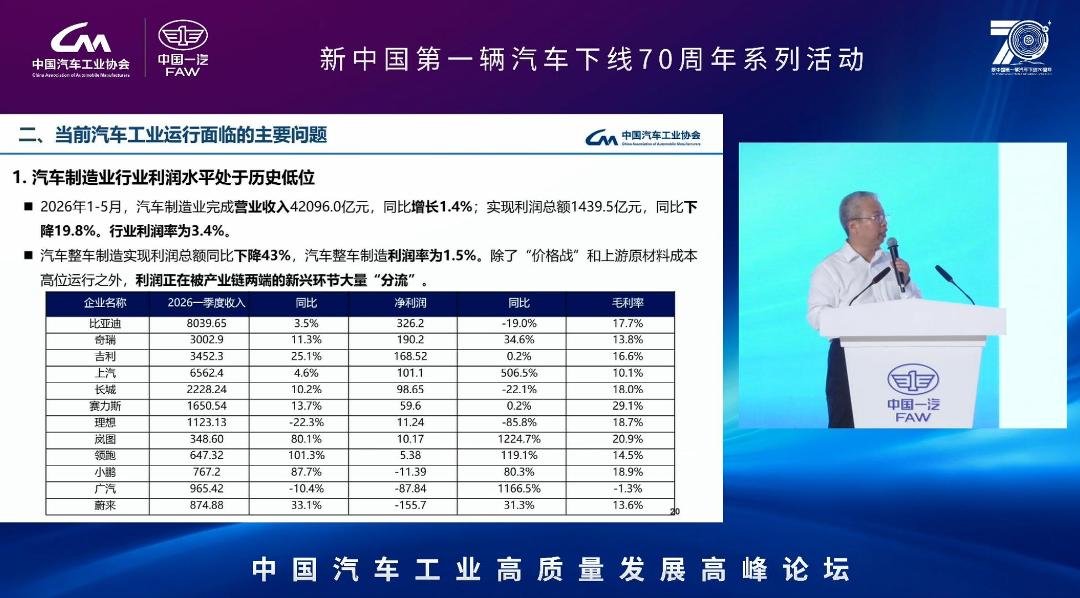
At the High-Quality Development Summit of China's Automotive Industry, Chen Shihua, Deputy Secretary-General of the China Association of Automobile Manufacturers, disclosed the current profitability status of the automotive industry:
From January to May 2026, the automotive manufacturing sector (including complete vehicles and auto parts) generated revenue of 4.2096 trillion yuan, representing a 1.4% year-on-year increase; total profits reached 143.95 billion yuan, down 19.8% year on year, with an industry profit margin of 3.4%.
The total profit of complete vehicle manufacturing dropped by 43% year on year, with a profit margin of just 1.5%. Apart from the "price war" and rising raw material costs in the upstream, profits are being significantly "diverted" by emerging segments at both ends of the industrial chain.
Chen Shihua stated: "The 'smile curve' of profits has now changed. It is no longer the traditional upstream auto parts suppliers that are earning our money, but the players focused on intelligent technology, batteries, and chips. At the downstream end, it is no longer the 4S dealerships that benefit, but the media platforms."
If the overall decline in profits across the automotive industrial chain is attributed to persistent industry involution and rising upstream raw material prices, then what is the reason for the uneven distribution of profits in such a challenging market environment?
The answer is straightforward — in the new energy vehicle era, the discourse power of automakers has been diluted.
Ignoring Brand Building? That's a Suicidal Move
Why are the profits in the upstream of the automotive industry being captured by intelligent technology, battery, and chip manufacturers? Because these new-era suppliers hold core technological barriers, and most of the functional features and impressive range performance that new energy vehicles rely on to differentiate themselves come from these suppliers.
Why are the profits in the downstream of the automotive industry going to media platforms instead of 4S dealerships? Because media platforms have more diversified reach channels, enabling them to occupy user mindsets faster and more effectively, and further boost vehicle sales through multi-channel engagement.
Under such an industrial model, the only reliable approach for automakers to run through the entire industrial chain, secure stable long-term premium returns, and regain discourse power is systematic brand building.
Compared to the widespread consumer recognition of "choosing CATL when buying an EV", the marketing rhetoric of some new automotive brands struggles to win consumer approval. This is not because the product strength of their vehicles is too low to be recognized by the market, but because their brand building in the new energy vehicle era has failed to keep pace with the market's rapid expansion.
In short, consumers do not trust the current new energy vehicle brands enough.

Many people consider brand building a "thankless task", as cultivating strong brand power is a long-term project. Automaker employees also tend to prefer proving their performance through quick, tangible traffic metrics rather than investing in the subtle, intangible improvements of brand value.
This has indirectly led to the emergence of a large number of new EV startups in the new energy vehicle era, rather than the established traditional automotive brands dominating the market with a winner-takes-all pattern.
NIO, Xpeng, Li Auto, and Leapmotor — the four leading new EV startups — have profound insights into brand building. Back when they were founded, each of them had laid down a distinct "hidden thread" for their brand positioning.
NIO focuses on high-end pure electric vehicles, impressing high-net-worth users with all-round premium services; Li Auto targets "family-friendly vehicles for dads", meeting the needs of family users with versatile product capabilities; Xpeng prioritizes technological innovation, attracting tech enthusiasts with intelligent features; Leapmotor emphasizes cost-effectiveness, reaching ordinary consumers with high-quality yet affordable products.
Today, China's new energy vehicle market has officially entered a phase of elimination, and the role of brand value has become increasingly prominent. Although NIO, Xpeng, Li Auto, and Leapmotor have certain brand advantages, they still face challenges keeping up with the cross-sector competition from brands like Xiaomi and Huawei.
Even so, no one is willing to admit defeat easily in the brand competition. Moreover, the four automakers have embarked on different paths in terms of brand development strategies.
Major Divergences in Brand Building Approaches
According to widespread market perception, NIO is the "most dynamic" player among new EV startups, and a typical representative of China's luxury new energy vehicle brands with abundant innovation but a less distinct premium luxury pedigree. Many even believe that NIO's "counter-trend growth" in the first half of this year is largely attributed to the dividends of its strong brand value.
While this holds true to a large extent, it is not the full picture. Beneath the brand facade, NIO's growth is supported by its long-term, heavily invested battery swapping system, R&D system, and service system.
In the first half of this year, Li Bin emphasized on multiple occasions that the industry has transitioned from a chaotic brand phase to a brand clarification phase. In his view: "A brand is not a castle in the air. It is the accumulated user perception formed after a complete system consistently delivers on its promises to users over the long term. NIO's growth in the first half of the year is the result of our years of systematic layout entering a full delivery period."
If NIO's automotive philosophy defines "brand as an extension of systematic capabilities", then Xpeng's brand is more like a "carrier of technological variables". Unlike NIO, Xpeng does not believe the automotive industry has entered a brand clarification phase.
From He Xiaopeng's perspective, the automotive industry is still in a transformative stage. Between 2025 and 2035, there remains huge room for the global automotive brand landscape to be reshaped, and technologies such as AI and autonomous driving will completely redefine the logic of brand competition.
That is why He Xiaopeng stated: "The core of Xpeng's own brand is exploration, technology, globalization, and a future-oriented mindset, adhering to using technological equity to improve public lives."
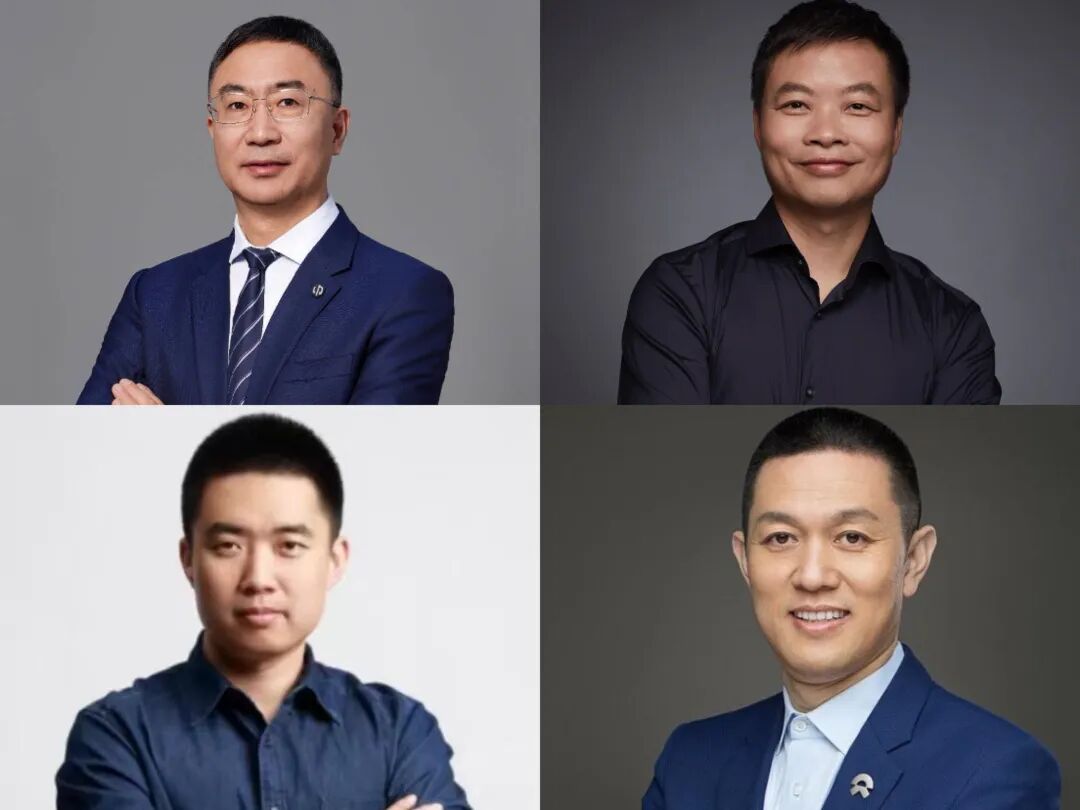
Leapmotor's understanding and definition of its brand are noticeably more down-to-earth. In an interview after the recent launch event of the Leapmotor D99, Zhu Jiangming put it bluntly: "Product is brand. A pure, abstract brand does not exist. In the minds of consumers, how Leapmotor's products perform directly defines what Leapmotor's brand stands for."
"Full-stack self-development" and "high-quality at affordable prices" are the two most frequently mentioned mottos of Leapmotor, which also constitute its product philosophy. This has led consumers to label Leapmotor as a brand of exceptional product value for money. However, this clearly does not mean Leapmotor can only sell low-cost vehicles, nor does it represent the full extent of Leapmotor's brand positioning.
According to Leapmotor's logic, the upcoming D-series products, the Q3 technology launch event, and the distinctive products from its second brand next year will all bring new growth and evolution to the Leapmotor brand.
In comparison, Li Auto seems to focus more on the functional value that products can deliver, to further realize the in-depth scenario integration of "car and home". Li Auto's efforts in AI and embodied intelligence are all aimed at making the entire vehicle usage scenario more intelligent and user-friendly.
Li Xiang said: "In the past decade, we created a mobile home. In the second decade, we will endow both the vehicle and the home with a sense of life."
In short, the "mobile home" concept has completed product validation in the physical space, representing the 0-to-1 stage of development; "endowing life" means upgrading the scenario experience through embodied intelligence, marking the 1-to-10 growth phase. This brand strategy has opened up a brand new growth narrative for Li Auto in the intelligent era, but it has also brought many new challenges.
Building a Brand Cannot Rely on Empty Hype
All in all, current brand building is not about leveraging brand premium to exploit consumers, but about using brand development to make consumers better recognize and understand your brand, so that enterprises can survive the "darkness before dawn" in China's automotive market.
However, a brand cannot exist without a solid foundation — it must have strong core support: NIO's support is its comprehensive system, Xpeng's support is its technological strength, Leapmotor's support is its product capabilities, and Li Auto's support is its scenario-oriented product definition.
In the past few years, many new energy automakers have misinterpreted brand building as simply pursuing traffic, exposure, and viral hot topics. These factors can only bring short-term attention, but cannot generate long-term value. A truly strong brand is the stable value perception that consumers can quickly establish when facing complex purchasing choices.
Capabilities that automakers previously emphasized repeatedly, such as 800V fast charging, smart cockpits, advanced driver assistance systems, and long-range batteries, are gradually transforming from differentiated competitive advantages into industry standard configurations. As technological gaps continue to narrow, the ultimate competition among automakers is no longer just about hardware specifications, but about which product delivers higher overall value, including emotional value.
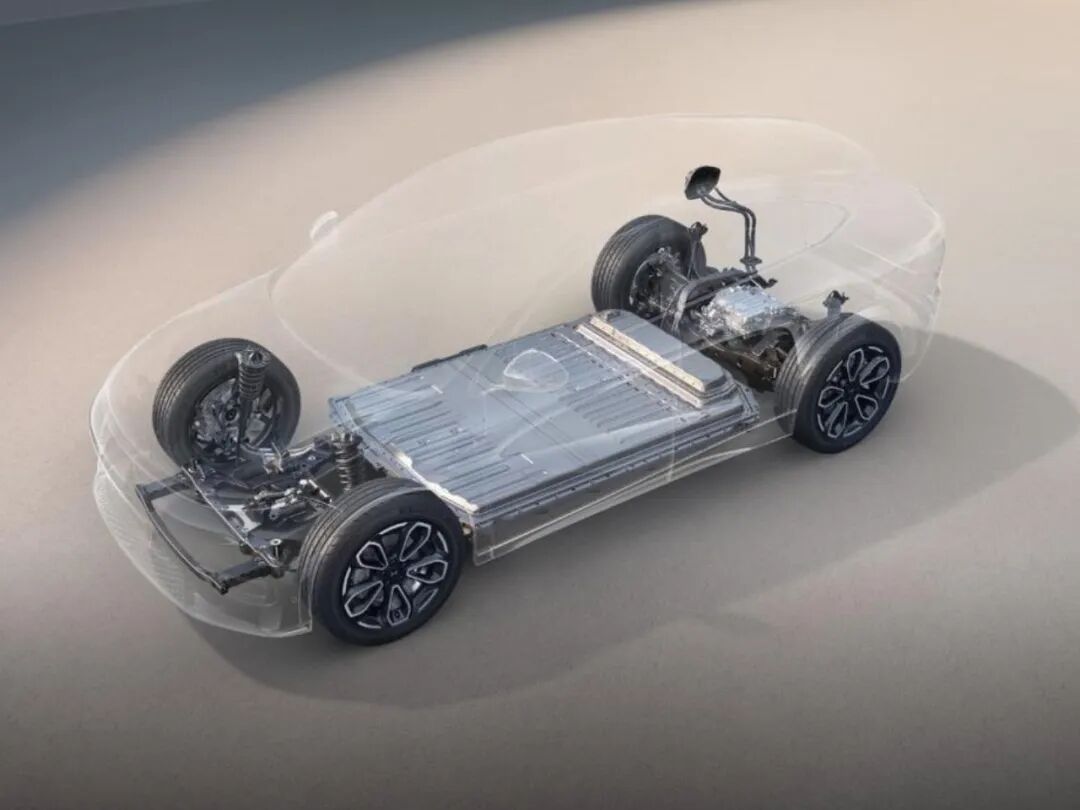
Consumers may know what battery your vehicle uses and what chip it is equipped with, but still fail to understand why they should choose your brand over others — this is the problem caused by insufficient brand building.
A brand cannot be built through empty hype; it is forged through consistent long-term delivery. Without technological support, a brand is nothing more than hollow publicity; without excellent product experience, a brand is just fleeting traffic; without continuous service engagement, it is difficult for a brand to build long-term consumer trust.
The upcoming competition in the automotive market will certainly not be limited to price or configuration battles. The core of competition will lie in which brand can establish a clearer and more stable perception in consumers' minds.
NIO, Xpeng, Li Auto, and Leapmotor have chosen different brand development paths, but essentially they are all answering the same question: as technologies become more widespread and product gaps keep shrinking, why should consumers still choose your brand?
In the elimination phase of the new energy vehicle market, the companies that get eliminated are not necessarily those with subpar products, but those that fail to leave a memorable impression, earn consumer trust, or build long-term value perception. After all, marketing only determines whether you can be noticed, while brand value truly determines whether you will be chosen by consumers.
This article is from the WeChat public account "Auto Community" (ID: iAUTO2010), written by Zhang Zhidong, and authorized for release by 36Kr.