Raising 100 billion yuan in half a year, embodied AI is betting on the second Wang Xingxing
At the 2025 Spring Festival Gala, Unitree Robotics became a viral sensation with its performance "YangBot". Since then, embodied intelligence has become the focus of market attention.
Investment and financing in the primary market directly reflect the market's interest in the embodied intelligence industry. According to data from IT Juzi, in 2024, the total financing amount of China's embodied intelligence industry was just over 10 billion yuan, and by 2025, this figure had risen to 45.3 billion yuan. In the first half of this year, the financing amount of the embodied intelligence industry has reached nearly 93.5 billion yuan.
At the secondary market level, embodied intelligence enterprises are also accelerating their layout. At present, companies such as UBTECH (9880.HK) and Dobot (2432.HK) have been listed on the Hong Kong Stock Exchange, while companies including Unitree Robotics, DeepMotion, and AgileRobotics are advancing their IPO processes. Leading embodied intelligence unicorns such as Agibot and QX Intelligence have also reported IPO plans, and the capitalization process of the industry is fully accelerating.
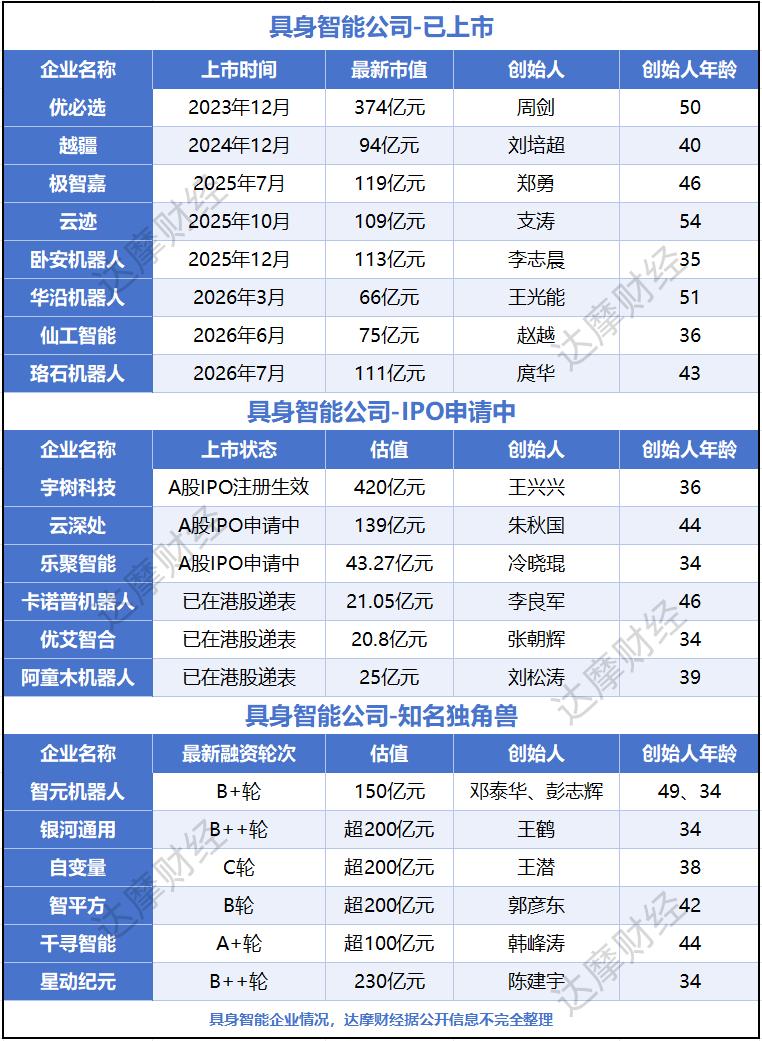
With continuous inflow of financing, the technological iteration speed of embodied intelligence enterprises has significantly increased. At this point, commercial implementation has become a new problem that the entire industry urgently needs to solve. Embodied intelligence enterprises that take the lead in establishing a sustainable commercial path will gain a competitive advantage in future industry competition.
Post-90s Founders as the Main Force
Compared with other tracks, founders in the embodied intelligence industry often have distinct talent characteristics: they generally graduate from top universities and have in-depth experience in engineering-related fields. From an age perspective, young people born in the 1980s and 1990s are the main force of entrepreneurship in the industry.
Wang Xingxing, the founder of Unitree Robotics, is arguably one of the most well-known founders in the embodied intelligence industry. Born in 1990, Wang Xingxing is 36 years old this year. In 2016, he obtained a master's degree from Shanghai University. After graduation, he briefly joined DJI, but only a few months later, he chose to resign and start his own business, founding Unitree Robotics.
In the early stage of entrepreneurship, Wang Xingxing focused on quadruped robot products and launched his first product "Laikago" in 2017, which became one of the earliest commercial quadruped robots in China. In 2023, Unitree Robotics released its first humanoid robot H1, and started small-batch commercial delivery in the same year.
At present, Wang Xingxing directly and indirectly holds 33.36% of the shares in Unitree Robotics. Calculated based on the latest valuation of 42 billion yuan for Unitree Robotics, Wang Xingxing's net worth has exceeded 14 billion yuan.
Peng Zhihui, co-founder of Agibot, is also one of the well-known post-90s figures in the industry. Peng Zhihui is 33 years old this year, and he studied for both his bachelor's and master's degrees at the University of Electronic Science and Technology of China. He is a Bilibili UP owner with 2.8 million followers and was once selected as one of Huawei's "Genius Youngsters". In 2023, Peng Zhihui co-founded Agibot and became the company's CTO and President.
In addition to Wang Xingxing and Peng Zhihui, there are many post-90s founders in the embodied intelligence industry, including Chen Jianyu, founder of MotionEra, Wang He, founder of Galaxy Universal, Li Zhichen, founder of AnBot, Zhao Yue, founder of RealRobotics, Leng Xiaokun, founder of Leju Robotics, and Zhang Zhaohui, founder of AgileRobotics.
Among these founders, Chen Jianyu, the founder of MotionEra, became a doctoral supervisor at Tsinghua University at the age of 28, making him one of the youngest doctoral supervisors at the university. Li Zhichen, founder of AnBot, and Leng Xiaokun, founder of Leju Robotics, are both alumni of Harbin Institute of Technology. After graduation, they both went south to Shenzhen and founded their own embodied intelligence companies relying on the local industrial ecosystem.
Compared with post-90s founders who embarked on entrepreneurship shortly after graduation, post-80s founders in the embodied intelligence industry mostly have relevant industry work experience.
Among them, Zhu Qiuguo, founder of DeepMotion, is an associate professor and doctoral supervisor at the College of Control Science and Engineering of Zhejiang University. Tuo Hua, founder of Rokae, has worked in companies such as Ericsson and Sinomach, and founded Rokae in 2014.
Li Liangjun, founder of Changzhou CNC, is one of the few founders in the industry with a blue-collar background. Li Liangjun graduated from Neijiang Coal Technical School in 1999 and founded Changzhou CNC in 2012.
Zhou Jian, founder of UBTECH, Zhi Tao, founder of CloudWhale (2670.HK), and Wang Guangneng, founder of Huayan Robotics (1021.HK), are among the rare post-70s founders in the embodied intelligence industry.
Zhou Jian was born in 1976 and is exactly 50 years old this year. Before founding UBTECH, Zhou Jian worked at German company Meyer & Co., and later founded U-King Machinery, which mainly engaged in business such as automated production line equipment for building materials. In 2008, Zhou Jian saw a humanoid robot at an exhibition in Japan, which became the opportunity for him to establish UBTECH.
Finding the Path to Commercialization
In both the primary and secondary markets, embodied intelligence enterprises are very popular, but from a commercial perspective, many companies have not yet formed a stable business model, and the practical application value of their products remains to be explored.
Taking UBTECH as an example, the company has made many moves in the embodied intelligence field in recent years, but its revenue mainly comes from non-embodied intelligence robots in industries such as logistics and education. In 2025, the revenue from the company's non-embodied intelligence robots, other robots and hardware equipment business accounted for 58.9%.
Moreover, due to UBTECH's long-term large investment in R&D, the company has not yet achieved profitability. From 2023 to 2025, the company's revenue was 1.047 billion yuan, 1.295 billion yuan, and 1.981 billion yuan respectively, and the net losses attributable to shareholders were 1.234 billion yuan, 1.124 billion yuan, and 703 million yuan respectively.
Other embodied intelligence enterprises also regard industrial and commercial service scenarios as the core landing markets for their products. For example, service robots under CloudWhale have been deployed in more than 30,000 hotels and 100 medical institutions. Geekplus, which has been deployed in the warehousing field for many years, launched its first general-purpose humanoid robot Gino 1 for warehousing scenarios in February this year.
In addition, Unitree Robotics also admitted in the second round of inquiries from the Shanghai Stock Exchange that its humanoid robot products are mainly used in scientific research and education fields.
However, in these markets, the commercial paths of embodied intelligence enterprises have basically taken shape. As the number of industry competitors increases, enterprises are bound to face greater market competition pressure. In this context, many enterprises regard the C-end market as an untapped blue ocean.
In June this year, UBTECH launched the full-size ultra-realistic humanoid robot "Utopia U1 Series" at a press conference. Public information shows that Utopia U1 is mainly positioned for family emotional companionship, with two versions for male and female, a height range from 1.60 meters to 1.85 meters, and the ability to interact through conversation and eye contact. According to official disclosures, the omni-channel orders for this product have exceeded 13,000 units.
From consumer feedback, Utopia U1 still has some problems, such as poor battery life and heavy weight, which need further optimization. To make more consumers accept embodied intelligence products, relevant enterprises may need to invest more effort in R&D.
This article is from the WeChat official account "Morgan Finance" (ID: damofinance), written by Morgan Finance, and published with authorization from 36Kr.