After a two-year wait, Apple Intelligence for China’s mainland market has finally obtained regulatory approval and integrated with Tongyi Qianwen.
Just now, the Cyberspace Administration of China announced that 7 on-device generative AI services for smartphones — Apple Intelligence, Huawei Xiaoyi AI Large Model, OPPO AndesGPT Large Model, vivo Blue Heart On-Device Large Model, Xiaomi Surge AI, Samsung Galaxy AI, and Nubia Doubao Mobile Large Model — have completed the regulatory filing.
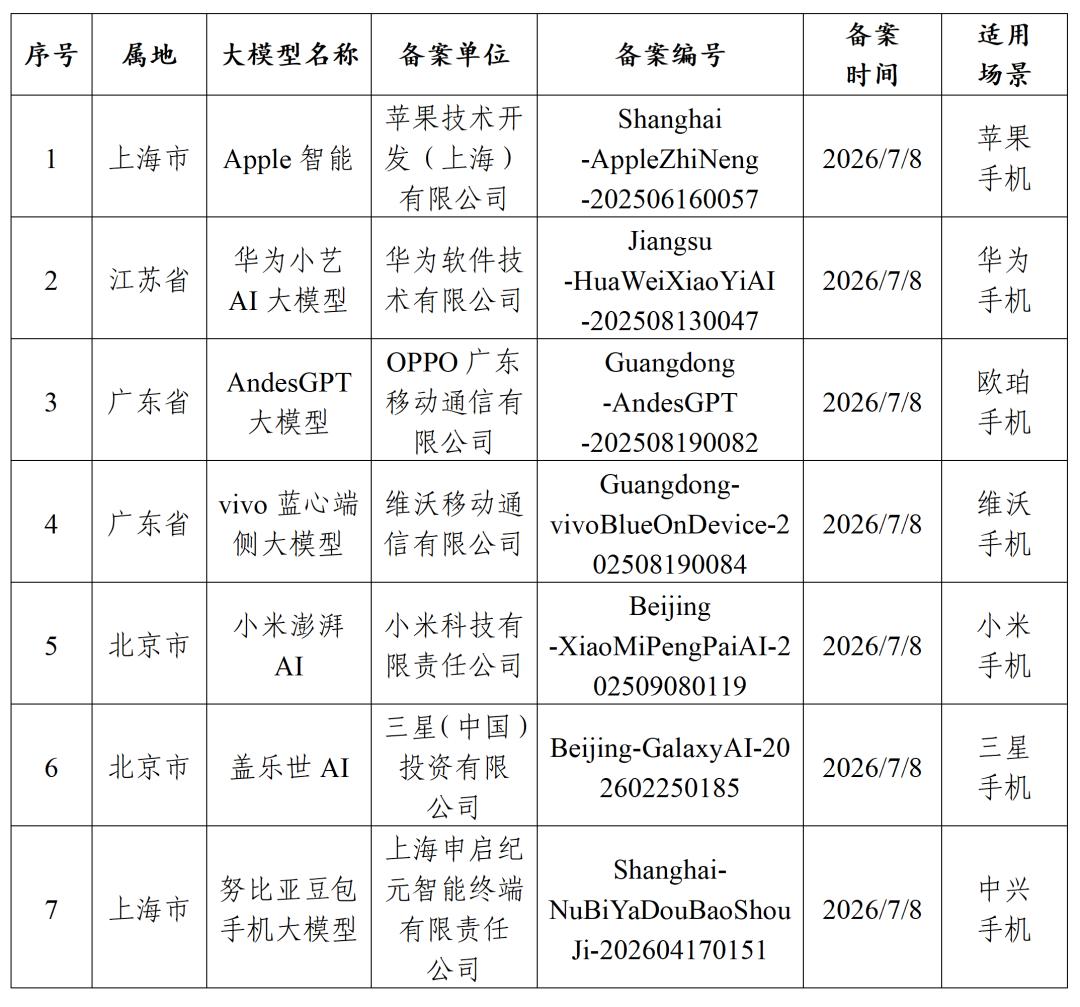
Announcement on the Release of Filing Information for 7 Registered On-Device Generative Artificial Intelligence Services for Smartphones
This marks the largest-ever collective regulatory approval in China's domestic on-device smartphone AI sector.
Since its debut at WWDC in June 2024, Chinese mainland users have waited two years for Apple's AI features.
Alibaba's Qwen will be integrated as the AI capability layer into Apple Intelligence, delivering features including text and image understanding and content generation for users of iOS, iPadOS, macOS, and visionOS in China.
In response to this news, Alibaba Group stated:
Alibaba's Qwen will be integrated as AI capabilities into Apple Intelligence, bringing intelligent experiences to Chinese users of iOS, iPadOS, macOS, and visionOS.
Users can directly access Qwen's capabilities for text and image understanding and content generation on their Apple devices without switching between different apps.
The regulatory filing serves as the compliance ticket to market entry, but before Apple secured this approval, Chinese mainland users had already experienced a brief, accidental test run of the features.
The Accidentally Leaked Beta Apple AI Failed to Meet Expectations
On March 31 this year, the day before the 50th anniversary of Apple's founding, the "Apple Intelligence & Siri" entry unexpectedly appeared in the Settings app of Chinese mainland iPhones.
There was no keynote event, no official press release — the features went live and were quickly taken offline shortly after.
Bloomberg journalist Mark Gurman judged this to be an accidental rollout: Apple would never launch AI features for the Chinese mainland without prior promotion, release them in the middle of the night local time, or use Google's engine for visual recognition instead of a domestic Chinese engine, which would also be inconsistent with local regulatory requirements. At that time, the official regulatory approval had not yet been granted.

https://x.com/markgurman/status/2038701276699967554
The practical performance of that short-lived launch can be summed up in two words: fast, but rough.
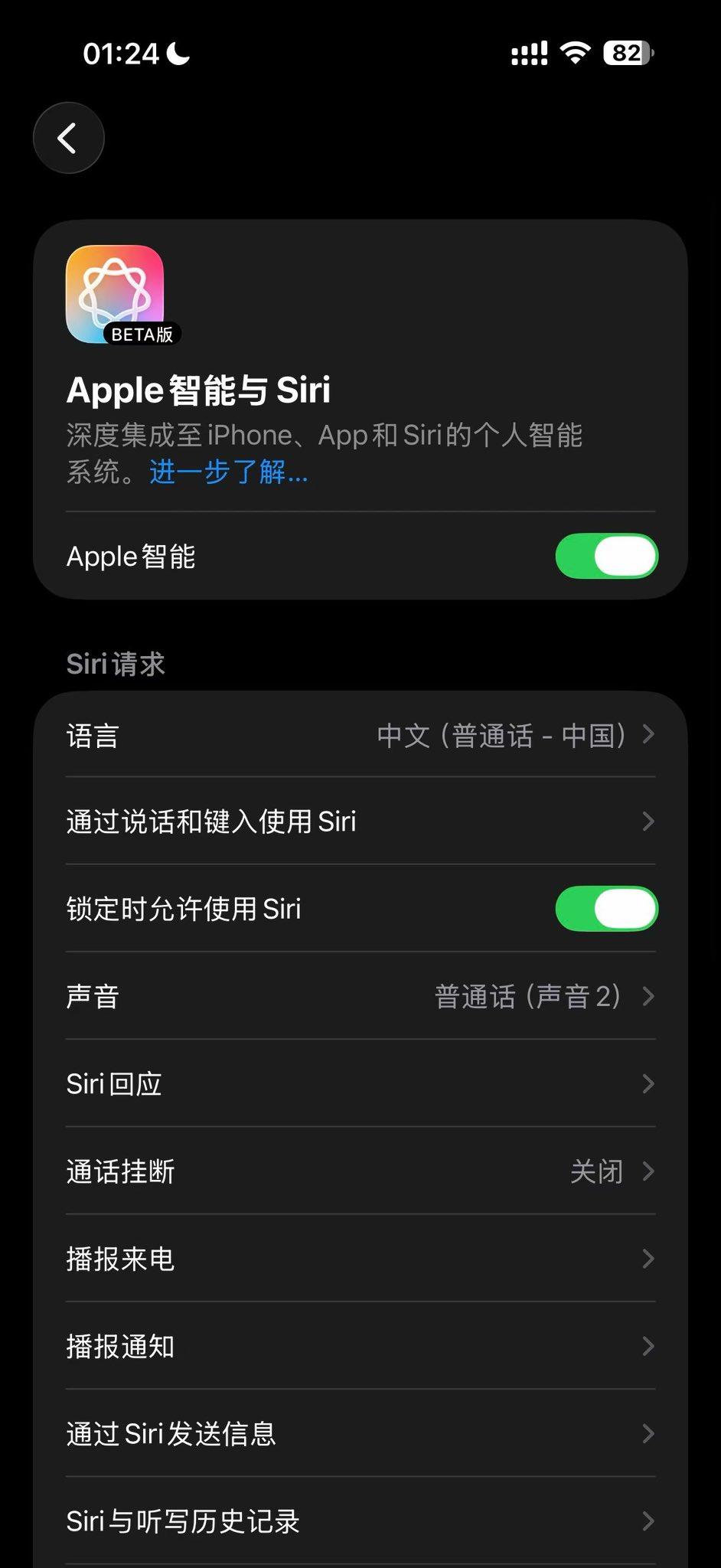
The speed of the on-device model is the most immediately noticeable user experience.
For tasks like text polishing, information summarization, and AI object removal, the responses arrive with almost no waiting time.
Clicking "rewrite in a professional tone" on a 200-word draft produces results in less than two seconds.
The image generation feature creates pictures based on text descriptions in three to five seconds, though the phone becomes noticeably warm during the process.
All processing is completed locally on the device, with no data uploaded to the cloud, ensuring privacy protection — at the cost of precision.
Summarizing long, complex texts may result in missing key information, and tone rewriting occasionally produces non-native, unnatural phrasing.
The AI object removal function works acceptably on simple backgrounds, but struggles with complex scenes, leaving behind residual shadows, blurred edges, and broken texture details.
The writing tools, translation, and visual recognition features are all functional, but each shows a perceptible gap compared to competing products that rely on cloud-based large models.
Apple made a trade-off between privacy and performance, prioritizing the former.
Although the unauthorized beta version in March was pulled offline in less than a day, it prematurely revealed the capability boundaries of Chinese mainland Apple Intelligence: the on-device model runs fast and safeguards user privacy, but its depth and precision must be supplemented by cloud-based model support.
There was no clear and reliable official confirmation of which exact model was actually integrated during that earlier test run.
Seven Manufacturers Pass Approval, Apple Arrives Two Years Late
Apple was not the only company to complete the regulatory filing.
Huawei, OPPO, vivo, Xiaomi, Samsung, and Nubia also obtained their market entry approvals on the same day, marking the collective regulatory approval of on-device AI services from seven smartphone vendors.
Nubia's Doubao mobile large model is expected to make its public debut during the WAIC event.
For Apple, the consequences of this delayed launch are already reflected in its financial reports.
iPhone sales in the Chinese market have faced continuous downward pressure. Tim Cook previously acknowledged during an earnings call that the absence of Apple Intelligence was one of the key factors eroding the product's competitiveness.
Huawei, Xiaomi, and OPPO have long established AI features as standard configurations on their flagship smartphones, with some brands even integrating models like DeepSeek, widening the user experience gap with Apple's offerings.
Earlier at WWDC 26, Apple showcased its next-generation Siri AI, developed in partnership with Google based on Gemini technology. This updated system supports cross-app context awareness and natural conversational interactions, and can even access email and calendar information in real time during phone calls.
However, at that event, Apple also explicitly stated that the new Siri AI would not immediately launch in the Chinese market.
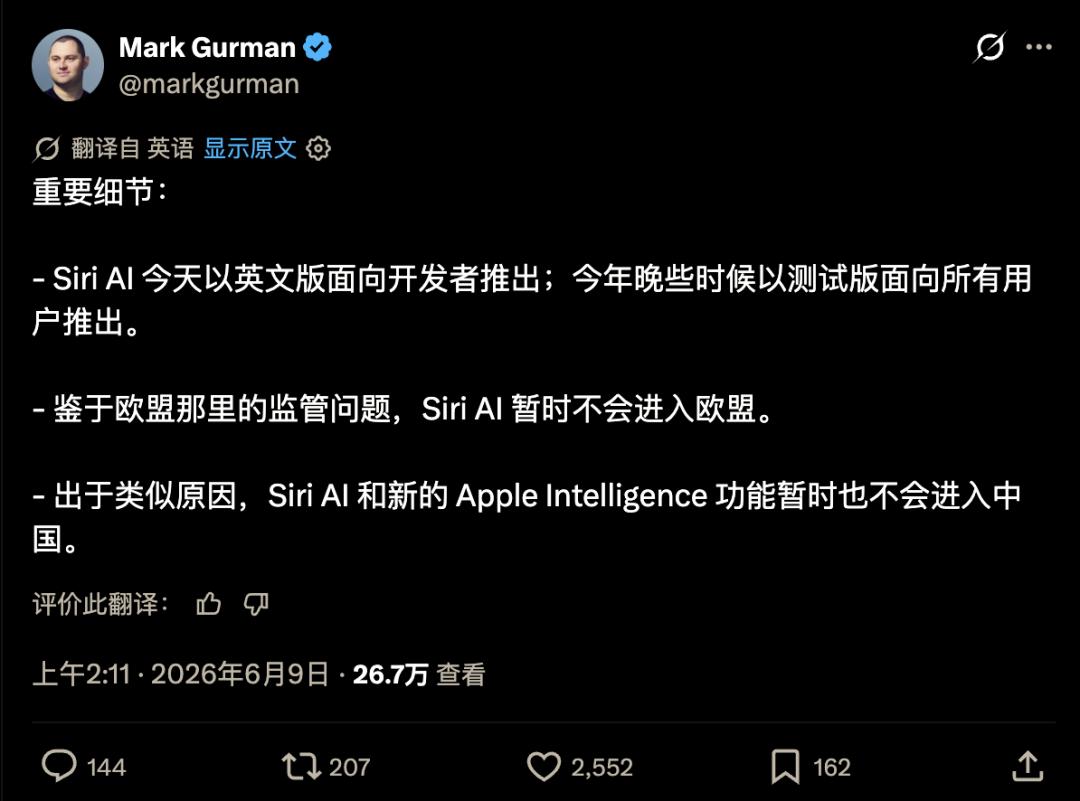
https://x.com/markgurman/status/2064047700488655019
The underlying AI capability foundation for the Chinese mainland variant is Alibaba's Qwen, which uses a completely different technical stack from the international version.
Apple has not made any public commitments regarding the official launch timeline or the full completeness of the feature set.
The regulatory filing resolves compliance requirements, but there are still critical engineering steps remaining before the product reaches users, including version adaptation, feature trimming, and model optimization.
For Chinese mainland iPhone users, the only thing that matters to judge the actual value of this AI market entry ticket is whether Apple Intelligence appears in the next iOS update changelog, and how many of its core features are retained.
Until then, the two-year wait is just one final step away from completion.
This article is sourced from the WeChat public account "AI Era", authored by ASI Revelation, and published by 36Kr with official authorization.