Starting from 60 trillion, an epic-sized market opportunity has arrived.
Recently, the State Council has officially issued the "15th Five-Year Plan for Expanding Consumption".
This marks China's first national-level five-year plan formulated specifically around boosting consumption.
The plan sets a target that by 2030, China's total retail sales of consumer goods (TRSCG) will reach roughly 60 trillion yuan. In 2025, the country's TRSCG stood at around 50 trillion yuan, meaning the coming years will see a 10-trillion-yuan increment. A thorough review of the full plan reveals that even greater growth in the future will not come from TRSCG alone.
Beyond the 60-trillion-yuan figure, China's consumption sector holds far more room for expansion and far-reaching transformations.
01 60 Trillion Yuan Is Only the Baseline
What is consumption?
In conventional perceptions, official statistics, and mainstream media narratives, consumption is often equated to TRSCG — simply eating, drinking, and purchasing physical goods.
We must seriously correct this misconception: this is a one-sided, even erroneous understanding of consumption.
Consumption certainly includes TRSCG, but as the economy develops and people's living standards improve, consumption has long surpassed the scope of TRSCG.
Outside of physical goods purchases, spiritual consumption such as entertainment, leisure, and experiential activities is increasingly becoming a core component of total consumption, and its proportion will continue to rise over time.
We generally categorize this type of consumption as service consumption.
China is currently in a phase where the share of service consumption keeps growing steadily. This is an inevitable outcome of a more developed economy and a better quality of life — much like the Engel's Coefficient, the more income people spend on non-food items, the more prosperous their lives become.
Therefore, judging consumption solely by TRSCG is as narrow-minded, even absurd, as evaluating living standards only by whether people have enough to eat.
This flawed perspective will inevitably lead to misinterpretations and misjudgments of the market and the broader economy.
Consumption is not limited to TRSCG; to understand consumption comprehensively, we must prioritize service consumption.
Official statistical data has increasingly emphasized this point. A key milestone came in August 2023, when the National Bureau of Statistics of China began releasing a new indicator: Retail Sales of Services. In June this year, the bureau launched another new indicator:
"Total Retail Sales of Consumer Goods and Services".
Statistical data shows that China's consumption growth engine is shifting from physical goods consumption to service consumption.
Taking May 2026 as an example, while the month's TRSCG reached 4.109 trillion yuan, representing a 0.6% year-on-year decline, retail sales of services grew by 5.4% year-on-year, with the cultural, sports, and leisure segment even exceeding 10% growth.
This further demonstrates that we can no longer assess consumption solely through TRSCG. If we only look at TRSCG, consumption performance seems weak, but on the other side of the coin, service retail is thriving — when we combine the two, the overall consumption situation is actually quite solid.
At the very least, it is far from being as poor as it appears when viewed through TRSCG alone.
Although the "15th Five-Year Plan for Expanding Consumption" only explicitly sets a target of around 60 trillion yuan for TRSCG, it places exceptional emphasis on the critical role of service consumption. Therefore, during the 15th Five-Year Plan period, the actual total consumption pie will be even larger than 60 trillion yuan.
The 60-trillion-yuan figure is merely the baseline.
Beyond incremental growth, the more noteworthy content in the plan may lie in transformations in quality and developmental trends.
02 More Personalized, More Diverse, Higher Quality
Televisions, refrigerators, air conditioners, washing machines, automobiles, computers, smartphones... Enterprises have continuously expanded production capacity and reduced costs, turning once-scarce products originating in developed markets into commonplace items, even over-supplied goods, that enter millions of households.
Up to now, China's consumption growth has largely been underpinned by this industrialized, large-scale supply model, following a consistent rule of development and competition: the enterprise with the largest scale and highest efficiency will dominate the market.
However, a massive transformation is now unfolding.
Most households and individual consumers no longer lack bulk standardized goods. A refrigerator can last for over a decade, a car can be driven for many years, and the replacement cycle for smartphones is getting longer and longer. Even if some households purchase an extra unit or upgrade their products more frequently, the incremental demand remains limited.
When the entire country has essentially moved past the explosive growth phase for durable goods and standardized consumer products, to persuade people to replace their existing items or purchase new products, offerings must bring genuine novelty, new value, and even these alone are no longer sufficient.
The old growth driver of "from nothing to something" has been replaced by the demand for "good enough", "sufficient novelty", and "thoughtful design".
The newly released plan provides clear guidance on this, repeatedly emphasizing personalized, diversified, and quality-oriented consumption.
Enterprises that can better meet demands for personalization, diversity, and high quality will emerge as the future winners.
In the past, a single hit product could serve 100 million consumers. In the future, there may be 100 niche demand segments, each serving 1 million consumers, collectively reaching a total of 100 million people.
In fact, many such enterprises have already emerged in China. Citywalks, camping, cycling, frisbee, paddleboarding, hiking — activities that were once niche hobbies are rapidly growing into new mass consumption markets.
The pet economy is a particularly typical example. By the end of 2025, the number of pet dogs and cats in China's urban areas had exceeded 120 million. Centered on the diverse needs of pets, this once-overlooked market has developed into a new industry rapidly approaching the trillion-yuan scale.

All enterprises that have succeeded in these sectors share a common trait: they do not invent technologies or products first, but identify demands first. They do not merely follow existing markets to satisfy pre-existing needs, but actively create new demands.
The current sluggishness in physical goods consumption is partly due to purchasing power constraints, but another factor cannot be ignored: for many consumers, they genuinely cannot find new products worth buying.
This is especially true for consumers with strong purchasing power — persuading them to buy another television, refrigerator, smartphone, or new piece of clothing? They may already own everything they need, so what compelling reason do you have to convince them to spend?
From a macroeconomic perspective, only when more enterprises are capable of creating new demands will consumption be further stimulated, which in turn drives supply growth. This will form new cycles of supply and demand, giving rise to new industries and ultimately pushing the entire economy forward.
To sustain the prosperity of physical goods consumption in the future, two paths must be pursued: first, to meet the demands that have not yet been fulfilled by standardized products; second, to widely identify and satisfy non-standardized personalized and high-quality demands. The latter path clearly offers far broader room for development.
Enterprises that can pursue innovation, embrace change, and reach new heights on this path will own the future.
03 Greater Growth Is No Longer on Store Shelves
As mentioned earlier, the greater growth potential in the future lies in the service sector.
This is the most remarkable highlight of the plan: service consumption has for the first time truly stepped onto the center stage.
Elderly care, childcare, healthcare, sports, culture, tourism, education, domestic services — all these sectors have been explicitly prioritized in the plan.
Why? Because physical goods consumption inherently has a ceiling. If all enterprises crowd into the physical goods market, even with personalization, diversity, and quality improvements, eventually the market that once had clear paths will become overcrowded, leaving no room for further growth.
Service consumption has a far higher ceiling and much more sustainable development space.
After a trip ends, people can go on another one; after a concert finishes, they can attend the next show. They can get an ear cleaning in the morning, a foot massage in the afternoon, and a SPA in the evening. While this may seem luxurious, it is far less wasteful than the old saying of "pouring out a second bowl of soy milk after drinking one".
Compared with physical goods, services, experiences, and spiritual fulfillment are far more diverse, and their potential is nearly limitless. This is the most critical growth engine for China's consumption and economy in the future, as well as an essential component of people's pursuit of a better life.
Why is Pop Mart highly promising? Because it should not be viewed as a manufacturing enterprise following traditional physical goods logic. It does not sell toys or ordinary products; instead, it delivers IP value, collection significance, emotional resonance, and spiritual experiences.
While Pop Mart has tangible products, its essence is a service-oriented enterprise that creates and fulfills users' spiritual needs.
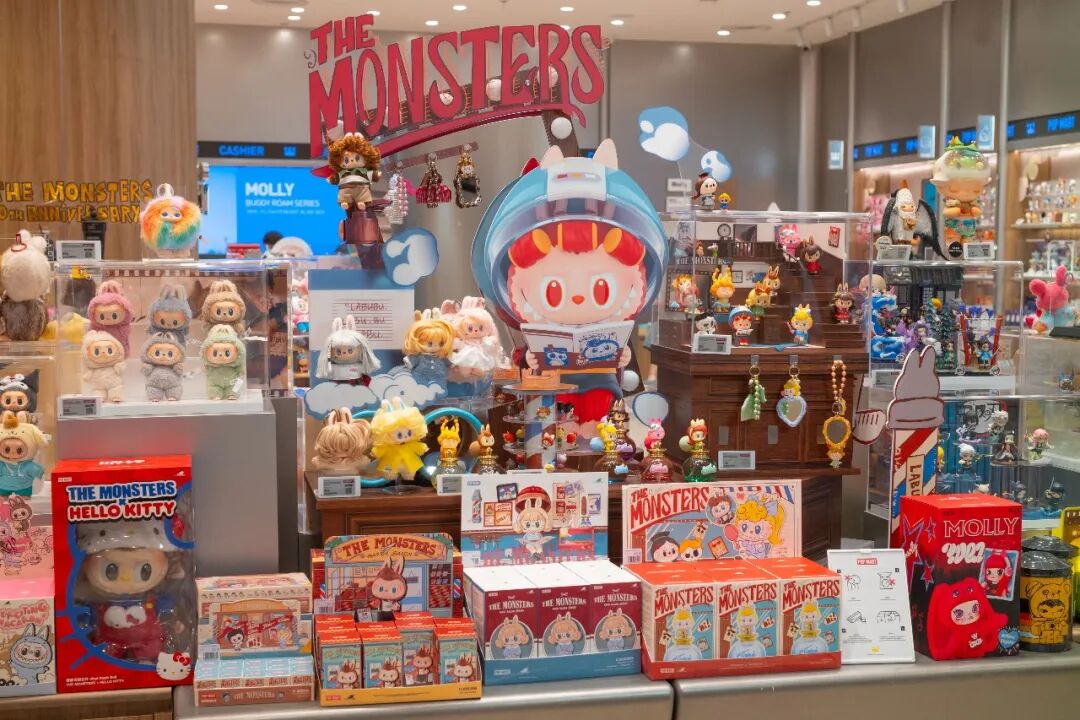
The scale of spiritual needs is truly immeasurable.
In terms of physical goods consumption, China's 1.4 billion people with continuously improving living standards have already surpassed the 340 million population of the United States.
Data supports this observation: according to figures from the Ministry of Commerce, between 2021 and 2025, China's TRSCG calculated by exchange rates was roughly 80% of that of the US. When measured by purchasing power parity, China's TRSCG has already reached 1.6 times that of the US.
Yet the US still ranks as the world's top consumption power. Why? Where does the gap lie? The answer is its enormously developed service sector.
Just look at the ongoing World Cup — the various entertainment activities, celebrations, and joyful experiences inside and outside the stadium all represent consumption and spending. This gives us a clear sense of how vibrant US service consumption is, and how much untapped potential China still has in this field.
What are our key priorities for service development? The plan clearly outlines the direction: we will expand the supply of service consumption in healthcare, elderly care, childcare, culture, tourism, sports and other sectors, and promote the high-quality development of service consumption to benefit the public.
While the manufacturing sector focuses on satisfying material needs, the service industry is the true driver that creates a sense of joy and well-being. Under this developmental direction, if China's consumption in the past was largely concentrated on physical goods, future consumption will be deeply integrated into daily life and people's journeys.
In the future, the biggest incremental growth in China's consumption will no longer come from selling more televisions or automobiles, but from persuading more consumers to happily and continuously spend on non-material experiences, just like what Pop Mart has achieved.
To Expand Consumption, First Deepen Your Understanding of People
Behind every consumption revolution, there are two most critical driving forces.
The first is demographics, and the second is technology.
From the perspective of these two factors, China's consumption sector is standing at the threshold of being redefined.
Demographic shifts are reshaping China's consumption landscape.
For example, population aging may lead to a certain degree of shrinkage in the youth consumption market, but it will create massive incremental markets for elderly care, rehabilitation, nursing, retirement travel, and age-friendly home renovations.
Falling birth rates seem to reduce consumption related to infants, children, and mothers, but they also mean that each child can receive more investment, driving sustained growth in high-quality childcare, education, healthcare, and child development services.
The rise of single-person households and small family structures appears to reduce traditional family-oriented consumption, but it has spawned a whole new range of consumption formats such as instant retail, compact home appliances, the pet economy, and on-demand delivery services.
To effectively capture these emerging demands, the first step is to thoroughly study the target consumer groups.
Technology, particularly artificial intelligence, is also reshaping both consumption demands and supply models.
The biggest opportunity for AI undoubtedly lies in the consumption sector. As mentioned earlier, future physical goods and services will both be highly personalized and segmented — which is exactly where AI can deliver its unique advantages.
In the traditional industrial era, enterprises that wanted to offer personalized products faced exorbitant costs. Today, AI-powered design, digital factories, flexible manufacturing, and intelligent recommendation systems are rapidly driving down the cost of personalization.
A pair of running shoes can be customized based on the user's foot shape, and a personalized health plan can be generated in real time based on the user's medical examination data... In the future, every consumer may have access to products and services tailored exclusively for them.
Even AI itself is becoming a new category of consumer goods. AI assistants, smart glasses, home robots, health companions, educational intelligent agents... Today, these are still emerging products, but in the near future, they will become a common part of daily life for ordinary households.
To fully seize these opportunities, the core priority remains to deeply understand human needs.
This also reflects the transformation in the competitive logic of China's consumer enterprises: in the past, enterprises that could produce and deliver goods faster, better, and more cost-effectively would win. In the future, only enterprises that truly understand consumers' pain points, preferences, emotions, and aspirations will be qualified to compete in the market.
Therefore, the "15th Five-Year Plan for Expanding Consumption" is not merely a policy document to stimulate short-term consumption. It is essentially a roadmap for the future of China's consumption sector: transitioning from goods-dominated consumption to a balanced development of goods and services, shifting from standardized mass consumption to personalized consumption, evolving from passive demand fulfillment to active demand creation, and moving from pursuing cost-performance to prioritizing overall quality of life.
Over the past few decades, China's remarkable success has been built on establishing the world's most complete and robust manufacturing system, lifting over a billion people out of material scarcity and into an era of abundant supplies. The new success and growth in the future will come from genuinely enabling 1.4 billion people to live fulfilling, joyful lives with diverse experiences.
Any enterprise that contributes to expanding this massive consumption pie will earn its share of the rewards.
This article originates from the WeChat Official Account "Huashang Taolue" (ID: hstl8888), authored by Huashang Taolue, and published on 36Kr with official authorization.