Wall Street is not worried about capital expenditure. Morgan Stanley estimates that the five major cloud providers will have a total capital expenditure of 1.2 trillion US dollars next year, which will reach 1.4 trillion US dollars by 2028, with computing power quadrupling.
Capital expenditure figures are growing larger, but Morgan Stanley believes this is not yet a problem.
According to the ZhuiFeng Trading Desk, the team of Morgan Stanley analyst Brian Nowak released its latest research report on July 12, raising the 2027/2028 capital expenditure forecasts for five major hyperscale cloud vendors (Meta, Amazon, Microsoft, Google, SpaceX) by 9%/10% overall, reaching approximately $1.2 trillion and $1.4 trillion respectively.
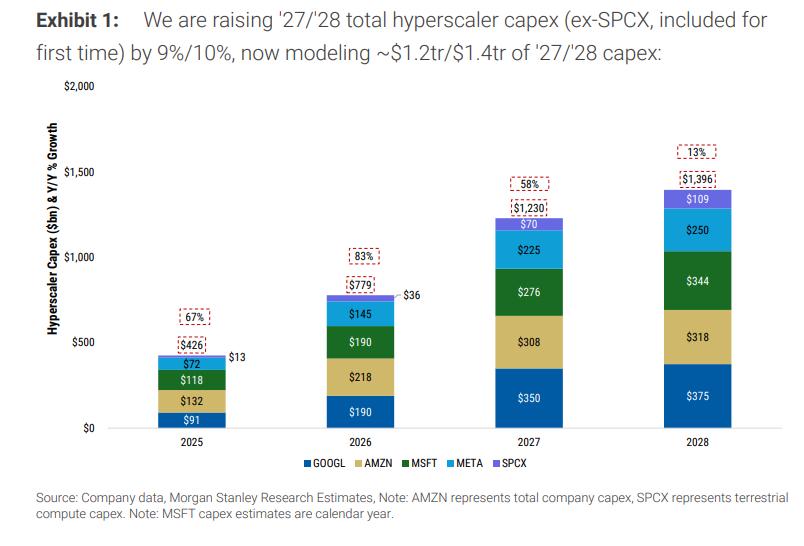
Why Capital Expenditure Keeps Rising: Driven by Dual Factors of Cost Inflation and Computing Power Shortage
The direct trigger for analyst Brian Nowak's upward revision this time is rising costs.
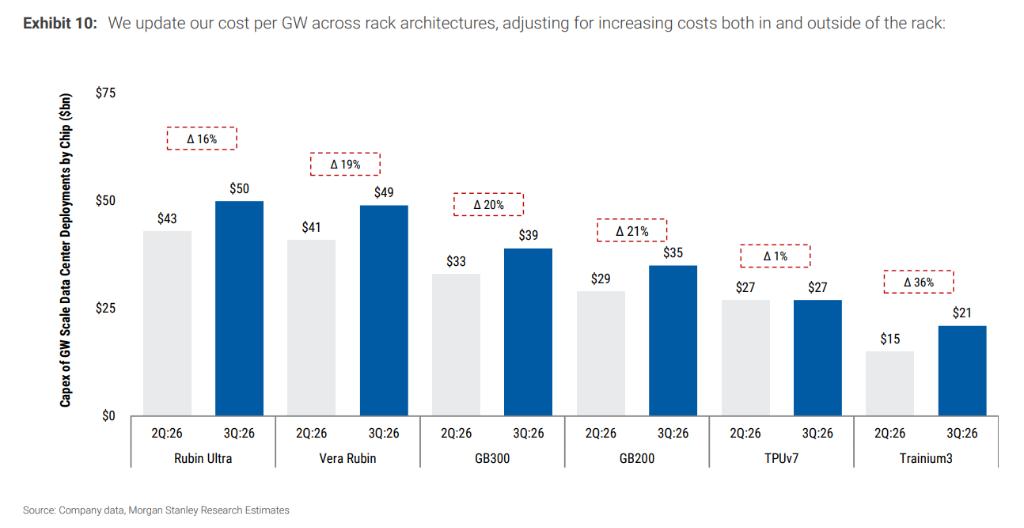
GPU-related costs have increased by approximately 20%, mainly from two sources:
Rising costs within racks: Memory prices have risen significantly. In Blackworth (GB300, GB200) racks, memory's share of total cost has increased from low single-digit percentages to high single-digit percentages; in Vera Rubin racks, memory's share has further risen from high single-digit percentages to around 25%.
Rising costs outside racks: Extended delivery times for electrical/mechanical equipment, shortages of construction materials, a lack of skilled labor, and the shift to "behind the meter power" solutions have collectively driven up data center construction costs. Morgan Stanley currently estimates that the off-rack costs for GB200, TPU, and Trainium range from $11 million to $13 million per megawatt, while next-generation GB300, Vera Rubin, and Rubin Ultra have further increased to approximately $16 million to $19 million per megawatt.
Specifically for the construction cost of each GW of data center: GB200 is approximately $35 billion, GB300 is approximately $39 billion, and Vera Rubin is approximately $49 billion; in terms of custom ASICs, TPUv7 is approximately $27 billion, and Trainium3 is approximately $20 billion.
In addition to cost factors, Nowak also pointed out that the cycle from groundbreaking to data center opening has been extended to a maximum of 3 years. At the same time, growing public opposition to data center construction and political uncertainty ahead of the 2028 presidential election are prompting cloud vendors to start construction early to highlight job creation. This further exacerbates inflationary pressures and accelerates the advancement of capital expenditure.
Computing Power Will Quadruple: From 30GW to 120GW
The end point of capital expenditure is computing power.
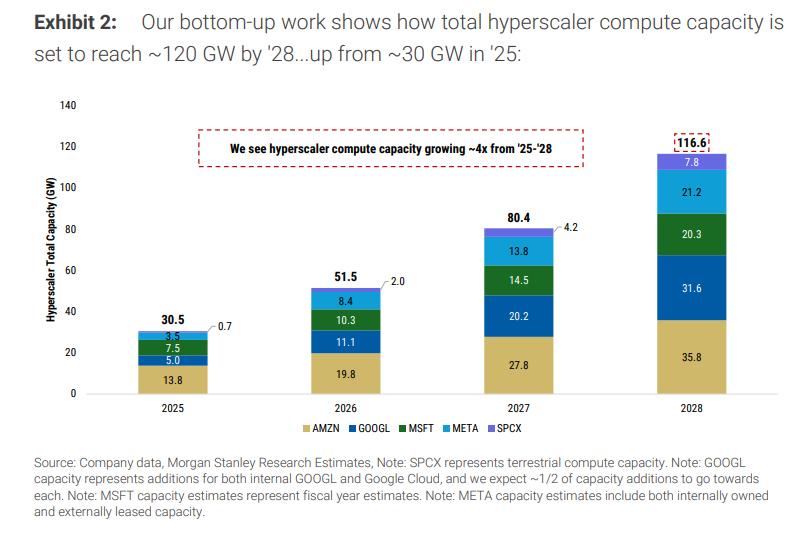
Nowak predicts that the available computing power of the five major hyperscale cloud vendors will grow from approximately 30GW in 2025 to approximately 116.6GW in 2028, an increase of nearly 4 times.
By company:
AWS: Reaches 35GW in 2028, the largest computing power scale
Google: Reaches 31.6GW in 2028, with the most new computing power added (9GW/11GW added in 2027/2028 respectively)
Microsoft: Reaches 20.3GW in 2028
Meta: Reaches 21.2GW in 2028, a sharp jump from approximately 3.5GW at the end of 2025; among the new computing power added in 2026/2027, 55%/90% comes from self-construction, and 45%/10% comes from third parties
Meta: 5 "Call Options" Not Priced in by the Market Yet
Morgan Stanley's Nowak maintains Meta as a top pick, with a target price of $775, corresponding to approximately 15% upside, and an Overweight rating.
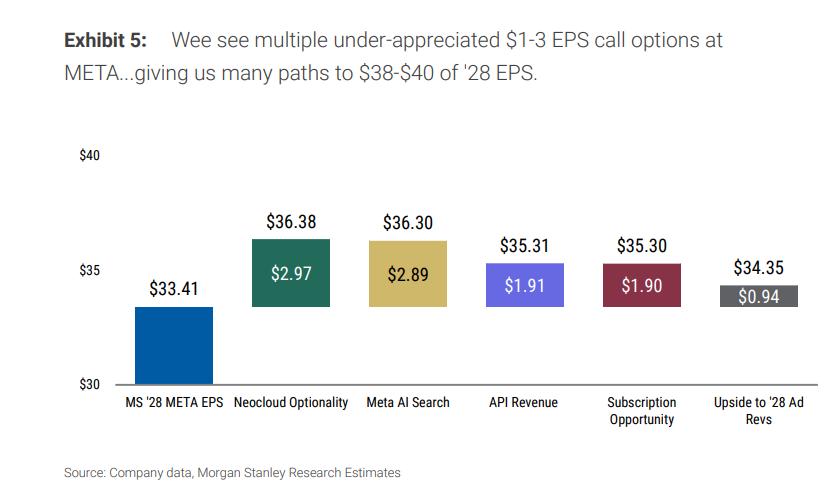
Nowak believes that the market is currently only "punishing" Meta's high capital expenditure, but not giving its potential revenue the due valuation. The report lists 5 profit drivers that have not yet been priced in by the market. If all are realized, they can contribute an additional approximately $10 on top of the baseline earnings per share of approximately $33, which means that Meta's current stock price corresponds to a 2028 price-to-earnings ratio of only approximately 15 times.
These 5 "call options" include:
Neocloud Monetization: Approximately $2.97 upside in earnings per share
Meta AI: Approximately $2.89
Search: Approximately $1.91
API Revenue: Approximately $1.90
Subscription Opportunities: Approximately $0.94
API Revenue: A New Business Worth Paying Close Attention To
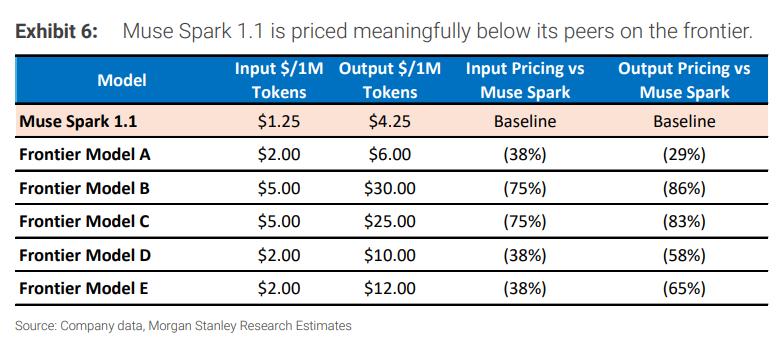
The API pricing for Meta's recently launched Muse Spark 1.1 model is 30% to 85% lower than that of competitors. Morgan Stanley estimates that every 100 megawatts of computing power allocated to the API business can generate approximately $85.88 billion in revenue, corresponding to approximately $1.91 in earnings per share, accounting for approximately 6% of 2028 earnings per share.
Under the baseline scenario, Morgan Stanley assumes that 25% of Meta's 15 million advertisers (approximately 4 million) pay approximately $200 per month for its products, which can also generate approximately $80 billion in revenue and approximately $2 in earnings per share.
Morgan Stanley points out that Meta only needs to allocate approximately 100 megawatts of GB300 computing power to support this API business, while it is expected to have a computing power base of approximately 21GW by the end of 2028, leaving plenty of room for expansion.
Valuation Adjustment: Morgan Stanley raises Meta's 2027/2028 capital expenditure by 29%/22% to $225 billion/$250 billion respectively, while incorporating $40 billion in new debt issuance. Higher depreciation drags down 2027/2028 earnings per share by 3%/7% respectively to approximately $32.99/$33.41. However, Morgan Stanley also slightly raises its 2028 revenue forecast (+1%), rolls the valuation to mid-year, uses a 23x price-to-earnings ratio corresponding to the average 2027/2028 earnings per share, and maintains the $775 target price.
Amazon: AWS Growth Rate Is Underestimated
Nowak raises Amazon's 2027/2028 capital expenditure by 15%/29% to $308 billion/$318 billion respectively.
But unlike Meta, Amazon's earnings per share forecast has been raised instead. The reason is that AWS revenue forecasts have also been significantly raised simultaneously: 2027/2028 AWS revenue is raised by 3%/7% respectively, corresponding to year-on-year growth rates of 40%/36%, with absolute values reaching $243.5 billion/$331.6 billion. Higher depreciation is offset by stronger AWS revenue, and 2027/2028 earnings per share are raised by 2%/3% respectively to approximately $11.53/$15.05.
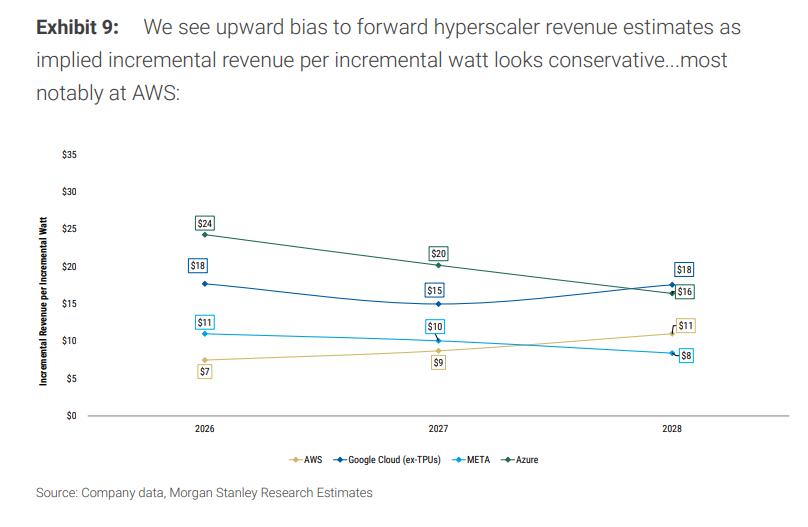
Nowak believes that the market's current revenue forecast for AWS is too conservative. The report points out that even Morgan Stanley's own 35%/40% 2026/2027 AWS growth rate forecast implies incremental revenue per watt of only $7/$9, "arguably conservative".
In addition, Nowak expects AWS's backlog of orders to increase sequentially by $110 billion in the second quarter to approximately $475 billion, mainly from large orders from private laboratories, which will enhance the market's confidence in the sustainability of multi-year growth.
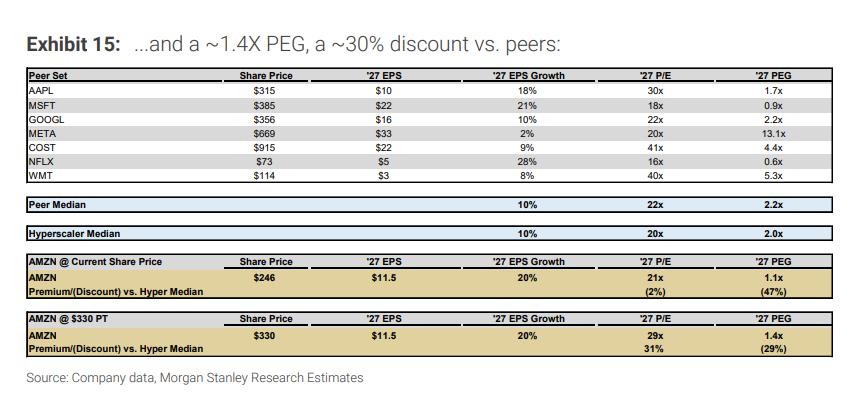
The $330 target price is based on the average 2027/2028 earnings per share of approximately $13 multiplied by approximately 25x price-to-earnings ratio, corresponding to a PEG of approximately 1.4 times, which is approximately 30% discounted compared to peer companies.
Google: Leading in Full-Stack AI, but Facing Short-Term Risk of Computing Power Constraints
Nowak assigns Google a target price of $415, with approximately 16% upside, and an Overweight rating.
Nowak expects Google Cloud's 2026 second-quarter/full-year growth rates to reach 77%/78% respectively, and the search business's 2026 second-quarter/full-year growth rates to be 17.5%/16% respectively, with 2027/2028 growth rates of 11%/8%.
However, Nowak specifically points out a tactical risk: Google is currently in a state of computing power constraints (its latest computing power lease agreement with SpaceX is evidence of this). Computing power constraints may drag down recent revenue growth or the pace of product launches, a risk that is relatively smaller for Meta and Amazon.
In addition, the launch of Gemini 3.5 has fallen behind the schedule set by Google at the I/O conference, and Morgan Stanley says it will pay attention to the further productization progress of the Gemini model in the second half of the year.
This article does not constitute personal investment advice, does not represent the platform's views. The market is risky, investment requires caution, please make independent judgments and decisions.
This article is from the WeChat official account "Wall Street CN", Author: Long Yue, published by 36Kr with authorization.