Rumors of a U.S. listing resurface, Samsung issues an urgent denial
Samsung Electronics is reassessing the possibility of listing on the U.S. capital market.
On July 14, citing people familiar with the matter, Bloomberg reported that Samsung Electronics has held preliminary discussions with multiple investment banks regarding a potential American Depositary Receipt (ADR) issuance, but relevant talks remain in the early evaluation stage. The company has not yet decided whether to proceed with the transaction, nor has it entered substantive phases such as underwriter selection.
SK Hynix previously completed a $26.5 billion U.S. listing, setting a record for the largest U.S. IPO by a foreign company, demonstrating the strong financing appeal of core players in the AI industry chain. However, Samsung still needs to weigh multiple factors including stock price volatility in the memory chip sector, its complex business structure, and future shifts in industry supply and demand.
SK Hynix's Record-Breaking IPO Prompts Samsung to Restart Evaluation
The report, citing people familiar with the matter, states that Samsung has studied the feasibility of issuing ADRs on multiple occasions in the past, but none of the attempts were ultimately implemented. This renewed evaluation is largely driven by SK Hynix's successful listing.
As two of the world's leading memory chip manufacturers, both Samsung and SK Hynix have directly benefited from the boom in AI infrastructure investment. SK Hynix's record-breaking IPO not only set a new size benchmark for foreign companies listing in the U.S., but also reaffirmed global capital markets' demand for exposure to core AI supply chain enterprises, even amid ongoing debates over whether AI asset valuations are excessively high.
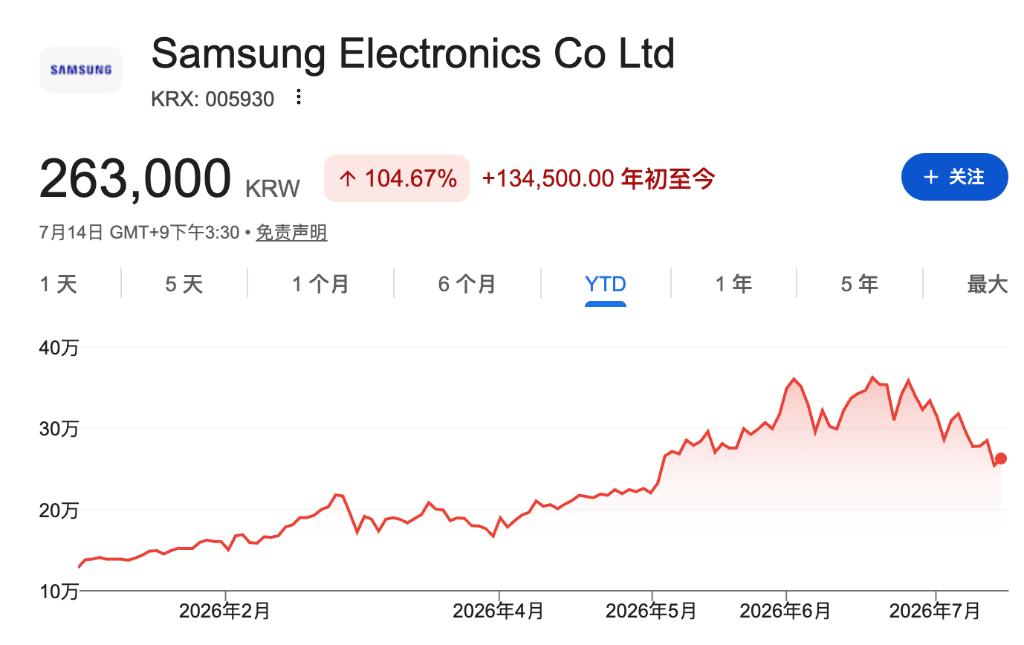
Since the start of this year, Samsung's stock price has risen by approximately 105% in total; SK Hynix's stock price has increased by around 183% over the same period. However, insiders emphasize that internal discussions at Samsung are still confined to the feasibility assessment stage, with no decision made to launch the issuance, nor has a specific transaction plan been finalized.
Diversified Business Structure Adds Complexity to U.S. Listing
Compared to SK Hynix, Samsung faces significantly greater challenges in pursuing a U.S. listing.
The report notes that Samsung's business spans multiple sectors including memory chips, logic chips, smartphones, consumer electronics, and display panels. Its business structure is far more complex than SK Hynix's, which focuses exclusively on memory operations, and this will raise difficulties for investor valuation and transaction structure design.
Furthermore, the company's recurring labor disputes in recent years may also emerge as a risk factor of concern for investors.
On the other hand, Samsung's stock price has already risen sharply, and the market holds high expectations for its earnings improvement, which means it is becoming harder for the company to outperform investor expectations going forward. This dynamic was already evident following its latest earnings release. Although Samsung's preliminary results overall exceeded market expectations, its stock price still saw a notable pullback afterward, reflecting the current high valuations in the AI chip sector and the market's sensitive sentiment.
Amid AI-Driven Capacity Expansion, Supply Risk Becomes a New Variable
Apart from the capital market environment, shifts in industry supply and demand are also critical factors Samsung needs to consider.
As AI demand continues to grow, global memory manufacturers are accelerating capacity expansion. Last month, the Samsung Group and SK Group respectively announced plans to build two new chip manufacturing facilities, with a total combined investment of approximately 800 trillion won (about $5.36 trillion), further expanding advanced chip production capacity.
Meanwhile, the South Korean government has unveiled an AI infrastructure investment plan worth 550 trillion won, partnering with enterprises including Naver to reach 8.4 gigawatts of AI data center capacity by 2029.
However, sustained capacity expansion also implies that memory chip supply may gradually increase in the future. Once supply-demand dynamics loosen again, chip prices and profit margins will face downward pressure, which will in turn affect market valuations for memory chip companies and become a key consideration for Samsung when deciding whether and when to proceed with the ADR issuance.
This article does not constitute personal investment advice, nor does it represent the platform's views. The market carries risks, please exercise caution in investment and make independent judgments and decisions.
This article is sourced from the WeChat Official Account "Wall Street CN", authored by Li Jia, and published by 36Kr with authorization.