The "face-saving project" of domestic cars, why is it monopolized by European, American and Japanese giants?
In 2025, China's automobile production and sales volumes have secured the top global position for 17 consecutive years, and the country has for the first time surpassed Japan to become the world's largest automobile exporter.
With an annual output exceeding 30 million units and total revenue surpassing 1 trillion yuan, China's automotive industry has led many to believe that the nation has evolved into a fully-fledged automotive powerhouse.
However, beneath this facade of "global number one" status lies a hidden, unaddressed weakness.
Automotive coatings, commonly known as car paint, still see over 90% of the market share dominated by foreign-owned brands.
We are capable of manufacturing technologically advanced smart vehicles that captivate the entire world — so why do we remain reliant on foreign paint suppliers?
How can China's automotive industry reclaim control over this critical "visual showcase" of its vehicles?
A New Battlefield for Automakers
At the end of last year, BYD's Yangwang U9 claimed the Supreme Gold Award at the International CMF Design Awards.
Surprisingly, the winning entry was not the vehicle's overall design, but a paint color named "Ager Purple."
BYD collaborated with PPG, a global automotive coatings giant, to integrate optical materials into car paint for the very first time. The vehicle's body transitions seamlessly from blue to purple under sunlight, while offering enhanced durability and wear resistance.
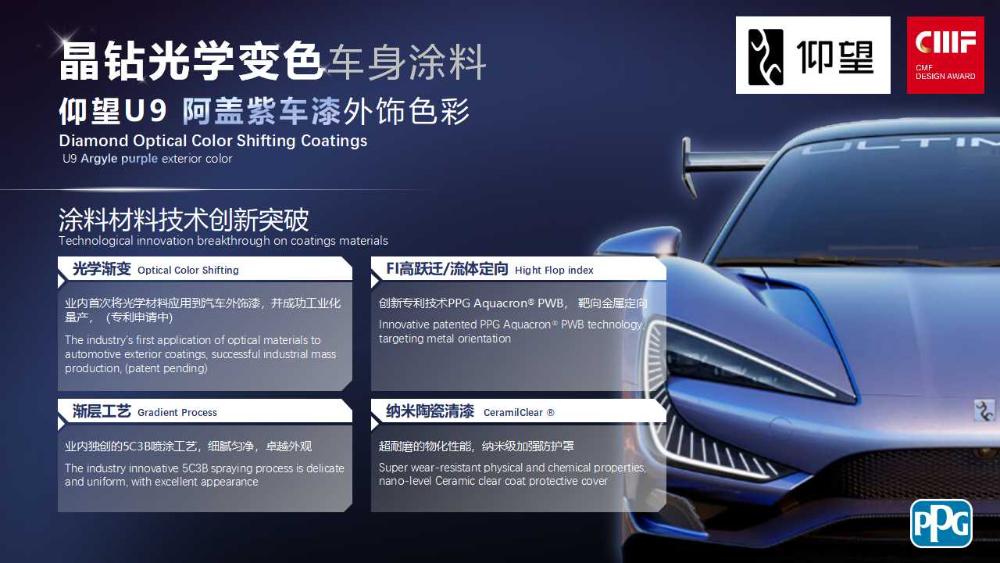
BYD's premium Yangwang U9 model earned an award for its innovative paint finish
Xiaomi, which has long aimed to position its automobiles as high-end offerings, has also invested tremendous effort into perfecting its vehicle paint systems.
Lei Jun personally led promotional campaigns, and Xiaomi launched its "Hundred Shades Project" in deep partnership with global industry leader BASF. The German firm plans to design 100 distinct paint colors for Xiaomi over three years to support customized, personalized finishes for its electric vehicles.
At the launch event for the XPeng P7, the brand dedicated 23 minutes to introducing six new paint colors — more time than it spent explaining core vehicle technologies — claiming the paint achieved "reflection-level" texture that meets Bentley's strict quality standards.
NIO also partnered with BASF to leverage the supplier's expertise, applying paint processes previously exclusive to luxury vehicles priced at over one million yuan to its own product lineup.
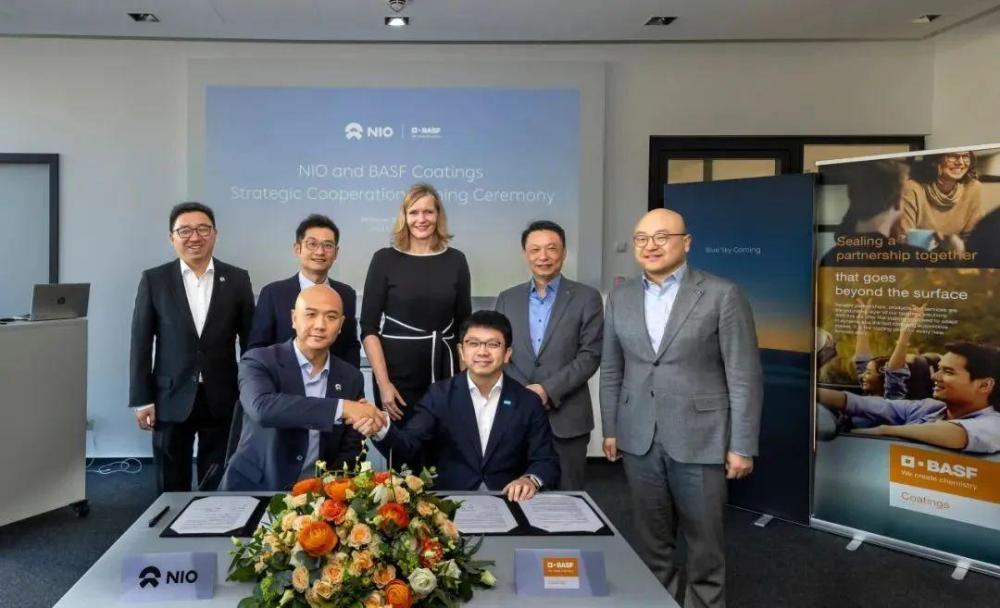
NIO established a strategic partnership with BASF for automotive coating solutions
Seres collaborated with WGSN, the world's leading fashion forecasting agency, framing paint colors as a key emotional value offering for young consumers — post-1995 buyers accounted for 60% of pre-orders for its new vehicle model.
Chery went a step further, partnering with coatings giant PPG to build a dedicated joint laboratory.
This Digital Color Lab represents the world's first collaborative R&D facility co-founded by an automaker and a coatings supplier, bringing automotive color design into the earliest stages of vehicle concept development.
Why have domestic Chinese automakers unanimously shifted their focus to refining paint color and surface quality?
The reasoning is straightforward: high-quality paint elevates a vehicle's aesthetic appeal, creates the critical first impression that defines a car's perceived character, and directly influences consumer purchasing decisions.
Beyond the visible exterior finish, automotive coatings with specialized functionalities are applied to components including vehicle bumpers, undercarriages, and even the battery packs of new energy vehicles.
Automotive paint is not merely a cosmetic feature — it is a critical component that determines overall vehicle durability and safety performance.
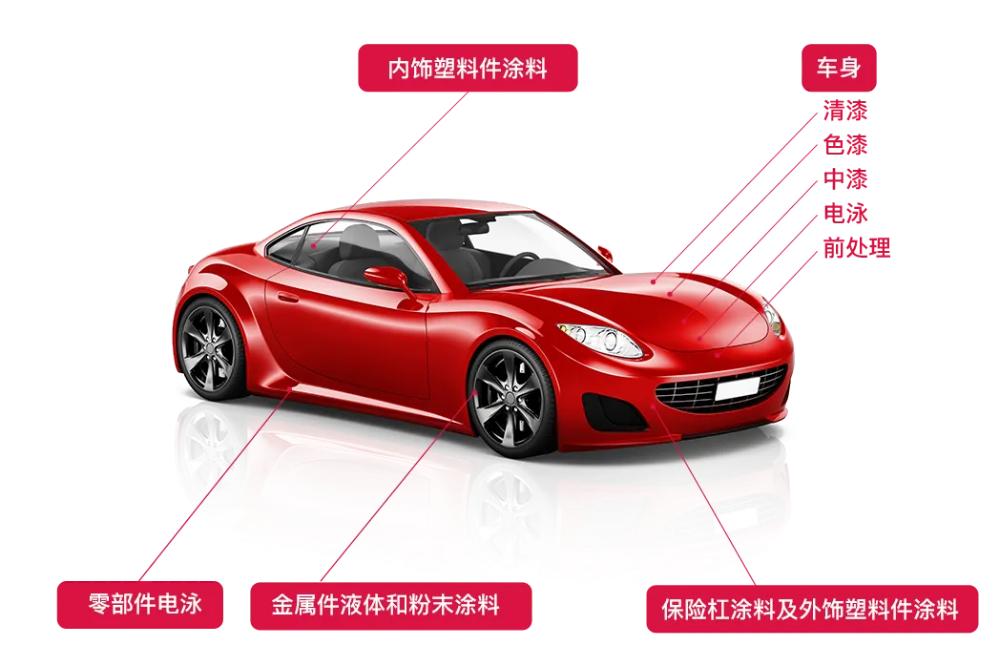
Automotive coatings are widely applied across entire vehicles, with body paint representing the highest level of technical sophistication
The manufacturing process for a complete automobile consists of four core stages: stamping, welding, coating, and final assembly. While coating accounts for the smallest share of raw material consumption, it represents the single largest capital investment in the production workflow.
Industry data shows that traditional gasoline-powered vehicles require approximately 70 square meters of coated surface area, while smart electric vehicles need 1000 square meters of total coating coverage, and autonomous driving vehicles rely on 4 to 6 distinct functional coating types.
Pursuing both aesthetic excellence and underlying performance quality, automotive paint has emerged as a new competitive battlefield for the world's automakers.
Foreign Brand Dominance
Virtually all major domestic Chinese independent automotive brands have simultaneously intensified their focus on automotive coatings, seeking to leverage premium paint quality to establish their high-end brand identity.
An undeniable reality is that the overwhelming majority of China's automotive coatings market is currently controlled by foreign-owned or joint-venture enterprises.
Within the passenger vehicle segment specifically, whether for entry-level models priced at roughly 100,000 yuan or premium vehicles costing several hundred thousand yuan, nearly 95% of all body coatings are supplied by major brands from Europe, North America, Japan, and South Korea.
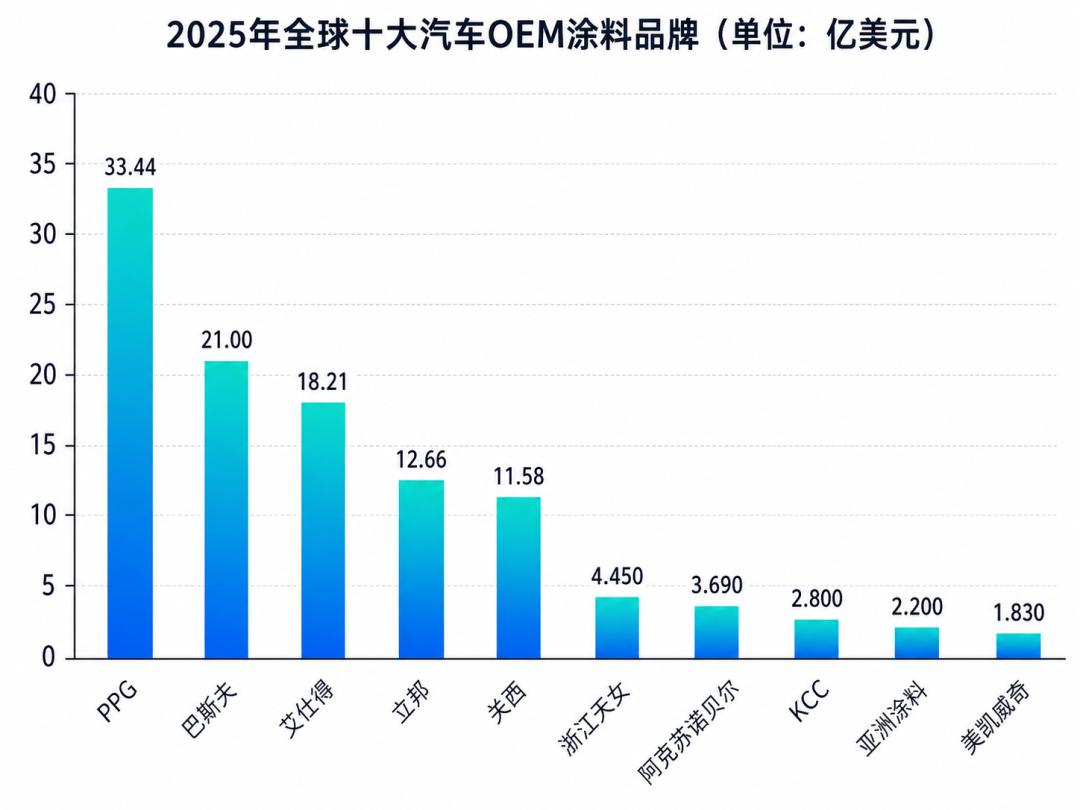
The top 10 global automotive OEM paint brands are almost entirely represented by companies from Europe, North America, and Japan
PPG Industries, the U.S.-based corporation, is the world's largest automotive coatings supplier, operating 14 manufacturing facilities and 4 research and development centers across China.
Entering the Chinese market in the late 1980s, PPG counts major clients including Volkswagen, General Motors, Mercedes-Benz, Dongfeng Citroën, Peugeot, and Chery among its long-term partners.
BASF, the German chemical giant, began selling textile dyes to China as early as 1885.
While automotive coatings represent only one segment of the company's diverse business portfolio, its premium "Glasurit" paint brand is the exclusive specified finish for ultra-luxury vehicles from Bentley, Rolls-Royce, and Porsche.
Among the mainstream automotive coatings brands that have obtained OEM certification or qualified as authorized suppliers to major automakers, five are European and American: PPG (U.S.), BASF (Germany), Axalta (U.S.), AkzoNobel (Netherlands), and Sherwin-Williams (U.S.). Three are Japanese brands: Nippon Paint, Kansai Paint, and Rock Paint. Two are South Korean suppliers: Kumho Petrochemical and Nohr Coatings.
Within this competitive landscape structured as "5+3+2+1," only one single Chinese brand is present — Donglai Technology.
This market concentration may not seem immediately clear, but examining the paint suppliers actually used by domestic Chinese automakers illustrates the situation vividly.
When the Xiaomi SU7 was launched, the marketing claim of "Rolls-Royce equivalent paint finish" became a widely discussed topic.
Although Xiaomi did not explicitly name its paint supplier, BASF officially announced:
Since 2023, BASF Coatings has collaborated closely with Xiaomi Automotive, participating comprehensively in every stage of the Xiaomi SU7's coating manufacturing process from initial color development through full production launch.
In fact, the entire Xiaomi SU7 product line and the subsequent YU7 series utilize full-system coating solutions supplied by BASF.
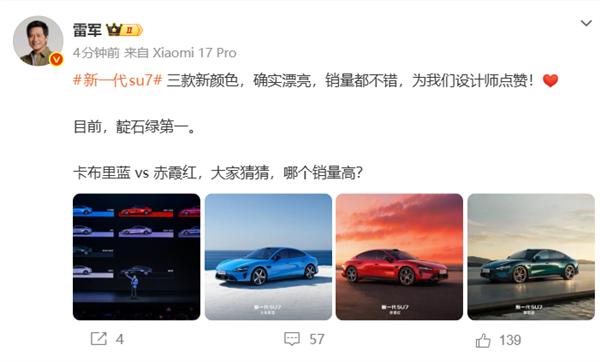
Lei Jun personally promoted the new generation paint colors for the Xiaomi SU7
Among BYD's official partners, domestic Chinese brands including Huahui, Kinlita, and Donglai Coatings are represented.
However, a substantial portion of the paint finishes used by the world's leading new energy vehicle manufacturer still originates from foreign or joint-venture coatings enterprises such as BASF, PPG, AkzoNobel, and Axalta.
According to the 2025 ranking of China's Top 30 Automotive Coatings Brands, China's automotive coatings market reached a total size of 43.6 billion yuan in 2024.
Foreign-owned brands captured over 60% of this total market share.
While domestic Chinese brands appear to hold a respectable market share, their operations are largely concentrated in lower-tier segments including commercial vehicle coatings, component coatings, and refinish paints. Within the passenger vehicle OEM body paint segment — the field with the most stringent technical requirements — foreign brands maintain an almost absolute monopoly.
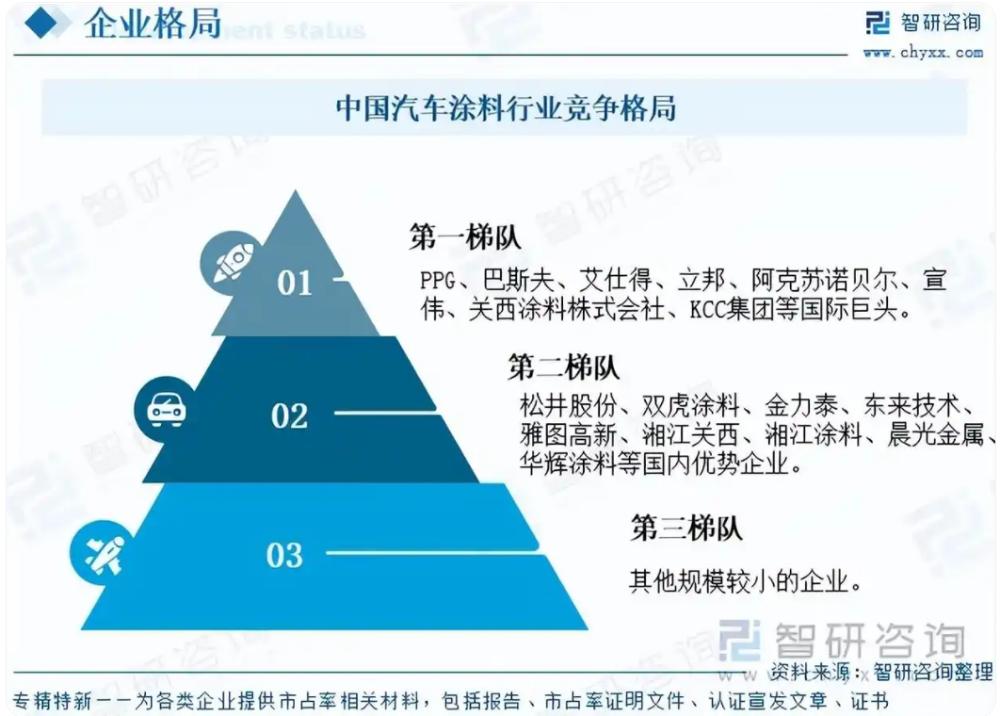
China's automotive coatings market features numerous domestic brands, but high-end product segments remain almost entirely dominated by foreign enterprises
Global industry giants have constructed formidable competitive moats in China's automotive paint market through wholly-owned operations and joint ventures.
The underlying reasons for this dominance are straightforward.
Nearly all leading automotive coatings suppliers are century-old enterprises that have evolved alongside the global automotive industry. They possess unmatched brand influence, deep technical heritage, and extensive experience in building impenetrable technological barriers.
The first wave of joint-venture automotive brands that entered the Chinese market also originated from Europe, North America, Japan, and South Korea.
From a chronological perspective, foreign automotive coatings enterprises entered the Chinese market almost simultaneously with their corresponding automotive brand partners.
This inherent preference for using familiar, home-market paint suppliers creates deeply entrenched, long-standing collaborative relationships.
Automotive coating application is far more complex than simple spray painting, requiring perfectly matched process workflows, specialized technologies, and dedicated equipment. Automakers must bear substantial testing costs and accept significant operational risks to qualify new suppliers, while lengthy OEM certification cycles create formidable market entry barriers that domestic paint manufacturers have historically struggled to overcome.
More critically, most domestic Chinese coatings enterprises remain confined to mid-tier operations focused on formula adjustment, lacking independent R&D capabilities for core raw materials. High-performance resins, specialized additives, and key color pigments remain heavily dependent on imports, and these fundamental materials directly determine paint performance characteristics and final production costs.
Developing, manufacturing, and applying passenger vehicle paint is an extraordinarily technically challenging process, earning it the reputation as "the jewel in the crown of the coatings industry."
Capturing this "jewel" is no simple achievement.
Domestic Industry Breakthrough
Without sufficient market demand, enterprises lack the incentive to invest in technological R&D, and without breakthrough technical capabilities, they cannot secure meaningful market access.
The domestic automotive coatings industry, which has long been trapped in this paradox, is now undergoing quiet but transformative changes.
As China's automotive production and sales volumes have maintained the top global ranking for consecutive years, and particularly with the explosive growth of new energy vehicles, the total output value of China's automotive coatings industry rose to 64.5 billion yuan in 2025.
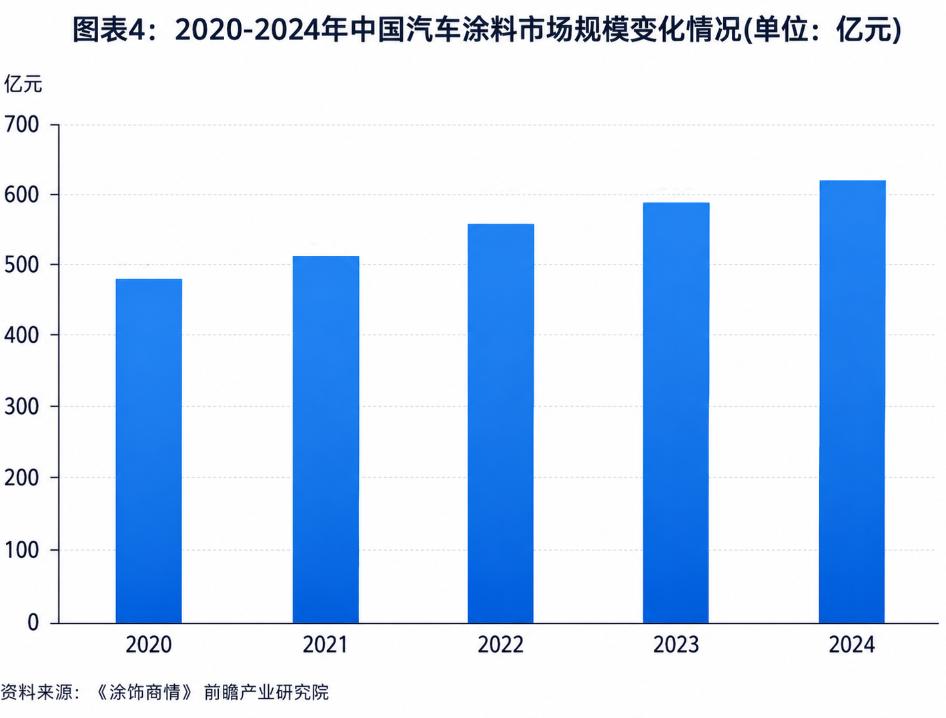
As China's automotive production volume grows, the automotive coatings market continues to expand year over year
The massive scale of domestic market demand, combined with the accelerating pace of Chinese automakers expanding into global overseas markets, has prompted independent automotive brands and domestic coatings enterprises to launch a concerted offensive against this final remaining "weak link" in their industrial supply chain.
From a national industrial security perspective, an automotive industry that is fully dependent on imported coatings effectively cedes critical decision-making authority to external parties, creating inherent strategic vulnerabilities.
Industry statistics indicate that automotive coating prices increased by 34% between 2022 and 2024, while the sector faces persistent risks of raw material supply disruptions.
The limited bargaining power created by foreign monopolies, combined with the fact that China's new energy vehicle sector has disrupted established global industry patterns, explains why domestic independent automakers — particularly new energy vehicle manufacturers — are so strongly committed to achieving full independent control over their entire supply chain ecosystems.
BYD has adopted a comprehensive strategy of "in-house R&D + strategic investment + self-built production facilities."
Beginning in 2022, BYD started constructing its own dedicated coatings production lines, investing 6 million yuan and 12.5 million yuan respectively to establish water-based coating production facilities and specialized functional interface material projects.
AITO, the automotive brand deeply associated with Huawei, has also achieved breakthroughs in domestic OEM paint solutions.
Local Chinese supplier Huahui Coatings has become the exclusive OEM paint supplier for multiple AITO vehicle models, delivering complete full-system coating solutions for the product lineup.
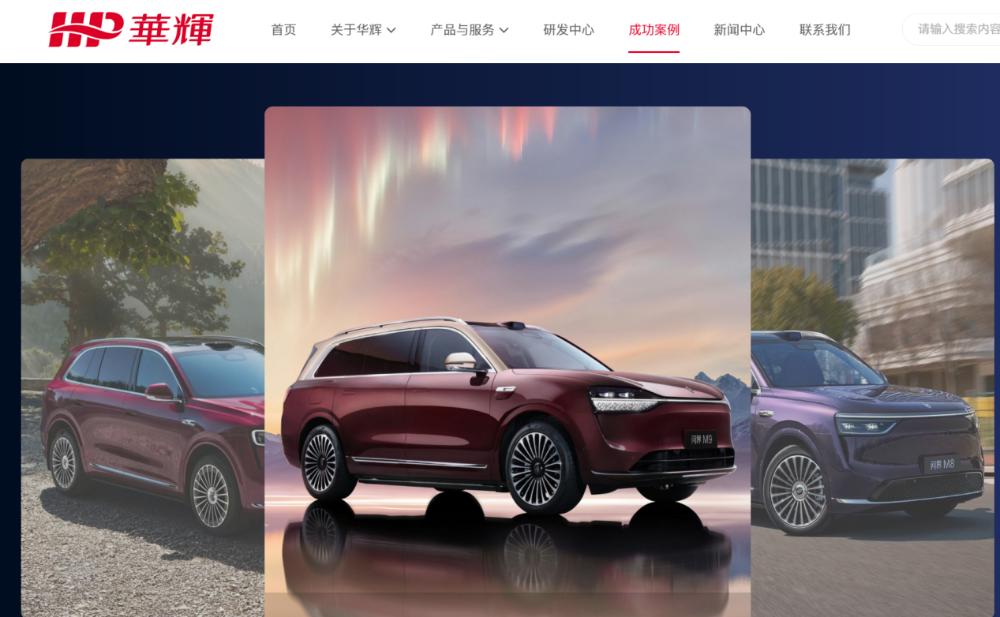
Huahui Coatings' official website showcases its case study providing complete coating solutions for AITO vehicles
Simultaneously, domestic Chinese automakers are establishing deep collaborative partnerships with local automotive coatings enterprises.
In 2025, BYD, Xiaomi, and XPeng made strategic investments in Huahui Coatings. BYD acquired a 17.54% ownership stake, Xiaomi invested over 2.22 million yuan to secure a 7.018% shareholding, while automotive giant Geely made a strategic investment in Zhejiang Youqian New Materials.
This deep, integrated collaboration between automakers and coatings suppliers not only delivers cost advantages and enhanced supply chain security for vehicle manufacturers, but also provides domestic automotive coatings enterprises with invaluable opportunities for technical validation and guaranteed order volumes.
From a technical perspective, the unique performance characteristics and evolving requirements of new energy vehicles have created unprecedented opportunities for latecomer domestic enterprises to achieve technological leapfrogging.
New energy vehicles impose entirely new functional requirements on coatings: battery packs must deliver exceptional fire resistance, thermal insulation, and anti-corrosion performance; vehicle bodies constructed from aluminum alloys and composite materials demand innovative coating application processes; and increasingly stringent environmental regulations are accelerating the widespread adoption of eco