National-level metropolitan areas, only 6 seats left
01
National-Level Metropolitan Areas: Only 6 Spots Remaining
Since the Nanjing Metropolitan Area was approved in 2021 to the recent approval of the Kunming Metropolitan Area this year, the total number of national-level metropolitan areas has increased to 21.
Which other national-level metropolitan areas will receive approval in the future?
The Yunnan provincial government recently revealed the answer.
On July 9, at the press conference for the Kunming Metropolitan Area Development Plan held by the Yunnan Provincial Government Information Office, Xu Dong, First-Level Inspector of the Yunnan Provincial Development and Reform Commission, introduced: The state will layout 27 modern national-level metropolitan areas across the four major regions of Eastern, Central, Western, and Northeast China, and the Kunming Metropolitan Area is the 21st.
The figure of 27 comes from official Yunnan sources, which uses no vague expressions such as "about", "around", or "approximately" — it is a definite number. This means 6 more national-level metropolitan areas will be established in the future.
Do these 27 metropolitan areas correspond one-to-one with the 27 provinces and autonomous regions in mainland China? The distribution is not uniform at all.
On one hand, Guangdong, Zhejiang, Shandong, and Fujian have each had two metropolitan areas approved; on the other hand, some spots are taken by those under direct-administrated municipalities, including the already approved Chongqing Metropolitan Area and the Capital Metropolitan Area.
The official statement from Yunnan is clear: the state's plan covers 27 metropolitan areas across the four major regions of Eastern, Central, Western, and Northeast China.
Looking at the 21 already approved national-level metropolitan areas: The eastern region has 11, including Nanjing, Fuzhou, Hangzhou, Guangzhou, Shenzhen, Qingdao, Jinan, Xiamen-Zhangzhou-Quanzhou, Ningbo, Shijiazhuang, and the Capital Metropolitan Area; the central region has 4: Changsha-Zhuzhou-Xiangtan, Wuhan, Zhengzhou, and Hefei; the western region has 4: Chengdu, Chongqing, Xi'an, and Kunming; the northeast region has 2: Shenyang and Changchun.
Among the existing national-level metropolitan areas, the eastern region accounts for over 50%, which makes perfect sense since most of the country's economy, population, and industries are concentrated there.
The "peacocks flying southeast" trend involves far more than just population flows.
Based on the division of the Hu Huanyong Line: This line was proposed in 1935. According to Hu Huanyong's calculations at the time, the area east of the line accounted for about 36% of China's total land area but held 96% of the population; the area west of the line made up 64% of the land but only 4% of the population.
Data from the 6th national population census in 2010 shows that the population east of the line accounted for 93.68% of China's total, while the west accounted for 6.32%.
The 7th national population census in 2020 indicates that the population west of the Hu Huanyong Line makes up 6.5% of the total, and the east accounts for 93.5%.
Therefore, we cannot simply conclude that the central, western, and northeastern regions have too few spots, and the remaining 6 spots will definitely not go to the eastern region.
That would be a misconception.
Considering the weights of population, economy, and industry, half of the remaining 6 spots will most likely still go to the eastern region.
02
10 Cities Competing for the Remaining Spots
Looking at the "15th Five-Year Plan" released by various cities, 10 cities are targeting the 6 remaining spots.
They include:
Shanghai Metropolitan Area: Shanghai's 15th Five-Year Plan mentions promoting the construction of the Shanghai Metropolitan Area to build an integrated commuting, industrial, and living circle.
Suzhou-Wuxi-Changzhou Metropolitan Area: The Jiangsu Provincial Party Committee's proposal and the province's 15th Five-Year Outline specify "accelerating the construction of the Suzhou-Wuxi-Changzhou Metropolitan Area".
Nanchang Metropolitan Area: Jiangxi's 15th Five-Year Plan notes strengthening the core engine role of the Nanchang Metropolitan Area and accelerating integrated development; Nanchang's 15th Five-Year Plan clearly states that a new round of Nanchang Metropolitan Area planning will be formulated to link Jiujiang and Fuzhou, building a 1-hour commuting circle.
Taiyuan Metropolitan Area: Shanxi's 15th Five-Year Plan outline proposes promoting the integrated development of the Taiyuan Metropolitan Area and strengthening the Taiyuan-Yuci-Taigu core zone; Taiyuan's 15th Five-Year Plan outline mentions pushing for the "Taiyuan Metropolitan Area Development Plan (2025—2035)" to be approved as soon as possible;
Nanning Metropolitan Area: Guangxi's 15th Five-Year Plan proposes building a modern urban system centered on the Nanning Metropolitan Area.
Guiyang Metropolitan Area: Guizhou's 15th Five-Year Plan implements a modern metropolitan area cultivation initiative.
Lanzhou-Baiyin Metropolitan Area: Gansu's 15th Five-Year Outline promotes the integration of Lanzhou and Baiyin to build a provincial capital metropolitan area.
Xining-Haidong Metropolitan Area: Qinghai's 15th Five-Year Plan advances the integration of the Xining-Haidong Metropolitan Area to strengthen the core driving force.
Hohhot Metropolitan Area: Inner Mongolia's 15th Five-Year Plan sets out to construct the Hohhot Metropolitan Area.
Among these 10 candidates, the Shanghai Metropolitan Area and Suzhou-Wuxi-Changzhou Metropolitan Area are almost certain to get approved.
There are two reasons:
First, the news was already hinted last year.
In December last year, the State Council approved the "Yangtze River Delta Territorial Space Plan (2023—2035)". This is the first territorial space plan for a national-level urban agglomeration in the Yangtze River Delta, and the third nationwide.
Point 4 of the plan clearly states: Optimize the metropolitan area-led spatial pattern, support Shanghai in playing its leading role, strengthen spatial integration between the Shanghai Metropolitan Area and the Suzhou-Wuxi-Changzhou Metropolitan Area, as well as spatial coordination with the Nanjing, Hangzhou, Hefei, and Ningbo Metropolitan Areas, to support the construction of a world-class urban agglomeration.
The State Council document mentions 6 metropolitan areas, among which Nanjing, Hangzhou, Hefei, and Ningbo have already been approved. The Shanghai Metropolitan Area and Suzhou-Wuxi-Changzhou Metropolitan Area will not have to wait much longer.
Some may wonder that the document only mentions them in passing, without explicitly stating that they will be approved.
You won't have this doubt if you understand the approval process for previous national-level metropolitan areas.
For example, the Nanjing, Fuzhou, Chengdu, and Xi'an Metropolitan Areas approved in 2021 were all explicitly mentioned in the official "Key Tasks for New-type Urbanization and Urban-Rural Integrated Development 2021", which stated that support would be given to the three cities (Fuzhou, Chengdu, Xi'an) to formulate and implement their development plans.
The approval of the Changsha-Zhuzhou-Xiangtan and Wuhan Metropolitan Areas in 2022 was also specified in the central government's "14th Five-Year Implementation Plan for the Development of the Middle Reaches of the Yangtze River Urban Agglomeration".
The Chongqing Metropolitan Area was named in the central government's "Chengdu-Chongqing Economic Circle Construction Plan Outline".
Qingdao and Jinan's approval was also hinted in the central government's "Opinions on Supporting Shandong to Deepen the Transformation of Old Growth Drivers and Promote Green, Low-Carbon, High-Quality Development", which clearly states: Promote the intensive development of the Shandong Peninsula urban agglomeration and build a growth pole for the Yellow River Basin. Cultivate and develop modern metropolitan areas in Jinan and Qingdao, and construct the Jinan New Old Growth Driver Starting Zone and Qingdao West Coast New Area with high quality.
However, the more than ten subsequent metropolitan areas were approved with no prior warning, and many did not make their specific planning documents public.
Second, the Shanghai Metropolitan Area and Suzhou-Wuxi-Changzhou Metropolitan Area have long met the approval criteria for national-level metropolitan areas.
What are the criteria for approving a national-level metropolitan area?
In September 2022, the National Development and Reform Commission issued a document emphasizing: Metropolitan areas are mainly concentrated in regions with advantageous economic development. Full consideration must be given to the development foundation and potential. When conditions are mature, metropolitan areas should be gradually cultivated relying on megacities, super-large cities, or large cities with strong radiating driving capabilities. We cannot overstep the development stage and push for metropolitan area construction when conditions are not in place.
Breaking down this passage, there are two key points: First, metropolitan areas are mainly located in economically advantageous regions, requiring full consideration of development foundation and potential, and gradual cultivation relying on megacities, super-large cities, or large cities with strong radiating capabilities when conditions are mature. Second, we cannot overstep the development stage and push for metropolitan area construction without sufficient conditions.
Subsequent approvals will only target megacities, super-large cities, or large cities with strong radiating driving capabilities.
In other words, the cities eligible for future national-level metropolitan area approval will mainly be megacities, super-large cities, and top-tier prefecture-level cities with exceptionally strong strength.
Shanghai, Suzhou naturally meet these criteria without question.
The main reason why the Shanghai Metropolitan Area has not been approved yet is that its scope has been continuously expanded.
The concept of the Shanghai Metropolitan Area was first proposed in 2016, initially covering only Shanghai, Suzhou, Wuxi, Nantong, Ningbo, Jiaxing, and Zhoushan. In 2022, Changzhou and Huzhou were added to the list.
In 2024, the Shanghai Metropolitan Area was further expanded to a "1+13" structure, totaling 14 cities, with the new inclusion of Hangzhou, Shaoxing, Taizhou, Xuancheng, and Yancheng.
As for the Suzhou-Wuxi-Changzhou Metropolitan Area, the concept was put forward more than 20 years ago, and all its member cities are economically strong. The core city Suzhou is the most powerful prefecture-level city in China, Wuxi ranks second among prefecture-level cities, and Changzhou is also a member of the 1-trillion-yuan GDP club.
In 2025, the GDP of the Suzhou-Wuxi-Changzhou Metropolitan Area reached 5.56 trillion yuan, which would rank second among all national-level metropolitan areas, only behind the Shenzhen and Nanjing Metropolitan Areas.
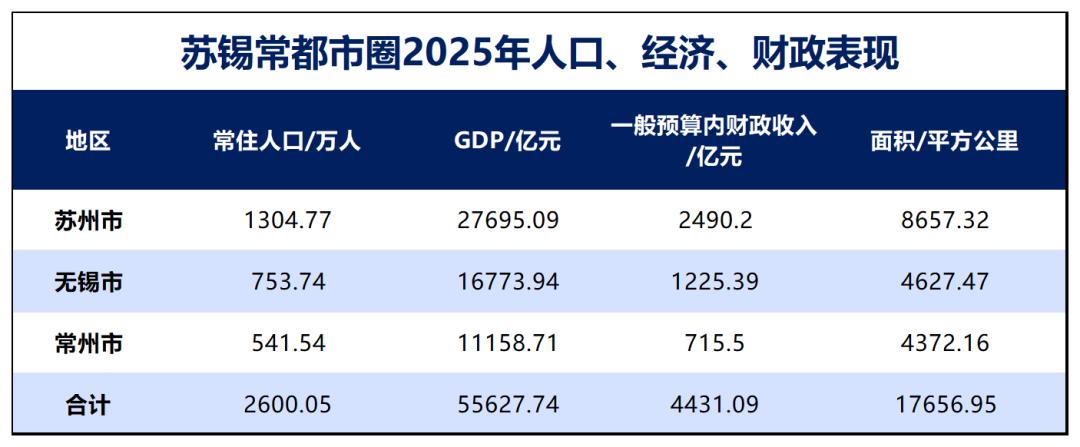
Cartography: Urban Finance; Data: Municipal Bureau of Statistics of each city
03
Harbin, Nanchang, Nanning Are Potential Candidates
According to the approval criteria for national-level metropolitan areas, subsequent approvals will only target megacities, super-large cities, or large cities with strong radiating driving capabilities.
The only remaining cities eligible for approval are Shanghai, Harbin, Dalian, and Suzhou.
Shanghai and Suzhou have already been discussed in the second section. Excluding these two, the metropolitan areas of Harbin and Dalian are both likely to get approved.
After Shanghai, Suzhou, Harbin, and Dalian take up 4 of the 6 remaining spots, the last 2 spots will have to go to cities that do not strictly meet the hard criteria for national-level metropolitan areas.
After all, among the 21 previously approved national-level metropolitan areas, some were approved as special exceptions.
For example, none of the cities in the Xiamen-Zhangzhou-Quanzhou Metropolitan Area meets the standard of a super-large city, nor do they meet the criteria of having strong radiating capabilities. The same applies to the Changchun, Fuzhou, and Ningbo Metropolitan Areas.
Therefore, it is not impossible that more special exceptions will be approved in the future.
Nanchang and Nanning may well be two of them.
Last year, Nanchang clearly stated in a reply letter that it did not yet meet the application threshold for a national-level metropolitan area, but the reply was later withdrawn. Our channel still retains a screenshot of the original document.
The reply was a comprehensive, detailed, in-depth, and pertinent response to the proposal "Unblock the Transportation 'Intermediate Cycle' and Enhance the Development Momentum of the Provincial Capital" put forward by Committee Member Jin Qiuping.
The reply mentioned: Industry expert reviews and assessments hold that currently, the economic, population, and other indicator scales of the Nanchang Metropolitan Area fall far short of the standards specified in relevant national policies, and it does not have the conditions to plan and build suburban railways. Going forward, the Provincial Development and Reform Commission will, based on regional economic and social development conditions, work with relevant cities and counties to deepen research on the suburban railway plan for the Nanchang Metropolitan Area, thoroughly demonstrate and improve the plan, and submit it for approval and implementation in due course in accordance with regulations.
The message is clear: Nanchang does not meet the standards for now and is difficult to get approved, and it will submit an application again when it meets the standards in the future.
The main reason for the difficulty in getting approved is that its economic and population scales do not meet the requirements.
However, the fact that the Changchun and Kunming Metropolitan Areas were approved shows that the criteria are not absolutely fixed.
From the perspective of regional patterns, Jiangxi is one of the few central provinces that do not yet have a national-level metropolitan area. Within the Middle Reaches of the Yangtze River Urban Agglomeration, the Wuhan and Changsha-Zhuzhou-Xiangtan Metropolitan Areas have already been approved, leaving Jiangxi as the only absent province.
More importantly, Jiangxi has long faced the problems of population outflow and industrial siphoning. In recent years, Jiangxi has proposed implementing a provincial capital-led strategy, holding successive high-standard conferences to promote Nanchang's high-quality development, with the essential goal of building Nanchang into the core carrier of the province's population, capital, industries, and innovation resources.
For the state, a strengthened Nanchang Metropolitan Area will not only enhance Jiangxi's own development capacity, but also help improve the spatial structure of the Middle Reaches of the Yangtze River Urban Agglomeration, forming a "three-pillar support" pattern of Wuhan, Changsha, and Nanchang.
From this perspective, the strategic value of the Nanchang Metropolitan Area even exceeds its current economic volume.
The logic behind the Nanning Metropolitan Area is different.
Nanning's biggest advantage is not its economic strength, but its strategic location status.
In recent years, the state has continuously promoted the construction of the Western Land-Sea New Corridor, the Pinglu Canal is about to open to navigation, and the building of the China-ASEAN Community with a Shared Future has been deepening. Guangxi has become China's front door for opening-up and cooperation with ASEAN.
As one of the provincial capitals closest to ASEAN in China, Nanning is the permanent host city of the China-ASEAN Expo, and also an important hub of the Western Land-Sea New Corridor.
From the perspective of the national strategic layout, if a national-level metropolitan area is to be cultivated in the southwestern coastal region in the future, Nanning has almost no competitors.
Especially against the background that the three inland national-level metropolitan areas of Chengdu, Chongqing, and Kunming have already been approved, it is entirely possible for the state to approve the Nanning Metropolitan Area to fill the strategic fulcrum for opening-up to ASEAN.
In other words, the Nanning Metropolitan Area undertakes not merely a regional economic function, but