Who has come out ahead in the transformation race amid the decoupling of the "Apple supply chain"?
The 2026 World Cup has reached the semi-final stage. This quadrennial football showcase repeatedly reinforces a timeless rule: no matter how impressive your performance in the group stage is, you will still be heading home if you cannot hold your ground in the knockout rounds.
At this very moment, a standout track in China's manufacturing industry is also going through its own "knockout phase". At the end of June, market rumors emerged that Apple's foldable iPhone was about to enter small-scale production, with a targeted launch in September. This represents Apple's biggest hardware innovation in nearly a decade. In the past, this would have been a moment of collective celebration for Apple Supply Chain concept stocks; however, this time around, the capital market's reaction was unexpected: the share prices of related companies not only failed to rise alongside the news, but several of them even dipped into negative territory.
Just over a decade ago, in the era of new iPhone launches, Foxconn's Zhengzhou factory found 24-hour shift work barely fast enough. Back then, being part of the "Apple Supply Chain" was the top-tier certification in China's manufacturing sector - aligning yourself with Apple meant aligning yourself with profitability.
Today, even with a blockbuster new Apple product, the Apple Supply Chain stocks can barely move upward.
Why is that?
Because Apple has changed, while the position of Apple Supply Chain companies has remained the same. The prestige of the Apple Supply Chain may still exist, but its actual value has long been transformed.
Apple is increasingly relying on services to generate profits, with its willingness to invest in hardware innovation diminishing; yet the revenue source for Apple Supply Chain companies is precisely the hardware manufacturing segment.
The risk of putting all eggs in one basket has never been as tangible as it is today.
Consequently, a collective breakout effort among Apple Supply Chain companies has begun.
1. Breaking Away from Apple Dependence - An Inevitable Path
Over the past 15 years, the growth formula for Apple Supply Chain companies was simple enough to fit on a single line: the incremental sales of Apple's products multiplied by their respective market share equals their own growth.
This logic almost never failed to deliver results.
Luxshare Precision started from being a frontline worker on Foxconn's assembly lines to becoming a billionaire entrepreneur; Lens Technology grew from a single glass component to achieving a market value of hundreds of billions...
These business legends were all written single-handedly by the iPhone.
However, the precondition for this formula to work was that Apple remained unchanged. Now, Apple itself has officially announced: Tim Cook, who has served as CEO for 15 years, is about to step down. As Apple evolves, this formula is naturally losing its effectiveness.
The problem lies in the profit-generation model: Apple's growth engine has long shifted from "selling one more phone" to "getting existing users to keep spending"; yet the role played by Apple Supply Chain companies has always been confined to the hardware manufacturing stage.
In this shifting landscape, Apple's growth dividends are no longer automatically shared with the Apple Supply Chain.
According to data from Bank of America (BofA), in fiscal year 2025, Apple's services segment contributed more gross profit than the iPhone for the first time, accounting for 42% of the total. It is projected that by fiscal year 2027, the gross profit share from services will further rise to 44%, while the iPhone's share will drop to 39%. Services including App Store commissions, iCloud subscriptions, and Apple Music boast a gross margin of 76.5%, nearly double that of hardware products.
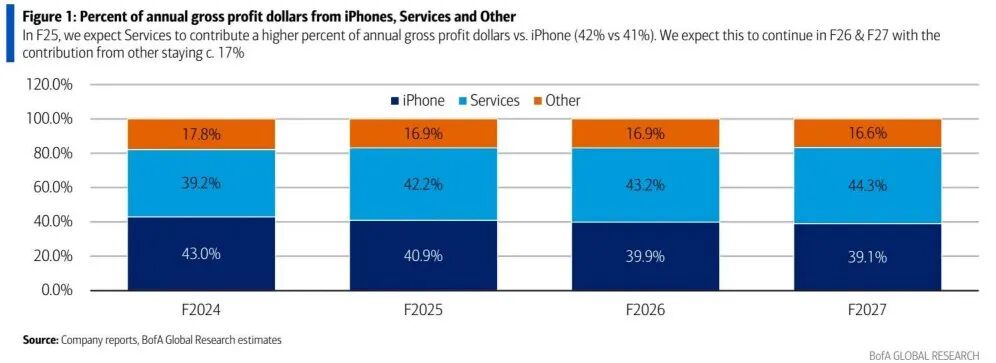
In other words, every iPhone sold keeps generating continuous "cash flow" for Apple.
And this money-printing machine has nothing to do with the Apple Supply Chain: every dollar Apple earns from services does not need to be shared with them. The higher the proportion of service revenue, the less dependent Apple becomes on its hardware business.
What Apple Supply Chain companies still get is only the profit from the hardware manufacturing segment - and this very pie is being actively split by Apple into emerging labor markets such as Vietnam and India.
This sends out a dangerous signal: Apple's willingness to invest in hardware innovation is decreasing, while its willingness to push down hardware costs is intensifying.
A dual squeeze follows: the share of the pie allocated to them is shrinking, and the pie itself is being thinned down.
Data does not lie. Over the past decade, the net profit margin of Apple Supply Chain companies has continuously narrowed: Luxshare Precision saw its margin drop from 11.16% in 2015 to 5.47% in 2025; Lens Technology fell from its peak of 13.41% in 2020 to 5.40% in 2025; Goertek plummeted from its 2016 high of 16.30% all the way to 3.97% in 2025...
Even more urgent than Apple's internal changes is the accelerating tightening of the external environment.
Under the shadow of tariff wars, the shrinking of China's share in Apple's supply chain has become unavoidable: Apple Supply Chain companies are no longer Apple's only options, and Apple is no longer the sole path to survival for Apple Supply Chain enterprises.
In 2023, India's iPhone production accounted for approximately 7% of the total; this figure rose to 14% in 2024, and rapidly jumped to 25% in 2025, currently stabilizing between 25% and 26%, primarily targeting the U.S. market.
According to Canalys data, in the second quarter of 2025, India overtook both China and Vietnam for the first time to become the largest supplier of smartphones to the U.S.; China's market share plummeted to 25% from 61% in the same period the previous year.
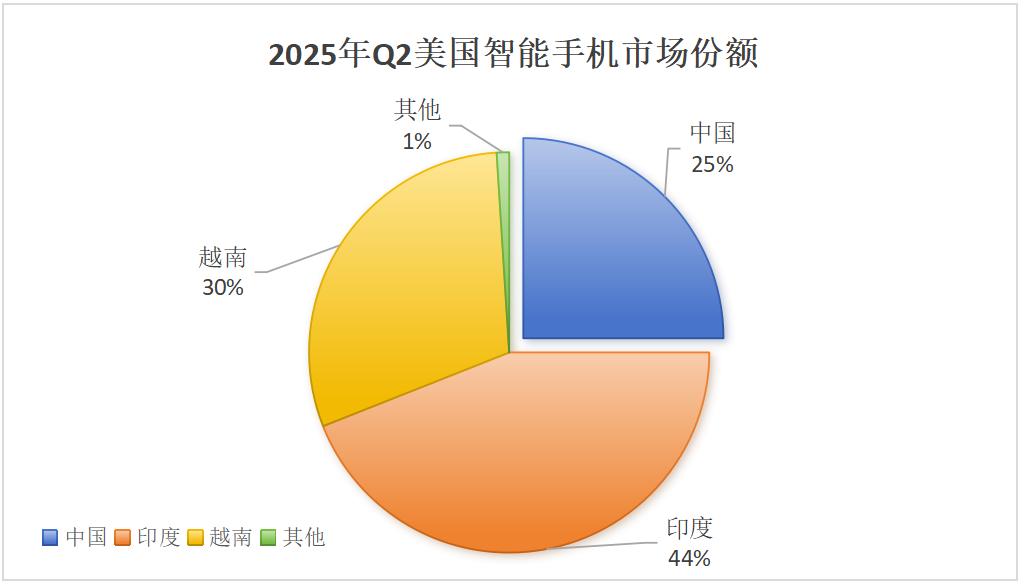
Caught between internal struggles and external pressures, "de-Apple-ization" is no longer just a slogan, but a matter of survival. Several companies have submitted completely different answers to this same challenge.
2. The Fork in the Road of Destiny
Under mounting pressure, the Apple Supply Chain giants have each rushed toward new tracks they believe in: AI computing power, humanoid robots, intelligent electric vehicles...
Yet the outcomes we see today have their seeds planted over a decade ago: some found new paths early on, while others are still relying on Apple's orders to stay afloat.
2015-2019: The Watershed Emerges
In 2014, the iPhone 6 series made its debut, with cumulative global sales reaching approximately 341 million units, making it the best-selling iPhone model of all time. Apple Supply Chain companies subsequently entered a golden period of growth.
While everyone was busy expanding production and competing for Apple's orders, some companies began conducting "counterintuitive" experiments.
In 2015, Goertek Acoustics changed its name to Goertek Co., Ltd. Chairman Jiang Bin judged that the ceiling for acoustic components was approaching, and VR/AR would be the next computing platform. In 2016, Goertek entered the VR track and became a core manufacturer for U.S. VR company Oculus - whose product later became the widely known Meta Quest.
During the same period, Sunwoda's consumer electronics business was generating steady profits, but Wang Mingwang was already exploring the potential of power batteries - he was convinced that the ceiling for consumer electronics would arrive in the near future.
Lens Technology made the opposite choice: after going public in 2015, it focused all its efforts on expanding production and capturing market share, deeply tying itself to Apple. After its sapphire business encountered setbacks, it placed all its bets on mobile phone glass. From 2015 to 2017, Lens Technology's revenue surged from 17.2 billion yuan to nearly 24 billion yuan.
Luxshare Precision also increased its focus on Apple: in 2018, it made a strategic investment in Merry Electronics, and in 2019, it acquired a 51% stake in Suzhou Meite to enter the acoustic components segment, gradually increasing its share of AirPods manufacturing. Yet behind the scenes, Wang Laichun had quietly extended her reach into automotive electronics.
There was also Foxconn Industrial Internet: established in March 2015, it listed on the A-share market in 2018, and immediately began engaging with Nvidia to discuss liquid cooling collaborations. Back then, its cloud computing business accounted for less than 10% of its total revenue, its share price fell below the issue price, and no one believed it could succeed.
At this stage, the Apple Supply Chain appeared to be thriving on the surface. But in hindsight, different choices had already sown the seeds for future divergences.
2020-2022: Turbulence and Differentiation
The pandemic, chip shortages... Apple Supply Chain companies faced their own unique challenges, each finding their own way forward.
In July 2020, Luxshare Precision acquired Wistron's iPhone assembly business for 3.3 billion yuan, becoming Apple's third-largest iPhone assembler after Foxconn and Pegatron. Wang Laichun's choice was to deepen its ties with Apple, and then use the cash flow generated from Apple's business to continuously nurture its automotive electronics segment.
In 2021, Goertek had invested over 4 billion yuan in XR, accounting for 5% of its total revenue. But the VR/AR market failed to take off as expected, and sales of the Quest series remained at low levels - Goertek waited for years without seeing its market opportunity arrive.
In the same year, Sunwoda spun off its power battery business for independent financing, with NIO, XPeng, and Li Auto all taking stakes. However, the power battery track was crowded with powerful competitors, led by CATL and BYD who pushed down prices, resulting in Sunwoda Electric Vehicle Battery posting billions in losses year after year.
Lens Technology continued to expand its mobile phone glass production, with its revenue reaching 45.2 billion yuan in 2021 - its scale grew larger, and its dependence on Apple deepened.
The proportion of Foxconn Industrial Internet's revenue from cloud computing gradually rose from 10% to 20%; its liquid cooling collaboration with Nvidia remained in the testing phase, and its share price stayed flat. The silence continued.
During those three years, some companies found themselves tied to a sinking ship, while others had quietly prepared to switch decks.
2024-2025: The Answers Are Revealed
In 2024, Nvidia's GPU power consumption rose to 1200W, making liquid cooling a hot commodity overnight. After years of lying low, Foxconn Industrial Internet finally saw its opportunity arrive: in 2025, its cloud computing business alone generated 602.679 billion yuan in revenue, accounting for nearly 70% of its total revenue; the proportion of revenue from Apple-related businesses dropped to around 30%.
Luxshare Precision has the most stable business lines among these companies: consumer electronics, automotive, and communications all advancing in parallel. In 2024, Luxshare acquired the German Leoni Group for approximately 1.5 billion euros, immediately securing supplier qualifications for brands such as BMW, Mercedes-Benz, and Volkswagen; in 2025, its automotive electronics revenue reached 39.255 billion yuan, skyrocketing 185.34% year-on-year.
Lens Technology's most prominent new story is robotics: in 2025, the Lens Technology Intelligent Robot Yong'an Park was put into operation, with an annual production capacity of 500,000 embodied intelligent robots; in 2026, at the Beijing Yizhuang Humanoid Robot Half Marathon, 132 core structural components of the "Lightning" robot were manufactured by Lens Technology. Yet on the flip side, in the first quarter of 2026, Lens Technology's revenue dropped by 17%, posting a loss of 150 million yuan. The new business shows promise, but it is not yet enough to light up the path ahead.

Goertek is still waiting: in 2025, global AR/VR headset shipments fell by approximately 20% year-on-year, and the revenue growth rate of its intelligent hardware business (including XR) has remained at a low level; profit recovery has largely relied on improved gross margins from AirPods manufacturing, rather than contributions from new businesses.
The most awkward situation belongs to Sunwoda: its power battery business lost 3 billion yuan, while the proportion of revenue from consumer batteries dropped from 54% to 50% - it failed to deliver its new business story, and its traditional core business is slipping away.
The Apple Supply Chain of today is no longer a group of partners on the same ship: some have boarded new vessels, while others are still repairing the leaky old one. Starting from the same point, why did they end up at completely different destinations?
3. The Decisive Factor in Transformation
Among the five companies, Luxshare Precision's path is the most worthy of detailed analysis - not because it is the most successful, but because it provides a fully reviewable case study.
Luxshare's transformation strategy is built on anticipating three major trends
First, capabilities can be transferred across domains.
Many people believe that automotive electronics and consumer electronics are two completely different fields. But for precision manufacturing, they share the same underlying capabilities: large-scale mass production, extreme cost control, and rapid response to customer demands.
Luxshare's automotive business can be traced back to 2008: at that time, it was still manufacturing computer connectors for Foxconn, but had already entered the automotive wiring harness sector as a Tier 2 supplier. In 2011, it officially established its automotive division, and subsequently expanded its footprint through a series of acquisitions. Its 2024 acquisition of Leoni in Germany essentially transplanted the manufacturing management capabilities accumulated during its Apple Supply Chain days directly into the supply chains of the world's top automakers.
