In the first half of the year, sales of vehicles priced under 50,000 yuan plummeted by 55%, while sales of new energy vehicles priced above 400,000 yuan surged by 46%.
In the first half of 2026, China's automotive market delivered a striking "extreme" performance.
On one hand, sales in the sub-market for vehicles priced below 50,000 yuan plummeted 55% year-on-year, with its market share halving from 2.8% to 1.4%; on the other hand, sales of new energy vehicles (NEVs) priced above 400,000 yuan surged 46% year-on-year, with domestic brands seizing 59% of this high-end segment, evolving from "participants" to "rule-setters" in the premium market.
This is not a cyclical fluctuation, but the beginning of structural restructuring.
Total market pressure and extreme structural differentiation define the core characteristics of China's passenger vehicle market in the first half of the year. The mid-to-low end market shrank sharply, while the high-end market maintained consumer resilience. Clear divergence emerged in the internal power structure and price segment performance of the NEV sector, with the industry's Matthew effect becoming increasingly prominent. The automotive market has bid farewell to broad-based growth, and the strength landscape of segmented tracks has gradually taken shape.
Mid-to-low end market sales slump sharply, with vehicles under 50,000 yuan seeing over 50% decline
In H1 2026, the overall market showed a typical pattern of "falling volume and rising prices", with structural changes directly driving up the industry's average transaction price. By segment, the entry-level price range witnessed the most brutal market contraction, making it the sub-market hit hardest by this round of adjustment.
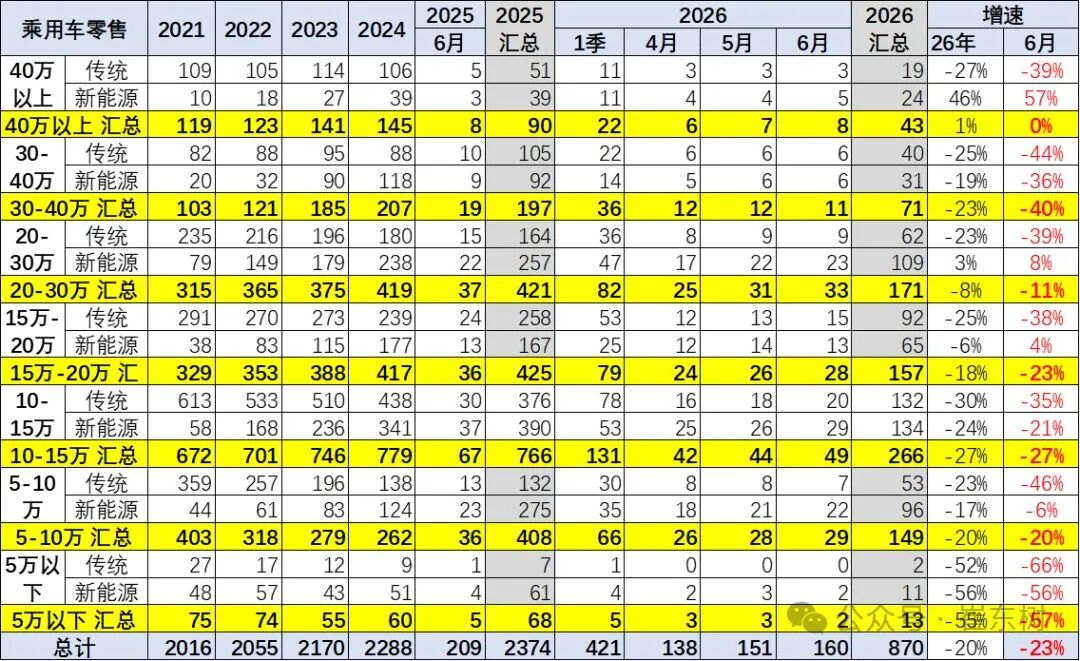
Image source: Cui Dongshu's official WeChat account
Data from the China Passenger Car Association (CPCA) shows that from January to June 2026, cumulative sales in the sub-market for vehicles under 50,000 yuan reached only 130,000 units, plummeting 55% year-on-year. Among them, NEV sales fell 56% and fuel vehicle sales dropped 52%, with the segment's market share shrinking from 2.8% in 2025 to 1.4%.
The 100,000-150,000 yuan market followed closely in decline — cumulative sales in H1 this year hit 2.66 million units, down 27% year-on-year. NEV sales in this segment fell 24%, while traditional fuel vehicle sales dropped 30%. Overall, the market share of vehicles priced 100,000-150,000 yuan slipped from 32.3% in 2025 to 30.6%.
The 50,000-100,000 yuan market also saw a notable downturn, with cumulative sales of 1.49 million units, down 20% year-on-year. NEV sales here fell 17% and traditional fuel vehicle sales dropped 23%, while the sub-market's share remained largely flat compared to 2025.
"The core reason for the sharp decline in the mid-to-low end market is that under the policy orientation of high-quality development, the technical indicators for NEV tax exemptions have been upgraded. Some entry-level models with short range and high power consumption face pressure to update, which, coupled with shrinking consumer demand, has led to a sharp contraction in entry-level market needs," Cui Dongshu, Secretary-General of the CPCA, told reporters from the National Business Daily.
It is worth noting that despite the sales decline in the 100,000-150,000 yuan NEV market, clear differentiation has emerged — battery electric vehicles (BEVs) have demonstrated strong competitiveness, with their penetration rate continuously rising, while plug-in hybrid (PHEV) and extended-range electric vehicles (EREVs) have suffered severe declines.
Image source: National Business Daily Media Asset Library
"In the 100,000-150,000 yuan PHEV and BEV tracks, as the advantages of electrification continue to strengthen, the competitiveness of BEVs in this price range is constantly improving. The iteration speed of electrification technology is very fast at present, with obvious progress in both charging efficiency and battery energy density, while battery prices continue to decline year by year. The average export price of batteries fell by about 28% in 2025, and continued to drop by 12% in 2026. The significant drop in battery prices for several consecutive years has remarkably enhanced the market competitiveness of electric vehicles," Cui Dongshu said. Based on this context, he judged that the electrification of A-segment sedans is an inevitable core development trend. In the past, many consumers tended to choose PHEVs out of concerns, but as the performance of BEVs in range, charging experience and other aspects continues to improve, consumers' mindsets are shifting, gradually moving from PHEVs to BEVs.
NEV market above 400,000 yuan surges 46% year-on-year, the only high-end fortress with positive growth
In sharp contrast to the mid-to-low end market, the mid-to-high end market above 150,000 yuan performed relatively stably, with the 300,000+ yuan high-end segment standing out. Domestic brands have made remarkable breakthroughs in the premium market above 400,000 yuan, showing a clear high-end development trend.
CPCA data shows that the price range above 400,000 yuan is the only sub-market with positive growth — cumulative sales in H1 reached 430,000 units, a slight 1% year-on-year increase. Among them, cumulative sales of NEVs above 400,000 yuan hit 240,000 units, surging 46% year-on-year, while cumulative sales of traditional fuel vehicles reached 190,000 units, down 27% year-on-year. In this sub-market, NEVs have taken an absolute leading position, with their penetration rate rising rapidly from 44% in 2025 to 56% in H1 2026, while the share of traditional fuel vehicles dropped by 12 percentage points. Looking at the overall market, the NEV market share in the 400,000+ yuan segment has risen from 1.6% in 2025 to 2.8%.
The continuous growth of high-end NEVs from domestic brands has become the main driving force of this sub-market. CPCA data shows that currently, domestic brands hold a 59% market share in the 400,000+ yuan segment, up 21% compared to the same period in 2025, while the share of luxury brands has fallen back to 38%, down 21% year-on-year.
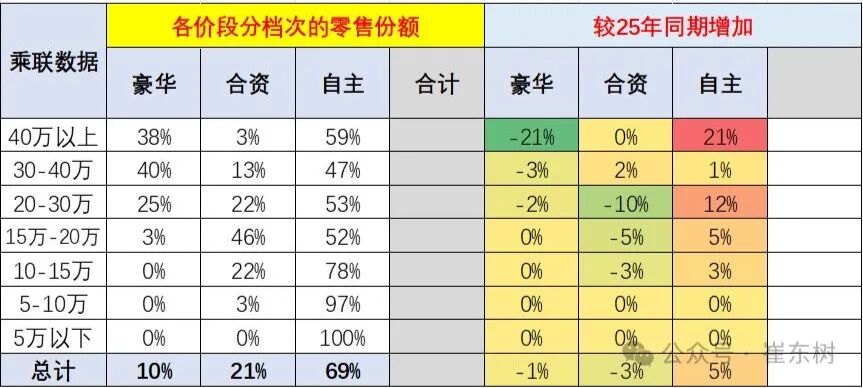
Image source: Cui Dongshu's official WeChat account
Notably, the penetration rate of BEVs above 400,000 yuan has risen rapidly, while EREVs have seen a clear decline. Additional data shows that from January to May 2026, cumulative sales of BEVs in China's 400,000+ yuan high-end market reached 84,900 units, and EREVs hit 27,800 units, with BEV sales volume reaching 3 times that of EREVs.
From the perspective of the SUV sub-track, the power structure of the three-row large SUV market has changed significantly, with BEV sales exceeding EREV sales for 9 consecutive months. The large five-seat SUV track also shows a divergence in technical routes: from June 2025 to May 2026, EREV sales have declined year-on-year for 12 consecutive months.
According to data provided by NIO, the BEV penetration rate within the large five-seat SUV track has risen rapidly. In Q1 2026, the sales ratio of BEVs to EREVs in the large five-seat SUV market was 1:2.2, a notable improvement from the 1:23 ratio in Q1 last year; in May, sales of BEV large five-seat SUVs surged 213% month-on-month, showing strong growth momentum.
In terms of passenger vehicle classification, the market share of large-sized vehicles is gradually increasing. In H1 this year, the market shares of B-segment and C-segment models reached 34% and 10% respectively, both up 2% compared to 2025.
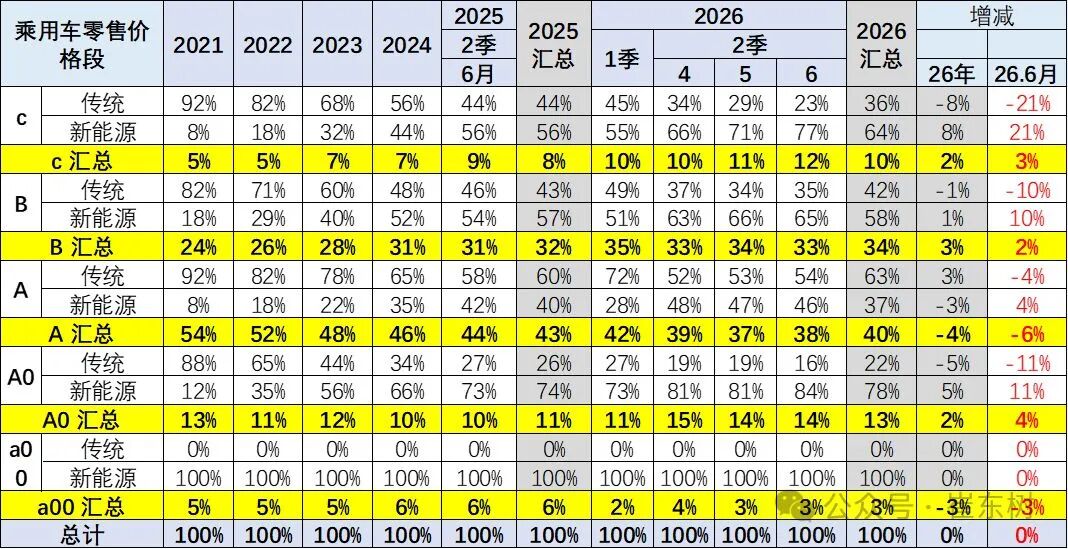
Image source: Cui Dongshu's official WeChat account
From the supply side, automakers are also accelerating the launch of more new large-sized vehicles. Cui Dongshu revealed to reporters that according to statistics, among the new vehicles launched from January to June, there are 43 models with a body length of over 5 meters, accounting for 61% of all new cars; there are only 2 models under 4.5 meters, accounting for a mere 2%. In contrast, in the same period last year, there were still 9 new cars under 4.5 meters, accounting for 13%, showing a sharp contraction in the supply of new small-sized vehicles.
"The industry's concentrated focus on large-sized vehicles is driven by the fact that large cars have higher profit margins, and can also compete for the existing market share of traditional fuel vehicles. As the market share of joint-venture brands continues to shrink, the luxury fuel vehicle market has become a new key diversion target for automakers. Therefore, most enterprises choose to deploy large-sized vehicles equipped with intelligent configurations, to seize the market space that originally belonged to luxury fuel vehicles," Cui Dongshu said.
In the first half of 2026, China's automotive market is completing its self-renewal in a brutal way. As the Matthew effect continues to intensify and brand differentiation becomes more prominent, 2026 may become the first year of "large stratification" in the automotive market — some models may be about to say goodbye, while others have already obtained the admission ticket to the new world.
This article is from the WeChat official account "National Business Daily", author: Sun Tongtong, editors: Cheng Peng, Yu Tingting, Du Hengfeng, proofreader: Zhang Jinhe, published with authorization from 36Kr.