SK Hynix +27%, IBM -25%: A day of explosive information volume
On Tuesday, July 14, two names dominated market headlines as U.S. stocks closed for the day.
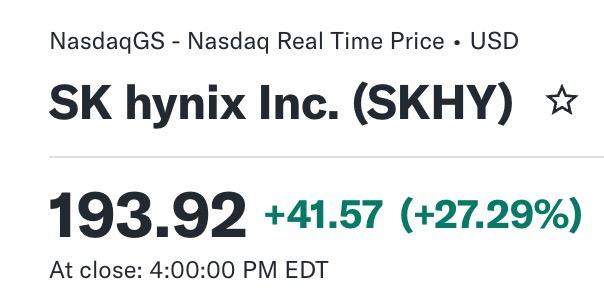
On one side was SK Hynix, the Korean chip giant newly listed on Nasdaq, which surged 27% in a single day to close at $193.92. Having dropped 9.3% the previous day, a single bullish candlestick on Tuesday fully recovered those losses and even hit a new all-time high. On the same day, its domestic Korean listing only rose 3.69%, putting its U.S. ADR at a 52% premium to its Korean-traded shares.
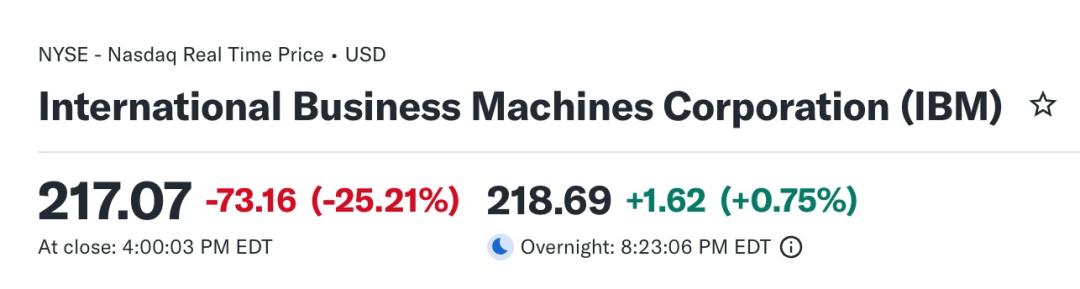
On the other side was IBM, one of the oldest established giants in the tech industry, which plunged 25.53% in a single session to $217.07, wiping out roughly $65 billion in market capitalization and marking its steepest one-day drop in nearly 50 years.
One skyrocketing, one crashing. What seem like two isolated industry events actually point to the same core truth: in the capital game of the AI era, micro market mechanisms, derivative leverage, and the flow of corporate IT budgets determine the fate of a company's stock price.
Let's break down each case separately below.
The Truth Behind SK Hynix's 27% Surge
I. The "One-Way Channel" Created by Structural Rules
Under normal circumstances, when price gaps emerge for the same stock across two markets, arbitrage capital will erase the discrepancy by "buying the cheaper shares and selling the pricier ones".
But in SK Hynix's case, structural restrictions block full convertibility between the two markets:
Investors holding U.S. ADRs can convert them back into the company's Korean-listed shares.
However, investors holding Korean domestic shares cannot directly convert them into U.S. ADRs for sale on the U.S. market, as such conversions require regulatory approval.
Many U.S.-based institutional and individual investors have allocation demand for SK Hynix — a core supplier of AI high-bandwidth memory (HBM) — yet the available float of its U.S. ADRs is limited, and Korean domestic shares cannot flow into the U.S. market in a timely manner.
This supply-demand asymmetry forces U.S. capital to compete for a limited pool of shares, driving the premium to extreme levels.
II. CPI Data: A Sudden Thaw in Macro Sentiment
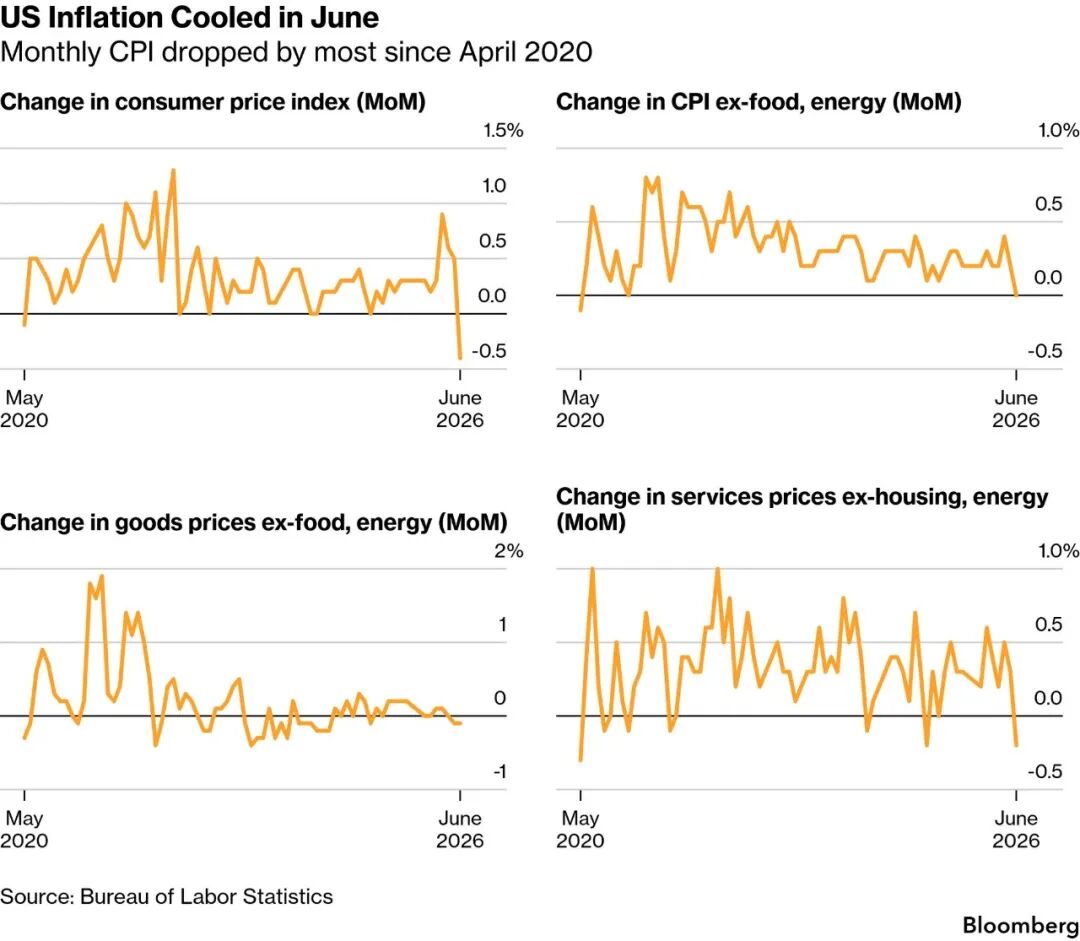
Ahead of Tuesday's opening, U.S. CPI data came in cooler than expected. Expectations for interest rate cuts surged immediately, triggering a sharp rebound across the entire tech sector. As a newly listed stock with scarce share supply, SK Hynix became one of the most volatile beneficiaries of this wave of bullish sentiment.
III. Newly Launched Options Trading Added Fuel to the Rally
Tuesday marked the very first day that SK Hynix's U.S.-listed options officially began trading, and instantly, capital found a high-leverage amplification tool.
According to real-time options tracking from U.S. stock data platform StockWe.com, SKHY's first-day trading volume directly hit 33,000 contracts, two-thirds of which were short-term speculative positions set to expire this Friday. Capital was placing bets on both sides of the market:
The most active contract was the $185 strike price call option, with roughly 2,900 contracts traded, as retail investors chased the rally aggressively;
At the same time, 2,600 contracts of the $145 strike price put option were bought as downside protection.
An additional pool of capital placed medium-term bets, with over 1,500 contracts of the August-expiring $200 strike price call option changing hands.
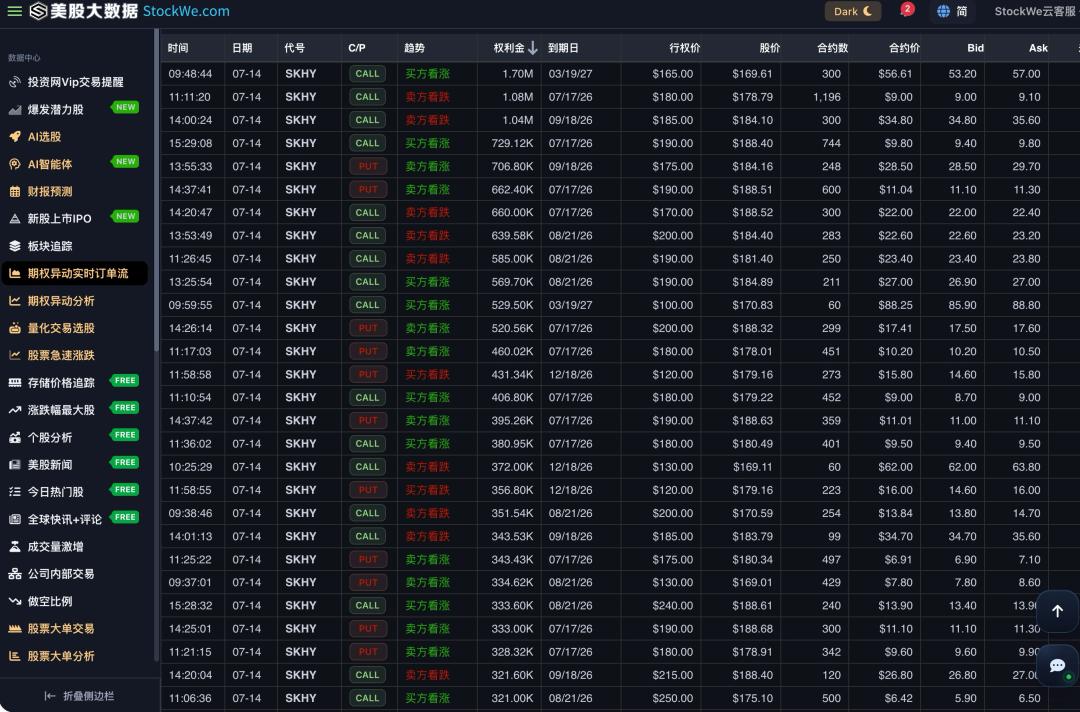
This triggered a classic long squeeze in the derivatives market: as massive capital frantically bought up these out-of-the-money $185 call options, Wall Street market makers who sold the contracts were forced to purchase large amounts of SK Hynix's underlying shares in the spot market to maintain delta risk neutrality for hedging purposes.
A self-reinforcing mechanical loop was then activated:
Soaring options volume → market makers forced to buy shares in the spot market → share price pushed higher → attracting more capital to buy call options → market makers forced to chase purchases higher.
The stock's trading volume exploded to an astonishing 71.65 million shares on Tuesday. The majority of this massive liquidity was not driven by active bullish conviction, but by mechanical hedging flows forced out of market makers. The stock price completely decoupled from fundamental valuations at this point.
The Truth Behind IBM's 25.5% Single-Day Collapse
IBM traded sharply lower throughout the day on Tuesday after releasing preliminary second-quarter results that fell short of expectations, with its maximum intraday decline at one point exceeding 25%.
By market close, IBM had tumbled 25.53% to a closing price of $217.07, wiping out roughly $65 billion in market capitalization in a single session.
Over the past year and more, IBM's share price had climbed steadily on the back of optimism around artificial intelligence and quantum computing. This 25% one-day correction completely erased the valuation premium built up by previous bullish expectations.
Surface Cause: Two Underperforming Report Cards
The direct trigger that prompted the market to sell off was IBM's underwhelming preliminary Q2 financial results. The core metrics that disappointed investors were:
Revenue miss: Quarterly revenue came in at $17.2 billion, roughly $660 million below the market's prior expectation of $17.86 billion.
Profit decline: Adjusted earnings per share (EPS) reached $2.93, which also fell short of the consensus forecast of $3.02.
What worried investors even more was slowing growth in IBM's high-margin business segments. The core software business, the centerpiece of IBM's transformation, saw its year-over-year growth rate drop directly from 11% in Q1 to just 5%; its consulting business recorded almost zero growth; and revenue from its traditional infrastructure business including mainframe systems declined 7% year over year.
Management acknowledged in a letter to investors that because the company failed to adapt quickly to changes in the external environment, a large number of major contracts originally scheduled to be signed this quarter were delayed by clients.
Root Cause: Corporate Budgets Are Being Drained by "Compute Power Hardware"
Why could IBM no longer close contracts as expected? If we expand our view to cover the entire tech industry, a deeper logic of capital flows emerges:
1. Compute Hardware Is Siphoning Budgets Away From Software
Today, as large language models and generative AI move into critical mass adoption, enterprises are rushing to purchase chips, servers, and high-bandwidth memory. Given that these foundational hardware components are in tight supply and command high prices, enterprises are prioritizing their limited IT budgets on hardware procurement.
This creates a crowding-out effect: after spending heavily on hardware, enterprises naturally tighten their spending on application software, middleware, and system consulting services. For IBM, which focuses on software and IT services, clients logically chose to push back their contract signings.
2. Acquisition-Fueled "Inorganic Growth" Has Been Exposed
Over the past two years, IBM has spent heavily to acquire external software assets including Red Hat, HashiCorp, and Confluent, in a bid to accelerate its transformation into a high-margin software company.
Looking at this quarter's results, while software revenue nominally maintained 5% growth, stripping out the contribution from recently acquired consolidated businesses reveals that the organic growth of IBM's legacy original software operations has effectively stagnated. This acquisition-dependent growth model cannot sustain upward momentum when corporate spending budgets contract.
3. Natural Aging of Legacy Mainframes and Fears of Technological Replacement
One of IBM's core profit pillars is its traditional mainframe systems (such as the Z series) and supporting system software. This business is now in the late stage of its product lifecycle, with sales declining naturally. Since this segment delivers extremely high margins, its downturn has a severe impact on the company's overall profitability.
At the same time, with the rapid advancement of AI code generation tools, the market is increasingly concerned that enterprises' future reliance on IBM's traditional system maintenance services will diminish. Amid uncertainty over the direction of technological evolution, clients have opted to take a wait-and-see approach, extending their contract decision cycles.
Key Metrics Investors Should Monitor Going Forward
Faced with these two extreme market cases, investors do not need to rely on vague macro analysis for their subsequent trades; focusing on the following three practical, actionable metrics will suffice:
This Friday's Options Expiration (For SK Hynix): The 52% premium is a bubble created by a distorted market structure. The rally driven by program trading and hedging flows will unwind just as sharply. After short-term open positions settle this Friday, the forced hedging buying flow from market makers will vanish instantly, and the U.S. ADR will very likely face steep pullbacks and high volatility.
July 22 Official Earnings Call (For IBM): The key focus will be whether management lowers its full-year "free cash flow guidance". If cash flow expectations are cut, it will indicate that business pressures are greater than previously anticipated, and the stock may need an extended period of range-bound trading to form a bottom.
ASML and TSMC Earnings (For the Entire Tech Sector): The performance of leading semiconductor giants serves as the ultimate benchmark for measuring hardware demand strength across the entire AI sector.
If their earnings results miss expectations, SK Hynix — with its inflated premium — will be the hardest-hit epicenter of a long squeeze. But if their results remain exceptionally strong, it will confirm that the entire industry's IT budgets continue to pour relentlessly into foundational chip hardware, meaning the tight budget environment facing software and service providers like IBM will likely persist for longer.
This article is sourced from the WeChat Official Account "U.S. Stock Investment Network" (ID: tradesmax), author: StockWe.com, and republished with authorization from 36Kr.