Facemind Intelligence has raised over 50 billion yuan in financing, with a valuation exceeding 200 billion yuan.
PE Daily has learned from informed sources that Bendi Intelligence has completed a new round of financing, with investors including national-level funds, central state-owned enterprises, automotive manufacturers and other industrial players, as well as renowned financial investors.
With this, Bendi Intelligence's total financing in the first half of 2026 has exceeded 5 billion yuan, with a valuation surpassing 20 billion yuan, making it the unicorn with the highest publicly disclosed valuation in the edge-side intelligence domain overnight.
Incubated from the NLP Lab of Tsinghua University in 2022, Bendi Intelligence's core founding team originated from this very institution. In just four years, the company has reached a valuation of over 20 billion yuan, marking that Chinese AI enterprises are embracing their golden era.
From Lab to a RMB 200-Billion-Valuation Unicorn
The story traces back to a laboratory at Tsinghua University.
Back in 2018, Zhiyuan Liu, then the lead of Tsinghua University's NLP Lab and a tenured associate professor at Tsinghua, led his team to develop the THU-ERNIE model series, pioneering the knowledge graph-enhanced pre-training framework. It was not until June 2020, when OpenAI released GPT-3, that Liu deeply perceived the technological generation gap, prompting him to contemplate how to translate lab innovations into industrial-grade productivity.
In 2021, Liu Zhiyuan spearheaded the release of China's first Chinese large model "Wu Dao · Wen Yuan" CPM large model, while initiating the incubation of a startup, aiming to drive the engineering implementation of technologies through corporate operations. Eventually in August 2022, Bendi Intelligence, a large model company, was founded, with Liu Zhiyuan serving as Chief Scientist. Shortly afterward, Li Dahai, former CTO of Zhihu, led Bendi's angel round exclusively via Zhihu, joined the company in person, and took the position of Chairman and CEO.

Liu Zhiyuan (Left), Li Dahai (Right)
In February 2024, Bendi Intelligence launched the world's first edge-side foundational large model MiniCPM 2.4B. Since then, with dual strategic focus on technological endowments and business models, Bendi embarked on the path of developing universal foundational large models for edge devices, which was undoubtedly a "non-consensus" choice at that time.
Liu Zhiyuan once stated that edge-side AI is not a short-term bet on a specific product form, but an inevitable layer emerging during the evolution from the information revolution to the intelligence revolution over the past decades. He believes that, similar to the early days of PC development, when computing power becomes sufficiently robust, computation will shift from mainframes to personal devices, and the development of AI will follow the same trajectory.
At that moment, an unprecedented "Hundred-Model Battle" unfolded in China. Drawing inspiration from Moore's Law, Bendi Intelligence's team pioneered the Densing Law for large models — taking capability density as the core metric to evaluate the performance of large language models, and revealing that the maximum capability density doubles every 3.5 months. The Densing Law was featured as a cover paper in *Nature* in 2025, becoming another fundamental law in the artificial intelligence industry following OpenAI's Scaling Law, and providing critical theoretical guidance for the industry to explore a scientific and sustainable development path for large models.
Following this path, Bendi Intelligence continues to act as a "trailblazer" for edge-side AI. Subsequently, the team released a series of edge-side models, including the world's first edge-side multimodal model MiniCPM-o 2.6, the first high-refresh-rate video understanding multimodal model MiniCPM-V 4.5, and MiniCPM-o 4.5 which enables instant free dialogue with full-modal full-time perception... In other words, Bendi Intelligence is one of the very few players globally that has built a universal foundational large model matrix for edge devices.
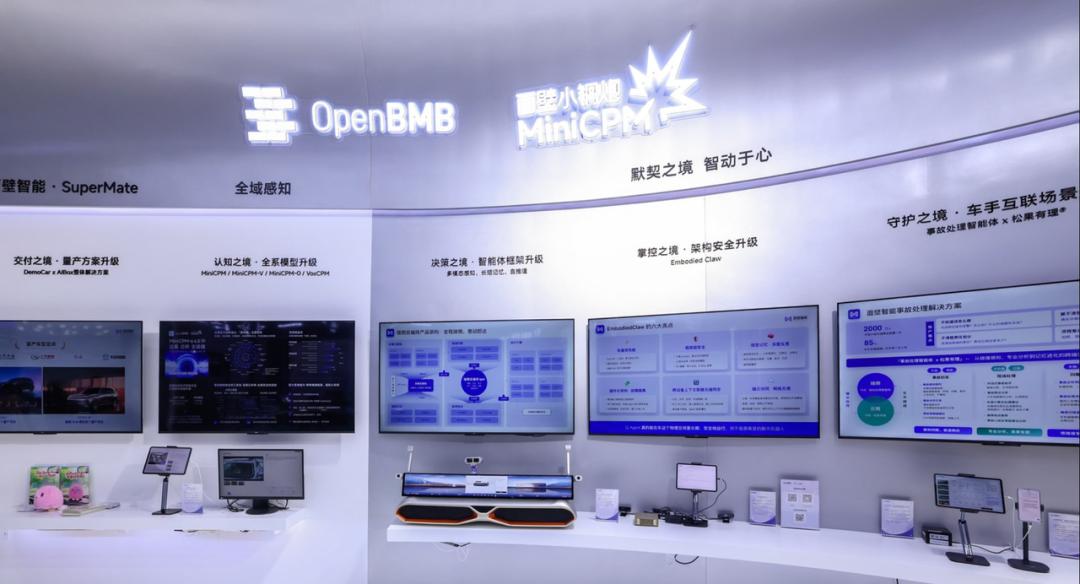
Time has validated Bendi Intelligence's choice. Currently, the competitive logic in China's large model industry is undergoing fundamental changes. Previously, cloud-based large models dominated the industry with first-mover advantages, but as numerous enterprises flocked to invest in computing resources, the sector faced severe homogeneous competition, and the challenges of commercial implementation became increasingly prominent.
With the upgrading of end-device hardware, the maturity of lightweight technologies, and the tightening of data privacy regulations, edge-side AI, characterized by low latency, high privacy, low cost, broad adaptability, and user-centric design, has reshaped the industry's competitive landscape. Today, edge-side AI has evolved from an optional feature to a mandatory requirement for all AI players, completing the transformation from a "non-consensus" view to the "broadest market consensus".
Under such circumstances, Bendi Intelligence's first-mover advantages are prominent. Unlike most enterprises that prioritize R&D over implementation, Bendi Intelligence focuses on translating native edge-side large model technologies into standardized products, and has achieved large-scale implementation results. PE Daily obtained a set of data: its self-developed open-source edge-side large model MiniCPM series has accumulated over 38 million downloads on platforms including GitHub and Hugging Face, making it a nationally popular edge-side AI model product.
In terms of industrial implementation, Bendi Intelligence has achieved benchmark-level deployments in core sectors including decision-making, smartphones, automobiles, low-altitude economy, civil aviation, and embodied intelligence, with plans to expand to industrial, smart home, and specialized fields in the future. In the automotive sector, Bendi Intelligence's technology has been successfully mass-produced and deployed in multiple vehicle models from Changan, SAIC Motor, Geely, and others, with an estimated hundreds of thousands of vehicles expected to carry its edge-side models in 2026. In the legal domain, Bendi Intelligence is about to officially release CPM for Legal, the first professional legal service infrastructure.
These implementation outcomes not only validate the commercial value of native edge-side large models, but also identify a replicable, deployable, and profitable commercialization path for edge-side intelligence across the entire industry.
Li Dahai once remarked: "AI that only relies on dialog boxes is just virtual interaction. To make intelligence penetrate into smartphones, automobiles, industrial hardware, and robots, edge-side intelligence is an unavoidable foundational layer and a fixed architecture for the intelligence revolution to land in the physical world."
In fact, Bendi Intelligence has long drawn global attention. During the Snake Year Spring Festival, DeepSeek made a groundbreaking debut, and *MIT Technology Review* subsequently published a report praising China's "Four Musketeers" of AI, which included Bendi Intelligence.
Today, China's large model landscape is evolving rapidly, with a new pattern of "Six New Emerging Unicorns" quietly taking shape, and Bendi Intelligence firmly securing its position among them.
The AI Watershed: The Doors of the Sci-Tech Innovation Board Gradually Open
As observed, an AI financing storm is sweeping through the primary market.
Data from Zero2IPO Research Center shows that by the first quarter of this year, the disclosed investment amount in China's equity investment market reached approximately RMB 2344.25 billion, representing a 15.4% year-on-year increase; the total investment in the AI sector exceeded RMB 1100 billion, surging 185.4% year-on-year.
Behind this thriving scene is the successive emergence of AI unicorns with valuations of tens of billions of yuan. Among them, a valuation of RMB 20 billion has become a critical watershed for AI startups: it not only intuitively reflects an enterprise's strength and industry status, but also signifies that the company has formally moved beyond the early exploratory stage and become a core player in the mainstream track.
A detailed review reveals that Bendi Intelligence's appeal in the primary market has long been evident.
In April 2023, Bendi Intelligence completed an angel round of several hundred million yuan led by Zhihu, with its seed round shareholder Zhipu AI continuing to participate. A year later, Bendi Intelligence secured a new round of financing of several hundred million yuan, led by Chunhua Capital and Huawei Hubble, with participation from the Beijing Artificial Intelligence Industry Investment Fund and others, while Zhihu continued to invest as a strategic shareholder.
Subsequently in December 2024, Bendi Intelligence completed another round of financing of several hundred million yuan, jointly led by Loongson Capital, CDH Investments, Zhongguancun Science Park Fund, and SAIF Partners, with participation from the Beijing Artificial Intelligence Industry Investment Fund and Zero2IPO Capital.
Soon, Moutai also made an investment — in May 2025, it co-invested in Bendi Intelligence's new financing round alongside Hongtai Fund, Sinocap, and Tsinghua Jinke. In December of the same year, Bendi Intelligence closed a financing round of several hundred million yuan with participation from Jing Guorui, CAS Investment, CICC Porsche Fund, Miju Capital, and Heji Investment.
Entering 2026, Bendi Intelligence quickly completed a financing round of several hundred million yuan after the Spring Festival, led by China Telecom, with participation from CITIC Goldstone and CITIC Private Equity. In April this year, it secured another new round of financing of several hundred million yuan, jointly led by Shenzhen Venture Capital and Inovance Industrial Investment, with participation from Daohe Long-Term Investment, Guotai Junan Innovation Investment, Wuyuanfeng Venture Capital, and others.
With the unveiling of this new financing, Bendi Intelligence's valuation exceeding RMB 20 billion marks that it has reached a new development milestone, eliminating many uncertainties faced by early-stage startups and obtaining the core qualifications to connect with the secondary market and undergo public market scrutiny.
At this juncture, policy signals have emerged — not long ago, Wu Qing, Chairman of the China Securities Regulatory Commission, explicitly stated at the Lujiazui Forum that the scope of application for the fifth set of Sci-Tech Innovation Board listing standards will be extended to the artificial intelligence sector, actively supporting high-quality AI large model enterprises to go public.
Undoubtedly, this policy has opened up the capitalization path for China's high-quality large model enterprises, providing a clear listing route for AI companies with solid core technologies, proven implementation results, and compliant operations. More importantly, the expansion of the fifth set of standards will accurately screen top-tier AI enterprises that truly possess core technologies and industrial value, which is expected to end the early-stage capital bubble in the industry. This development is undoubtedly a major opportunity for AI unicorns like Bendi Intelligence.
Of course, Bendi Intelligence's next opportunity extends beyond the capital market.
According to forecasts by Frost & Sullivan, the global edge-side AI market size will expand rapidly at a compound annual growth rate of 40%, rising from USD 321.9 billion in 2025 to over USD 1.22 trillion by 2029. This indicates that edge-side AI is on the verge of explosive growth, making it critical for enterprises to seize long-term development opportunities.
Bendi Intelligence has taken a leading position in full-stack independent R&D and domestic substitution. On one hand, Bendi Intelligence has assisted domestic chip manufacturers including Huawei Ascend and Cambricon in building their software stacks, and released China's first ternary quantization large model BitCPM-CANN, which reduces memory usage by approximately 6 times during the inference phase. Notably, this model completed full-stack training and development on the Ascend cluster; on the other hand, Bendi Intelligence recently launched MiniCPM-o 4.5, the industry's first full-duplex multimodal large model, which achieves simultaneous multimodal interaction of voice, video, and text with a streamlined parameter scale of 9B, marking another breakthrough in its mission of "enhancing intelligence density". Additionally, Bendi Intelligence has open-sourced the world's first complete framework for AI manufacturing AI, and released MiniCPM 5, the world's first large model fully trained by AI, whose 1B-parameter performance surpasses that of GPT-4o with 200B parameters.
In summary, Bendi Intelligence has gradually formed a closed-loop full-stack technology ecosystem covering "Theories - Models - Tools - Applications", spanning from the scientific theories of the Densing Law and architectural innovations, to the R&D of MiniCPM edge-side large models and efficient toolchains, and further to large-scale implementation in end-device sectors such as automobiles, smartphones, and smart homes.
Outstanding enterprises are destined to go global. Bendi Intelligence has made frequent moves in globalization: in April this year, Bendi Intelligence reached a strategic cooperation with Aptiv, opening up global delivery channels for its edge-side AI cockpit solutions; in June, as one of the first batch of intended settled enterprises, it signed a cooperation memorandum with the Macau International Science and Technology Industrial Center. Furthermore, Bendi Intelligence is advancing edge-side AI to empower the digital cooperation of the "Belt and Road Initiative", having successfully deployed the Lao National Sovereign Large Model in ASEAN, with plans to achieve broader global technology exports in the future.
From a global perspective, China leads the world in the edge-side intelligence industrial chain built through the integration of software and hardware, with clear comparative advantages. This fertile ground for entrepreneurship boasts the most complete edge-side AI industrial chain, and outperforms Europe and the United States in supply chain capabilities and engineering efficiency. It is foreseeable that every breakthrough made by Chinese AI enterprises will rewrite this grand narrative.
As Liu Zhiyuan remarked, "The 5,000-year history of Chinese civilization has always been a contributor to technological innovation. The Four Great Inventions once reshaped the course of human civilization, and today we have no reason to remain in the stage of technological catch-up. In the AI era, China is fully capable of becoming a technology definer."
This outcome is not accidental, but an inevitable choice of history.
This article originates from the WeChat Official Account "PE Daily" (ID: pedaily2012), authored by Liu Bo, and published by 36Kr with authorization.