Half a year after the Doubao phone hit the market, why are Step and Honor still being so stubborn?
The first-ever AI agent smartphone in the world may not be paid for by end users
On the evening of July 13th, StepVerse unveiled its AI terminal brand STEPX, the agent-native operating system Step AOS, and the personal agent Step Amoo, with the debut of its first smartphone, the STEPX Neo.
Four days later, at the World Artificial Intelligence Conference, the AI agent smartphones will face their first head-to-head showdown.
Nubia will showcase a mass-produced flagship that it claims is "the world's first AI agent smartphone", widely regarded in the market as the second-generation Doubao Phone. Honor has also confirmed that its Robot Phone will be unveiled at the WAIC special forum on July 18th, with on-site hands-on experience available.
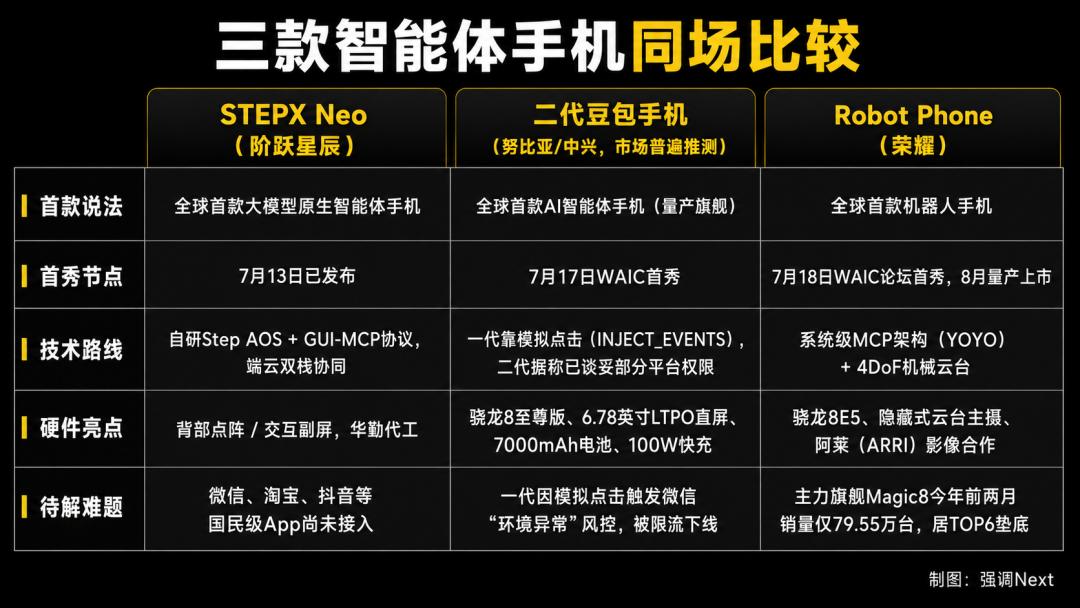
Together with the STEPX Neo from StepVerse, three agent smartphones all claiming to be the "world's first" will be exhibited side by side. StepVerse highlights its native agent operating system, Nubia emphasizes mass production and cross-app execution capabilities, while Honor integrates agents with a 4-DOF motorized gimbal.
The simultaneous emergence of three "world's first" claims in a short period indicates that this track has no universally recognized standards yet. Everyone can redefine what "first" means, precisely because no one has truly established a viable business model.
01. AI-native apps are booming, but the AI features from phone makers remain underused
The "2026 H1 AI Application Market Development Insight Report" released by QuestMobile yesterday explains the underlying logic behind these manufacturers' layout of agent smartphones.
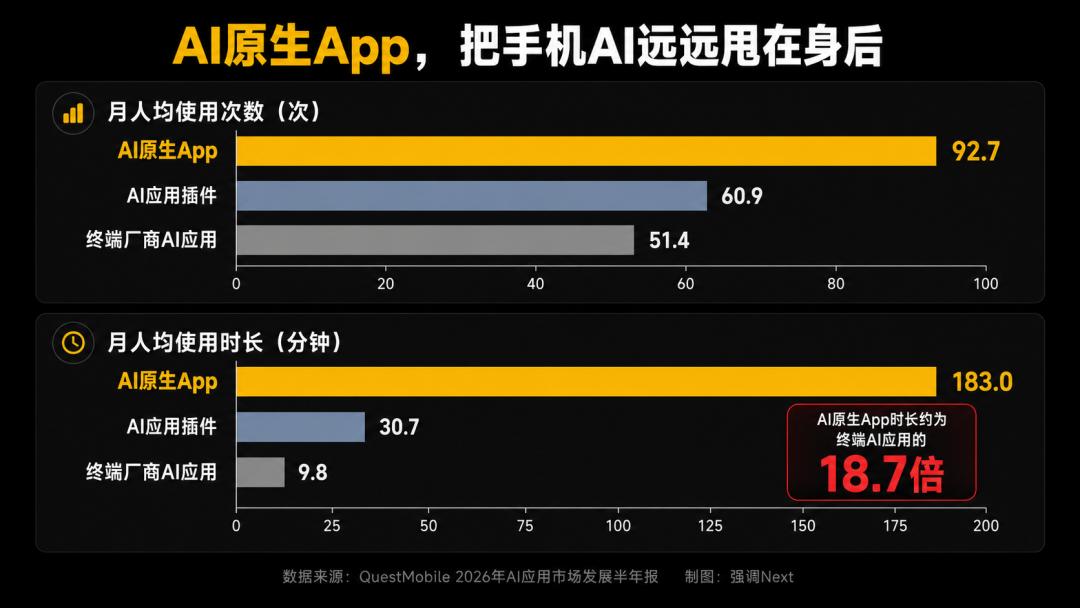
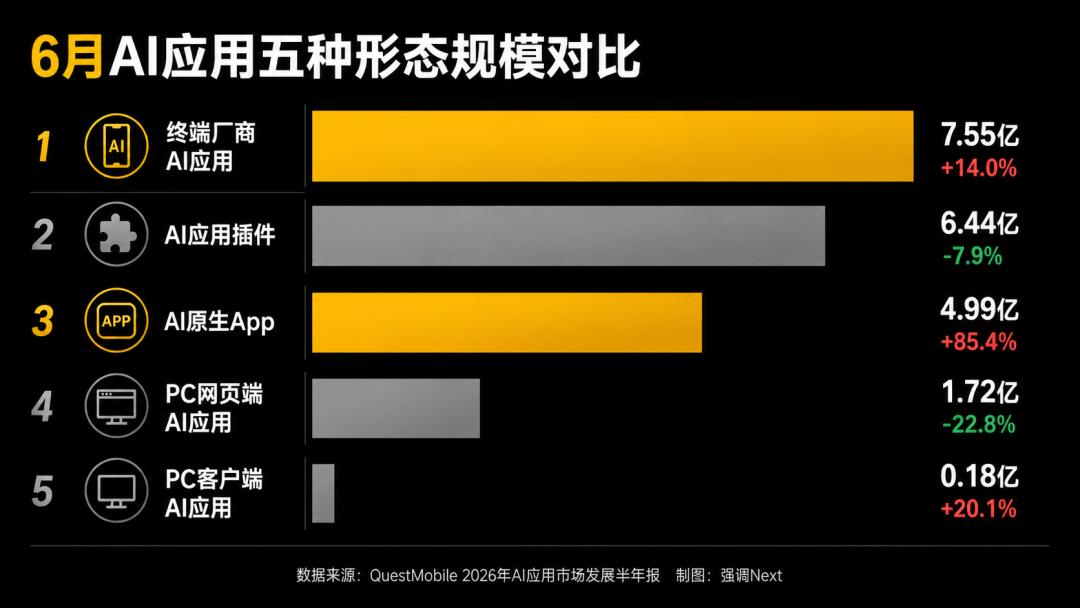
As of June, domestic AI-native apps have 499 million monthly active users (MAU), representing a 85.4% year-on-year increase, with monthly per capita usage time reaching 183 minutes, a 40% year-on-year rise. They have crossed the "novelty trial" threshold and become a daily necessity. However, the same report shows that the largest volume actually comes from the system assistants pre-installed by phone manufacturers, which have 755 million MAU, 256 million more than AI-native apps.
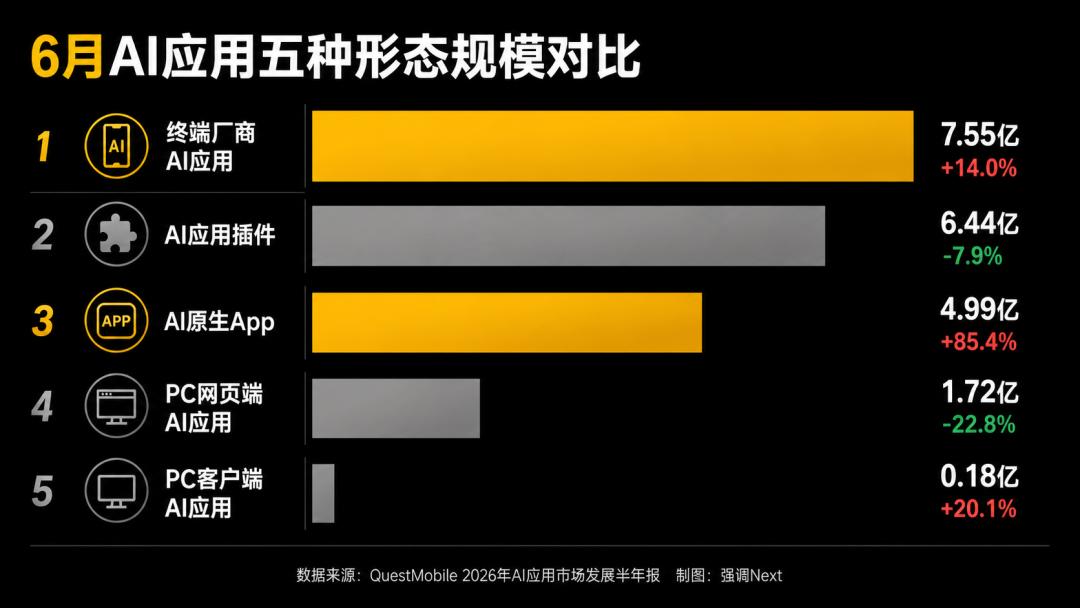
But in terms of monthly per capita usage frequency, AI-native apps reach 92.7 times, while system assistants only have 51.4 times, nearly half the figure, and the usage time gap is as high as 18.7 times. Phone manufacturers have won the user volume through pre-installed hardware, but they are left far behind in usage depth.
This contradiction is even more prominent at the brand level. QuestMobile data shows that OPPO's Xiaobu ranks first with 165 million MAU, but the most frequently used one is actually Xiaomi's Super Xiaoai (29 times per capita per month). Apple's Siri is at the bottom, with only 3.8 times per capita per month, less than one-twentieth of the average level of AI-native apps.
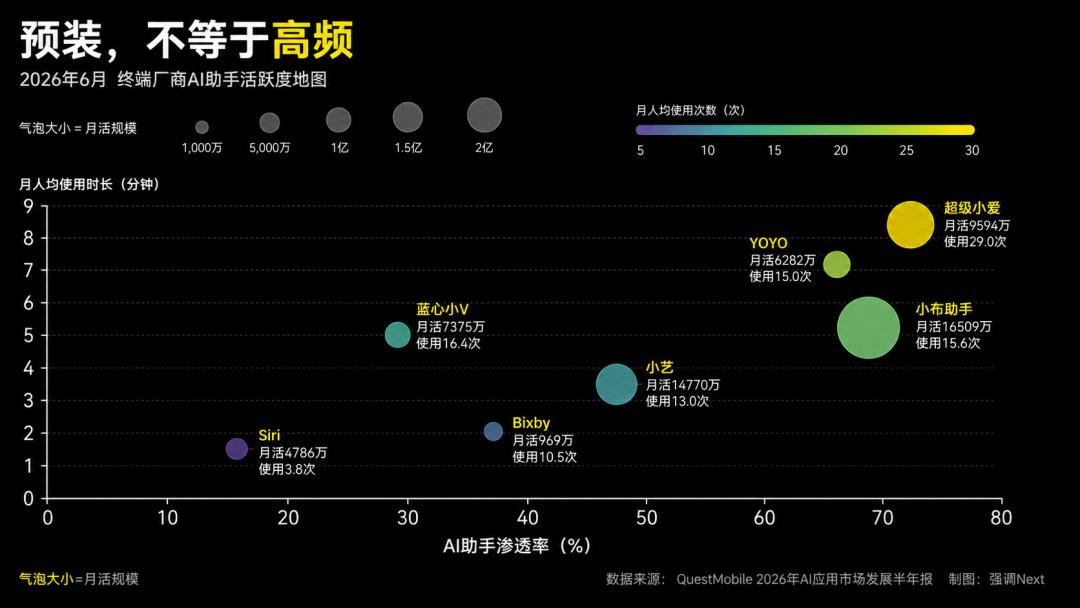
This exposes an awkward fact: phone manufacturers have pre-installed more and more AI features, but users have not changed their usage habits accordingly.
Features like summarization, translation, image editing, and search seem to be all available, but they are just scattered tools in the system. Users still need to remember these AI features first, then actively call them out. No matter how powerful the model is, if the entry point is not user-friendly, its capabilities can hardly be translated into usage frequency.
Yin Qi, Chairman of StepVerse, put the situation of model manufacturers more bluntly: agents that dwell in other people's operating systems are always just "visitors". Only by building a new house specifically for agents can they become "natives".
But this is more like a judgment for the industry and the capital market, rather than a proven conclusion.
The core change of these three prototypes is to elevate the AI assistant to a higher level, making AI not just a pre-installed add-on, but a system-level control center. The difference only lies in the starting points and forms adopted by phone manufacturers and model manufacturers. However, whether this path can succeed does not depend on technology, but more on commercial interests and user habits.
Although the STEPX Neo has passed the L3 level test of the national standard "Intelligent Classification of Artificial Intelligence Terminals", the certificate only proves its upper limit of capabilities, not whether users are willing to entrust it with complex cross-app operations. This is exactly the part that none of the three companies has provided a satisfactory answer to.
02. The route competition behind the three "first-ever" claims
The core of the problem is how agents call third-party apps.
StepVerse adopts the protocol route. Its GUI-MCP protocol uses a layered dual-stack architecture, where original screenshots are stored locally, and only semantic summaries are transmitted to the cloud. The open-source GUI proprietary model has a parameter count of 4B, and the official claims that it can recognize and operate more than 200 apps. Its first batch of ecological partners includes Alipay, Meituan, Didi, Amap, JD, Baidu, WPS, CapCut, Ctrip, Tongcheng, Weibo, etc.
However, WeChat, Taobao, and Douyin, which the market cares most about, are not on the list.
Nubia takes the most radical path. The first-generation Doubao Phone (engineering model Nubia M153, released in December 2025, priced at 3499 yuan) relied on the system-level "INJECT_EVENTS" simulated touch permission, with the wake word "Doubao Doubao", which could respond to almost any user instruction. It sold out quickly after launch, and its second-hand price was once driven up to over 10,000 yuan.
But the cost soon followed: this high-frequency automated click behavior was quickly recognized by WeChat as an abnormal operation trajectory, triggering an "abnormal environment" alert. Some accounts were restricted from logging in, and platforms like WeChat and Taobao subsequently blocked the relevant permissions one after another.
Tencent later publicly stated that it opposes uploading users' phone screen recordings to the cloud through automated plug-in methods. According to reports, the second-generation model has negotiated with some leading internet companies to open permissions for high-frequency scenarios such as socializing, office work, and travel, but the exact scope of the opening will not be known until July 17th.
Honor chooses the most "rule-abiding" path. Its YOYO agent is based on the system-level MCP architecture, covering more than 3000 scenarios, which is safe, but also limited by whether third-party developers are willing to actively adapt the interfaces. If the instruction is too complex and spans multiple non-adapted apps, YOYO may stop responding.
This interaction logic of "judging the capability boundary first before issuing instructions" to some extent explains why the market feedback of Honor's flagship Magic8 is not very good. According to data previously disclosed by digital bloggers, by the 8th week of this year, the total sales of the Magic8 series were only 795,500 units, ranking at the bottom of the flagship sales list of the top 6 smartphone brands.
03. Who is qualified to click "Confirm" on behalf of users
The essential difference between the three routes lies in whether agents need the consent of apps to perform operations on behalf of users.
The logic of simulated clicks is that what users can operate, agents can in principle also operate, without waiting for any platform to open interfaces. This is the most radical and fastest path, but it also faces the biggest challenges. IDC predicts that the shipment volume of AI phones in China will reach 147 million units in 2026, accounting for more than half of the total smartphone shipments, but over 90% of them only add AI auxiliary features to the system, without truly touching the underlying paradigm of human-computer interaction. The Doubao Phone is one of the very few products that dares to take a step forward, at the cost of being the first to hit the boundary of super apps.
The logic of the MCP protocol is the opposite: let apps decide for themselves how much capability to open. StepVerse's GUI-MCP and Honor's system-level MCP both belong to this path, which is safe and controllable, but therefore naturally moves at a slower pace. App manufacturers have no obligation to adapt immediately, and the completeness of user experience depends on the willingness of ecological partners, not the technical upper limit.
The problem is that both paths ultimately have to face the same dilemma: super platforms like WeChat, Taobao, and Douyin can hardly hand over their transaction and account systems to others. This is an issue about who owns the right to allocate traffic and control the advertising system. On the surface, it involves security, but deeper down, it concerns the core business model of these enterprises.
Therefore, what agent smartphones are really competing for is the right to interpret service choices on behalf of users.
Alibaba breaking down Taobao and Amap into callable atomic skills is a limited opening within its own rules. Tencent's restrained posture of "light connection, heavy backend" essentially does not want to cede the power to interpret the rules. None of the three internet giants is willing to make the first concession, which is the hardest nut to crack in this melee.
And agent smartphones that lack the support of these leading platforms will inevitably seem somewhat useless.
04. The smartphone is not a product, but a bargaining chip
In this half-year report from QuestMobile, the ones that have shown clear commercialization signals are AI-native apps, not agent smartphones.
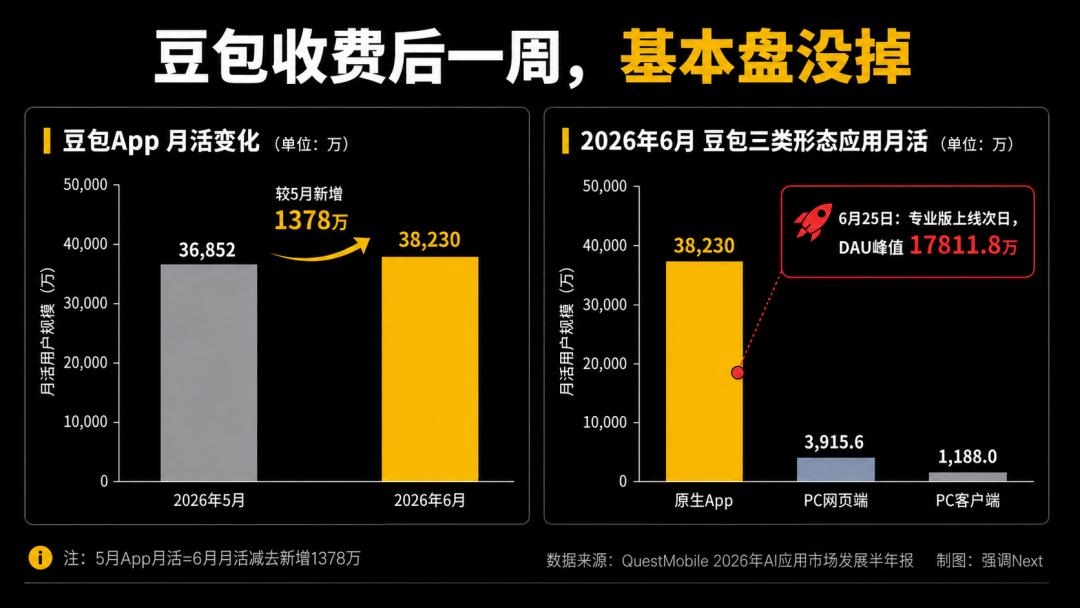
In June, the activity of Doubao's three types of applications remained steadily high, with 13.78 million new users added to its app version compared to May. After the paid professional version was launched on June 24th, the daily active users (DAU) exceeded 178 million the next day, hitting the peak of the month. The paid service did not damage its user base, and the "inclusive + value-added" model has been proven viable.
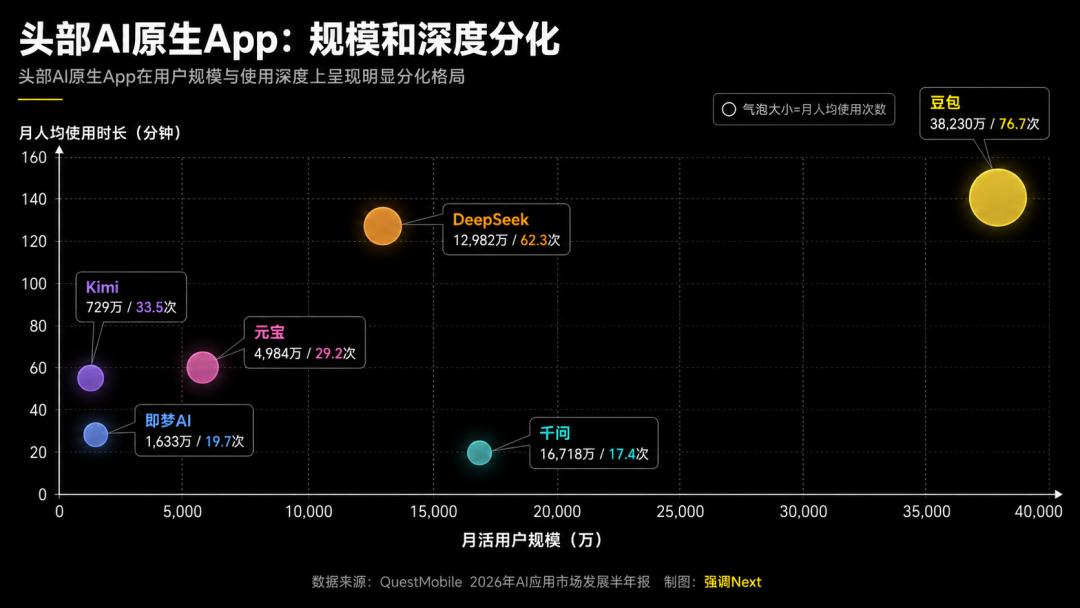
At the same time, Qianwen has 167 million MAU, a year-on-year surge of 5792.9%, and DeepSeek has 130 million MAU. In the first echelon formed by the three products, the proportion of heavy users who spend more than 10 minutes on the apps is increasing. Doubao accounts for 27.5%, DeepSeek 30.0%, and Kimi 26.1%, all rising by at least 2 percentage points compared to the same period last year.
In contrast, the three agent smartphones are still in the prototype verification stage.
As of July 14th, STEPX Neo has not announced its specifications, price, and release date. StepVerse stated that it will not monetize through hardware price differences or pre-installed ads, and has no rigid shipment targets. Nubia's mass-produced flagship has not announced its selling price and launch date either. Honor's Robot Phone is only confirmed to be launched in the third quarter, most likely around August. At the current stage, agent smartphones are more like a declaration of industrial status, rather than a proven and profitable consumer electronics business.
What really determines who can laugh last is actually the industrial binding behind the scenes.
In January this year, StepVerse completed a Series B+ financing of over 5 billion yuan, with Huaqin Technology as one of the industrial investors. In May, the company completed a new round of financing of nearly 2.5 billion US dollars, with core consumer electronics industry chain companies such as Huaqin, Longcheer, OmniVision, and ZTE participating intensively. The Hong Kong Investment Management Corporation, known as the "Hong Kong version of Temasek", also joined the shareholder list. The company completed share reform and dismantled its red-chip structure in the same period, and media judged that it is clearly preparing for a Hong Kong stock IPO.
It is worth noting that StepVerse's Step series models have been pre-installed in about 60% of leading smartphone brands through cooperation with manufacturers such as OPPO, Honor, and ZTE, with the installed volume exceeding 42 million units, serving nearly 20 million person-times per day. Therefore, how many units of the STEPX Neo prototype are sold is not important. What matters is whether it can help StepVerse gain an extra physical bargaining chip when negotiating interfaces, permissions, and revenue-sharing rules with smartphone manufacturers and app platforms.
Following closely behind is OpenAI. According to reports, its first AI agent smartphone will be mass-produced as early as the first half of 2027. This arms race for agent terminals is never just a ranking competition among domestic players.
This is quite similar to the logic of Google co-founding the Open Handset Alliance with HTC, Motorola, Qualcomm, and carriers in 2007 to promote Android with real devices.
But agent smartphones face greater resistance. Back then, Android helped phone manufacturers reduce system development costs, and almost all participants could benefit from it. However, once agents truly enter the system, they may change the system entry of phone manufacturers themselves, bypassing the pages, ads, and recommendation links that super apps rely on for survival. No one can be sure that they are pure beneficiaries.
Therefore, the short-term goal of StepVerse and ByteDance making smartphones is not necessarily to sell millions of units. What they need is a tangible physical device to prove that their models can truly run in the operating system, and then with this bargaining chip, renegotiate permissions, interfaces, and revenue-sharing rules with smartphone manufacturers and app platforms. The smartphone is the most conspicuous prop in this game, but the real negotiation table is not at the press conference.
· Data Sources and Notes: QuestMobile "2026 H1 AI Application Market Development Insight Report", official releases and public reports from StepVerse, Honor, ZTE