After four long years of waiting, this "loneliest subway line across the entire network" has finally become bustling.
"The loneliest metro line across the entire network" has officially opened to traffic.
Counting from the initial operational section at the end of 2022, the northern segment of Foshan Metro Line 3 stood isolated in Shishan Town for more than two years. On the day the final 4-kilometer gap was connected, some residents sighed that they had finally "made it through the hard times". From empty carriages to crowded ones, and from arduous cross-district commutes to relaxed, seamless travel, Foshan residents waited for a full decade to finally get a proper north-south line that truly belongs to their city.
After years of slow, intermittent new line openings over the past five years, Foshan Metro has finally launched a new extension recently — though this 4-kilometer opening came 4 years later than originally planned.
On June 18 this year, after nearly two years of split operation, Foshan Metro Line 3 was fully connected. The once-isolated segment in Shishan Town, famously known as "the loneliest metro line on the internet", was finally integrated into the Guangzhou-Foshan metro network.
No official opening ceremony was held for the new section, but many Foshan residents spontaneously came to visit the new stations. Starting from the first train of the day, crowds gathered to take photos in front of the 19-meter-long Foshan Autumn Festival folk culture mural at Dunhou Station, celebrating the long-awaited new station.
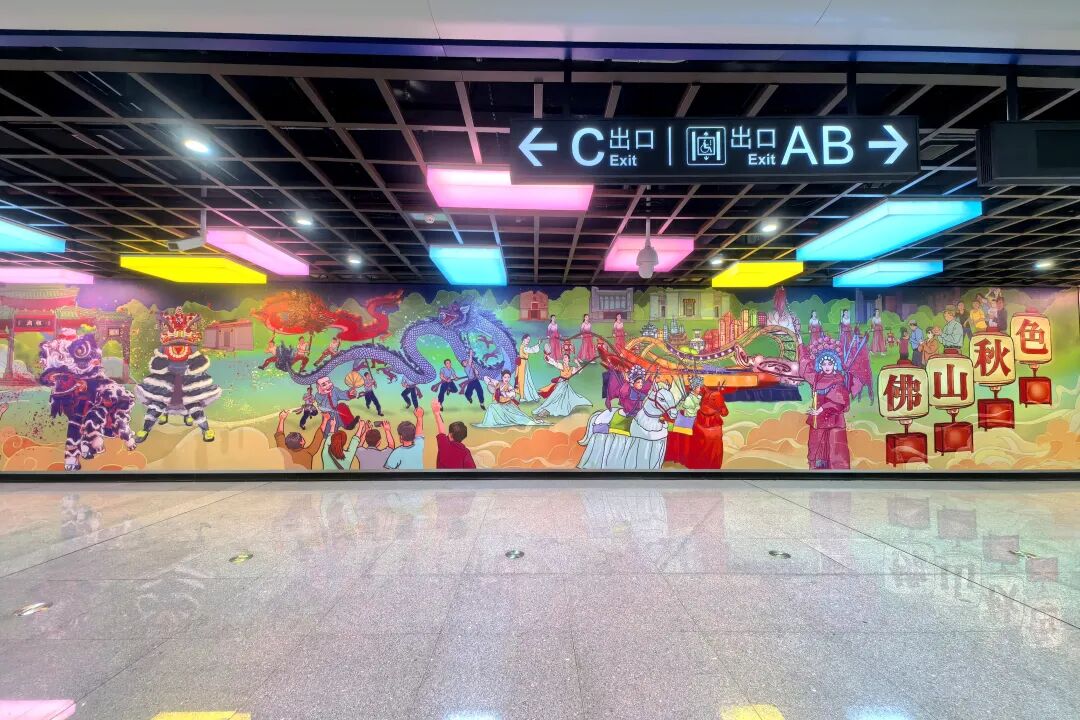
The "Foshan Autumn Festival" cultural wall in the Dunhou Station concourse, located above the former Foshan Railway Station. (Photo by Liang Hao)
The most genuine experience comes from office workers who have long commuted via Line 3.
Posts noting that "Line 3 is now packed" have popped up across social media platforms, with some people playfully complaining that the once-empty carriages are now full: "Foshan Metro, tell me — have I lost my freedom to pick any seat I want during my commute?" Their surprised tone was laced with obvious delight.
For those who can finally ride the full Line 3, the excitement is even more tangible.
A Dunhou village resident whose neighborhood station finally opened expressed that he had "finally made it through"; a Guangxi migrant worker employed in Foshan's urban area called the full opening a timely blessing, saying "I can take the metro directly to Foshan West to catch the high-speed train home for the Spring Festival". Under a local Foshan real estate WeChat account, a Luocun resident who had just paid off his mortgage earlier that month celebrated the full line opening weeks later: "The mortgage is done and the metro is here — life is going to be great from now on."
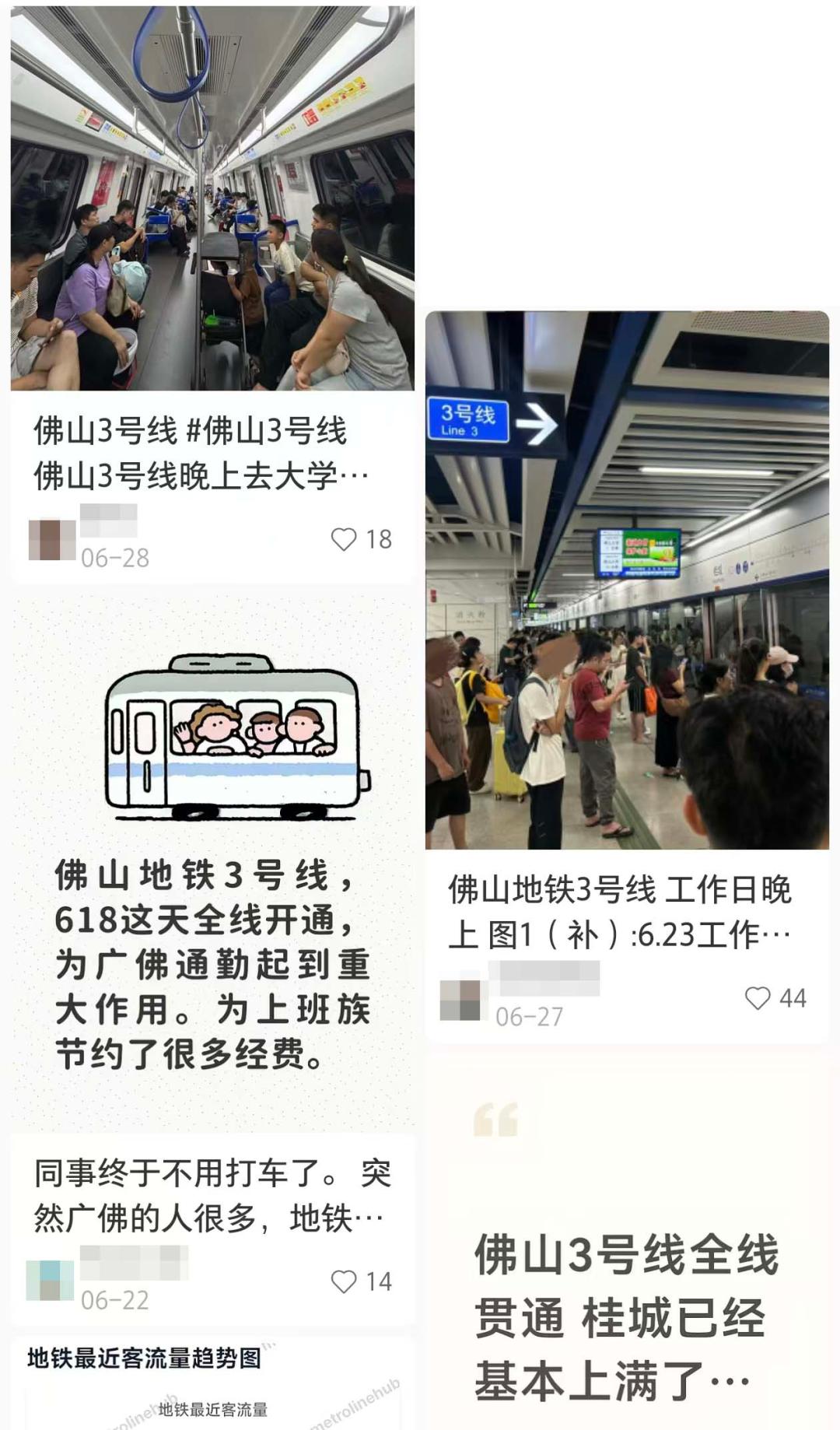
Many Foshan residents shared on social media that passenger flows on Line 3 have risen sharply after full opening, saying "things are finally looking up". (Screenshot from social media)
Though Foshan launched metro services back in 2010, scenes of such widespread public joy are rarely seen. Now that the dark blue line that was split in the metro map for nearly two years is finally connected, the old "loneliness" is history, and everyone's daily activity radius has expanded significantly.
The Loneliest Metro Line on the Entire Network
Rumors that Line 3 would be fully connected first spread after the May Day holiday this year.
On May 6, 2025, the Foshan Development and Reform Commission published a revised metro fare chart on its official website, setting the full-line ticket price for Line 3 at 12 yuan, a 2-yuan fare for the central section (Zhongshan Park to Lianhe), and a 20-yuan price cap for cross-city transfers across the Guangzhou-Foshan network.
Around the same time, internet users noticed that the long-shuttered Dunhou Station, completed two years prior, had turned on its interior lights, and operation timetables had been posted at its three entrances.
All signs pointed to Foshan's long-awaited "underground giant", poised to challenge the Guangzhou-Foshan Line for passenger volumes, finally making its full public debut.
Foshan previously had no fully operational north-south metro line. Stretching 69.5 kilometers, Line 3 connects the core districts of Nanhai, Chancheng, and Shunde from north to south, integrating one airport, two high-speed railway stations, two university towns, and multiple intercity rail lines. The areas it serves account for roughly 80% of Foshan's total GDP, making the title of Foshan's north-south "main artery" far from an overstatement.
However, the project faced repeated setbacks: it received construction approval from the National Development and Reform Commission back in 2012, only broke ground in 2016, and did not open its initial segment until the end of 2022. It took ten years for Shunde's city center, 30 kilometers outside Foshan's main urban area, to be incorporated into the Foshan metro map.
The newly launched Line 3 was far from perfect. Due to track layout constraints, south-to-north trains from Shunde could not reach Guicheng to transfer to the Guangzhou-Foshan Line for a long period, and had to turn back at the prior station. It was not until August 2024 that the southern section of Line 3 finally reached Guicheng and extended northward to Zhongshan Park, while the northern segment (Foshan University to Lianhe) opened on the very same day.
During that period, Foshan's metro map displayed two separate segments both labeled "Line 3" with identical colors: the southern segment connected to the rest of the network, while the northern segment operated in isolation. Coincidentally, since the entire northern segment lies within Shishan Town in Nanhai District, local residents jokingly called it "Shishan Metro Line 1", and it earned widespread internet fame as "the loneliest metro line in the country".
Where did the missing middle section go? The issue was tied to the new Foshan Station project on the Guangzhou-Zhanjiang High-Speed Railway. To make way for the high-speed rail station, the pre-built metro tunnel running underneath the station was demolished, forcing the line to operate in separate sections.
Though frequent shuttle buses ran between the two disconnected segments, the routine of "exiting the metro, waiting for a bus, then boarding another metro" would add 20 to 30 minutes to every trip, which few commuters were willing to tolerate. The 9 stations on the northern segment saw almost no foot traffic, functioning like isolated islands cut off from the wider Guangzhou-Foshan metro network — cementing the "lonely metro" nickname.
This "loneliness" was directly reflected in passenger flow data. Before full connectivity, the southern segment of Line 3 was one of the busiest lines in the network, while the northern segment consistently ranked last, with average daily ridership less than one-tenth of the southern segment's volume.
Fortunately, this awkward situation is now in the past. After the Guangzhou-Zhanjiang High-Speed Railway was completed, the disconnected metro tunnels were reconnected, reuniting the northern and southern segments to end their split operation. When the new Foshan High-Speed Railway Station officially opened on July 1 this year, the final remaining Line 3 station, Dunhou, welcomed its first passengers, bringing this nearly two-year-long isolated north-south corridor to its full, completed form.
After the "Lonely Metro" Becomes a "North-South Artery"
Nearly a month after full opening, Foshan Metro Line 3 released its first ridership results.
Data from the Foshan Rail Transit Bureau shows that Line 3's average daily ridership rose from around 140,000 before full connectivity to over 170,000, delivering an immediate ridership boost. Foshan Metro previously projected that the full opening of Line 3 would bring a roughly 25,000 increase in daily passenger flow within one year.
Travel demand to transfer to the Guangzhou-Foshan Line for trips to Guangzhou has also driven ridership growth, while travel between Chancheng, Nanhai, and Shunde has become far more seamless thanks to the connected line.
Some residents tested the full travel time of Line 3 after its opening: the full trip from Shunde College Station to Foshan University Station takes roughly one and a half hours. From the central district of Daliang, passengers can reach both Foshan West Station and Foshan Station for high-speed trains, as well as Shadi Airport for flights, all within one hour via metro — comparable to driving times, but eliminating the hassle of finding parking. Shadi Airport, known online as "the most down-to-earth airport", has become even more accessible now that the metro reaches it.
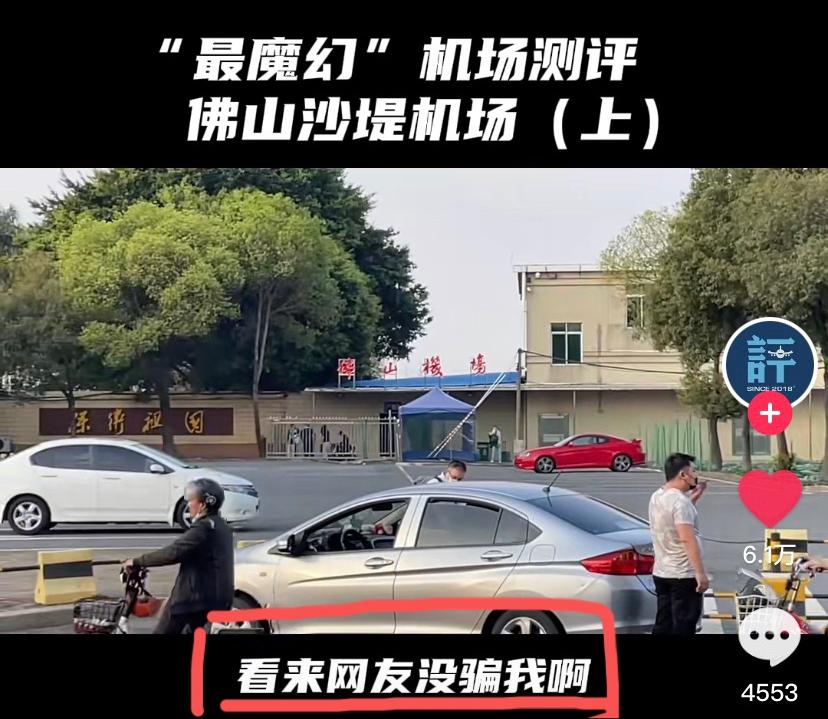
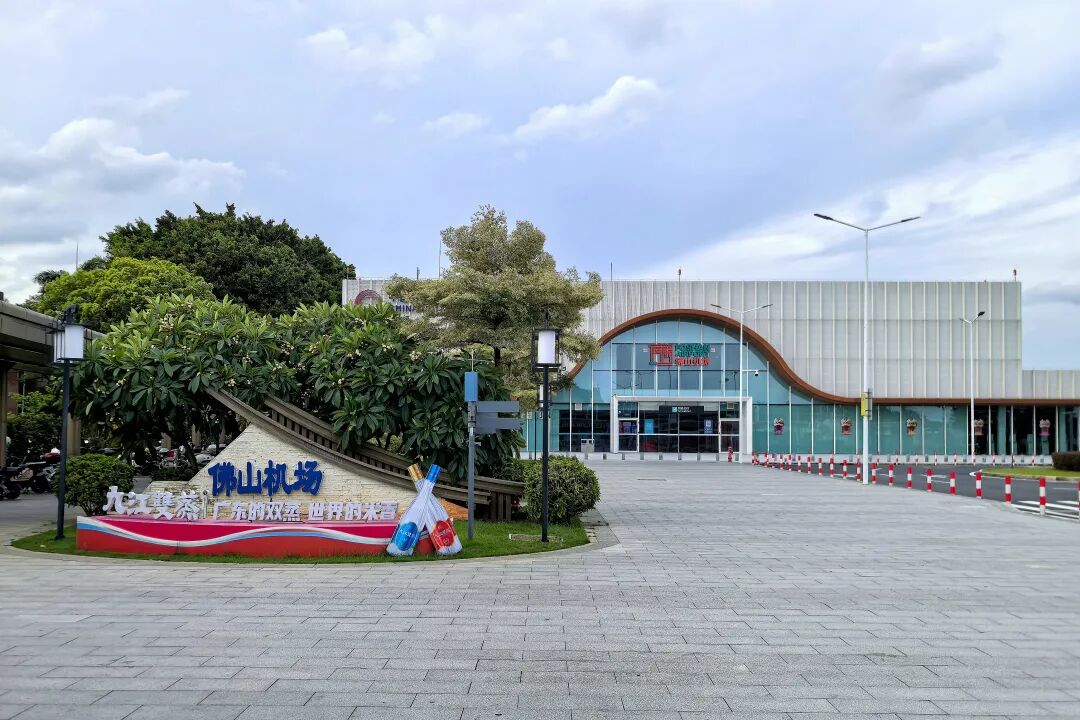
Foshan Shadi Airport is known as "the most down-to-earth airport". Before its 2024 renovation (top), it was mocked for resembling a bus terminal; after the 2024 upgrade (bottom), its passenger facilities have been greatly improved. (Top image from Douyin @Caogen Hangping; bottom photo by Liang Hao)
The most welcome improvement is the fare. Chen Hao, a resident who lives near Daliang Huanshi North Metro Station, became a frequent traveler through Shadi Airport after a friend recommended it years ago. Before the full line opened, he could only reach the airport by taxi, paying fares of 100 yuan or more. Now the one-way metro trip costs just 9 yuan.
"Backpackers like me try to save money where we can. Spending 100 yuan on a taxi before even leaving Foshan, plus the return fare, almost added up to the price of a China United Airlines ticket," Chen says. Since Line 3 opened, he has not taken a single taxi to the airport.
Many Foshan residents share this mindset. Foshan Airport is compact: check-in, security, and boarding take less than 15 minutes total, and its location on the edge of the city center makes it far more convenient than many larger airports across the Greater Bay Area. With the metro now running, exiting at Xiaode East Station near the airport puts passengers just a 200-meter walk from the terminal entrance — making this already popular, approachable airport feel even more connected.
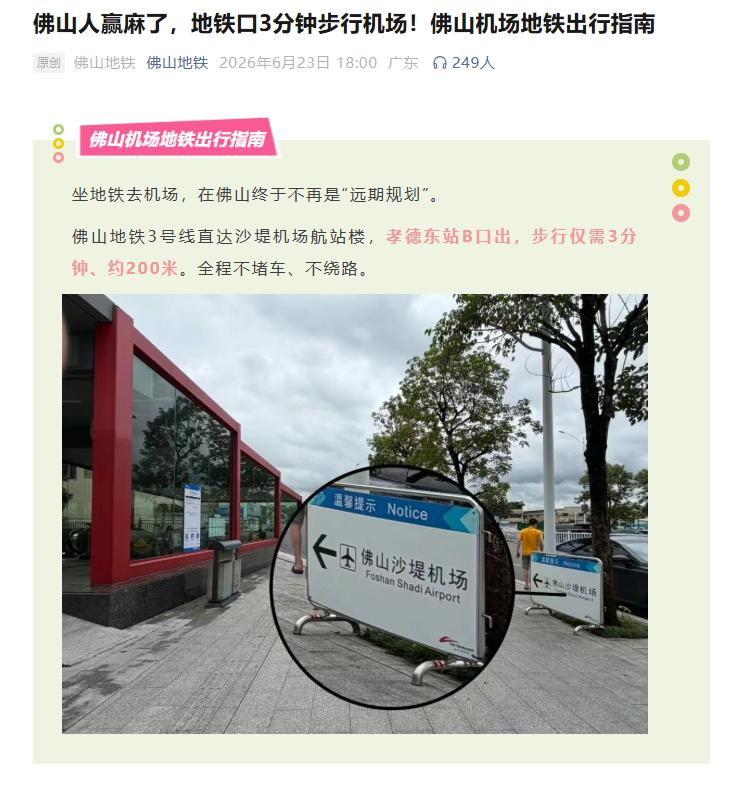
"You don't even need 50 minutes of taxiing after landing — you can walk straight onto the metro!" (Image from Foshan Metro WeChat official account)
The connected metro has not only changed how Foshan residents travel long distances, but also dramatically improved cross-district mobility.
Foshan is famous for its "town-level economy", with distinct development patterns across its five districts. Chancheng and Guicheng in Nanhai are close neighbors, forming the Chancheng central area that has long been Foshan's most densely populated and busiest zone. However, the central areas of the other three districts are all far from Chancheng, with cross-district car trips taking an hour or more. Shishan, one of Foshan's three "100-billion-yuan output towns", has a robust manufacturing base and is home to Foshan's only university town, generating huge cross-district travel demand. Previously, a trip to Chancheng for shopping would take an entire day, with unpredictable delays from traffic jams on major roads like Guidan Road and Foshan Ring Expressway.
These frustrating travel experiences are now history thanks to Line 3. The northern segment once mocked as "Shishan Metro Line 1" no longer runs empty and isolated. Residents of Shishan and Luocun now happily ride the metro together, no longer envying Guicheng residents with direct metro access.
The happiest beneficiaries are students at Nanhai University Town, located on the city's outskirts. After the full line opened, travel time to Foshan's central districts was cut in half, thrilling students who enjoy going out: "We finally got to ride this huge, beautiful new metro before summer vacation, saying goodbye to overcrowded buses for good."
Some even joked: "Couples from Foshan University and Shunde Polytechnic can finally end their 'long-distance relationship'."
When Will Foshan Get Its Next Metro Line?
Jokes aside, the full opening of this north-south metro artery has become one of Foshan's biggest local events this summer, comparable in public enthusiasm to the famous Diejiao dragon boat drift races. Now that the "lonely metro" is history, the convenience brought by direct metro access has extended far beyond station entrances nearly a month after opening.
Over the past five years, Foshan has gradually opened new metro lines, and ridership has steadily risen, but still remains at a moderate level. It will take time for the metro to fully integrate into the daily lives of Foshan residents.
The latest operational data from the Ministry of Transport shows that even including the Guangzhou-managed Guangzhou-Foshan Line and Guangzhou Metro Line 7 (Foshan section), Foshan's metro operational intensity is only 3,600 passengers per kilometer per day — still far below the widely recognized "passing standard" of 7,000 passengers per kilometer daily.
In comparison, cities with similar economic output and urban scale to Foshan, such as Suzhou, Ningbo, and Fuzhou, all have higher metro network density and operational intensity.
The reasons behind this gap are multifaceted, linked to broader economic conditions as well as Foshan's famously laid-back, "Buddha-like" approach to metro construction.
A popular internet meme about Foshan Metro is that "it takes ten years to finish one line" — a pattern that held true for Line 2, which opened in 2021, as well as the newly completed Line 3.
And this meme may well continue to hold true.
After Line 3's full opening, public attention has shifted to the 55-kilometer Line 4, a key line connecting to Sanshui District. Since breaking ground in January 2022, only 18 kilometers of it have been completed, with most of the remaining sections still in early planning stages, and no confirmed opening date.
As for the Phase 2 extension of Line 2 towards Gaoming District, Line 11 running from Ronggui in Shunde north to Hedong East in Guangzhou, and the reserved