YTO Express, ZTO Express, STO Express, Yunda Express, the hidden rivalry among the "Three Tongs and One Da" is far from over
When the "anti-involution" policy dividends were released at the start of the year, market sentiment in the express delivery industry was extremely high, and the "three links and one delivery" players also delivered solid operating performance data.
However, this positive momentum did not last long. Shortly after the release of the first-quarter financial reports, the stock prices of leading players retreated one after another, erasing all the gains accumulated since the beginning of the year.
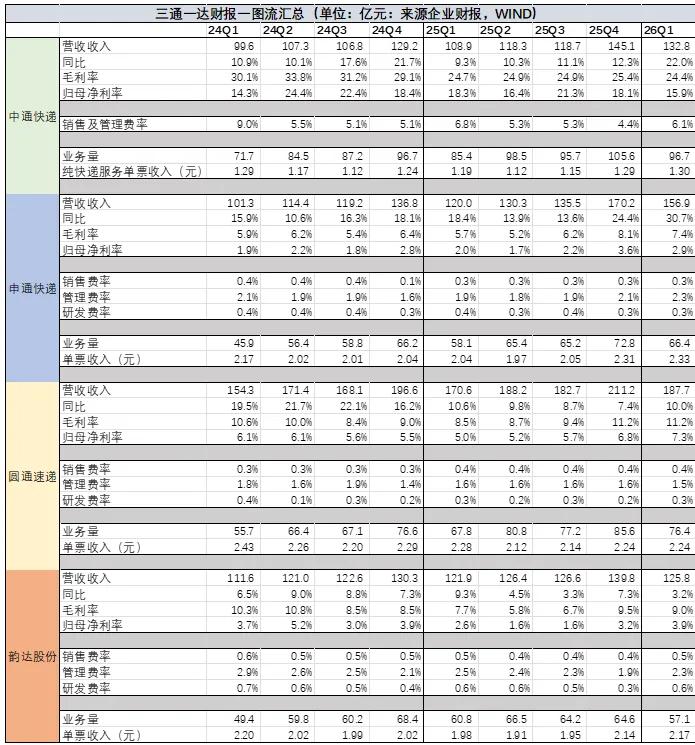
Chart: A snapshot of the "three links and one delivery" financial reports, unit: 100 million yuan
This raises a critical question: Why couldn't the operating performance sustain its strength after just one quarter? And why did the market stop pricing in the "anti-involution" narrative after the first quarter?
By examining the full financial statements of the "three links and one delivery" players, our core conclusion is: Without fundamental changes to the market structure, the valuation anchor of the express delivery industry has always been firmly tied to its cost curve.
Our key observations are as follows:
1. While anti-involution policies drove growth in revenue per parcel, corresponding expenses also rose. For enterprises that achieved improved profit margins, their total business volume declined, ultimately limiting the upside for overall profit growth.
2. Historically, the express delivery industry's growth has been highly dependent on the expansion of e-commerce. With e-commerce growth slowing down significantly today, there are no clear new incremental drivers for the logistics sector, making competition over service quality and operating costs somewhat inevitable.
3. Analyzing the trajectory of past price wars, the range of 2.5 to 2 yuan per parcel generates the maximum incremental demand. Data from Shentong and Yuantong shows that every 0.01 yuan drop in price per parcel drives approximately 140 million additional parcels, but this incremental effect diminishes once prices fall below 2.1-2 yuan.
4. Currently, the core anchor determining the valuations of the "three links and one delivery" players remains on the cost side. The largest variable component of costs is transportation prices, which are strongly correlated with oil prices. This explains the rapid valuation correction after the first quarter. Yuantong's latest performance announcement devotes significant attention to how AI optimizes transportation costs, and the market's expectation of sustained improvement in cost structures will inevitably reshape the mid-term valuation logic for the entire sector.
Anti-involution has achieved initial results, but competitive pressures are far from fully resolved
To start our analysis, let's first review the outcomes of the "anti-involution" campaign implemented in the second half of last year.
Since the fourth quarter of last year, revenue per parcel for all "three links and one delivery" players has seen a notable increase. Compared to the low point in the second quarter of last year, Shentong (following its integration with Daniao Logistics) recorded the highest revenue per parcel growth at 14.4%, followed by Yunda and ZTO with growth rates of 9.7% and 9.3% respectively, while Yuantong posted a 1.5% decline compared to the first quarter of last year.
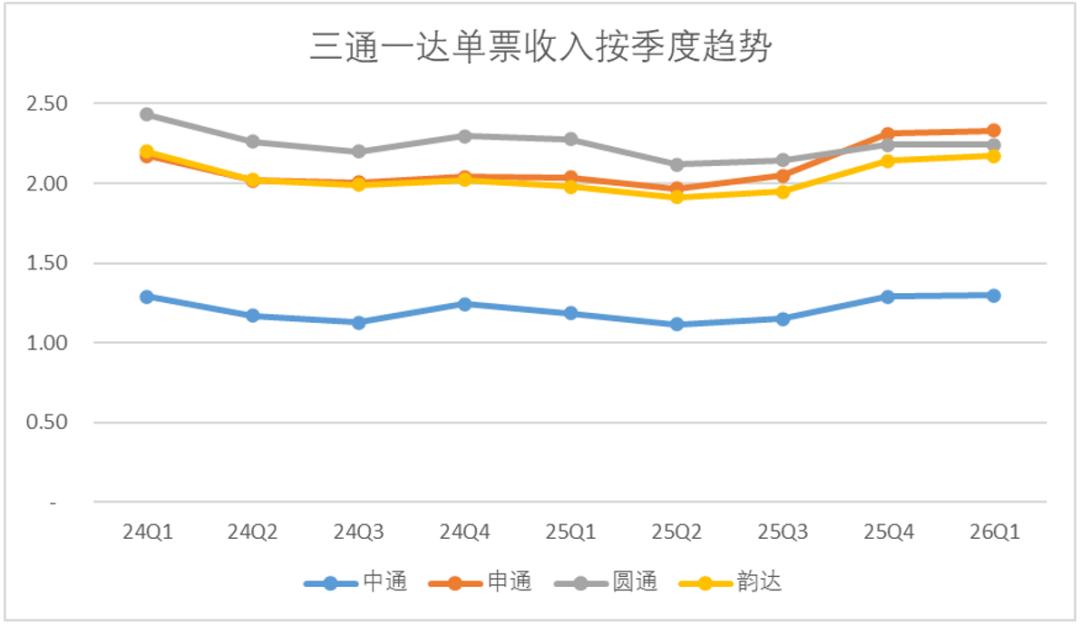
Growth in revenue per parcel was the core driver behind the valuation recovery of the express delivery sector in the first quarter of this year.
However, when looking at the profit side, performance divergence among the "three links and one delivery" players becomes far more pronounced. Yuantong and Yunda saw their net profit margin attributable to parent companies recover for three consecutive quarters alongside rising revenue per parcel. In contrast, ZTO's attributable net profit margin has continued to decline since the third quarter of last year, approaching the low point from that period in this year's first quarter; Shentong also recorded a noticeable drop in its attributable net profit margin in the first quarter.
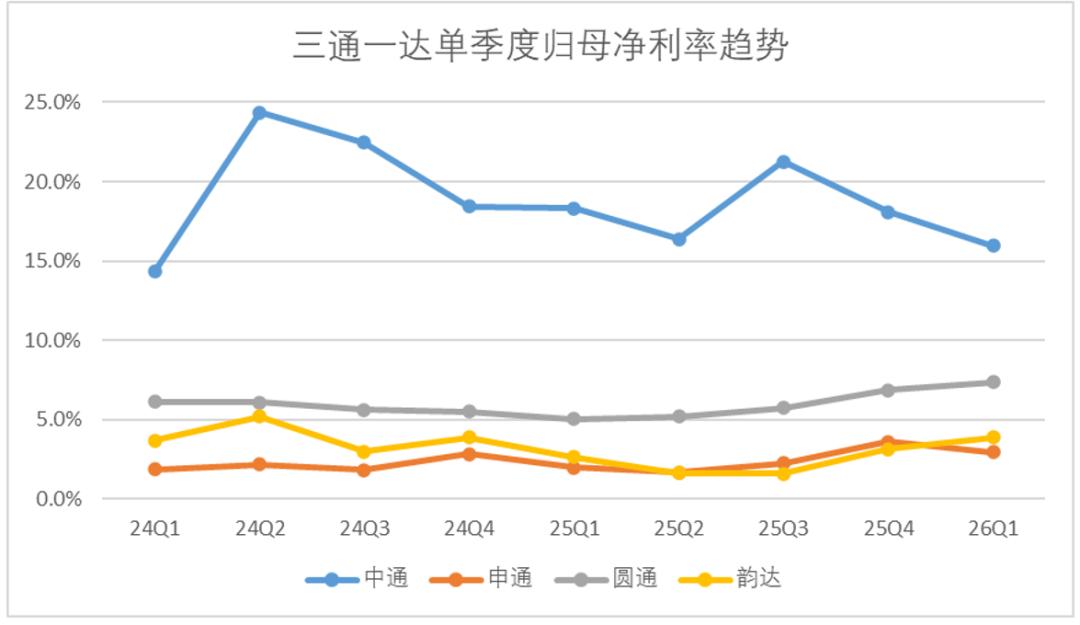
The primary cause of this divergence lies in expense control. Since the second quarter of last year, Yuantong and Yunda have maintained relatively stable expense ratios, but ZTO's overall sales and management expense ratio rose 170 basis points quarter-on-quarter in the first quarter, while Shentong's increased by 20 basis points. Seasonal factors partially explain this trend (for example, ZTO traditionally has higher first-quarter expenses, as employee compensation is concentrated in this period).
Nevertheless, a notable pattern emerges from the latest operating data: ZTO and Shentong, which saw weaker profit recovery, recorded 13.2% and 14.3% business volume growth in the first quarter respectively. Yuantong, which experienced a year-on-year decline in revenue per parcel, achieved 12.7% business volume growth. Meanwhile, Yunda, which showed strong improvement in both revenue per parcel and attributable profits, saw its business volume decline by 6% year-on-year.
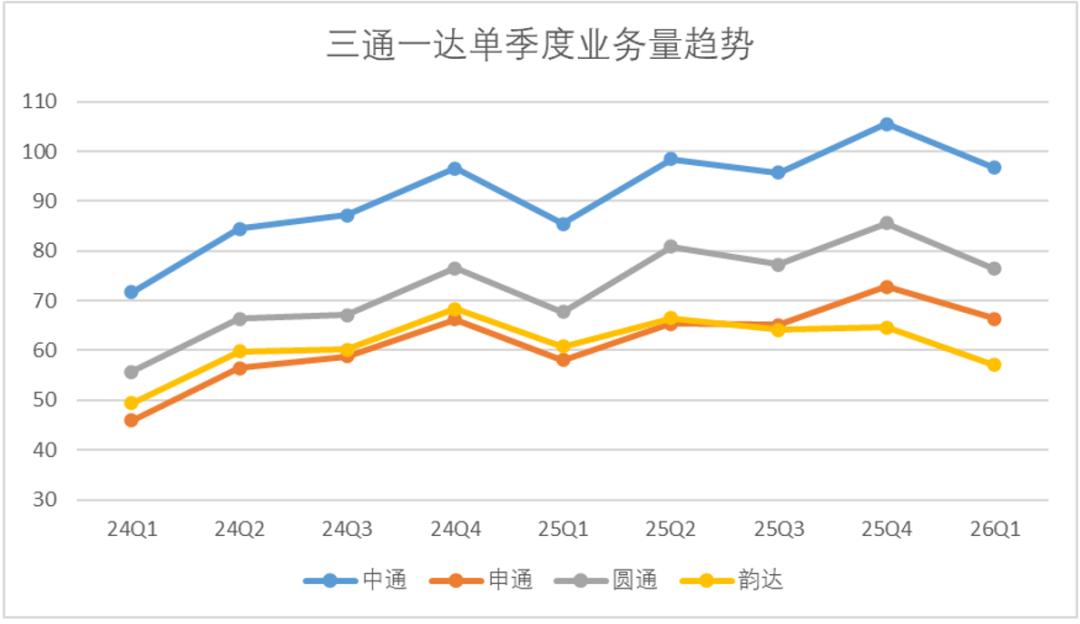
Overall, anti-involution policies have clearly delivered tangible results in boosting revenue per parcel. But looking at the actual profits retained by enterprises, the additional profit margin from higher revenue per parcel is either offset by rising expenses, or comes at the cost of declining business volume.
There is a clear trade-off between rising revenue per parcel and business volume growth. In other words, while anti-involution policies have improved the headline number of "price per parcel", competition has simply shifted to a different form: from explicit price wars on financial statements, to hidden cost wars.
The undercurrent of competition among express delivery companies is far from over.
The express delivery industry cannot sustain strong independent growth
From a macro perspective, the intensifying competition within the express delivery industry follows a certain inevitable logic. In any industry without new incremental growth opportunities, it is extremely difficult for all players to achieve win-win outcomes without either undergoing structural market consolidation or surviving a price war shakeout.
This is precisely the core issue: the express delivery industry lacks an independent growth narrative, especially for those enterprises that focus on low-margin economic parcels.
Taking the "three links and one delivery" players as an example, their total revenue growth trajectory aligns almost perfectly with Alibaba's revenue curve. Since 2020, their revenue has experienced two counter-cyclical growth surges in 2021 and 2024, which exactly correspond to Alibaba's strongest annual sales performance periods.
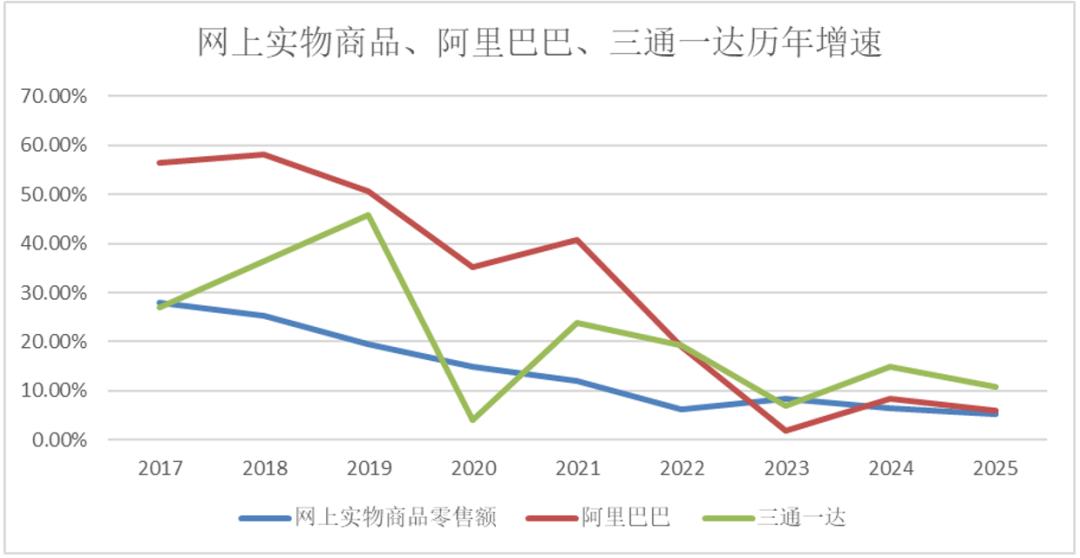
This growth pattern is consistent even for global express delivery giants.
FedEx, for instance, saw the U.S. domestic parcel market grow by a mere 0.4% in 2025. As e-commerce growth slowed, FedEx's expansion also narrowed. After reaching a peak revenue of $93.5 billion in 2022, it entered a plateau phase with two consecutive years of negative growth in 2023 and 2024, driven primarily by cooling global freight demand and e-commerce growth returning to normal levels.
The ratio of global express parcel revenue to global GDP has only increased by 2 basis points since 2022, demonstrating that the logistics value system has long been strongly correlated with overall economic conditions.
The challenges faced by the "three links and one delivery" players are fundamentally no different from those of global industry leaders. Over the past decade, new e-commerce growth points emerged roughly every two years from platforms like Taobao, Pinduoduo, and Douyin.
While J&T Express's 0.8-yuan nationwide shipping offer acted as the trigger for the latest price war, the root cause is the lack of new growth stories in the online market over the past two years. In a relatively saturated market, the express delivery industry sees few alternatives to price competition.
Of course, every coin has two sides, and price wars are not entirely without merit.
A 0.01 yuan drop in parcel price generates 140 million additional shipments
The flip side of this dynamic is: Price remains the only proven effective lever in the express delivery industry over the past decade to unlock extra incremental demand.
Looking at ZTO first, its average quarterly revenue per parcel in 2023 was 1.18 yuan, and 1.21 yuan in 2024 - a negligible difference. Its business volume grew by 12.6% in the same period, while Alibaba's revenue rebounded noticeably to 8.3%.
In 2025, the average quarterly revenue per parcel dipped slightly to 1.19 yuan, hitting a historic low of 1.12 yuan in the second quarter. That year, business volume increased by 13.3% while Alibaba's growth slowed to only 5.9%. This indicates that lower parcel prices captured spillover demand from multiple e-commerce platforms.
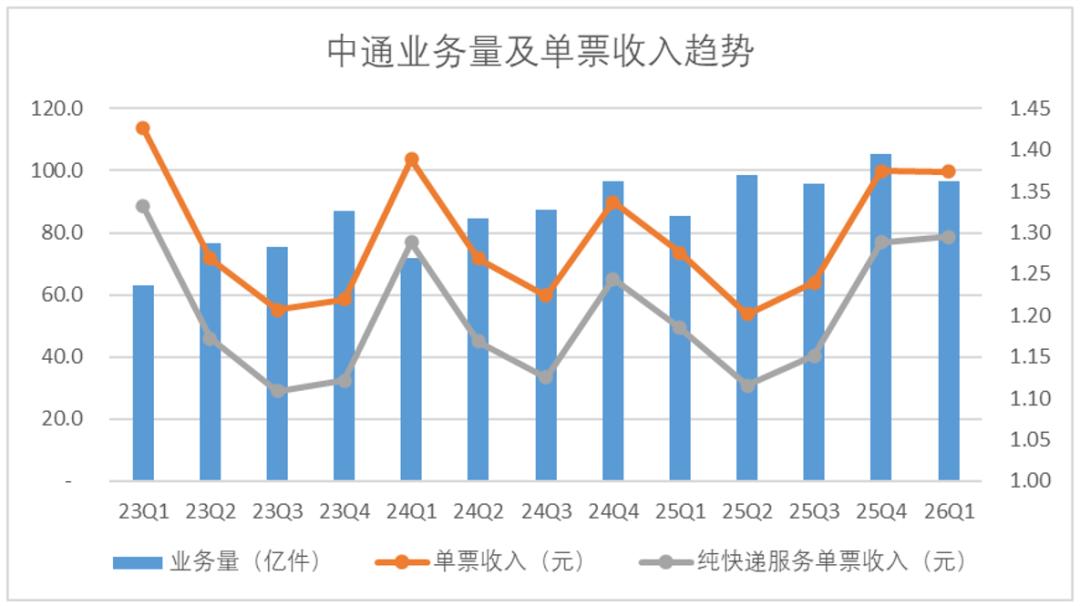
Shentong follows the same pattern. As one of the earliest participants in the price war, its average quarterly revenue per parcel fell by 0.19 yuan in 2024, but its business volume surged by 29.8%. In the second quarter of 2025, its revenue per parcel broke below the 2-yuan threshold, driving a 15% business volume growth rate that outpaced overall e-commerce growth.
The same logic applies to Yuantong and Yunda. If we compare revenue per parcel, business volume, online physical goods sales growth, and Alibaba's revenue growth over the past two years, the resulting chart clearly illustrates the following trends:

· In 2024, Shentong's revenue per parcel dropped by 0.18 yuan, creating a growth gap of approximately 23.3% compared to overall online physical goods sales growth. Yuantong's revenue per parcel fell by 0.12 yuan, corresponding to an 18.8% growth gap. Yunda saw a 0.32 yuan decline in revenue per parcel, with a 19.6% growth gap.
· In 2025, Shentong's revenue per parcel rose by 0.05 yuan, leading to an 8.5% growth gap. Yuantong's revenue per parcel fell by 0.1 yuan, creating a 10.7% growth gap. Yunda's revenue per parcel dropped by 0.06 yuan, resulting in a mere 1.1% growth gap.
Comparing Shentong and Yuantong, their growth rate difference was 4.5% in 2024, corresponding to a 0.06 yuan difference in their parcel price declines. In another period, their growth gap reached 2.3% alongside a 0.15 yuan parcel price difference. Yunda's data clearly shows that declining revenue per parcel no longer delivers proportional volume growth.
Combining data from Shentong and Yuantong, within the price range of 2.5 yuan to 2.05 yuan per parcel, every 0.01 yuan reduction in revenue per parcel generates roughly 0.3% additional business growth, equivalent to about 140 million parcels based on their average two-year volume. However, this incremental contribution diminishes as prices continue to fall. Yunda's data demonstrates that the incremental volume from price cuts below 2 yuan per parcel becomes extremely limited.
Current valuations of the "three links and one delivery" are inseparable from their cost curves
Competition over the past two years has proven that price cuts can drive volume growth, but their marginal benefits are rapidly diminishing. The price elasticity of the express delivery industry is not infinite: once revenue per parcel drops below a certain threshold, further price reductions generate almost no new demand. This is the underlying reason why regulators intervened in the market.
Meanwhile, the market share structure of the express delivery industry has become highly entrenched. The gaps between leading players are minimal - no single company can easily take over another's market share, and no player is willing to voluntarily exit the market. The share differences are too small to eliminate competitors, while exit costs are prohibitively high for any party to leave first.
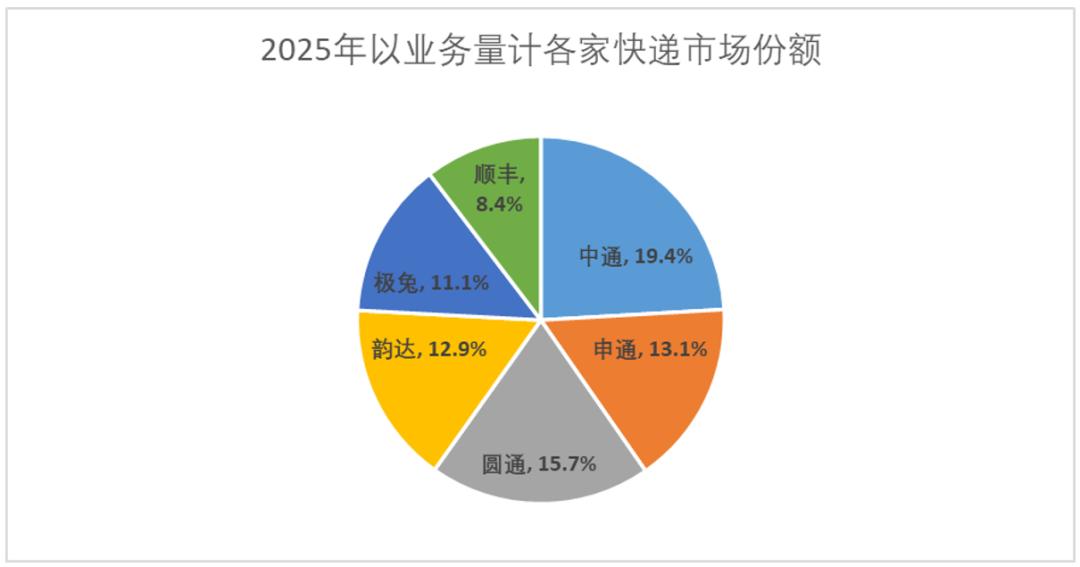
This stalemate where no player can easily outcompete others ensures that competition will not cease - it will simply shift from the revenue side to the cost side. The market's recognition of this dynamic is what triggered the sustained valuation correction. As the optimism from rising revenue per parcel fades, investors are refocusing on the real competitive driver in the current market: the cost fluctuation curve.
Taking Yuantong as an example, over the past three years, its parcel pickup and delivery costs have fluctuated within a range of about 0.6 yuan per unit, sorting and transit costs have varied by roughly 0.3 yuan, and waybill costs have changed by around 0.1 yuan. The largest source of cost volatility, however, comes from transportation costs per parcel.
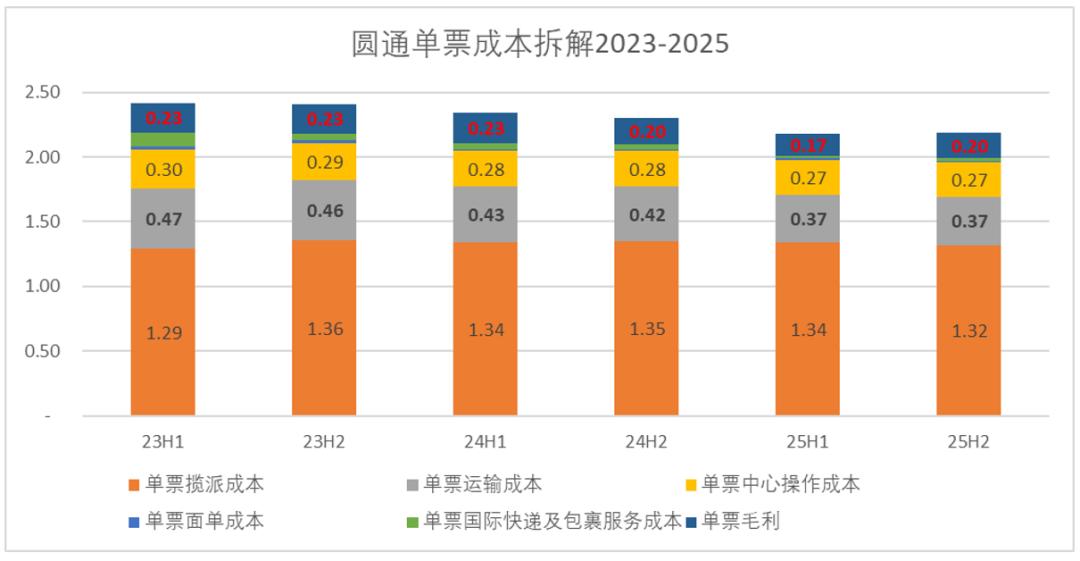
In fact, the gross margin trends of the logistics and transportation industry over the past decade clearly show that oil prices directly impact profit curves. Among 40 quarters of statistical data, three-quarters of the samples demonstrate an inverse correlation between gross margin and oil prices within the same quarter.
