The last-minute entrant in China's foundational model arena has taken the lead in laying out the landscape for the Agent era
Since 2024, the large model industry has gradually shifted from the frenzy of the "100-model battle" to landing anxiety. If large models only stay in the chat box, they will never realize their commercial value. Only by becoming partners that can complete tasks across applications and devices can they truly integrate into users' daily lives.
A convergence of industry consensus has begun.
In 2026, OpenAI partnered with former Apple chief designer Jony Ive to develop AI terminals. Meta deployed various terminal forms including AI pendants. Domestic large model companies such as Alibaba, ByteDance, and Zhipu AI have also stepped into the hardware and chip sectors. On the other hand, phone manufacturers including OPPO, Honor, and Huawei have all placed heavy bets on AIOS, attempting to embed large model capabilities into existing terminals.
At this critical industry turning point, StepFun's product launch event on July 13 stood out remarkably.
This three-year-old large model company unveiled its brand-new large-model-native AI terminal brand STEPX. Alongside the brand launch, STEPX announced three key developments: the agent-native operating system Step AOS (Step Agentic-native OS), the new-generation personal agent Step Amoo, and the surprise debut of the large-model-native agent phone STEPX Neo. This move has fully established a complete end-to-end chain covering foundational models, agent systems, and hardware terminals.
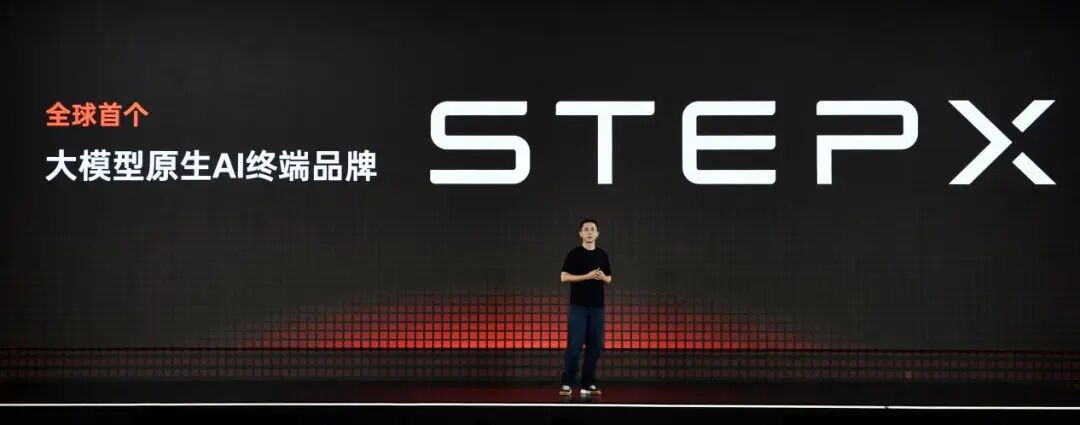
The origin of this strategic expansion from large models to hardware traces back to the first meeting between Ni Jiale, President of StepFun Terminal, and Yin Qi, Chairman of StepFun.
At that time, Ni Jiale had stepped down as President of Honor China Region, with over a decade of full-link experience in the terminal industry. Based on her judgment of the future, she went to Hong Kong to pursue AI-related courses, believing that in this era "all hardware is worth reimagining with AI." Meanwhile, Yin Qi, a serial AI entrepreneur and Chairman of StepFun, had long been searching for breakthroughs to bring large models into the physical world, and was eager to find a partner who understood both hardware and AI.
During a chance meeting, the two hit it off immediately. They quickly aligned on a key insight — C-end reconstruction is one of the most core opportunities in the AI era, and native AI terminals represent a brand-new future completely different from the past.
In the past, despite the ups and downs of the hardware industry, a "20-year law" can be summarized. Almost every 20 years, the hardware industry undergoes a major iteration. The first was in the early 1980s, when the IBM PC emerged and personal computers reshaped how humans process information. The second was the release of the iPhone in 2007, when touchscreens and the App Store ushered in the mobile internet era.
Today, nearly 20 years have passed since the iPhone's launch. As innovation in hardware forms hits a bottleneck, the explosion of agents has become the key breakthrough to break the existing pattern.
"The era of agents is coming, and we are now standing on the eve of this transformation," Ni Jiale judged.
Native AI Cannot Grow on Top of Legacy OS
Over the past decade, the development of AI has gone through three stages of differentiation.
In the AI 1.0 era, the industry focused on solving the problems of "seeing and hearing," with typical applications including image recognition and speech-to-text. In the AI 2.0 era, the industry overcame the challenges of "understanding and generation," where large language models and multimodal models enabled AI to write copy, generate images, and answer complex questions.
Now in the 3.0 era, the core mission of AI has become "doing things for you." Agents are equipped with capabilities of perception, memory, planning, and action, enabling them to complete user tasks across applications and devices. For example, with the help of agents, AI can assist users in booking flights, organizing meeting minutes, and more.
This transformation has directly exposed the underlying flaws of existing operating systems. Over the past 60 years, the evolution of human-computer interaction has progressed from graphical interfaces to natural language interaction, but the underlying logic of all systems has always been "humans operating machines" rather than "agents operating machines."
This explains why most mainstream operating system solutions in the current industry are essentially overlaying AI capabilities on existing operating systems. Typical examples include Google embedding the Gemini assistant into the existing Android system, Apple integrating Apple Intelligence into iOS, and a large number of domestic phone manufacturers mostly updating AI features on top of their original operating systems.
As a result, most users do not have a strong sense of experience with "AI phones" — the changes are nothing more than adding an "AI Erase" function in the photo album, an "AI Summary" feature in meeting apps, or a floating AI sidebar at the edge of the home screen.
Essentially, all these so-called AIOS have only chiseled a window for AI invocation on the territory of legacy operating systems, rather than designing a dedicated operating system for AI agents.
StepFun aims to overturn all this. Ni Jiale, President of StepFun Terminal, used a vivid metaphor: what StepFun is doing is essentially "building a new house" from the ground up for agents, rather than simply "opening a window" on the old one.
To achieve this goal, Step AOS attempts to directly tear down the "three walls" that have long blocked the development of AIOS.
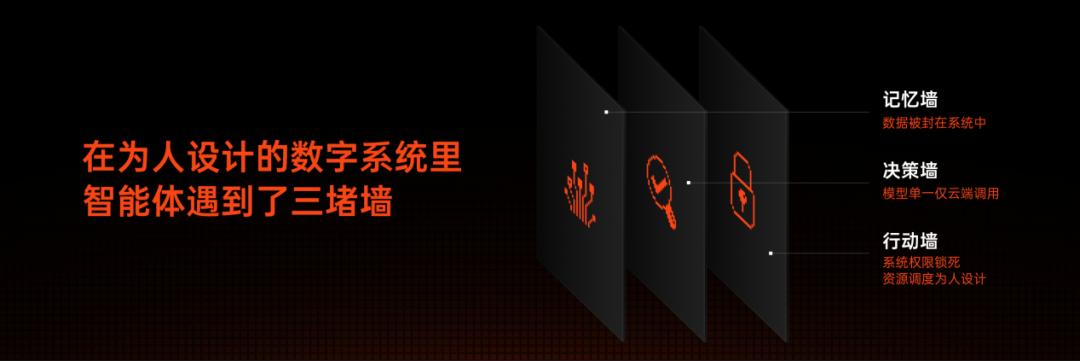
The first wall is the memory wall. In traditional OS, data from apps like WeChat, Calendar, and Gallery are not interconnected. These "data silos" prevent agents from building "global memory." For example, AI has to repeatedly ask basic questions such as "which city are you going to tomorrow" or "which coffee shop would you like," lacking memory of the user's personal preferences.
To solve this problem, StepFun built a "Memorize-Organize-Remember" architecture on Step AOS.
According to Ni Jiale, with user authorization, Step AOS will "memorize" fragmented information scattered across various apps, then "organize" this information through algorithms by adding tags and categorizing it to form structured long-term memory files. When the user issues an instruction, the system can accurately "remember" the relevant details without repeatedly asking basic questions like "which city are you going to tomorrow."
The second wall that Step AOS tears down is the decision-making wall. For a long time, the decision-making process of AIOS has been full of pain points — relying entirely on the device side leads to insufficient computing power, while relying entirely on the cloud results in slow response and high costs.
To address this, Step AOS has created a device-cloud collaborative routing system, where the device side handles "fast responses" and the cloud side undertakes "deep thinking." It also innovates a set of "cascade scheduling" mechanisms, whose core logic of intelligently distributing tasks is similar to the "distributive law of multiplication" in mathematics.
For example, under this mechanism, more than 90% of high-frequency lightweight tasks (such as checking the weather, setting alarms, and finding local files) can be completed on the device side. This not only saves Token costs but also avoids the endless loading waiting caused by network latency. The remaining less than 10% of complex multi-step tasks are uploaded to the cloud, avoiding the "killing a chicken with a butcher's knife" scenario and balancing response speed, computing power costs, and privacy security.
Immediately after that, the third wall torn down by Step AOS is the action wall. In legacy AIOS, agents are like "blind people" — they have no native interfaces and can only operate apps through "pixel-level imitation" by simulating screen clicks. This method is not only inefficient and error-prone but also often intercepted by risk control systems.
To solve this pain point, Step AOS adopts a more radical approach. Instead of being directly compatible with existing apps, it breaks down services such as Alipay and travel platforms into thousands of system-level minimum capability units, forming an atomic capability engine and service scheduling framework.
The advantage of this framework is that agents no longer need to recognize buttons and simulate clicks with "naked eyes," but directly call underlying APIs through protocols such as MCP and A2A. With agents equipped with "legitimate hands," Step AOS has successfully expanded in-depth cooperation with major applications including Alipay, avoiding the predicament faced by the first-generation agent phones.
However, the premise of endowing agents with such "legitimate hands" is that users must grant extensive access to personal data and operation permissions. For users, facing a "digital butler" that can independently transfer money, book tickets, and read or write private files, it is inevitable to have privacy concerns. Once authorization gets out of control, agents may change from "assistants" to "insiders."
To dispel users' concerns about the "action wall," StepFun also announced at the launch event that it will jointly release the "New-Generation Agent System Security Technology White Paper" with Shanghai AI Laboratory, and propose a four-dimensional governance framework of "Trustworthy, Visible, Controllable, Reversible." This means all operations of agents will be completed in a trusted execution environment, with every step auditable and traceable, and misoperations can be revoked with one click.
After tearing down the three walls that once blocked AIOS, StepFun aims to build a more thorough operating system for the agents of the future.
Why Are Foundational Model Vendors More Suitable for Building AI Hardware?
Nevertheless, building the operating system infrastructure is only the first step. StepFun's ambition points directly to the AI Device sector.
Ni Jiale's judgment hits the core: in the future competition of native AI terminals, the decisive factor will never be hardware parameters, but the deep closed loop of model, software, and hardware — which is precisely the weakness of traditional phone manufacturers who are obsessed with "piling up hardware specs," yet the biggest opportunity window for foundational model vendors.
In Ni Jiale's view, the model itself is the first moat for foundational model vendors to enter the AI Device sector.
On the model front, StepFun did not take the shortcut of "one model for all scenarios." Instead, it spent three years building a "1+N" model layout: one main foundational model system (Pro/Flash/Edge three-layer architecture) + N multimodal capability matrix (five senses), which precisely matches the core needs of agents.
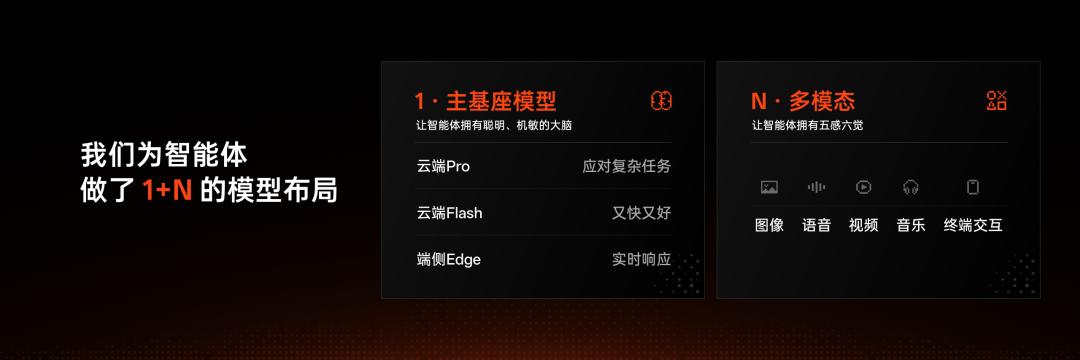
Specifically, the cloud-based Pro model acts as the "most powerful brain" specializing in complex reasoning. The Flash model, internally known as the "carbs model," reduces Token costs with an ultra-high speed of 409T/s to support high-frequency interactions. The device-side Edge model achieves 100-millisecond local response through in-depth optimization, balancing privacy and latency.
This architecture precisely targets the three key competitive points of the agent era: long context, long-horizon tasks, and Recursive Self-Improvement (RSI), forming a solid technical foundation.
However, the technical advantages of foundational models must be translated into product logic, and foundational model vendors are also trying to reconstruct hardware from the product definition level.
In the past, traditional phone manufacturers often followed the "Terminal + AI" approach, where hardware essentially defines everything, and AI is just an add-on at a later stage. They even blindly piled up hardware specs for benchmark scores, ignoring the real needs of agents. In addition, most traditional phone manufacturers tend to choose the path of outsourcing models, which inevitably leads to the loss of data sovereignty.
In contrast, after launching the new brand STEPX, StepFun has fully shifted to the "AI + Terminal" approach: first anchor model capabilities and user pain points, then reverse-design software and hardware solutions.
The shift from "Terminal + AI" to "AI + Terminal" is not just a reversal of word order, but a bottom-up transformation of product definition rights, R&D leadership, and even business logic.
Ni Jiale once revealed a highly representative internal "game" process.
In the initial stage of hardware definition, StepFun's hardware team followed industry inertia and instinctively wanted to adopt the most powerful chips and the highest specifications — this is the muscle memory accumulated by the phone industry over 20 years.
However, the AI team, based on calculations of real agent scenarios, insisted on the principle of "good enough." The reason is that if the chip specs are over-piled, the motherboard, heat dissipation, battery, and battery life will all be compromised, resulting in a counterproductive product where "the model is smart, but the user experience is terrible."
Eventually, both sides reached a consensus anchored in the needs of the target user group and AI agent requirements: refuse to pile up hardware specs in vain for marketing indicators such as benchmark scores, reserve computing power for model optimization, and leave more space for heat dissipation and battery life.
Nevertheless, to make this "AI defines hardware" logic work smoothly, the rigid hierarchical systems of traditional hardware manufacturers are clearly incompatible. The AI Native organizational model of foundational model vendors, on the other hand, has formed a third layer of invisible competitiveness that is difficult to replicate.
Inside StepFun, the second consensus reached by Ni Jiale and Yin Qi is to "treat the organization as a product."
Supported by this management philosophy, StepFun's terminal team has nearly 500 employees with an average age of 28. They not only broke down the departmental walls that once separated "hardware, software, and AI teams working in isolation," but also formed a brand-new AI Native working method — capabilities are no longer constrained by fixed job roles, but more like freely combinable building blocks, giving technical staff great autonomy.
Inside StepFun, an intern born in 2002 spent only one week building an automated evaluation system based on the Feishu bot, taking over the entire process of experiments, data processing, and report writing that originally required manual work. In traditional large companies and phone manufacturers, such tasks often require layers of approval, and an intern would never be allowed to "start the project as they wish."
An algorithm engineer who transferred from a large internet company also had deep feelings about this working method. Previously, when he was doing cloud-side development, he did not need to worry about computing power and power consumption. After switching to device-side development, he had to face three constraints: privacy compliance, power consumption control, and the limited GPU computing power on the device side.
But in StepFun's AI Native organization, he did not need to wait for the hardware team to do adaptation work. With the help of AI tools, he independently built a device-side image and text search workflow, and connected the full chain from visual recognition to effect verification — transforming from a screw responsible for a single module to a versatile expert capable of handling the entire process.
Ni Jiale summarizes StepFun's organization as a new type of production relationship — "breaking information barriers so that every team can get sufficient 'context'," and "identity is not a threshold, ideas and depth are what matter."
This flat management not only improves R&D efficiency but also adapts to the rapid iteration requirements of the AI era. When agents need to schedule chips, models, and apps simultaneously, any departmental wall may become a breakpoint in user experience.
Therefore, from all perspectives, foundational model vendors have become particularly suitable players in the AI Device track. They not only have full-stack model moat in technology, "AI-first" definition logic in product development, but also a culture that adapts to rapid iteration in organization.
Moreover, leveraging the mature hardware industry chain accumulated in China over the years, foundational model vendors may have a much higher success rate in making AI Devices than traditional hardware manufacturers that need self-revolution, as well as internet companies that lack hardware experience.
"The Agent Era Is Wonderful"
Although StepFun is a relatively late entrant among domestic foundational model vendors, nearly two years behind the first echelon, looking back at its layout, it has precisely avoided the internal consumption of parameter competition in the "100-model battle," and directly placed its bets on the infrastructure of the agent era.
If we regard an agent as a digital person capable of completing tasks, StepFun has spent three years gradually building up the technical infrastructure required for the agent era: the large model is the "brain," which StepFun has already polished, with the "1+N" model