Can MiniMax still reach new heights?
Once hailed as one of the "Two Giants of Large Models," MiniMax is losing its luster.
In the capital market, MiniMax's (00100.HK) Hong Kong stock price has plummeted from its peak of HK$1,330 to the current HK$230, with total market capitalization shrinking from approximately HK$410 billion to around HK$72 billion.
Even though MiniMax closed 3.32% higher at HK$230 on July 14, the market believes this rebound is largely a technical correction after a steep decline rather than a trend reversal.
In reality, MiniMax has seen no good news lately. From the flood of share unlocks and the M3 pricing controversy to institutional downgrades of its target price, a series of chain reactions are erupting all at once.
But the real question worth asking is not "why did it fall," but what fundamental reversal has occurred in MiniMax's valuation logic?
Over the past six months, MiniMax has fallen from its status as one of the "Two Giants of Large Models," and its market capitalization gap with another large model firm, Zhipu, has widened to more than 10 times.
On July 8 and 9, after share unlocks, Yan Junjie, Founder & CEO of MiniMax, and Tang Jie, Founder of Zhipu, successively released internal letters. Yan Junjie announced he would take "zero salary" until AGI is achieved, trying to stop the bleeding and stabilize the situation; meanwhile, Tang Jie grandly launched the "Touch High Initiative" to push full steam ahead toward the next peak of AGI.
Both moves were meant to "boost morale," but after these internal letters, the capital market took two different paths. Zhipu continued its strong upward trend, while MiniMax kept "bleeding" nonstop.
Yan Junjie is no less willing to "touch high" like Tang Jie, but at least for now, the road ahead looks extremely tough.
Of course, the story is far from over, and MiniMax still has a chance to turn things around. But it must also face stricter scrutiny and deliver results that satisfy the market under these new standards.
-01- MiniMax "Stops the Bleeding," Zhipu "Touches High"
After the restricted shares were unlocked, Yan Junjie wrote an internal letter.
On July 10, Yan Junjie made a commitment in an all-staff internal letter: starting immediately, he will no longer draw any salary from the company until AGI is achieved.
At the same time, Yan Junjie announced he would allocate 4% of the company's total shares under his name for team incentives, and set up a dedicated 1% fund to support the open-source community.
However, this positive commitment failed to halt the downward trend. In reality, Yan Junjie is facing a major turning point, and behind this letter lies the most dramatic turbulence MiniMax has experienced since its listing.
On July 9, the company saw its first large-scale unlock of restricted shares, with approximately 146 million shares, accounting for 48.9% of total share capital, released from trading restrictions. On the unlock day, MiniMax closed at HK$297.4, plummeting 17.98% in a single day.
Worse still, MiniMax's decline did not stop there.
On July 13, its stock tumbled as much as 19.81% at one point during trading, hitting HK$217.8, even falling below its listing-day low. By market close that day, MiniMax was at HK$222.6, with its market capitalization dropping from a peak of over HK$410 billion set on March 18 to less than HK$70 billion.
During Hong Kong trading hours on July 14, MiniMax's stock continued to swing wildly. Shortly after opening, it dropped to a new all-time low of HK$209.2, down more than 6%.
Although it closed at HK$230, the market believes MiniMax's rebound is mostly a technical correction after excessive decline, rather than a sustained trend reversal.
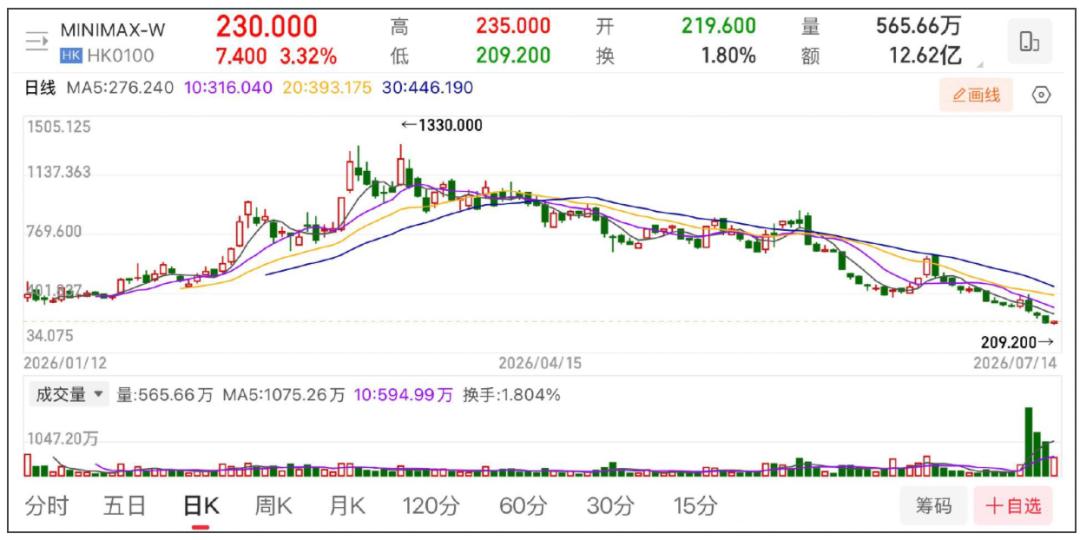
Figure: MiniMax Stock Price Chart, Source: Screenshot from "TingTing Tech" via Eastmoney
Interestingly, in the same week that its stock crashed, MiniMax announced it had completed a massive HK$160 billion refinancing. This placement and convertible bond offering attracted over 20 international institutions across Asia-Pacific, Europe, and the United States to subscribe.
On one hand, capital was "transfusing blood" to rescue the firm; on the other hand, the market was "bleeding out" through sell-offs. Yan Junjie's "zero salary" declaration reads like a last-ditch effort to use his personal credibility to stop the market's bleeding.
Within less than a week, JPMorgan twice downgraded MiniMax's target price, cutting it from HK$300 to HK$240, citing concerns over equity dilution from the refinancing.
Dramatic twists always catch people off guard. It was only half a year ago that MiniMax surged 109% on its listing day, with market capitalization exceeding HK$100 billion.
Some have completely diverged, while others have withstood the pressure.
In stark contrast, Zhipu, the other "Large Model Giant" that listed alongside MiniMax, not only stabilized its stock price but also saw its market capitalization rise.
On July 8, Zhipu saw its first batch of shares unlocked. On July 11, Founder Tang Jie released an internal letter announcing the launch of the "Touch High Initiative." In the letter, he stated that the company will not pursue short-term application monetization over the next two years, but instead make strategic investments aimed directly at the next peak of AGI.
As of July 14, Zhipu's total market capitalization stood at around HK$745.6 billion, more than 10 times that of MiniMax. Just half a year ago, MiniMax's market cap was twice that of Zhipu's.
Market analysis points out that Tang Jie's internal letter is more like a forward-looking technical manifesto that systematically outlines Zhipu's understanding of AGI. Meanwhile, Yan Junjie's remarks focus on the long-term alignment between the founder and the team, acting more like an emergency "bleeding-stopping" measure amid collapsing market confidence.
From this perspective, it is obvious who is "patching up loopholes" and who is "climbing higher."
-02- Why Has MiniMax Kept Falling?
Many analyses point out that MiniMax's stock crash is the result of multiple overlapping factors.
"The share unlock is the most direct trigger," industry insider Yang Ge admitted. "This time, the unlocked shares account for roughly 63% of the Hong Kong share capital, with financial investors making up over one-third. Before the unlock, the actual free-float of the company was only around 5%. With supply exploding, the selling pressure is easy to imagine."
But more noteworthy than the unlock is the M3 price hike controversy.
On June 1, MiniMax released its flagship model M3. At the same time, the company changed its billing model from per-call to per-token, with the lowest-tier package jumping from 29 yuan to 49 yuan, without giving users advance notice.
"This move was like 'acting first and reporting later,' instantly igniting the developer community," developer Li Ming said frankly.
"I've been using MiniMax's API since M1, and I always thought it offered decent value for money. But this M3 price hike was done without any prior communication, with prices changed directly in the backend. That means halfway through our project, our cost budget suddenly doubled," Li Ming told "TingTing Tech."
Other users calculated that for the same tasks, the actual cost increase using M3 reached 257%.
Beyond the price hike, many developers also raised specific issues with their user experience.
On social platforms, users commented that "MiniMax's API response speed fluctuates, especially during peak hours" and "for real-time interactions, user experience comes first — and just on that point, we don't dare use it for core business."
In addition, MiniMax was accused of adopting a "double standard" in API pricing between China and overseas, charging higher prices domestically than abroad, which goes against the common industry practice for Chinese large model firms where "overseas pricing is usually higher."
Citi noted in its report that the M3 pricing controversy and lukewarm market response, combined with negative sentiment, user retention concerns, and monetization strategy uncertainties, will continue to create pressure in the short term.
User dissatisfaction has, to some extent, hurt M3's market performance. Third-party evaluation firm Artificial Analysis Intelligence Index ranked M3 9th among mainstream models, while Chatbot Arena placed it outside the top 40.
In reality, all these issues point to one common problem: "MiniMax is not only expensive now, but also not as good to use as before."
So the question becomes: what exactly went wrong with MiniMax?
Yang Ge admitted that the deep-rooted problem lies in the fragility of its business model.
A close breakdown of MiniMax's structure shows that over 70% of its revenue comes from overseas consumer-facing products, mainly including the virtual companion app Talkie (domestic version called "Xingye") and Conch Video.

Figure: Xingye Agent Page, Source: Screenshot from MiniMax Official Website via "TingTing Tech"
But the problem is that MiniMax's consumer business has a low gross margin of only 4.7%. Therefore, relying on consumer-facing products to make quick money and fund the costly foundational model R&D has become increasingly unsustainable in 2026, amid rising computing power costs and cutthroat price wars.
Take 2025 as an example: MiniMax's revenue hit $79 million, up 159% year-over-year, but its R&D expenses reached as high as $253 million. Meanwhile, MiniMax's full-year loss exceeded 12.8 billion yuan.
From a financial perspective, this is a typical "high-growth, high-loss" company.
Worse still, MiniMax's consumer products are facing tightening regulatory scrutiny.
Public information shows that in 2025, Talkie encountered overseas policy fluctuations due to virtual companion content that touched on minor protection issues. Meanwhile in China, Xingye also faces regulatory pressure.
Facing challenges like the "plateauing" of consumer product commercial value and rising computing power costs, MiniMax chose the most user-damaging path — lack of communication, arbitrary rules, and double-standard pricing — which directly led to a large-scale trust crisis.
Later, even though MiniMax issued an urgent apology and introduced compensation measures, this kind of behavior that "betrayed" developers has caused irreparable harm to its image of inclusive technology. On the very day M3 was released, MiniMax's stock opened higher then plunged, closing nearly 16% down.
At the same time, the capital market's valuation anchors for large model firms are shifting.
"The market no longer just looks at stories and visions; it focuses on commercial implementation and profitability. MiniMax's revenue structure is still dominated by low-margin consumer business, while its high-margin enterprise business remains small in scale," Yang Ge explained.
"Moreover, Talkie's monthly active users dropped sharply quarter-over-quarter in Q4 2025, all of which made the market re-evaluate MiniMax."
-03- Is There Still Hope to "Touch High"?
On the product side, developers have made their choices. But more alarming than developer churn is the shift in the capital market's underlying logic.
It cannot be denied that in 2025, with revenue doubling, user counts surging, and overseas expansion accelerating, the market was happy to buy into MiniMax's "high-growth story," and these metrics supported its hundred-billion market capitalization.
But entering 2026, as the global AI sector enters the elimination round, institutional focus has shifted from "how fast you grow" to "how long you can survive" and "what makes you profitable."
From this perspective, the problems facing MiniMax become very stark.
"Whether it's the mismatch between revenue structure and cost structure, or the 'selling more, losing more' model, these could be sustained when financing conditions were loose. But after share unlocks, when financing becomes harder, their long-term viability will be highly questioned," Yang Ge said.
In reality, MiniMax is not unaware of the limitations of its consumer business. Since the second half of 2025, it has repeatedly announced its push into the enterprise service market, and released the enterprise version of M3 targeting business clients.
But the problem is that the market for enterprise transformation is also extremely competitive.
For example, in the enterprise market, MiniMax faces brutal competition. Zhipu, with its "model-as-a-service" ecosystem, has captured a large number of government and enterprise clients, while DeepSeek has penetrated the long-tail small and medium business market with extreme cost-effectiveness.
Meanwhile, models from internet giants like ByteDance, Alibaba, and Tencent have built high barriers through ecosystem lock-in. For MiniMax, which lacks both ecosystem advantages and price competitiveness, breaking into the enterprise market will be far more difficult than expected.
Of course, the story is not over yet.
Some market analysts still believe MiniMax holds certain cards: it still has over 400 million global monthly active users, Talkie remains a phenomenal product overseas, and its cash reserves are relatively ample after completing the HK$160 billion refinancing.
"The key is whether MiniMax can quickly adjust its strategy and deliver tangible breakthroughs," Yang Ge noted.
For example, it can adopt a more transparent pricing mechanism, more stable API services, and make real, substantial investments in the developer ecosystem to rebuild developer trust.
At the same time, in terms of enterprise commercialization, instead of going head-to-head with giants in the broad, all-encompassing enterprise service market, it can build differentiated advantages in vertical sectors such as gaming, social media, and education. MiniMax's accumulated understanding of users from its consumer business can precisely become the unique value of its enterprise products.
Notably, MiniMax also holds a strong card in AI video generation.
In May this year, foreign media reported that Chinese AI teams have overtaken U.S. competitors in the video generation field. ByteDance's Seedance 2.0, Kuaishou's Keling, and MiniMax's Conch have surpassed OpenAI's and Google's products in video generation quality and ease of use.
Some creators said they switch between Keling, Seedance, and Conch based on task requirements and cost. Three global financial institutions — Goldman Sachs, Bank of America, and Citi — all gave MiniMax a "Buy" rating in the first week of July, with the core catalyst being the upcoming new-generation video model.

Figure: Conch Video, Source: Screenshot from MiniMax Official Website via "TingTing Tech"
In addition, sources say MiniMax is developing a large language model with 2.7 trillion parameters, internally dubbed M3 Pro. It could launch as early as the third quarter of this year with plans to open-source it, a scale far exceeding its current flagship M3's 428 billion parameters.
"But all of this is premised on