Once requiring 3 hours of queuing and generating an annual revenue of 500 million yuan, KUMO KUMO has now closed 180 stores within a year.
KUMO KUMO, once dubbed the "Hermès of the cake world" where customers queued for hours and even had to purchase with real-name ID verification, is now disappearing from an increasing number of cities.
iBrandi learned that KUMO KUMO, a cheesecake brand that once operated over 200 stores nationwide at its peak, has closed roughly 180 locations in the past year. According to data from Zhaimen Canyan, as of July 13, only 56 of its stores remain open across China, covering a mere 13 provinces. Its store footprint has shrunk by more than 70%.
In Beijing, only two KUMO KUMO stores are still in operation, and one franchised location will shut down when its contract expires. Hangzhou, which once hosted multiple outlets in core commercial districts, now has just one store left at the Olympic Sports Impression Mall. In cities including Guangzhou, Chengdu, and Tianjin, the brand's iconic bright orange stores are also gradually closing their doors. Meanwhile, the brand's official WeChat public account has not been updated since the end of 2025, and its once-highly promoted "Business Partner" program has largely ground to a halt.
Just two years ago, KUMO KUMO was planning to open 500 stores within a single year. Back then, it was one of the most high-profile new consumer brands in the baking sector. A 39-yuan cheesecake could sustain a small 20-30 square meter shop, and even generate business stories of monthly revenues reaching millions of yuan. Yet, KUMO KUMO went from being the "queue king of mall B1 floors" to closing 180 stores in a year in less than six years.
From 3-hour Queues to Annual Sales Over 500 Million Yuan: KUMO KUMO's "Orange Myth"
The KUMO KUMO story began in the familiar year of 2020.
At the end of 2020, founder Jiang Haowen opened the first KUMO KUMO store nationwide at Metro City in Shanghai. The inaugural outlet was only about 20 square meters, with no in-store dining area. Centered around the theme of "cheese", the brand focused on freshly baked cheesecakes, complemented by cheese ice cream, baked puddings, and other products. The original cheesecake sold for 39 yuan, while flavors like chocolate and salted egg yolk were priced at 49 yuan — not cheap, but not so expensive that young consumers would hesitate to buy at the time.
Of course, what made KUMO KUMO stand out was not just the cheesecake itself, but its striking signature "Hermès orange" color scheme.
The highly saturated "Hermès orange", transparent production windows, hand bells ringing when cakes came out of the oven, on-site cake branding, and randomly appearing hidden patterns together formed a complete consumer ritual. What customers bought was not just a cake, but the entire experience of queuing, waiting, taking photos, and sharing their purchase.
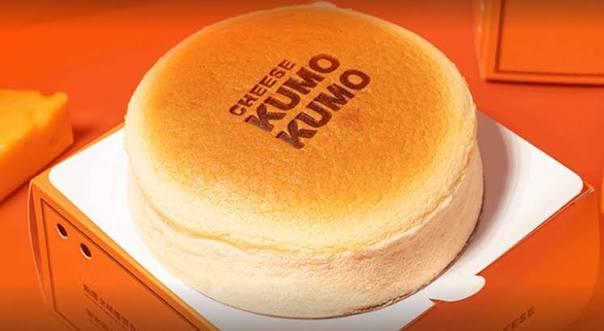
Looking back now, that original design perfectly tapped into the traffic secrets of new consumer brands: using a highly focused core product to lower consumer awareness costs, and leveraging a distinct visual identity and sense of ritual to drive social media sharing. This earned KUMO KUMO the nickname "Hermès in the cheesecake industry". In 2021, its Xinjiekou store in Nanjing once required customers to register and purchase with real-name ID due to overwhelming queues, with scalpers even reselling cakes at marked-up prices outside the store.
The traffic quickly translated into impressive store operational efficiency. Public data shows that one 23-square-meter KUMO KUMO store set a record of over 1.78 million yuan in single-month revenue, with some locations achieving monthly per-square-meter productivity exceeding 90,000 yuan. In 2024, a roughly 25-square-meter store in Shenzhen even recorded monthly sales of over 2 million yuan.
Such a compelling success story naturally attracted capital attention. In 2022, KUMO KUMO secured tens of millions of yuan in exclusive funding from Qingrui Venture Capital; by October that year, the brand operated around 30 stores nationwide. Over the following two years, KUMO KUMO expanded from Shanghai across the country, reaching 130 stores by July 2024 with annual sales exceeding 500 million yuan.
The brand's "peak glory" and rapid acceleration arrived in 2024. That February, KUMO KUMO officially launched its "Business Partner" program. According to data disclosed by the brand at the time, the investment budget for a single store was around 348,000 yuan, excluding rent and renovation costs. Before the official public announcement, the brand received over 20,000 partnership applications, and set a target of opening 500 stores throughout the year.
Franchising pushed KUMO KUMO to its peak scale. In 2024, the brand opened more than ten new stores almost every month, with over 30 locations launched in August alone; by the end of that year, KUMO KUMO's total store count had surpassed 200.
In just four years, a cheesecake brand born in the B1 floor of a Shanghai mall completed the full journey from viral single-store success, capital entry, to nationwide expansion — a near-perfect archetype of a star new consumer brand story.
Yet, the moment KUMO KUMO was moving the fastest was exactly when its problems began to accumulate.
"Internal Troubles and External Pressures"? It's Not That Baking Has No Market, But That "Internet-Famous" Brands No Longer Deliver
Regarding KUMO KUMO's contraction, many might assume the main reason is that the baking business has become harder to operate. In reality, however, the baking industry has not stopped growing in terms of overall market size.
Data from the Hongcan Industrial Research Institute shows that the domestic specialty bakery market reached 110.5 billion yuan in 2024, a year-on-year increase of 5.2%; the market size is projected to further grow to 116 billion yuan in 2025. As of May 2025, the total number of baking stores across China has reached 338,000.
The market is still expanding, but the rules of competition have changed — especially for "star-level consumer" brands like KUMO KUMO.
Let's first examine the "external factors": shifts in the industry and consumer behavior.
When KUMO KUMO rose to popularity, the market craved products that felt fresh, were highly photo-worthy, and could quickly leave a memorable impression. Today, however, consumers' priorities for baked goods have shifted from "is this worth checking in for" to "does it taste good, is it fresh, and can I buy it regularly".
According to the *2025 Baking Industry Trend Report*, consumers now pay more attention to flavor, freshness, and quality when purchasing baked products, and are actively checking information on calories, additives, and raw materials. "Clean label" features such as low sugar, low fat, and no additives are gradually evolving from differentiated selling points to basic requirements for new products.
This marks the first challenge KUMO KUMO faces: its product lineup centered on cheesecake, paired with its original brand design, is well-suited for one-off novelty purchases, but struggles to support stable, regular daily consumption.
On one hand, the core offering of a "whole cheesecake" has relatively limited consumption scenarios, mostly corresponding to gatherings, sharing, or occasional indulgences, rather than high-frequency occasions like breakfast, afternoon tea, or meal replacements. Although KUMO KUMO later added products such as cheese rolls, baked puddings, and ice cream, consumers' strongest association with the brand has always remained its signature round cheesecake. On the other hand, the product itself is highly substitutable: for example, its later-launched semi-soft cheesecake does not have a particularly distinct flavor profile compared to similar products from traditional baking brands like Holiland.
A focused core product was an advantage in the brand's early days: it helped consumers remember the brand quickly, allowed stores to reduce SKUs, cut down on space requirements, and improve production efficiency. But once the novelty wore off, the single product rapidly became a limitation: consumers lost new reasons to visit stores, and outlets lacked offerings tailored to scenarios like breakfast, afternoon tea, snacks, and gifting.
As new competitors entered the market, KUMO KUMO found itself in an awkward position: it cannot match the product variety of full-service bakery stores; it cannot compete on price with supermarkets and baking factories; and cheesecake is no longer a scarce, novelty product.
Second, the all-too-common "old problem": after securing funding, expansion speed outpaced the validation of its single-store operational model.
KUMO KUMO once envisioned a highly efficient small-store model: using a large orange display facade to attract foot traffic, eliminating in-store dining areas to reduce space and rent costs, improving production efficiency with a small number of SKUs, and reinvesting the saved costs into higher-quality raw materials — thereby achieving small footprint, high per-square-meter productivity, and strong performance.
During the peak traffic period, this model was viable. A small 20-30 square meter store did not require many staff, nor did it need customers to stay for long. As long as mall foot traffic was high enough and every batch of cakes sold out quickly, the limited space would create an impression of a bustling, popular business.
But the flip side is that these stores had almost no room for error. No in-store dining meant outlets could not extend customer stay times through environment and service; limited SKUs meant there were no alternative products to offset declines in foot traffic; and locations concentrated in core malls meant rent and commission costs remained high.
Once the initial traffic boom faded, the so-called "high per-square-meter efficiency of small stores" quickly turned into "low revenue for small stores".
More aggressive franchise expansion further amplified these risks. In 2024, KUMO KUMO opened its franchising system at the height of its popularity, pushing its total store count to over 200 within a year. However, as new stores rapidly launched in cities of different tiers, it became a major challenge for the brand to synchronously cover all locations with its supply chain, regional operations, marketing support, and store management capabilities.
Some franchisees stated that after the initial consumer novelty wore off, the brand's follow-up marketing support was limited. Coupled with the growing number of baking brands in malls, store repurchase rates never managed to improve. Data shows that the average lifespan of KUMO KUMO's historical stores is roughly 1.4 years.
Third, looking at the "internet-famous brand" itself: the traffic-centric strategies it excelled at are rapidly losing their effectiveness.
The Hermès orange color scheme, open transparent kitchen, oven bell ringing, and hidden cake patterns once helped the brand achieve extremely high recognition. However, these experiences did not have a high barrier to replication. As more baking brands began to prioritize store design, in-store baking displays, and social media marketing, KUMO KUMO's once-unique experiences gradually became standard industry practices.
In the era of value-for-money quality, consumers are increasingly reluctant to pay a long-term premium for a brand solely because of a color, a ceremonial experience, or a "Hermès of [industry]" label. Consumer trend reports released by organizations including the All-China Bakery Association show that consumer price sensitivity is on the rise, with over one-third of respondents believing current baked goods are overpriced.
Meanwhile, the entire baking industry is undergoing dramatic reshuffling. Data from Zhaimen Canyan shows that as of May 2026, the baking industry saw a net reduction of roughly 88,000 stores in the past year, with a store closure rate of 25%. The average lifespan of a bakery store is around 32 months, and 57% of outlets cannot stay in business for two full years.
This means KUMO KUMO's decline stems from both internal issues and is a microcosm of the high elimination rate among internet-famous baking brands. In the past, brands could quickly gain traction with a single core product, a distinct visual identity, and a round of social media viral marketing; today, consumers are still willing to buy baked goods, but no longer easily remain loyal to any single internet-famous brand.
Traffic can only help a brand secure a customer's first purchase. Every subsequent repeat purchase must be earned again through product quality, pricing, scenario relevance, and store operational efficiency.
Conclusion
The last post published on KUMO KUMO's official WeChat public account dates back to the end of 2025, with no updates in 2026, and the brand's official franchising information page has also become inaccessible.
Jiang Haowen, founder of KUMO KUMO, repeatedly stated in public interviews that what set KUMO KUMO apart from other brands was its value-for-money quality: "Consumers spend 39 yuan to get the joy worth 49 yuan."
In hindsight, 39 yuan never truly delivered that value-for-money promise. The extra 10 yuan consumers were willing to pay did not fully come from the cheese, cream, and raw materials — but from the queuing experience, oven bells, cake branding, and the novelty generated when the internet-famous brand was at its peak popularity.
Novelty has an expiration date, and that kind of joy is hard to standardize and replicate. When there are no longer queues at the door and no more viral posts on social platforms, consumers will no longer calculate how much "joy" they are getting from that 39-yuan cheesecake — instead, they will re-evaluate whether it is actually worth 39 yuan at all.
What's more intriguing is that as KUMO KUMO's popularity faded, Jiang Haowen has already pivoted to another "internet-famous track" — artisanal gelato. In 2025, Jiang founded a new brand called Gelo, focusing on drinkable gelato, freshly made gelato, and gelato fries.
Will this become Jiang Haowen's next KUMO KUMO?
Perhaps the more pertinent question is: will it replicate KUMO KUMO's viral success, or will it also repeat KUMO KUMO's downward spiral?
This article is from the WeChat public account "New Consumption Daily" (ID: ibrandi), authored by Empowering Global Brands, and published with authorization from 36Kr.