Bright Dairy, Junlebao, Feihe, New Hope: Who is leading the race, and who is wasting effort in vain?
The competition among the four leading players in the second tier of China's dairy industry is growing increasingly intense, with the rivalry between Bright Dairy, Junlebao, Feihe, and New Hope Dairy revealing deep-seated dynamics within the sector.
Against the backdrop of a market dominated by two top giants alongside a crowded field of competing players, Yili and Mengniu maintain relatively stable leading positions, while the primary shifts and competitive focal points of the industry are concentrated in the second tier. These four enterprises—Bright Dairy, Junlebao, Feihe, and New Hope Dairy—each boast annual revenue exceeding 10 billion yuan and occupy a critical place across the entire industry.
However, despite operating at comparable revenue levels, the four companies deliver vastly different performance outcomes.
Junlebao has achieved steady growth through its fully integrated industrial chain and strong presence in the fresh dairy segment; Feihe faces development bottlenecks amid a cyclical downturn in its single core product category; Bright Dairy carries deep industry heritage but struggles with poor profitability; New Hope Dairy has adjusted its operations following merger and acquisition expansion to secure stable growth. This round of industry competition essentially serves as a comprehensive assessment of each enterprise's strategic planning and operational management capabilities, laying bare their actual operational realities.
Bright Dairy: A Century-Old Brand Upholding Its "Freshness" Heritage
Bright Dairy is one of the pioneers in China's domestic fresh liquid milk category, having cultivated the chilled dairy market for decades, with "freshness" forming the core foundation of its brand identity.
First, solid regional distribution infrastructure. In its long-established East China home market, Bright Dairy relies on its "FreshGo" home delivery system covering Shanghai, Jiangsu, and Zhejiang to build a large base of loyal, stable customers. Its community-embedded distribution network not only preserves its market share but also mitigates competitive pressure from the industry's top leaders.
Second, robust industrial chain support. Building on this foundation, Bright Dairy has connected the full supply chain from dairy farms to end consumers, with its supporting cold chain logistics system earning one of the first national five-star accreditations in China. Leveraging this strong industrial foundation, the enterprise successfully bred the country's first local breeding bull ranked among the world's top 100 last year, breaking foreign monopolies on germplasm resources and securing product quality fundamentals at the very start of its industrial chain.
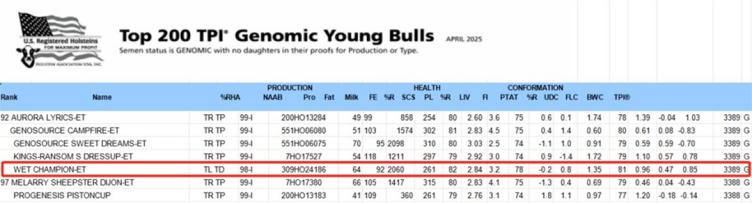
(Source: National Holstein Association USA)
Third, distinct inherent brand advantages. Drawing on a century of brand accumulation as a Shanghai-based enterprise, Bright Dairy outperforms ordinary regional dairy companies in brand recognition and distribution penetration across its core Shanghai-Jiangsu-Zhejiang market. This advantage, deeply rooted in local consumer memories, also provides a relatively stable cash flow foundation.
Even with its solid developmental foundation, the enterprise still faces certain constraints on its growth.
Not only has revenue growth in its core local market come under mounting pressure, but its national market expansion has also progressed slowly. Meanwhile, its farming segment continues to operate at a loss, and cold chain operational costs remain persistently high.
Compounded by frequent management turnover and a lack of consistent strategic focus for new product R&D, these factors collectively squeeze profit margins, resulting in subpar overall profitability. The enterprise still needs strategic optimization and operational model transformation to break through its current developmental bottlenecks.
Junlebao: The "Fresh Powerhouse" Built on Full Industrial Chain Integration
Junlebao has established strong competitive advantages in the dairy industry through a complete product portfolio and continuous iterative category innovation.
First, accurately capturing consumption upgrading trends. The enterprise maintains sharp market insight, having successfully developed two benchmark products—Jianchun zero-sugar yogurt and Yuehuoxian premium fresh milk—securing leading positions in their respective tracks. This fully demonstrates its outstanding market analysis and product R&D capabilities.
Second, full industrial chain layout enhances risk resilience. Drawing on 30 years of accumulation, Junlebao has connected the entire value chain from upstream farming, midstream processing to downstream sales. Leveraging a highly self-sufficient milk supply system and six world-class operational standards, the enterprise effectively reduces costs and improves efficiency, sustaining robust operational resilience amid industry cyclical fluctuations and enabling rapid responses to market changes.
Third, dual advancement of scientific research and digitalization drives quality upgrading. As reported by *China Food Safety News*, the enterprise invested 500 million yuan to build its own strain resource bank, storing over 1,300 bacterial strains—45 of which hold national patents—breaking foreign technological monopolies in this field.
At the same time, thousands of sensors have been deployed for intelligent feeding at dairy farms and across production processes, achieving a 99.88% digital control rate for equipment. By deepening its maternal milk research database and empowering the industrial chain through digitalization, the enterprise comprehensively guarantees product freshness and premium quality.
Nevertheless, the enterprise faces notable operational shortcomings, trapped in a high-debt, low-profit predicament. Its asset-liability ratio exceeds the industry average, with prominent short-term debt repayment pressure.
Prior intensive mergers and acquisitions conducted ahead of its planned IPO have accumulated significant goodwill risks and put considerable strain on distribution channel cash flows. Its long-standing low-price strategy has compressed gross profit margins, creating obstacles for high-end transformation amid the stock market competition.

Feihe Dairy: Transformation Pains for the Leading Infant Formula Giant
As the domestic industry leader in infant formula milk powder, Feihe Dairy positions "being better suited for Chinese babies" as its core mission, building unique local scientific research and operational barriers.
First, a closed-loop scientific research system consolidates product foundations. The enterprise has long focused on maternal milk research in China, achieving full independent control across the entire chain from milk source selection, R&D innovation, formula optimization to product validation. Sustained long-term clinical feeding trials continuously iterate its formulas, translating its brand promise into tangible scientific advantages that earn deep consumer trust.
Second, premium milk sources create distinctive quality features. Leveraging the world-class milk source belt at 47° North Latitude, Feihe established the industry's exclusive golden production zone for Chinese infant milk sources. It operates an efficient production process where fresh milk is spray-dried within two hours of collection, with full cold chain freshness preservation throughout the process to form unique market recognition.
Third, deep channel cultivation ensures operational resilience. Through on-the-ground promotion teams and a fully covered sinking maternal and child retail network, the enterprise has built a stable distribution moat. Relying on the high gross profit characteristics of its infant formula business, it has accumulated abundant cash flow, providing solid financial support to navigate industry cyclical shifts and advance long-term strategic development.
As the industry landscape evolves, Feihe has exposed structural operational issues: its revenue is heavily dependent on the single infant formula track, which accounts for 88% of its total revenue. Against the backdrop of continuously declining birth rates, the market space for its core business is shrinking, creating a structural industry dilemma that cannot be resolved through conventional operational adjustments.
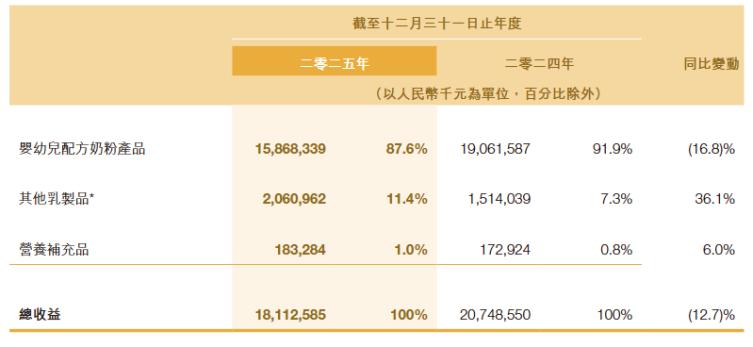
(Source: Hong Kong Stock Exchange Disclosure Website)
Traditional offline promotion methods can no longer adapt to the developmental trends of digital consumption, while exorbitant sales expenses are continuously eroding the enterprise's profits.
Additionally, new businesses such as adult milk powder deliver low profitability and fail to fully leverage existing channel resources. These new segments remain in early developmental stages and cannot fill the growth gap left by its core business, placing immense transformation pressure on the company.
New Hope Dairy: The "Fresh Cube" of a Regional Allied Fleet
New Hope Dairy adopts a model of merging and integrating regional dairy enterprises, continuously acquiring and incorporating local brands across different regions to expand its distribution and partner networks.
First, collaborative integration reduces expansion resistance. This approach minimizes operational obstacles when entering local markets in different cities, allowing the enterprise to establish a presence across multiple regions simultaneously while avoiding direct head-on confrontation with industry giants. This collaboration-focused integration model preserves a high degree of operational initiative for the acquired enterprises.
Second, building profitability advantages in the chilled dairy track. The enterprise prioritizes chilled liquid milk as its core development direction, with chilled products already accounting for 53.8% of its total revenue. Compared to ambient-stable milk, chilled dairy products deliver a gross margin of 36%—approximately 12 percentage points higher than that of ambient milk. Driven by stronger consumer repurchase loyalty, the overall profit structure has improved, turning "freshness" from a mere marketing slogan into a genuine source of revenue.
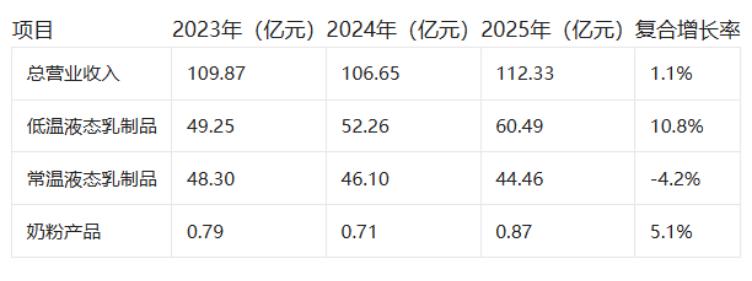
(Source: New Hope Dairy IPO Prospectus)
Third, operational resilience builds performance moats. New Hope Dairy's robust financial position and reliable profit realization distinguish it from other second-tier peers. Even during periods of broad industry pressure, the company has maintained double-digit growth in both operating revenue and net profit. Leveraging granular refined operations and deep regional cultivation, it has demonstrated strong operational resilience and profit elasticity amid encirclement by top-tier enterprises, standing out as a rare high-performing benchmark in the second tier.
Nevertheless, the enterprise still faces clear developmental bottlenecks. As a regional dairy player, its ambient milk business has long been suppressed by the two industry giants, and national market expansion can only be advanced through continuous mergers and acquisitions and cold chain system upgrades, limiting its overall growth potential.
At the same time, post-acquisition internal integration challenges across different regions, high cold chain logistics operational costs, and distribution gaps in lower-tier markets have persistently hindered the enterprise's large-scale expansion.
Conclusion
As the dairy industry breaks through the 100-billion-yuan revenue threshold and competition intensifies for the third overall industry position, the four leading second-tier dairy enterprises have demonstrated distinct development models and growth trajectories.
Junlebao maintains strong momentum for scale expansion through its fully integrated industrial chain layout and breakout chilled products, consistently securing a leading position in its core tracks. New Hope Dairy focuses on deep cultivation of the chilled dairy segment, delivering healthy profitability and achieving steady growth through targeted regional breakthroughs.
In comparison, Bright Dairy possesses solid industry heritage but lags behind in national market layout with low profitability, requiring innovative strategic adjustments and operational improvements to avoid falling into developmental stagnation. Feihe Dairy must break away from its over-reliance on the single infant formula business to identify new growth points amid the gradual disappearance of demographic dividends.
In the second half of the industry's development, enterprises that are first to address their shortcomings and upgrade their operational models will seize the initiative and gain competitive advantages, while brands that persist in outdated operational patterns will eventually be eliminated by the evolving industry trends.
This article originates from the WeChat public account "Financial External Reference" (ID: jrwaican), authored by Wai Can, and published with authorization from 36Kr.