Even the top players in the automotive industry struggle to keep up with rapidly iterating accounts
On July 16, China's auto market was destined to be exceptionally bustling — a total of 7 new models from 6 automakers chose to launch on the same day, and among these 7 vehicles, the shortest interval from their previous generation was only 8 months and 4 days.
For comparison, the average interval between consecutive generation launches of the same product line in China's smartphone market in 2025 was 10.3 months.
Compared to the 60-month R&D cycle in the traditional fuel vehicle era, the development timeline for domestic new energy vehicles has been compressed to 18-24 months. In the first half of this year, 550 new models hit the market, with new energy vehicles accounting for the absolute majority.
Under this "China Speed," even the most laid-back foreign companies would find themselves "confused yet deeply shocked" — in July this year, Ferrari's Global Marketing Director Manuele Ciarlando stated in an interview that Chinese automakers' product development approach resembles that of fast-moving consumer goods. From his perspective, the progress of Chinese vehicles in performance and configurations is astonishing, but high-frequency iteration also quickly renders older models obsolete, making it difficult to foster long-term driving-related emotional connections.
Ferrari, the centuries-old European luxury brand generating 1.6 billion euros in annual profits, naturally has the capital to slow down and talk about "driving emotions."
However, for Chinese automakers still trapped in a life-or-death competitive struggle, the outcome of "slowing down" is brutal — it means voluntarily surrendering hard-won market share to rivals that frequently launch new products with stronger cost-effectiveness.
In the past, public discussions about the costs of this speed race largely focused on consumers. Existing car owners complained of being "backstabbed" by automakers, as newly delivered vehicles immediately became the "previous generation," with their value depreciating instantly.
Now, this cost is beginning to circle back to the automakers themselves.
On July 12, Seres released a pre-loss announcement for its 2026 semi-annual performance, predicting a net loss attributable to shareholders of 1.5 billion to 1.8 billion yuan in the first half of the year; among this, its core sub-brand AITO is expected to post a loss of 1.05 billion to 1.3 billion yuan. As a point of comparison, Seres recorded a net profit attributable to shareholders of 2.941 billion yuan in the first half of 2025.
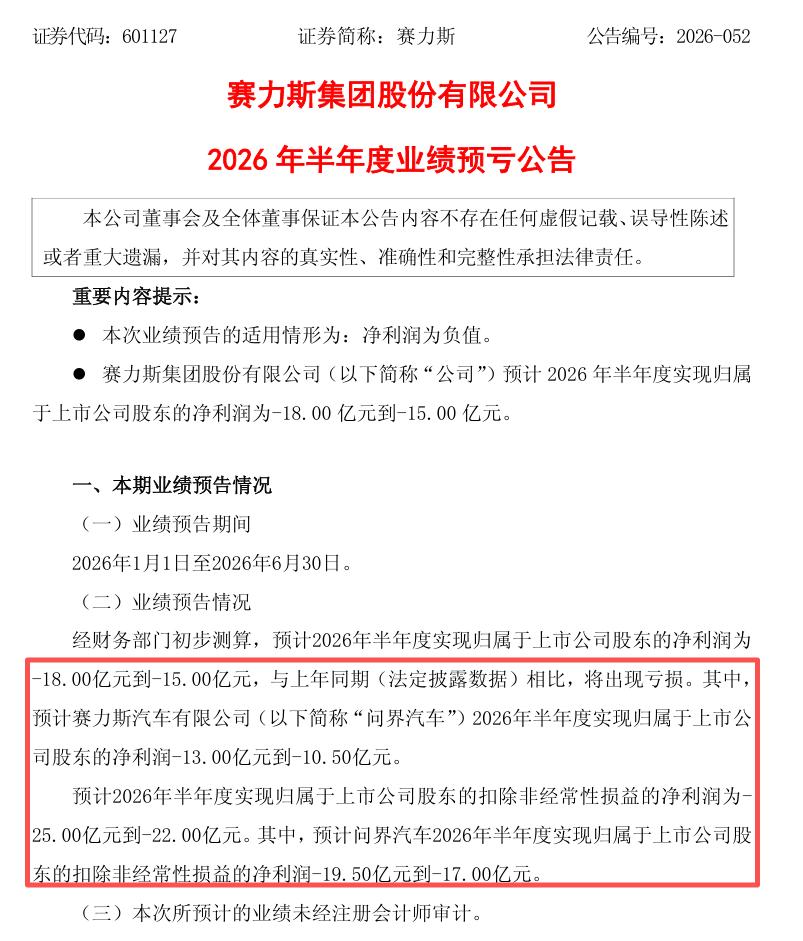
▲ Image source: Official website of the Shanghai Stock Exchange
Even the top-performing player in the industry, a representative of premium brands born with a silver spoon, with an average selling price of nearly 400,000 yuan and a gross profit margin ranking among the industry's highest, now has to pay the price for its past breakneck expansion.
Oddly enough, the massive losses are accompanied by continuous sales growth — in the first half of this year, Seres' total cumulative sales reached 160,800 units, a 5.6% year-on-year increase; AITO's cumulative deliveries over the same period rose 10.2% year-on-year. If AITO's loss of 1.05 billion to 1.3 billion yuan is spread across its total sales, it translates to a loss of roughly 6,500 to 8,100 yuan per vehicle.
It should be noted that Seres is not an automaker that pursues sales volume at the expense of low profit margins. In 2025, the gross profit margin of Seres' new energy vehicle business reached 28.8%, with its full-year net profit attributable to shareholders approaching 6 billion yuan. Among domestic independent new energy automakers, it holds a leading position in both profitability and average product price.
Precisely because of this, this sudden shift from profit to loss appears particularly striking. In response, Seres' official statement provided two explanations:
First, the broader market environment is challenging, with prices of key raw materials including memory chips, industrial metals, and lithium carbonate rising, driving up production costs. Seres Chairman Zhang Xinghai stated that the average cost of each AITO vehicle has increased by 15,000 to 20,000 yuan.
Amid the already fierce price competition, automakers find it nearly impossible to fully pass these cost increases onto consumers, ultimately forcing them to squeeze their own profit margins.
Second, based on expectations for future returns on assets, the company adjusted the book value of certain "existing assets with limited compatibility due to technological iteration and model upgrades."
This second point brings us right back to the cost calculation we discussed earlier.
When a new model is launched, automakers need to make substantial upfront investments — covering R&D achievements, testing and validation, production equipment, molds, raw materials, and component inventory.
Under the traditional automotive industry's business model, these assets were supposed to recoup their costs gradually over several years of production and sales.
However, the accelerating market pace has completely shattered the old cycle. As new technologies and model updates become increasingly frequent, even on a semi-annual basis, a mismatch begins to emerge between the service life of automakers' assets and the lifecycle of their products.
Seres is not the only one facing this headache; NIO CEO Li Bin also directly stated in an April interview that "a major reason the entire automotive industry is seeing higher sales but no revenue growth, and higher revenue but no profit growth, is that new models are iterating far too quickly."
Suppose a model was originally planned to sell for five years, with its supporting technologies, equipment, and components amortized gradually over that period. If the product is significantly updated after just two or three years or even less, the future revenue generated by older technologies declines, dedicated components lose their matching applications, and some equipment and molds can no longer be fully utilized.
GAC Group's financial reports also corroborate this point: in 2025, the company recorded approximately 1.223 billion yuan in inventory impairment, 1.246 billion yuan in intangible asset impairment, and combined with other related impairments on fixed assets, the total of these three items reached roughly 2.7 billion yuan. Among these, inventory impairment primarily stemmed from sluggish sales and overstocked models in its self-owned brand segment; intangible asset impairment arose from the accelerated phase-out of fuel vehicle technology routes, leading to rapid depreciation of assets formed by past R&D investments.
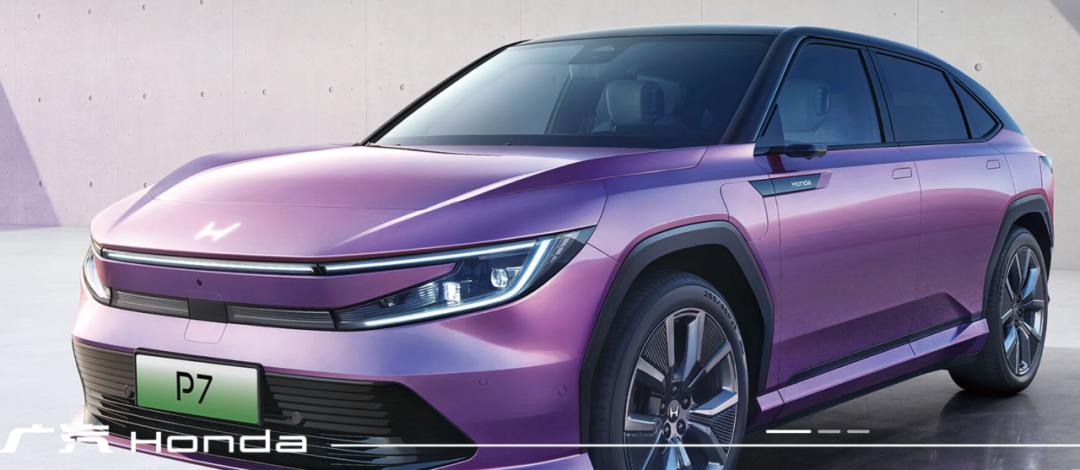
▲ GAC Honda's all-electric model P7 underperformed sales expectations after launch, with cumulative deliveries not exceeding 1,000 units three months after release
GAC Group acknowledged in its response to the performance forecast that impairment provisions for intangible assets reached 856 million yuan, 1.19 billion yuan, and 1.21 billion yuan respectively from 2023 to 2025, noting that "the transition from fuel vehicles to electrification and intelligentization has shortened the economic life of historical technological assets, leading to a systematic decline in the value of related assets."
Rapid model iteration means that investments originally expected to be recouped over five years may lose their revenue stream as early as the third year. The impressive financial statements driven by strong sales begin to shift from profit to loss exactly at this point.
Yet like other brands, even AITO has no room to slow down amid the current red-hot competition in China's auto market.
Looking outward, intelligent driving capabilities, battery performance, and in-cabin experience remain key factors driving consumers to switch vehicles. Competitors are continuously launching new technologies, and any automaker that lags even slightly could miss the critical product launch window.
Looking inward, AITO's status as a benchmark within the Harmony Intelligent Mobility ecosystem also requires it to take the lead in adopting new-generation technologies. As the number of partner brands and models under Harmony Intelligent Mobility continues to grow, AITO must consistently integrate and pioneer the deployment of the ecosystem's latest technologies to preserve the premium brand perception it has built.
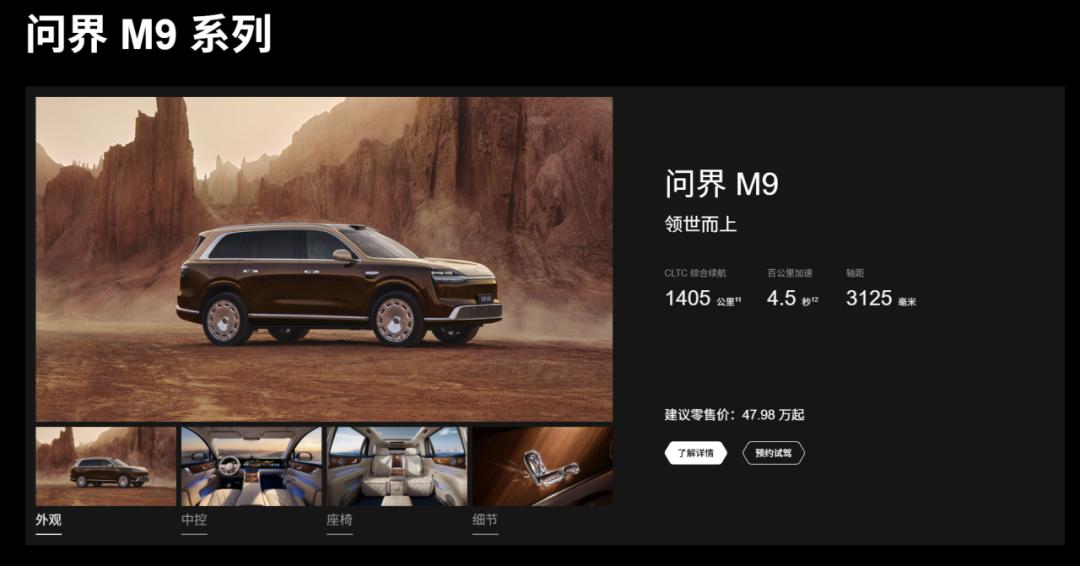
▲ AITO M9 launched on May 27, 2026, Image source: Brand official website
As a result, AITO presses the accelerator to iterate forward while looking back to reassure its older car owners left behind.
Over the past six months, AITO has undergone a dense round of product updates.
In March, Harmony Intelligent Mobility launched a new generation of 896-line dual-path imaging-grade LiDAR, which was subsequently equipped on the refreshed AITO M9, M7, and M8 models;
In April, AITO introduced the all-new M6 model targeting the 250,000 to 300,000 yuan market, offering both all-electric and extended-range versions;
In May, the AITO M9 was launched in another refreshed iteration, with updates spanning the vehicle body and cabin to the powertrain, chassis, and intelligent driving system, featuring over 140 new technologies and adopting an 800V high-voltage dual-silicon carbide powertrain platform across the entire lineup.
Admittedly, these updates have boosted AITO's product competitiveness — the AITO M6 recorded cumulative deliveries exceeding 30,000 units just 54 days after launch; the all-new AITO M9 has also maintained strong market momentum since its release. For AITO, the high-frequency integration of Huawei's latest technologies has been a critical driver behind its brand elevation over the past few years.
However, a single technological leap showcased at a new model launch translates to a long cost chain when it reaches the production end.
An insider from the automotive industry explained to us that even replacing a small forward-facing perception sensor may require reconfiguring the physical compatibility of the bumper and the entire vehicle body structure, as well as recalibrating related algorithms. If the intelligent driving system undergoes changes, it may even trigger joint debugging across the powertrain domain, chassis domain, and electronic control systems, followed by a full round of corresponding testing.
On the other hand, model iteration does not always proceed according to automakers' intentions. As Li Bin put it, "when intelligent driving chips iterate, vehicles must iterate; when battery technology advances, or when lighting and interior designs are updated, vehicles also need to iterate" — no new energy vehicle consumer wants to buy a new car whose core components are a full generation behind the latest standards.
Ultimately, those investments made on previous-generation models that cannot be carried over to new products will flow back to automakers' income statements in forms such as discounted inventory clearance and asset impairment.
In comparison, Seres' asset impairment losses in the first half of 2025 were approximately 275 million yuan; by the end of 2025, this figure had risen to 1.579 billion yuan, including 759 million yuan in intangible asset impairment, 655 million yuan in inventory write-down losses, and roughly 76 million yuan in fixed asset impairment.
Of course, this 1.579 billion yuan cannot be entirely attributed to model upgrades. But like GAC Group, Seres' annual report explicitly noted that certain molds and machinery were impaired due to accelerated product upgrades and the discontinuation of specific model lines.
At present, Seres has not disclosed which assets are involved in this book value adjustment or the specific amounts, and full details will only be available when the semi-annual report is released.
What is certain, however, is that a former major beneficiary of rapid iteration in the auto market has begun to pay the price for this model.
When rapid iteration evolves from a competitive tactic to an industry-wide default practice, speed itself becomes a cost. Automakers have no choice but to keep moving fast, but not all of them have the resources to sustain this pace indefinitely.
This article originates from the WeChat Official Account "NoNoise", authored by Liu Shiyu, and is republished with authorization from 36Kr.