With a valuation of 11 billion U.S. dollars, this super unicorn is poised to help startups go global from Day 0.
At 3 a.m., a newly established AI startup may already be serving clients in San Francisco, procuring technical services in Seoul, and signing contracts with partners in Lagos. The company may not even have hired its first full-time finance staff, yet its operations have already spanned multiple markets, currencies and regulatory jurisdictions.
AI is making this kind of entrepreneurial path possible. Work that previously required a full global team covering marketing, operations, customer service and other roles can now be largely handled by agents. The new generation of startups no longer need to expand following the traditional sequence of "establishing a solid foothold in the local market before gradually going global". Instead, they can directly face global clients and suppliers from the very first day of their establishment.
But while AI is moving forward at a remarkably fast pace, the financial pipelines of most enterprises are still not prepared for this. That is why top global capital has started betting on the AI-powered reconstruction of financial infrastructure.
In June 2025, Airwallex, a global financial infrastructure platform, announced the completion of a $320 million Series H funding round, with a valuation reaching $11 billion, a significant jump from $8 billion half a year earlier. This round was led by existing shareholder Addition, with participation from new and existing investors including Baillie Gifford, T. Rowe Price and Amex Ventures.
This funding round also sends a clear signal: the AI economy requires a matching financial operating system, and Airwallex is one of the few players that not only has a global compliance foundation, but also is proactively reconstructing such a system.
A Sharp Mind, A Paralyzed Wallet
A visible gap is emerging between the explosive growth of AI capabilities and the lag of financial infrastructure.
In the past, AI acted more like an advisor, telling humans what to buy, who to pay, and which remittance route to take. Now, AI agents are becoming executors: whether it is procuring computing power, subscribing to SaaS services, or making payments to overseas suppliers, more and more commercial actions are being initiated autonomously by AI.
A report released by global market research institution Forrester points out that between 2024 and 2025, AI agent-assisted payments have rapidly moved from the proof-of-concept stage to practical deployment. OpenAI officially supported AI agent-assisted payments in ChatGPT in September 2025, and Stripe also launched the Agentic Commerce Protocol designed specifically for AI agents. The problem, however, is that AI makes decisions at the millisecond level, while the financial systems it relies on still operate at the pace of manual approval and T+2 settlement.
This contradiction is even more prominent for B2B AI enterprises that have overseas procurement needs. Imagine a rapidly expanding Chinese AI company: it needs to make payments to multiple cloud service providers and data suppliers in the US, Europe and Southeast Asia at the same time, involving multiple currencies such as USD, EUR and SGD. Each cross-border transfer may touch the compliance requirements of different countries. Uncertainties from exchange rate fluctuations, intermediary bank fees and settlement cycles often leave the finance team overwhelmed.
What is more tricky is that as the enterprise scales up, the fragmented situation of bookkeeping, expense reimbursement, tax and banking systems will exponentially increase management costs. A CFO who has served multiple AI enterprises going global once described such a scenario: the company has suppliers in more than a dozen countries, and the finance team spends nearly a whole week on reconciliation alone every month, while also having to respond to verification requirements for capital flows from regulatory agencies across different regions at any time.
This means that the most valuable time and energy of the finance team are being consumed in repetitive work that could have been automated. Worse still, the lagging reconciliation cycle keeps the management in a long-term financial blind spot. The data that decisions rely on is often days out of date, and enterprises barely have enough response time once they encounter sharp exchange rate fluctuations or surprise regulatory inspections.
Of course, a sophisticated AI model alone may be able to read invoices, detect anomalies and give payment suggestions, but it cannot obtain financial licenses out of thin air, nor can it replace banking partnerships and the extensive local payment networks around the world. Only when these financial capabilities are fully interconnected, integrated, and opened in a way that AI can access, can AI's analysis and judgment be truly transformed into financial operation efficiency.
This has also led to the re-evaluation of financial infrastructure in the AI era. In the past, cross-border financial platforms mainly solved the problem of how enterprises can collect and pay funds more efficiently. Now, as AI gradually integrates into financial workflows, enterprises not only need payment channels, but also need to allow AI to call financial tools within a clear authorization scope, while ensuring that the entire process complies with internal rules and regulatory requirements, and leaves traceable records.
For the new generation of AI companies, this set of capabilities is particularly important. AI allows enterprises to serve global clients with a smaller team, but it does not eliminate the inherent complexity of cross-border finance. If accounts, payments and financial management are still scattered across different systems, the so-called going global from Day 0 will easily get stuck at the most basic capital operation stage.
Gartner predicts that by 2026, 33% of enterprise software will integrate Agentic AI capabilities, and the financial function will be one of the fields with extremely deep penetration. More importantly, when the AI agent economy truly matures, the party whose financial foundation can support "autonomous agent transactions" will hold the ticket to the next stage.
This is exactly the direction targeted by Airwallex in this funding round.
Airwallex's Two Key Assets
Founded in 2015, Airwallex has spent ten years obtaining more than 85 regulatory licenses around the world and integrating 160 local payment networks. According to its disclosure, Airwallex currently has an annualized transaction volume of $287 billion, 93% of its transactions can be settled on the same day, and its business covers more than 200 countries and regions around the world.
The value of this infrastructure is being revalued in the AI era: the compliance networks and local channels laid out over ten years have exactly become the underlying pipelines required by the agent economy. This Series H funding round is Airwallex's strategic move to add an "intelligent layer" on top of these pipelines, with two new products as its core carriers: T:0 and Airi.
T:0 targets the reconstruction of enterprise financial operations.
Most of the current enterprise financial systems are a hybrid pieced together from scattered tools: bookkeeping, expense reimbursement, tax and banking systems operate in isolation, data generates constant friction when flowing between them, and a large amount of the finance team's energy is consumed in repetitive verification and data entry work.
T:0 is equivalent to an autonomously operating financial department, designed based on first principles to reimagine the system: it integrates bookkeeping, forecasting, tax, compliance, reporting and reconciliation into a continuously running unified platform, allowing financial functions to operate like a non-stop engine, freeing the finance team from managing trivial work and focusing on strategic decision-making.
For founders starting from scratch, T:0 means having CFO-level books with built-in compliance logic from day one, without the pain of system migration. This is because T:0 can directly access Airwallex's existing global payment channels, multi-currency accounts and compliance frameworks, so that financial data and capital flows form a closed loop within the same infrastructure. T:0 is currently in private beta and is expected to be launched more widely in a few weeks.
Airi addresses a more realistic proposition: when AI agents begin to replace humans to complete purchasing behaviors, the business world needs far more than a smarter checkout page. Airwallex defines this as "agentic commerce".
The industry has long had precedents of agent layout. OpenAI and Stripe jointly launched the Agentic Commerce Protocol (ACP) in 2025, providing a standardized protocol framework for AI agents to execute purchasing behaviors; Mastercard also released a payment solution for agentic commerce in the same year. However, these solutions share common limitations: they are essentially adding an AI interface on top of traditional card payment channels, and do not solve the underlying problem of AI agents safely accessing and transferring funds globally.
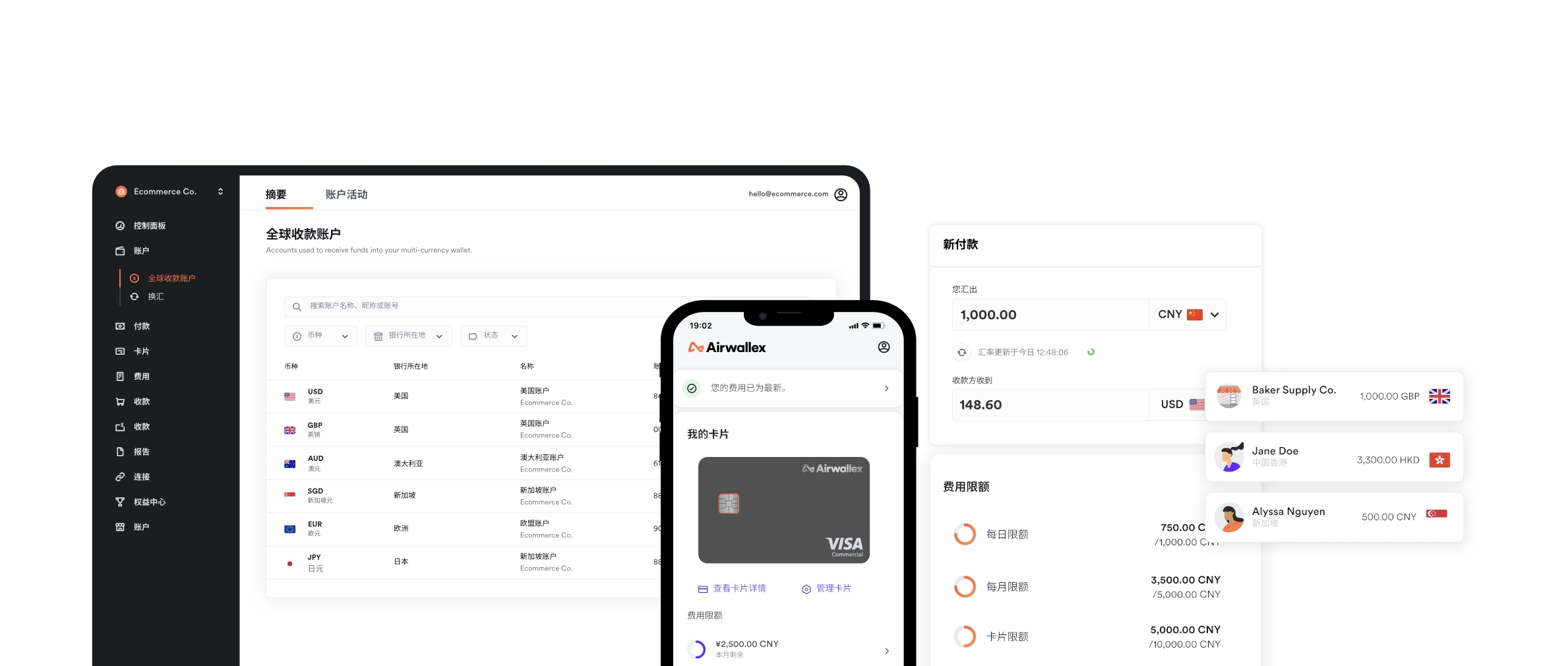
Airi is built to fill this gap. It reconstructs a complete set of underlying agent wallet capabilities: AI agents can hold exclusive agent cards, autonomously initiate transactions within the set spending limit, and access balances in different currencies according to the permission hierarchy. The entire process operates within a regulated framework, enabling AI agents to truly have the ability to complete cross-border transactions on behalf of humans.
At present, Airi has realized the "one-click checkout" function. After consumers complete identity binding, AI agents can directly initiate payments within the authorized scope, without manually filling in information every time. Early test data shows that merchant conversion rate has increased by 14% as a result. Next, it will evolve into a complete agent wallet infrastructure, and work with Airwallex's broader agentic commerce suite to connect the entire capital link from discovery to settlement.
If T:0 solves the problem of "how to manage money", Airi solves the problem of "how to spend money" — the former is for enterprise finance teams, while the latter is for merchants and AI developers. Both are built on Airwallex's existing global compliance network, forming a protocol-agnostic, inherently global financial operating system.
In a world where AI agents may run on different ecosystems such as OpenAI, Anthropic and Google at the same time, not being bound by any single protocol is a strategic advantage in itself.
Why Airwallex, Why Now
Airwallex's this funding round can be regarded as a signal that the industry window is opening. The AI-powered reconstruction of financial infrastructure is becoming the next real main battlefield of competition. What it competes for is no longer model capabilities, but whose pipelines can make AI truly functional.
This track has a special moat: regulatory qualifications and local payment networks. The application cycle for a payment license often takes years, access to local clearing networks requires negotiations one by one, and the establishment of a compliance system requires long-term investment in each market, which can hardly be achieved by simply pouring money in a short period of time.
Airwallex's 85+ global licenses and 160+ local networks accumulated over ten years have become a scarce asset in the AI era, and the time barrier has become one of its core values. That is why this round of funding can attract Amex Ventures to participate: as the strategic investment arm of the traditional financial giant American Express, its bet is also a recognition of the value of this compliance infrastructure.
It is worth noting that this funding round takes place against the backdrop that Airwallex has already achieved profitability. According to official data released by Airwallex, its annualized revenue has reached $1.3 billion, its ARR turned positive in the fourth quarter of 2025, and more than 675,000 enterprises around the world use its services to manage cross-border financial operations directly or through the platform. These figures prove that its business model has been successfully verified. This Series H funding round is a proactive move to accelerate entry into a new strategic stage on the premise of sound financial performance.
In the process of Agentic AI reshaping financial functions, the platforms that can truly win will be those that have both global compliance capabilities and AI-native architecture. Coincidentally, Airwallex has both conditions: on the one hand, it has the compliance infrastructure accumulated over ten years, and on the other hand, it has a product architecture redesigned for the agent economy starting from first principles. The combination of the two forms its unique advantage in this window period.
There are no local markets in the AI era. When AI agents begin to autonomously conduct transactions across national borders, the financial foundation that enterprises need must be global from day one. Companies that are still using traditional bank accounts and manual approval processes to support overseas operations are using yesterday's infrastructure to run at tomorrow's speed. When the wave of the agent economy truly arrives, the time window left for migration and reconstruction may be much shorter than most people expect.