Dialogue with Ma Min from Yuanfudao: Entrust the extremely lonely matter of reading to AI
Ma Min talks about her seven-year-old son.
One day, the child's father casually asked, "Who is your favorite character in The Romance of the Three Kingdoms?" She had expected her son to ask back "Who do you think is good?" as he usually did. Kids at this age are always used to reading adults' moods first. But this time he blurted out: "I like Cao Cao." His father was stunned for a second: "Why do you like Cao Cao?" The child did not hesitate at all: "Yeah, he's very ambitious, and he made it." He paused for a moment and added, "But I can only give him more than 80 points. The dozen points deducted are because he is really too insidious and crafty."
In a story where Liu Bei is written as the protagonist and Cao Cao as the villain, a seven-year-old child dares to speak out his unconventional preference, and at the same time keeps a clear sense of proportion for this preference. Ma Min said that at that moment she realized that her child's entire learning attitude had completely changed. He shifted from passively receiving knowledge to actively thinking on his own, with the mindset of "I will take the initiative to think, so what even if my opinion is different from all of yours?"
This is exactly what "Yuanfudao AI Advanced Reading" aims to transform.
In July 2026, Yuanfudao AI Advanced Reading was officially launched. It is an AI one-on-one companion reading product for 2nd to 6th grade primary school students, priced at 1499 yuan per year. It guides children to intensively read one good book every month, provides personalized follow-up questions and feedback throughout the whole reading process, and makes the heuristic guidance that used to be exclusive to high-priced private tutors affordable for every ordinary family through AI technology, with an average cost of less than 15 yuan per class.
Behind the product, Yuanfudao has jointly launched the "Practical Research on AI Technology Empowering Children's Personalized Reading Guidance" with the Research Center for Children's Reading and Children's Book Evaluation of Beijing Normal University, using professional teaching research to consolidate the educational value of technology implementation.
In fact, in the view of Ma Min, Vice President of Yuanfudao, reading has been the loneliest thing for thousands of years: you read by yourself, you get it if you can, you don't if you can't; you can't express your thoughts after finishing the book, and parents can't help — they can't read it for you. The saying "After reading a book a hundred times, its meaning reveals itself naturally" essentially means you have to read it over and over again by yourself. What she wants to solve is this "real problem" that almost no one has addressed head-on: what if the child can't get into the book, and what if he can't express his thoughts even after he does?
In the past decade of the internet education boom, Yuanfudao is regarded as a leader. Now with the arrival of the AI wave, almost everyone is asking the same question: will traditional education giants be subverted, and are they delivering value to users?
To answer this question, Ma Min gave a very straightforward response at the 2026 China Internet Conference on July 9: "Ten years ago, Yuanfudao defined online education with mobile internet; today, we hope to redefine education itself with AI."
Therefore, Yuanfudao AI Advanced Reading is the first step Yuanfudao has taken, and in Ma Min's eyes, it is also a bigger stepping stone: to make parents believe for the first time that AI education products are practical and useful.
After the speech, 36Kr conducted an in-depth interview with Ma Min. They talked about the "long-term companionship" of AI Advanced Reading, how an education company views AI, and the bottom line she firmly believes in — no matter how powerful the general large language model is, it can never grow a "soul" on its own.
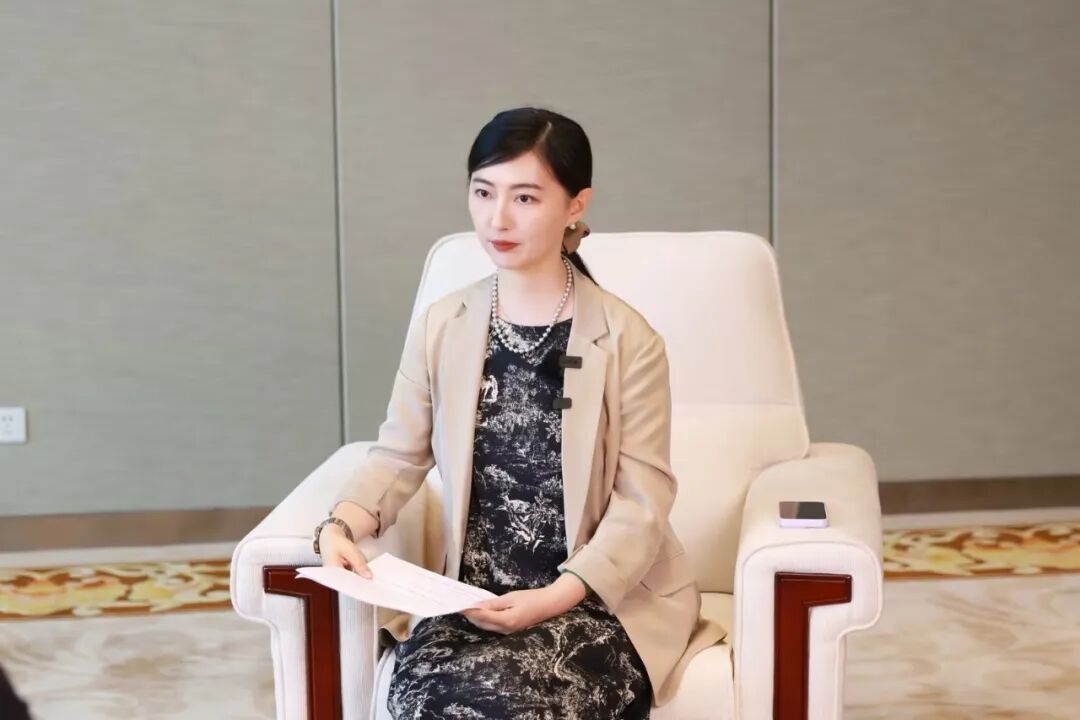
Because behind every choice in education — "to correct, to guide, or even to give the answer directly" — lies an educational philosophy, which machines cannot make on their own. The following is the edited transcript of the interview:
Reading has been a lonely thing for thousands of years
36Kr: You mentioned "long-term companionship" in your speech, saying that parents' expectations have changed. When did this change start?
Ma Min: Probably after the pandemic. Our internal statement is: in the past, parents only cared about test scores, but now they want both test scores, competence and literacy, and ideally good learning habits and broad knowledge.
The underlying reason is that parents have become more rational. Many parents themselves are high-score achievers, and after stepping into society, they find that being good at doing exercises and getting high scores cannot solve all the problems in work and life. So they have increasingly higher requirements for those abilities that benefit children for a lifetime, and reading is one of them.
36Kr: So what is the "real problem" you have identified with AI Advanced Reading?
Ma Min: Reading has been a personal matter for thousands of years. If the child can't get into the book, parents can't do anything; if he can't say anything after finishing reading, what else can parents do? Maybe many parents haven't even read that book themselves.
I am a mother myself. When summer vacation comes, all kinds of mom groups are talking about not letting children hold the tablet all the time, just let them read for a while. But the reality is that most children have no interest in books, can't get into them, and think short videos are more fun.
For example, my son is reading Andersen's Fairy Tales. After he finished reading Thumbelina, he told the AI that the story is about Thumbelina being bullied at first and becoming powerful later. He is only 7 years old, and he already felt it is a story about growth. He even suddenly looked up while playing and said he thought it was a bit similar to The Ugly Duckling. He takes the initiative to think and reflect. This dilemma of loneliness, being unable to get into reading, and being hard to get help from others, is exactly that real problem.
36Kr: I understand that many parents outsource reading. They brush short videos every day but ask their children to read, or simply sign up for a crash course. If I am such a parent, how would you convince me?
Ma Min: Because our product form is very different.
For this pain point, the industry has tried many solutions. In the early stage, there were animated adaptations, for example, turning 20,000 Leagues Under the Sea into cartoons. This method can arouse interest, but children often only focus on the plot, and still cannot express their thoughts clearly after watching.
Then the large-scale live streaming class model became popular, where famous teachers directly teach the main theme of Journey to the West or Sun Wukong's spirit of resistance. This is essentially a kind of knowledge indoctrination. Although it was already a relatively good solution before the emergence of AI, it at least provided professional guidance.
We have taken a step further now. Yuanfudao AI Advanced Reading does not focus on indoctrination, nor does it require children to memorize a single correct answer after listening. Instead, it lets children speak out their own thoughts, and explore the deep meaning of the book on their own through heuristic follow-up questions.
Which parent would not expect to see their child truly immersed in reading, and be able to speak clearly and make more and more reasonable arguments after finishing the book? Compared with traditional large-scale live streaming classes, this sense of gain based on independent thinking is not only more profound, but also easier to be intuitively demonstrated and verified.
36Kr: So what is missing in current reading scenarios may not be methods or content, but "guidance"?
Ma Min: It is one-on-one guidance and critical thinking training.
Why place heavy bets on a "slow" thing
36Kr: Reading is slow, and the effect does not show up quickly. Why does Yuanfudao place heavy bets on such a "slow" thing?
Ma Min: Actually, it has nothing to do with being noble, nor is it a deliberate effort to tackle a difficult problem.
First of all, reading is a very rigid demand. After the implementation of the new curriculum standard in 2021, schools have clear reading assignments, and the required reading list is even directly included in the exam scope. Secondly, the pain point of reading is relatively hidden. When a child encounters a math problem he can't solve, he will get stuck immediately; but if a child doesn't read or pretends to read, it won't make a family fall into trouble in the short term. However, this kind of hidden pain point like "frog being boiled in warm water" is exactly the biggest opportunity for reading when AI arrives.
It's just like before the invention of cars, people were used to riding horses and didn't think it was a pain point; before the popularization of smartphones, people didn't feel inconvenient without a music player. But once the new species appears, everyone will exclaim: "It could be done this way!"
The same is true for reading. In the past, besides reading books silently on their own, what better choices did children have?
But now, when a child is reading, there is an AI tutor who can talk to him at any time and inspire his thinking. Isn't this a huge leap in experience?
36Kr: I understand that there is no lack of demand for reading, what is lacking is supply. You have repeatedly mentioned "staying ahead of supply", what does that mean?
Ma Min: Education is highly professional, and users can hardly clearly describe "what kind of product I need". It is not like buying a pair of shoes or a camera, where the standards are concrete — you know the camera needs to take clear pictures, and the shoes need to look good. In terms of education, parents can only express a vague anxiety: "I don't think the current situation is very good", but they don't know how to solve the problem.
Therefore, our requirement for ourselves is to use supply to drive demand, and stay ahead of user demands. We must predict the current pain points in education and the growth bottlenecks of children, and put forward solutions of "you should learn this way, you should cultivate this way" one step earlier, so as to guide and promote parents.
Take English education as an example. In the past, parents didn't pay much attention to it because it accounted for a small proportion in exams; now they not only care about grades, but also care about whether the pronunciation is authentic, whether children read original picture books, and whether they can have an international vision and multicultural awareness. These have gone beyond exam-oriented education, and are demands at the competence level. Of course, we are not trying to get ahead of the public education system, but closely follow the national education layout.
The country's research in this area is very forward-looking. The "big concept learning method" we advocate is essentially in line with the core literacy concept put forward by the country and moves in the same direction.
The implementation of core literacy cannot be achieved overnight to cover all primary and secondary schools. With our advantages in talents and technology, we can implement advanced concepts on a large scale, and respond to and help promote the popularization of national education policies one step earlier.
36Kr: Is AI Advanced Reading a short-term product or a long-term product?
Ma Min: Of course it is a very long-term product. On the one hand, the country's emphasis on national reading is a long-term strategy; on the other hand, how to keep children focused on reading and not addicted to pan-entertainment electronic devices is also a long-term pain point for families. As long as these core demands and broad market exist, "Yuanfudao AI Advanced Reading" has long-term value that can go through cycles.
Don't give the answer, let the child speak out
36Kr: What is the first hurdle that AI Advanced Reading helps children cross?
Ma Min: The first thing to solve is to make children willing to open the book and keep reading.
The first part is the guide video. We invited the well-known host Li Sisi to tell the background of the books, so that children won't start reading carelessly as soon as they open the book. For example, for Andersen, we will first tell children that Andersen's fairy tales are often his profound thinking about human nature and the world, and he himself was once ridiculed a lot. With this background, when children read The Ugly Duckling later, their sense of immersion will be completely different. My son even asked after finishing reading: "Was Andersen himself like the ugly duckling?" With this sense of immersion, he will associate it with reality: "Just like a classmate in our class, will everyone laugh at him too?" This empathy is inspired instantly.
The second part is animation-assisted content. Some children may not be sensitive to pure text, but sensitive to images; some children are not that fond of studying, but have extremely strong empathy. Through multi-dimensional content design, we can accurately capture the interest points of different types of children.
There is also a very key setting, which is the "reading companion" role. For example, when reading The Little Prince, the reading companion is the pilot. In our user research, this role has an extremely high praise rate. Because today's children are actually very lonely — they are not short of people around them, but few people are willing to truly walk into their inner world. Adults usually only care about test scores, food, clothing, housing and transportation. After my son finished reading The Little Prince, he kept saying: "This pilot is so nice, when can I talk to him again?" You see, when reading has emotional sustenance, children will naturally not want to put it down.
36Kr: Can you demonstrate with a book how AI asks questions step by step?
Ma Min: Take Journey to the West as an example, when discussing why Sun Wukong lost to the Buddha, many children's first reaction is that the Buddha is too powerful. At this time, the AI will not correct immediately, but ask heuristic questions: "Think about how he performed when he fought against Nezha and Erlang Shen? Aren't those people powerful? How did Sun Wukong behave at that time?" Through this kind of questioning, guide children to recall and compare on their own. If the child still doesn't realize the point, the AI will further prompt: "Go back to that specific page in the book, what is the difference between the description of fighting the Buddha and the description of fighting Nezha?" Through this little by little guidance, the child can finally piece together the complete character image on his own, and find out that it is because he underestimated the enemy.
36Kr: If you want to chat with AI, you can keep chatting nonstop. How do you restrict it, so that it won't give the answer quickly, or give endless answers?
Ma Min: This is indeed the core point. Our principle is that we neither give you the answer at the very beginning, nor do we follow you all the time and center on you like a general large language model.
"Don't give the answer at the very beginning, but to inspire" reflects our teaching philosophy, which aims to stimulate children's autonomy. And "don't blindly cater to children" reflects our professionalism. Because our AI companion reading ultimately has teaching objectives, we can't just chat for the sake of chatting, and make children only get temporary happiness.
For example, the ultimate goal of reading about Sun Wukong is to guide children to extract the character's quality through the description of his deeds, and master this reading comprehension ability.
We have also specifically studied the "shallow guidance". On the surface, it is asking questions, but in fact it is just to lead to the preset sentence. It's just like in daily social interactions, some people ask you a question purely to pick up the point they want to express. Children can easily see through this insincere guidance, and eventually feel that you are tricking them into asking for the "correct answer". Therefore, the AI's questions must be sincere guidance.
36Kr: Which is more important, the amount of knowledge, or the ability to ask questions and inspire?
Ma Min: The transmission of knowledge is relatively easy. Any education enterprise, or even any random person offline, can explain the background of Journey to the West clearly, because the country's requirements for the required reading list are very clear. The real barrier lies in the latter — how to inspire, how to guide through several rounds of follow-up questions, and when to pull the digressing child back to the topic.