Interim reports are around the corner – who has been swimming naked? A review of the performance of 13 global publicly listed music and entertainment companies
Recently, stock prices have plummeted across the board, and market sentiment is overwhelmingly bearish. Meanwhile, the interim reporting season that puts investor confidence to the ultimate test is just around the corner!
In this critical cycle that the Spotify CEO has dubbed the "Year of Raising Ambition", what kind of half-year performance report can global publicly listed music and entertainment companies be expected to deliver? As of July 10, what are their market capitalizations, stock prices, and valuation levels? Can their interim results meet the capital market's expectations?
The editorial team of Music Finance (ID: musicbusiness) has selected 13 representative companies spanning five major tracks: streaming platforms, live performances, record labels, K-pop entertainment, and Hong Kong-listed IP-focused firms, to conduct a comprehensive multi-dimensional comparison.
Music Streaming Platforms: Slower Growth, Doubled Profits
Let's first examine the financial reports of the three giants in the music streaming sector.
In the first quarter of 2026, Spotify delivered results that could be described as a "profit machine".
Spotify's total revenue reached 4.533 billion euros, a 14% year-on-year increase at constant currency. Its monthly active users exceeded 761 million (+12%), and paid subscribers hit 293 million (+9%). Even more encouraging to the market, its operating profit soared to 715 million euros, and net profit reached 721 million euros, a staggering 220% surge from the 225 million euros recorded in the same period last year. Gross margin improved from 31.6% to 33.4%, and the operating margin hit an all-time high of 15.8% at 15.8%.
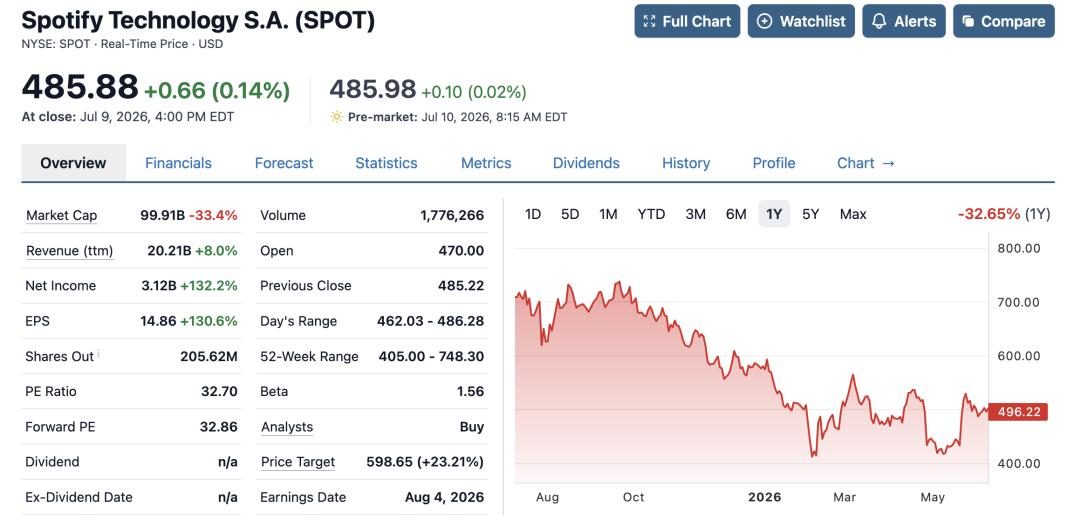
Spotify's leap in profitability did not happen by chance. Since 2023, large-scale cost reduction and efficiency improvement measures (including layoffs, cuts to podcast investments, and optimized content costs), combined with steady growth in paid subscribers and rising ARPU, have continued to unlock leverage effects.
Currently, the company holds 7.26 billion euros in cash on its balance sheet, with net cash reaching 6.71 billion euros. Clearly, Spotify has evolved from the "burning cash for growth" stage to a self-sustaining cash cow phase.
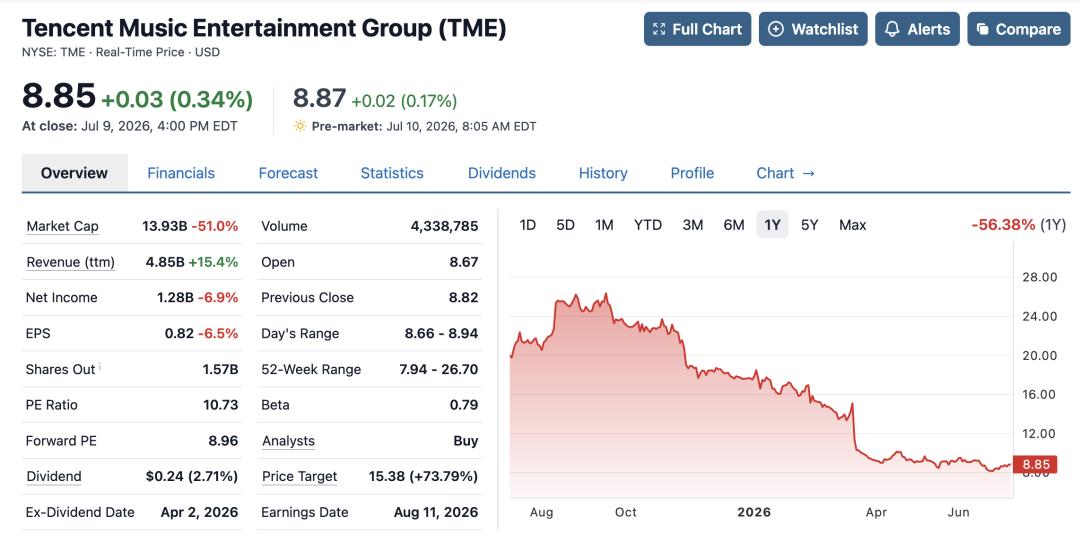
Tencent Music (TME) generated total revenue of 7.9 billion yuan (approximately $1.09 billion) in the first quarter, representing a 7.3% year-on-year increase. Its adjusted net profit stood at 2.33 billion yuan, up 4.8% year-on-year. Revenue from music-related subscription services reached 4.57 billion yuan, a 6.6% year-on-year rise, while music-related non-subscription service revenue delivered particularly strong performance at 1.94 billion yuan, surging 28.0% year-on-year.
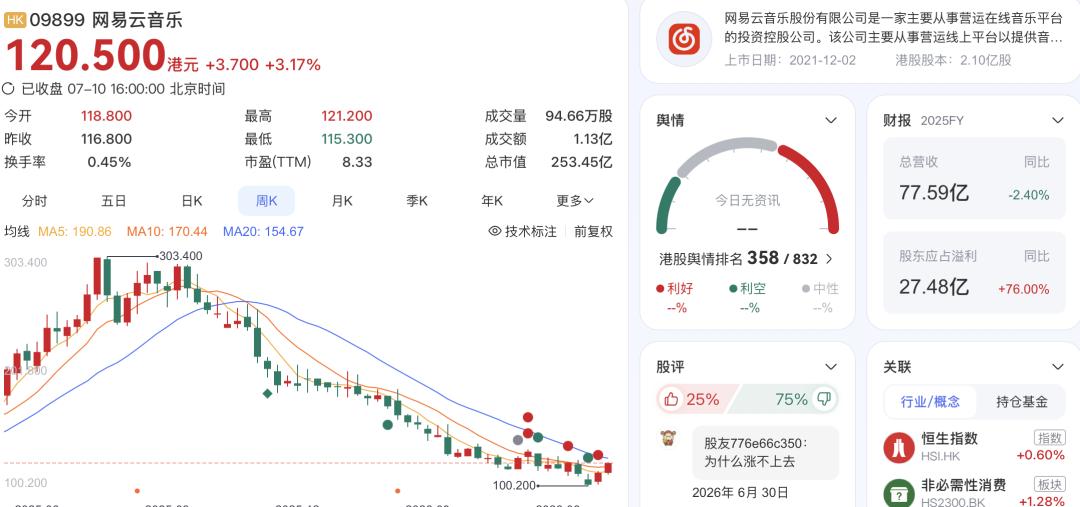
NetEase Cloud Music posted net revenue of 2 billion yuan in the first quarter, a 6.6% year-on-year increase. Its revenue in the previous quarter and the same period last year was 2 billion yuan and 1.9 billion yuan respectively. For the full 2025 fiscal year, NetEase Cloud Music achieved a net profit of 2.746 billion yuan, up 75.5% year-on-year.
The current reality facing domestic music streaming platforms is that the industry has entered an era of stock competition. While paying music users continue to grow and the business remains highly profitable, the fierce competition from ByteDance's Qishui Music poses a threat of erosion to their core user base. According to QuestMobile data, Qishui Music's monthly active users have reached 156 million, surpassing NetEase Cloud Music's 147 million.
Live Entertainment Market: Live Nation's Revenue Surges, Damai Doubles Its Profit
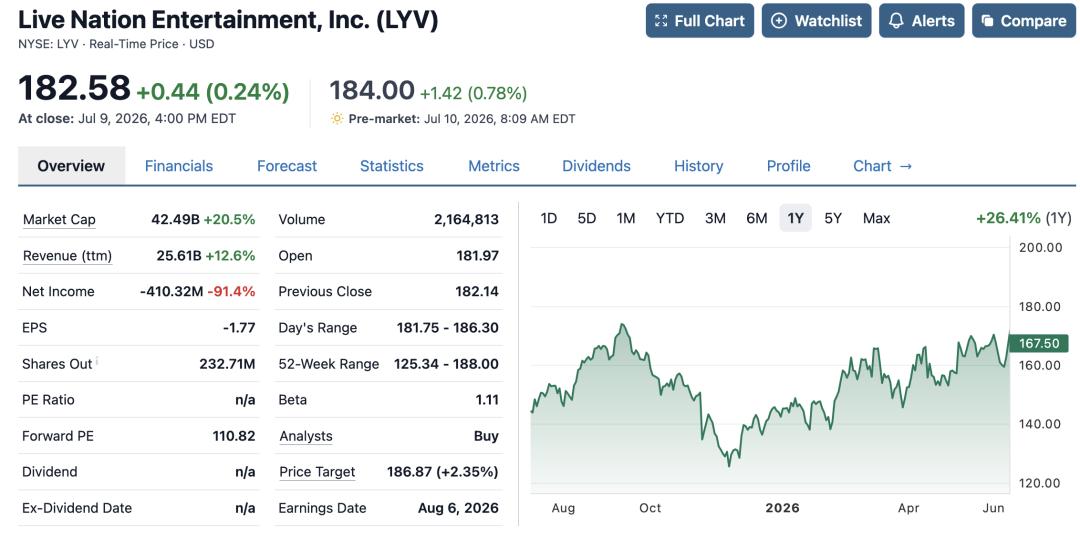
Live Nation recorded revenue of $3.79 billion in the first quarter of 2026, a 12% year-on-year increase that nearly 6% above market expectations.
All three of the company's business segments delivered strong results: concert revenue hit $2.776 billion, up 12% year-on-year; ticketing revenue reached $765 million, a 10% year-on-year rise; and sponsorship and advertising revenue amounted to $259 million, growing 20% year-on-year. GAAP net loss per share came in at $1.85, significantly missing expectations due to a $450 million legal reserve the company set aside for antitrust investigations.
In terms of audience metrics, Live Nation welcomed 25 million concert attendees in the first quarter, a 7% year-on-year increase, with total ticket sales reaching 81 million, up 4% year-on-year. Most critically, the company's event-related deferred revenue hit a record $6.6 billion, a 22% year-on-year rise, signaling that this summer's performance season is on track to be the "strongest ever".
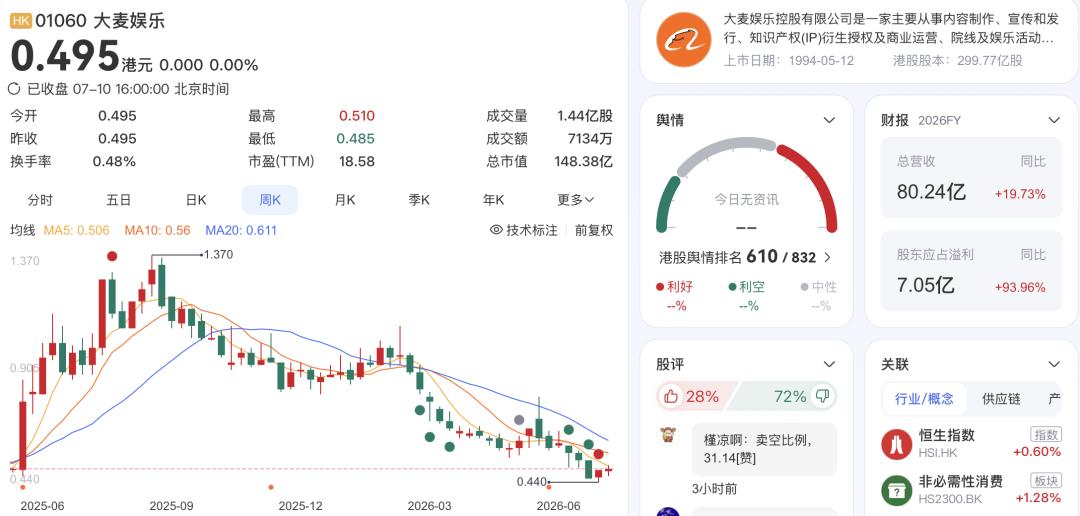
On May 27, Damai Entertainment released its 2026 fiscal year performance report. During the reporting period, it achieved total revenue of 8.024 billion yuan, a 20% year-on-year increase; net profit attributable to owners of the parent company reached 705 million yuan, surging 94% year-on-year. Profit growth far outpaced revenue growth, marking a significant improvement in operational quality.
Among these metrics, total performance box office revenue rose 6.39% year-on-year to exceed 60 billion yuan; the number of shows increased 6.58% year-on-year to over 600,000; and total attendees climbed 4.22% year-on-year to 194 million. Damai's platform GMV has grown for three consecutive years, maintaining its industry leadership. The number of shows for which it provided ticketing services posted double-digit year-on-year growth to 400,000, while large-scale performance volumes rose 50% year-on-year to 5,800.
Notably, Damai Entertainment has achieved a full doubling of its overall company profits. The synergy between its two platforms — Damai (live performance ticketing) and Taopiaopiao (film ticketing) — is being unleashed, with the Alibaba ecosystem's traffic and technological foundations providing it with a differentiated competitive moat. Furthermore, Damai Entertainment has launched its overseas primary ticketing platform "Maiseat", which has already entered markets including Singapore, Malaysia, Thailand, and South Korea, supporting Chinese-speaking artists such as GAI and Zhao Lusi to go global and hold world tours.
As things stand, live performances are the most certain high-growth track in the current music industry.
Record Label Giants: UMG Steady, Warner Music Accelerates
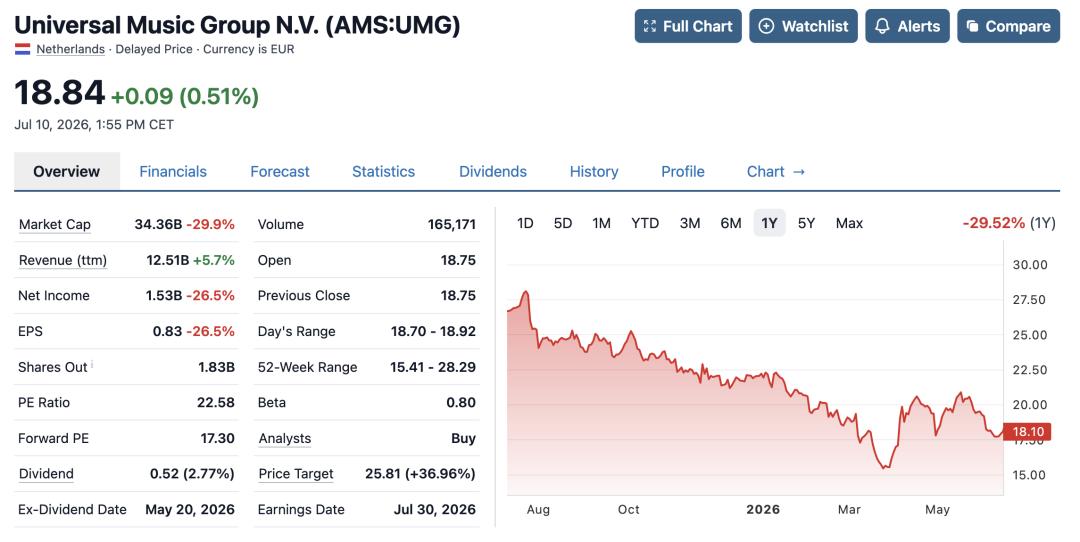
Universal Music Group (UMG) generated revenue of 2.9 billion euros in the first quarter, growing 8.1% at constant currency (including the Downtown Music acquisition completed in February). Excluding the impact of mergers and acquisitions, organic growth stood at 4.9%. Its adjusted EBITDA reached 636 million euros, representing a 21.9% margin.
Notably, UMG's revenue from recorded music subscriptions grew 7.9% organically, benefiting from the "Streaming 2.0" wholesale price hikes implemented by platforms like Spotify at the end of 2025. UMG's CFO estimated that the wholesale price increase contributed approximately 3 percentage points to this growth.
This year, UMG announced significant capital moves: doubling its share repurchase authorization to 1 billion euros; securing board approval to sell half of its stake in Spotify, with the proceeds earmarked for share buybacks; and rejecting the acquisition proposal from Ackman's Pershing Square.
This series of signals indicates that UMG's current management believes the company's current share price of 18.90 euros is undervalued, echoing its previous explicit decision to "not proceed with a U.S. listing for the time being". Based on adjusted EPS of 1.03 euros, UMG's current P/E ratio is approximately 22.6x, sitting at a relatively low percentile since its listing.
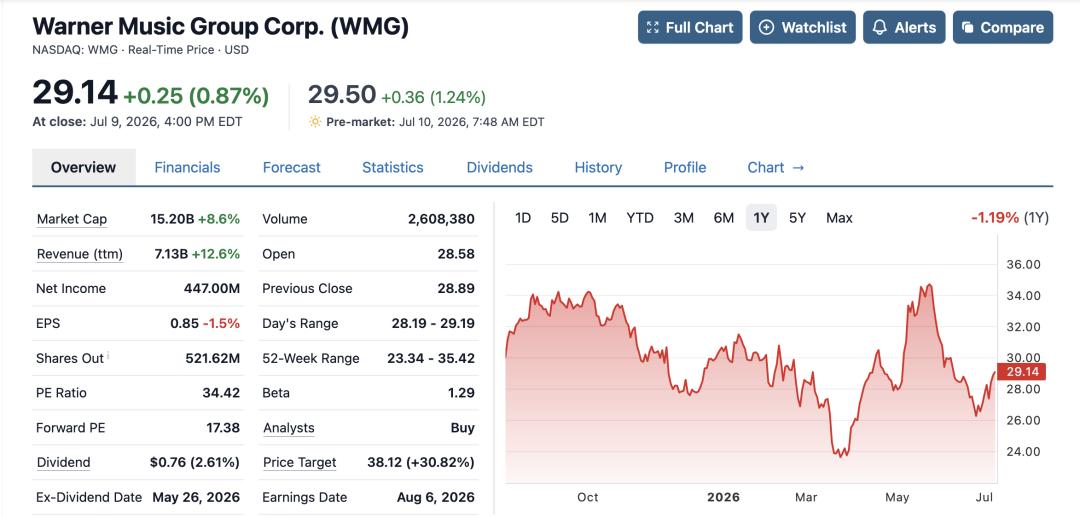
Turning to the financial report of Warner Music Group (WMG), it should be noted that WMG uses a slightly different fiscal calendar, with its fiscal year ending on September 30.
The financial results show that the company's Q2 of fiscal 2026 (corresponding to calendar Q1 2026) generated revenue of $1.73 billion, a 16.7% year-on-year surge that beat forecasts by 7.45%. After the earnings release, the company's share price jumped 9.92%. At constant currency, revenue rose 12% year-on-year, driven primarily by a 15% growth in subscription streaming, 13% growth in recorded music, and 10% growth in music publishing.
Adjusted OIBDA surged 24%, and operating cash flow skyrocketed 83%, demonstrating the company's strong operational execution and margin expansion capabilities. At the time, Warner Music CEO Kyncl emphasized that the company is undergoing strategic transformation through AI collaborations and content expansion to sustain its growth momentum in the coming quarters.
Comparing the two major record giants, UMG has a larger scale but its growth rate has stabilized at a steady state, while WMG has a lower revenue base but more room to unlock operational leverage.
Whether it's the continued growth of streaming revenue, the explosive rise in artist services and extended rights revenue, or the tangible results of cost control, strategic transformation is delivering tangible outcomes — this is no empty slogan.
The Four K-pop Mid-Cap Players: Each With Its Own Strengths, Each Facing Unique Challenges
Let's now look at the performance of the four leading K-pop entertainment firms this year.
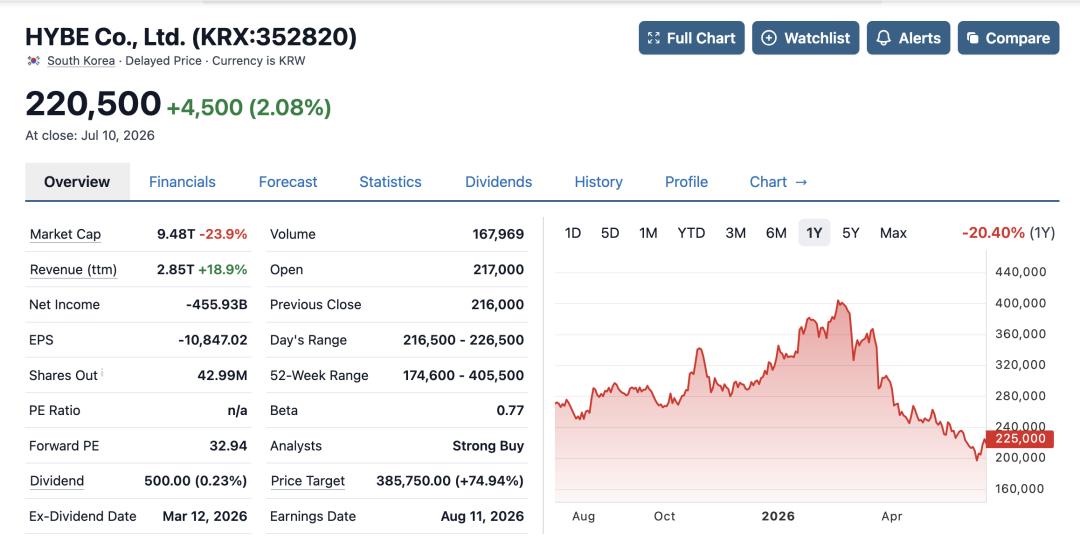
HYBE Entertainment generated revenue of 698.3 billion won (approximately $485 million) in the first quarter, a staggering 39.5% year-on-year surge that hit a new all-time high.
The majority of this incremental growth came from BTS's comeback album "ARIRANG" and their world tour: recorded music revenue reached 271.5 billion won (+98.9%), and content revenue hit 105.9 billion won (+157%). However, a 255 billion won employee stock grant expense directly pushed the company into a net loss of 156.7 billion won. Excluding this one-time item, adjusted operating profit was 58.5 billion won (+170%), with a gross margin of 42.8%.
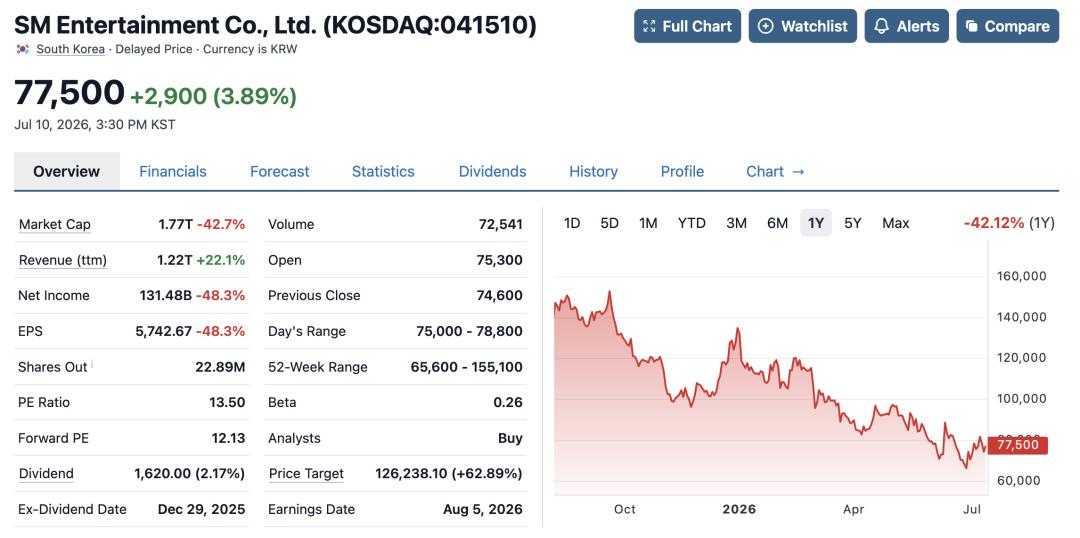
SM Entertainment posted consolidated revenue of 279.1 billion won in the first quarter of 2026, a 20.6% year-on-year increase. Its standalone revenue (per separate financial statements) was 189.3 billion won (+14.4% year-on-year), and consolidated operating profit reached 38.6 billion won, up 18.5% year-on-year. The company's main growth driver came from its concert segment, with revenue rising 56.0% year-on-year, while merchandise and licensing revenue grew 20.3% year-on-year.
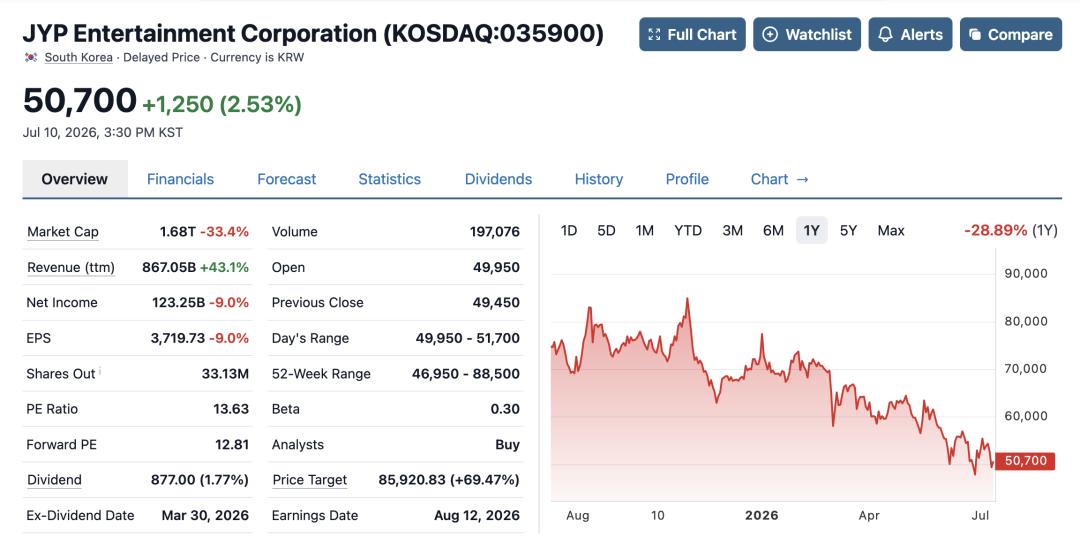
JYP Entertainment recorded first-quarter 2026 sales of approximately 185.96 billion won, up 31.1% year-on-year, with operating profit of 33.37 billion won. The primary growth driver was the stable cash flow from TWICE's comeback and world tour, in addition to the strong performance of ITZY and Stray Kids in the North American and global markets.