The 10-billion-yuan jasmine industry is "soaked in floods" — will tea drink prices rise across the board?
"Jasmine Town" Hit Hard, Tea Drink Supply Chain Under Strain
A torrential rainstorm is sending ripples across the entire new-style tea beverage industry.
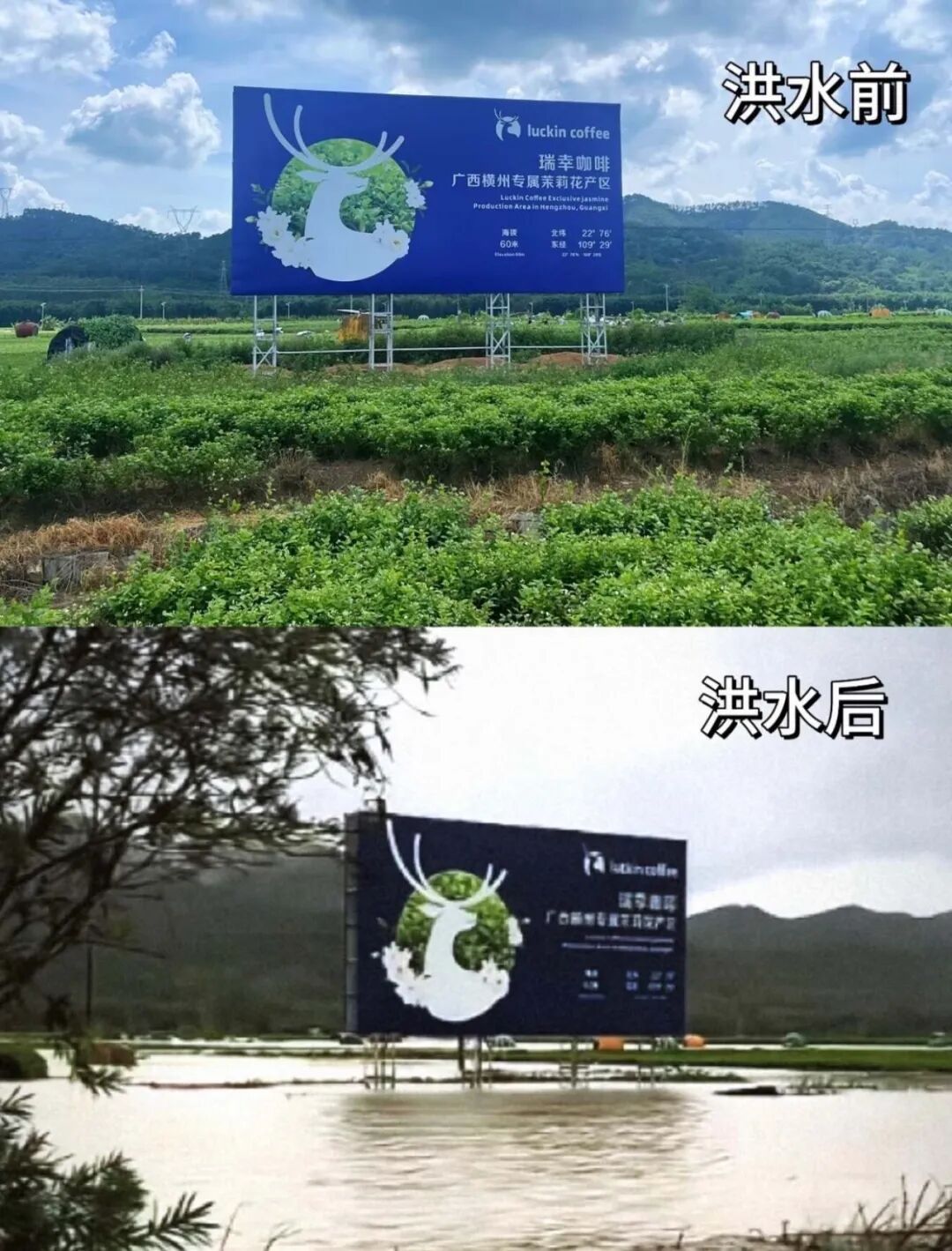
Influenced by Typhoon Maysak, Hengzhou City in Guangxi, known as the "World Jasmine Capital," suffered from continuous heavy rainfall and reservoir breaches a few days ago, leaving vast jasmine fields flooded by surging waters.
Standing water in entire planting zones rose above jasmine branches, leaving only scattered green leaves floating on the surface. Pure white jasmine petals scattered in the floodwaters, and flower fields that were once in full harvest season turned into a scene of devastation overnight.
For the entire tea beverage industry, this incident means a core supply chain has suffered severe damage.
Hengzhou is not only the largest jasmine producing area in China, but also one of the most critical jasmine supply bases worldwide. Data from China Central Television News shows that the annual output of fresh jasmine flowers and jasmine tea in Hengzhou accounts for more than 80% of the national total and over 60% of the global total respectively.
At present, the local jasmine planting area spans approximately 200,000 mu, with 340,000 flower farmers. The annual output of fresh jasmine flowers exceeds 130,000 tons, and jasmine tea production tops 110,000 tons. In 2025, the comprehensive brand value of Hengzhou jasmine (tea) reached 22.669 billion yuan.
More importantly, this region serves as the raw material heartland for the entire new-style tea beverage industry.
It is understood that 150 leading tea and coffee brands have established direct supply bases in Hengzhou so far, including names like Jasmine White, Bawang Chaji, Guming, Mixue Bingcheng, Chabaidao, Luckin Coffee, and Baozhugong.
Nearly all mainstream tea beverage brands have star products featuring jasmine as their core tea base. Examples include Bawang Chaji's Boya Juexian, Luckin Coffee's Fresh Brew Light Jasmine, and Jasmine White, which even has jasmine in its brand name... Starbucks' newly launched "Iced Shaken Tea" series recently also uses Hengzhou jasmine.
Precisely because of this, the entire tea beverage industry quickly mobilized to support the disaster-stricken area after the flood hit.
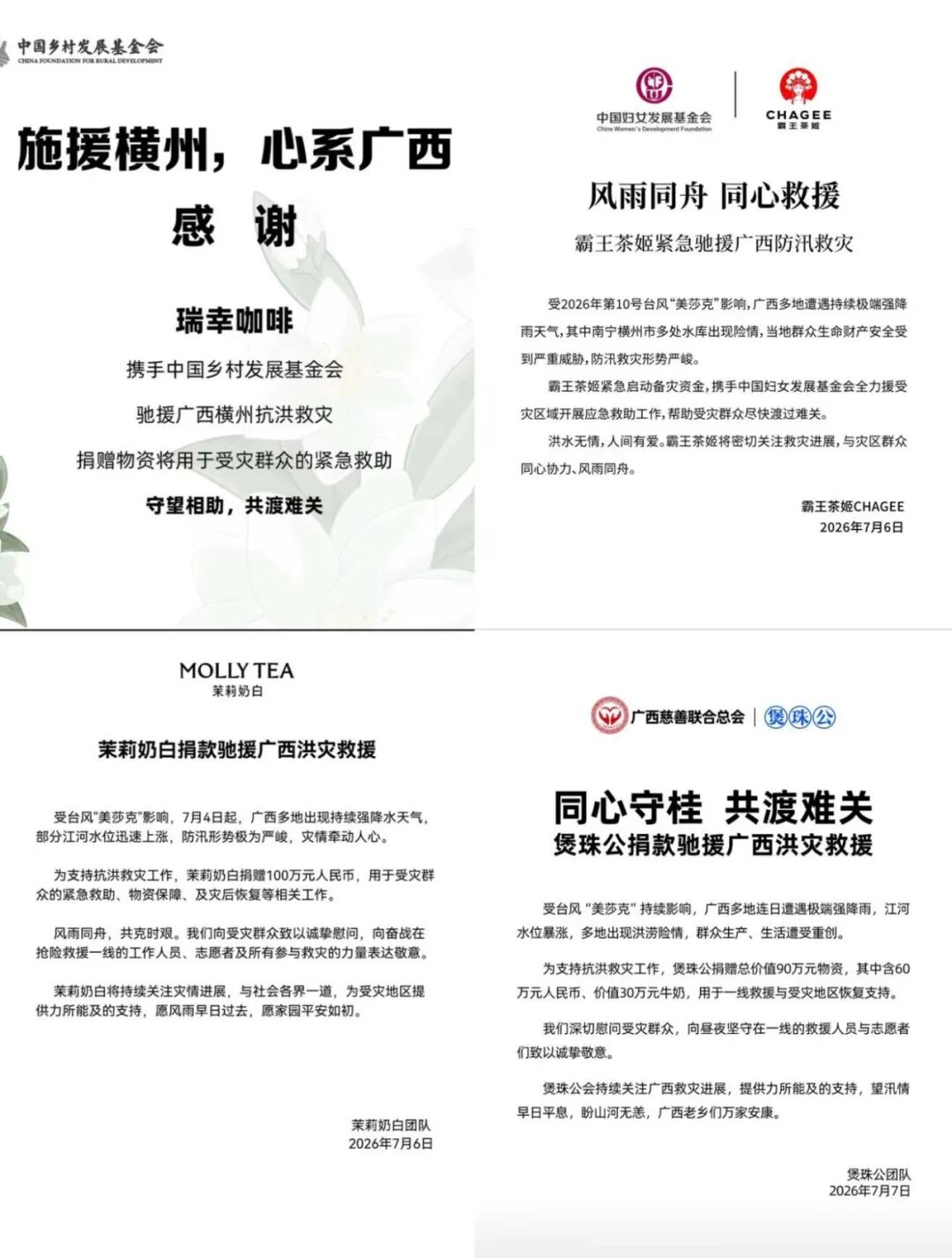
Brands such as Luckin Coffee, Bawang Chaji, Jasmine White, Mixue Bingcheng, Heytea, and Baozhugong have responded one after another, investing funds to support post-disaster relief and flower farmers' resumption of production. Meanwhile, the New-style Tea Beverage Public Welfare Foundation has joined hands with Heytea, Chabaidao, Guming, Shuyi Shaoxiancao, Hushang Ayi, Yihetang, Chayanyuese, 7 Minutes Sweet, and Tianlala to jointly carry out relief efforts.
The restoration of flower fields has only just begun. Since the initial focus of rescue operations was on search and rescue of people and resettlement of residents, drainage and rescue work on flooded flower fields only started on July 8, and the recovery of agricultural production will still take time.
As rescue operations gradually unfold, market attention has shifted toward supply chain recovery.
Plunging to 5 Yuan Then Surging to 34 Yuan: Jasmine Prices Rise to Nearly 7 Times the Low Point
And jasmine prices have already reacted first. In just a few days, the market has experienced a rollercoaster-like price trend.
The "Flower Price Updates" released by the "Huaxiang Yinxiang" WeChat public account of Hengzhou City Media Convergence Center shows that from July 2 to 4, the average market prices of fresh jasmine flowers in Hengzhou were 18.71 yuan per jin, 18.26 yuan per jin, and 15.89 yuan per jin respectively.
In the early morning of July 5, Hengzhou entered the core rainstorm zone, a large number of flower fields were flooded, logistics was blocked, and market transactions quickly came to a standstill, with the average price falling to 7.78 yuan per jin that day. On July 6, only Maling Town still had transactions across the city, and the average price further dropped to 5.12 yuan per jin, down more than 70% from pre-disaster levels, while other townships had no market quotes, no buyers, and no trading activity. On July 7, the market was almost completely shut down.
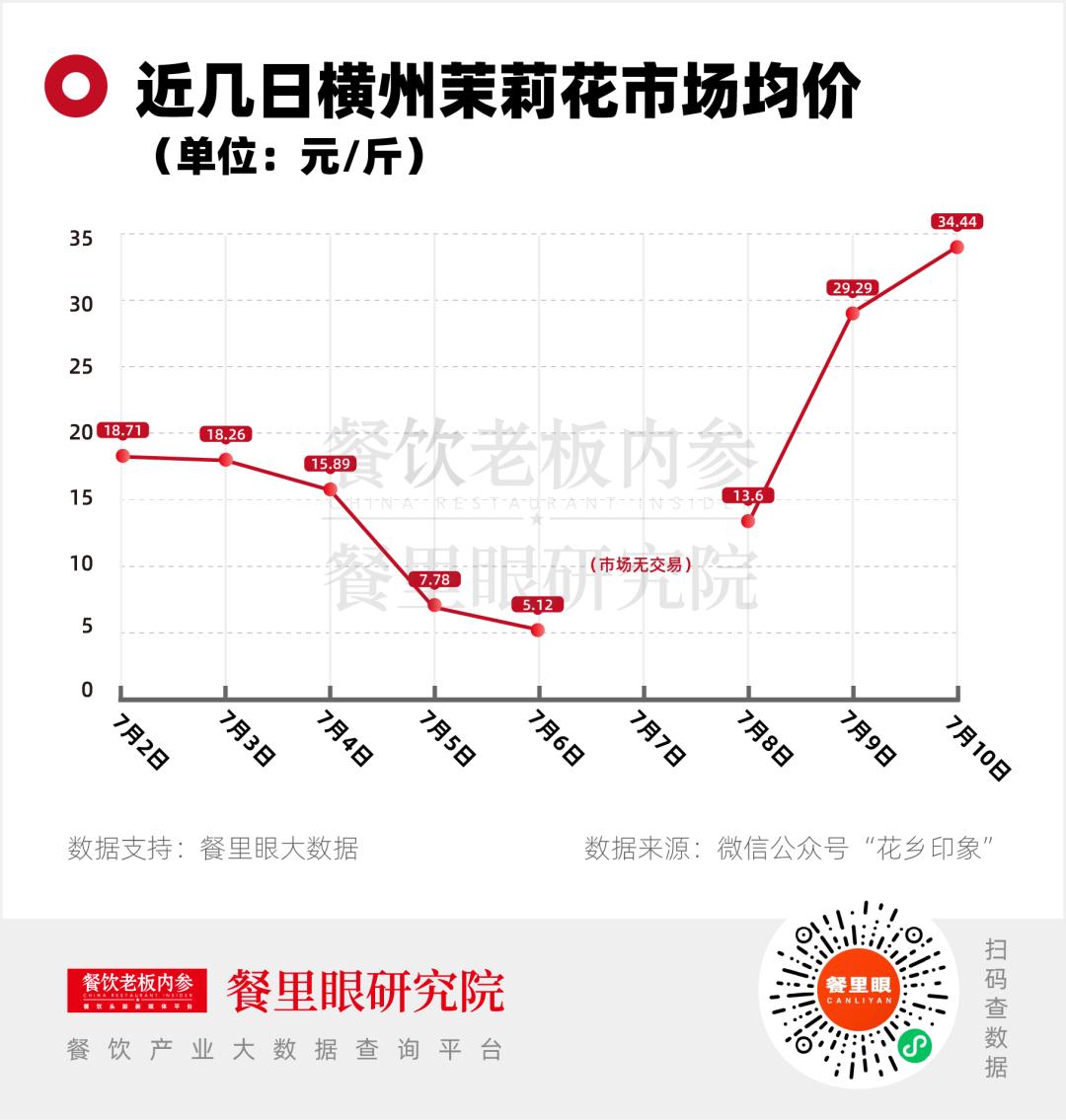
As standing water gradually receded and flower fields began to drain, market transactions resumed on July 8, with the average price rebounding to 13.6 yuan per jin that day. It quickly climbed to 29.29 yuan per jin on July 9, and by July 10, the average price further rose to 34.44 yuan per jin, nearly doubling compared to pre-disaster levels.
Some residents even reported that the highest jasmine price on the 10th had reached 40 yuan per jin, saying, "This is the first time I've seen such a strong price this year, but it's a pity that many jasmine fields have been soaked in water."
The reversal from a sharp plunge to a skyrocketing price reflects the shift in market transaction logic before and after the disaster.
During the rainstorm, a large number of fresh flowers could not enter the market due to flooding and transportation disruptions, bringing transactions almost to a halt. At the same time, continuous rainfall also increased the moisture content of fresh flowers, weakened their aroma, and raised processing losses, significantly reducing purchasers' willingness to buy, which caused prices to drop rapidly. As floodwaters receded and market transactions resumed, the industry's focus quickly turned to future supplies. With expectations of reduced production due to the disaster overlapping with the peak season of the dog days, the market began to worry about insufficient supply of high-quality fresh flowers, and prices rebounded immediately.
According to a report from Nanfang Daily, Chen Daoping, Secretary of the Party General Branch and Vice President of the Hengzhou Jasmine Tea Association, made an initial prediction: "The jasmine output in July is expected to decrease by 30% to 40%, and the impact in August will narrow to around 10%."
In addition, industry insiders judge that as supply gradually recovers, if the average daily output of fresh Hengzhou jasmine flowers can reach 3 million jin, prices will gradually return to rational levels. "15-20 yuan per jin is a normal price range acceptable to both flower farmers and tea enterprises."
Will Milk Tea Prices Rise After the Flood?
Many consumers are beginning to worry: will major coffee and tea beverage brands raise their prices?
For now, the answer is that the short-term impact is limited, but different brands have varying capacities to withstand pressure.
According to Nanfang Daily reports, on one hand, large-scale tea beverage brands usually adopt annual procurement and inventory mechanisms; on the other hand, the disaster-stricken areas are mainly concentrated in some local townships of Hengzhou, without damaging the foundation of the entire industry. A relevant person in charge of Guangxi Lixiang Tea Industry Group stated: "At present, the flood has not caused much impact on the company's workshops, warehouses, equipment, and raw material inventories. Production lines are still operating, and the company's orders and supplies are being delivered normally."
In addition, many leading tea beverage brands have stated that raw material supplies are generally stable at this stage, and there are no plans to adjust terminal prices for now.
According to China Business Daily, a relevant person in charge of Bawang Chaji said that there is no obvious impact on their business for the time being; Jasmine White responded that the company has pre-stored sufficient jasmine tea base inventory to cover the usage needs of all stores across the country for 3 to 4 months, and will not adjust terminal product prices in the short term; Luckin Coffee said it has activated an emergency raw material reserve plan, simultaneously allocating special funds to assist flower farmers in resuming production after the disaster to ensure long-term and stable supply.
In fact, for leading brands, the impact of the flood is more reflected in the uncertainty of future supply, rather than an immediate shortage of raw materials.
In recent years, leading tea beverage enterprises have generally established supply chain systems such as direct sourcing from producing areas, long-term orders, and raw material reserves. Many enterprises also lock in procurement prices in advance and process tea bases into semi-finished products for storage. Therefore, even if fresh flower prices fluctuate sharply in the short term, it will not immediately transmit to terminal retail prices.
The ones truly under pressure are likely regional chain brands and a large number of small and medium-sized tea beverage stores.
Compared with leading enterprises, they generally lack self-built warehousing capabilities, have limited procurement scale, weak bargaining power, and insufficient inventory to buffer raw material price fluctuations. Once upstream tea merchants raise their quotes, they can only purchase tea bases at higher prices, and cost pressures will transmit to their operations more quickly.
Multiple local tea beverage store owners revealed that they have successively received notifications of raw material price increases from upstream suppliers recently. Calculated based on current procurement prices, if they maintain the existing selling prices of jasmine series products, the profit per unit product may be compressed by nearly 30%; but if they raise prices accordingly, they worry that consumers will turn to lower-priced alternative products, falling into a dilemma where "raising prices is difficult, and not raising prices is also difficult."
Summary
This disaster has once again brought the new-style tea beverage industry back to an old question: Supply chain capabilities are becoming a new watershed for brand competition.
In the past few years, competition in the new-style tea beverage industry has mostly focused on product innovation, co-branding marketing, and store expansion. Whoever launches new products faster, has more popular co-branding collaborations, and opens more stores can usually gain market attention. But as the industry enters an era of stock competition, more and more brands are realizing that what truly determines competitiveness is no longer a single new product, but the supply chain behind that new product.
In fact, in recent years, many leading brands have continued to expand upstream in the industrial chain.
From building their own tea gardens and establishing fruit bases, to delving into core raw material producing areas for jasmine, lemons, and milk, and locking in high-quality raw materials through methods such as long-term orders, direct sourcing from origins, digital planting, and co-building bases, the supply chain has become one of the most heavily invested "infrastructures" for brands.
For example, Mixue Bingcheng's Guangxi factory is located in Fusui, Guangxi. It is one of Mixue Bingcheng's core national raw material production bases, which has been sourcing characteristic Guangxi agricultural products such as Hengzhou jasmine, Baise mango, and Lipu taro on a large scale throughout the year.
The recent flood in Hengzhou has further demonstrated the value of such investments.
Faced with the same disaster, leading brands with inventory, long-term procurement agreements, and origin cooperation systems can rely on pre-stocked goods and supply chain scheduling to smooth out short-term fluctuations. In contrast, small and medium-sized brands that lack procurement scale and inventory capabilities are more vulnerable to the direct impact of raw material price increases.
In other words, when facing the same flood, what is being tested is not just procurement capabilities, but the resilience of the entire supply chain.
What is more noteworthy is that extreme weather events have become increasingly frequent in recent years.
From reduced coffee production in Yunnan due to drought, to the jasmine flood in Hengzhou, Guangxi, to raw materials such as fruits and milk sources being constantly affected by climate factors like high temperatures and heavy rainstorms, the tea beverage industry is no longer just facing a single supply issue, but a competition in supply chain risk management capabilities.
For the new-style tea beverage industry, which is increasingly dependent on single hit raw materials, how to establish multi-origin layouts, expand raw material reserves, and improve supply chain risk resistance capabilities is becoming a more important long-term issue than product innovation.
In the end, the competition between brands ultimately comes down to a competition of supply chains.
This article is from the WeChat public account "Restaurant Owner Internal Reference", written by Neicanjun, and published with authorization by 36Kr.