The airport business in provincial capitals of central China is being taken away by high-speed railways.
Recently, multiple regions have released their airport passenger flow data for the first half of the year. Despite rising international oil prices driving up airfares and reduced flight routes across many areas, China's civil aviation passenger volume still recorded a 1% positive growth.
However, the gap in passenger numbers between different airports is widening rapidly.
While Guangzhou Baiyun Airport has regained its top position nationwide and drawn widespread attention, the airports of six provincial capitals in central China have collectively posted a rare negative passenger growth. The passenger throughput of Wuhan Tianhe, Zhengzhou Xinzheng, Changsha Huanghua, Taiyuan Wusu, Hefei Xinqiao, and Nanchang Changbei decreased by 4.3%, 0.9%, 7.7%, 6.2%, 3%, and 3.9% respectively in the first half of the year.
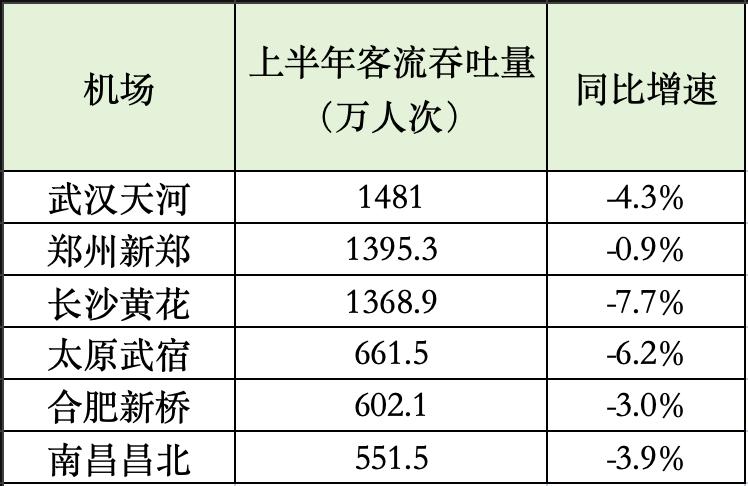
Changes in passenger flow of central provincial capitals in the first half of the year (Data source: CADAS Transportation Big Data)
Behind the divergence in airport passenger flow lies a shift in their growth logic. In the past, airlines and high-speed railways competed for the same group of travelers, but today, an airport's future competitiveness depends more on its position within the comprehensive transportation system.
For the provincial capitals in central China, which host the country's densest high-speed rail network, this change is particularly drastic.
As high-speed trains continue to get faster, the question that central airports need to answer may be how to accurately identify their own future division of labor in the transportation landscape.
Why Did Passenger Flow Decline Collectively
If we only look at the national civil aviation market, this year cannot be considered a "slow year."
In the first half of this year, the total passenger throughput of China's civil aviation maintained positive growth. Large airports including Guangzhou Baiyun, Beijing Capital, and Shanghai Hongqiao continued to see rising passenger numbers. With a passenger throughput of 43.333 million, Guangzhou Baiyun Airport overtook Shanghai Pudong once again, reclaiming the title of the country's busiest airport after a one-year gap.
At the same time, airports such as Haikou Meilan and Urumqi Tianshan achieved counter-trend growth. However, among the 41 airports with annual throughput exceeding 10 million, 18 saw negative growth, and all six central provincial capital airports were on that list.
Beyond the numerical decline, the rankings of some city airports have also shifted. For example, Changsha Huanghua Airport dropped four positions year-on-year.
This means that air travel demand has not disappeared, but has been redistributed among different airports.
Leading international gateway airports are continuously attracting more domestic and international passengers. With the rapid recovery of international routes—driven by the expansion of visa-free policies, increased cross-border business exchanges, and rebounding outbound tourism—the profit margin of international routes has once again surpassed that of domestic routes. Airlines have started to readjust their capacity, deploying more wide-body aircraft and prime flight slots to the international market.
Against this backdrop, international gateway airports in Beijing, Shanghai, Guangzhou, and Shenzhen have been the first to benefit. Take Guangzhou Baiyun Airport as an example: as of July 3, the port of Guangzhou Baiyun International Airport handled over 10 million entry-exit passengers this year, marking a 19.6% year-on-year increase.
Among them, inbound and outbound foreign nationals exceeded 3.9 million, up 34% year-on-year, 8 percentage points higher than the national average growth rate. They accounted for more than 41% of the total entry-exit passengers at the port, with both the number and proportion hitting record highs.
Inland airports that have long relied on domestic routes, however, are facing mounting pressure.
On one hand, the provincial capitals in central China have close economic ties, similar industrial structures, and highly consistent travel patterns for local residents, with passenger flows mainly supported by business and tourist routes to major hubs like Beijing, Shanghai, Guangzhou, and Shenzhen.
In contrast, Guangzhou and Shanghai not only have a huge local passenger base but also serve as international gateways and regional transfer hubs. Haikou and Sanya benefit from their status as popular tourist destinations, while Urumqi has gained new growth opportunities thanks to its geographical advantage connecting to Central Asia and other regions. The functions of different airports have begun to show clear differentiation.
Parallel to this functional differentiation is the development direction of the national air hub system.
In recent years, China has gradually formed a "3+7+N" international air hub layout, with Beijing, Shanghai, and Guangzhou forming the first echelon, enhancing intercontinental connectivity and global radiating capacity to support the construction of the "Air Silk Road." Chengdu, Shenzhen, Chongqing, Kunming, Xi'an, Urumqi, and Harbin make up the second echelon, building regional international route networks.
All six central provincial capitals fall into the "N" or other categories. This means that international route resources, flight slots, and airline capacity allocation are further concentrated in a small number of super hubs.
From the experience of global aviation development, this is an inevitable trend. Air transportation has obvious economies of scale: the more international routes an airport has, the higher its transfer efficiency, and the more attractive it becomes to airlines, forming a virtuous cycle. For central airports outside the top tier, this means the competitive landscape is changing.
Rising Competitiveness of High-Speed Rail
Taking a longer-term perspective, the challenges facing central airports are not limited to the civil aviation sector itself.
An increasingly dense and high-speed rail network is reshaping the regional transportation pattern.
The six central provincial capitals share a common feature: they have long been the country's most important railway hubs. Wuhan is known as the "thoroughfare of nine provinces," Zhengzhou is hailed as the "heartland of the nine states and a gateway to ten provinces," Changsha is accelerating the completion of its "star-shaped" high-speed rail network, and Nanchang, with its geographical location connecting the Yangtze River Delta and the Pearl River Delta, is gradually emerging as a new regional high-speed rail center.
This also means that the functions of these high-speed railways largely overlap with those of air travel.
For a long time, a widely recognized judgment in the industry has been: for trips within 800 kilometers, high-speed railways usually have higher comprehensive travel efficiency than air travel, thanks to their advantages of city-center to city-center connectivity, high punctuality, and short waiting times. For trips over 1200 kilometers, air travel still holds absolute advantages. The 800-1200 kilometer range is the most fiercely contested zone between the two modes of transport.
Most key travel destinations from the central provincial capitals fall exactly within this competitive range.
Take Wuhan as an example: the distances from Wuhan to Beijing, Shanghai, Guangzhou, and Shenzhen are 1,142 km, 770 km, 992 km, and 1,064 km respectively. Within four hours, travelers can reach major domestic cities including Beijing, Shanghai, Hangzhou, Nanjing, Guangzhou, Shenzhen, Changsha, and Xi'an.
Data from the Ministry of Transport shows that China has built the world's largest high-speed rail network, with a total operating mileage of 48,000 kilometers, accounting for more than 70% of the world's total high-speed rail mileage, covering 97% of the country's cities with a population of 500,000 or more.
As the "Eight Vertical and Eight Horizontal" high-speed rail network continues to expand, and more cities are connected by 350 km/h high-speed railways, business travelers and short-distance tourists are increasingly opting for high-speed trains, putting sustained pressure on the domestic trunk air routes that airports once relied on.
Therefore, for central airports, the passenger transport market may not return to the high-growth phase of the past. With high-speed railways taking charge of short and medium-distance regional connectivity and air transport focusing on long-haul travel, the division of labor between the two modes will become increasingly clear.
Central Cities Seek New Directions for Civil Aviation
However, this does not mean the importance of airports is diminishing. The civil aviation industry has already taken proactive steps to explore new competitive directions.
Shortening check-in times and facilitating seamless transfers is a major priority. Over the past year, more than 30 airports with 10-million-level throughput across China have gradually cut their check-in cutoff times, with many reducing the boarding pass closing time from 40 minutes to 30 minutes or even less.
In April this year, the *Implementation Guidelines for Facilitating Civil Aviation Passenger Transfers (Third Edition)* officially came into effect. Reforms such as one-time baggage check-in for transfers, inter-airline connectivity, and information sharing are being continuously promoted, making transfer efficiency a new focus of airport competition.
At the same time, the development focus of airports is shifting from simply pursuing passenger volume to more diversified hub functions. For central provincial capitals, the opportunities they can seize lie more in air cargo.
According to plans, while international passenger resources continue to concentrate in leading airports, the air cargo network is expanding into inland regions. Among them, Zhengzhou is positioned as an international logistics center, and Hefei will serve as an international air cargo distribution hub. Leveraging the rapid growth of high-value-added industries such as electronic information, biomedicine, and cross-border e-commerce, air logistics is becoming a key driver for central China to expand its opening-up.
Hunan recently proposed building a Changsha-Yueyang international air logistics hub, which also reflects this strategic thinking.
During this year's National Two Sessions, the Hunan delegation submitted the *Proposal on Supporting the Construction of the Changsha-Yueyang Airport Economic Zone and Building Yueyang International Air Cargo Hub*. According to the plan, Changsha will continue to serve as the province's passenger transport gateway, while Yueyang will focus on developing air cargo, forming a development pattern of "passengers in the south, cargo in the north, and coordinated operation between trunk and feeder routes."
Another noteworthy trend is that high-speed railways and civil aviation are evolving from competition to cooperation.
Last year, the Civil Aviation Administration of China and China State Railway Group jointly issued the *Key Task List for Promoting High-Quality Air-Rail Intermodal Development (2025-2027)*, proposing to build comprehensive transfer centers and promote intermodal models such as "one-stop ticketing and one-ID travel." In the future, passengers will be able to take high-speed trains to reach aviation hubs in Wuhan, Zhengzhou, Changsha and other cities, and then seamlessly connect to international flights. Airports, supported by high-speed railways, will extend their service radius to urban clusters hundreds of kilometers away or even further surrounding areas.
In this sense, high-speed railways have not weakened airports, but helped them expand their hinterland. The two networks of air and high-speed rail are gradually integrating, rather than replacing each other.
For central provincial capitals including Wuhan, Zhengzhou, Changsha, and Nanchang, the real question they need to consider may no longer be how to recapture the passenger flow diverted by high-speed railways. Instead, against the backdrop of the continuous restructuring of the national comprehensive transportation system, they should figure out how to leverage the high-speed rail network, air logistics, and international opening platforms to find their own unique new positioning.
This article is from the WeChat official account "City Reading Studio", written by Wang Chenting, and authorized for release by 36Kr.