50! Private property developers are making a comeback
In the first half of 2026, the divergent trends in the real estate market continued to evolve, with central and state-owned enterprises maintaining a strong leading position and firmly occupying a dominant market share.
According to data from CRIC, in the first half of the year, 8 real estate enterprises recorded full-caliber sales revenue exceeding 50 billion yuan, and all of them were central and state-owned enterprises. Among them, Poly Development, China Overseas Land & Investment, and China Resources Land firmly secured top-tier positions in the industry with performances surpassing 100 billion yuan each.
At the same time, however, private real estate enterprises have begun to gradually break through by leveraging their local resource advantages.
Statistics show that among the top 100 real estate enterprises by full-caliber sales in the first half of the year, the number of private enterprises increased to 50, marking the first rebound of this figure in nearly six years after consecutive declines.
In 2020, the number of private enterprises among the top 100 real estate developers reached 72, then declined year by year, dropping to 60 in 2022 and leaving only 47 by 2025.
This clearly demonstrates the significant importance of the rebound seen in the first half of this year.
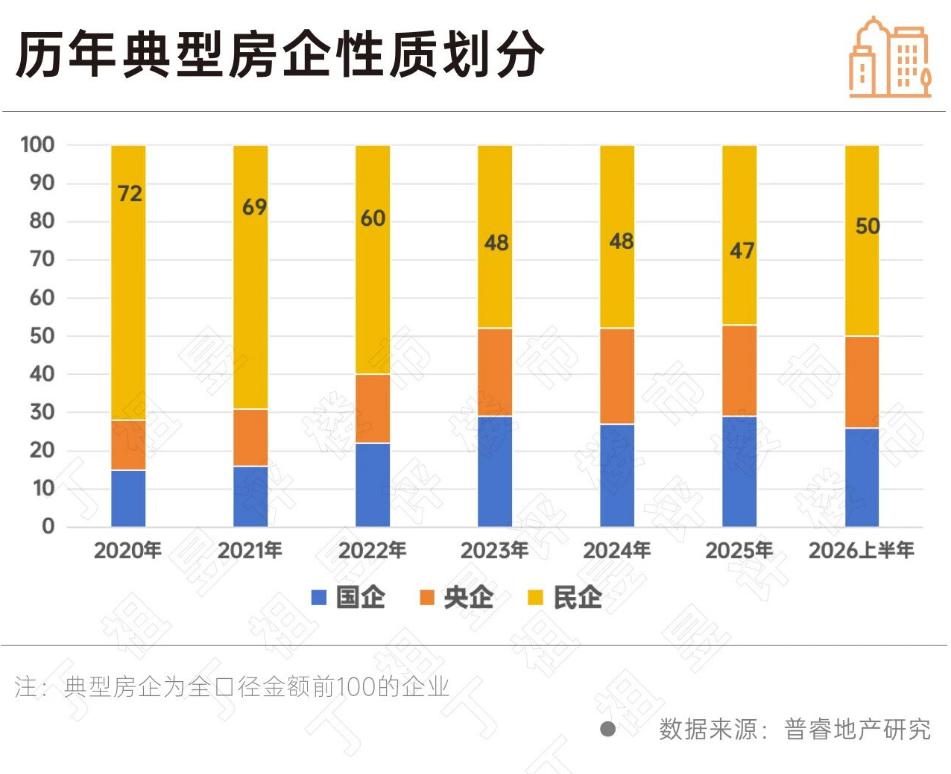
Industry insiders believe that the activity level of private enterprises serves as a key indicator of the market's temperature. In the previous two years, private enterprises generally scaled back their investments, leading to a lackluster competitive landscape and sluggish market recovery. Today, a group of locally based small and medium-sized private enterprises with refined operations have regained momentum, injecting new vitality into the market. Compared with the standardized development model of central and state-owned enterprises, local private enterprises have a better understanding of local market demands, boast faster product iteration and operational adjustment capabilities, can enrich the stratification of market supply, break the solidified pattern dominated by state-owned developers, and signal that the endogenous recovery momentum of the property market is continuously strengthening.
In terms of performance growth, 31 of the top 100 real estate enterprises achieved counter-trend growth in full-caliber sales performance in the first half of the year, including 10 central SOEs, 7 local SOEs, and 14 private enterprises.
Among the 14 private enterprises with growing performance, 13 posted total sales below 8 billion yuan, yet their average growth rate reached an impressive 46%.
The "Ding Zuyu's Real Estate Review" points out that these enterprises generally do not pursue blind nationwide expansion, but have accumulated deep government-enterprise resources and strong customer reputations in their familiar local markets.
For example, Haicheng Group has deepened its presence in Chongqing's districts and counties to consolidate its core market base, Junyi Holdings has focused on Qingdao to build a benchmark for local products, and Luen Thai Properties has rooted itself in the Pearl River Delta to continuously deepen its regional layout.
In other words, these private enterprises may not be extremely large in scale, but they boast solid regional foundations, stable operational fundamentals, and more prominent risk-resistance capabilities.
The only private enterprise with performance exceeding 10 billion yuan that achieved growth is Bangtai Group.
In the first half of 2026, Bangtai Group recorded full-caliber sales revenue of 16.08 billion yuan, ranking 22nd among the top 100 real estate enterprises, with a gap of merely 390 million yuan from Longfor Group, a top-performing private enterprise in the sector.
This is mainly because over the past three years, Bangtai Group has maintained its land acquisition scale at a level above 2 million square meters, and its newly acquired high-quality land reserves have laid a solid foundation for the company's performance growth.
"Ding Zuyu's Real Estate Review" states that among typical real estate enterprises, the bottoming out and recovery of private enterprises acts as a "barometer" for market confidence restoration and a key signal for the return of market mechanisms. Its significance lies in breaking the single dependency on the "state advancing while private sector retreats" pattern, serving as a crucial verification of the recovery of the market's endogenous momentum, and a necessary condition for confirming that the industry has moved from the "policy bottom" to the "market bottom".
Against the current backdrop of overall market scale contraction where all enterprises are attaching increasing importance to individual projects, private enterprises that have taken the lead in stabilizing in their local markets through a "small yet refined" model will become an extremely important force in the future market.
This article is from the WeChat public account "Leju Finance", authored by Zhao Panpan, and published by 36Kr with authorization.