Significant changes have taken place in the listing volume of second-hand houses
In the first half of this year, second-hand home transactions in 20 key cities hit a new half-year high in nearly four and a half years.
Behind the rebound in transactions, we notice that the listed inventory of second-hand homes in typical cities has shrunk simultaneously. The total listed volume of second-hand homes in 15 cities has dropped by around 20% from its peak level.
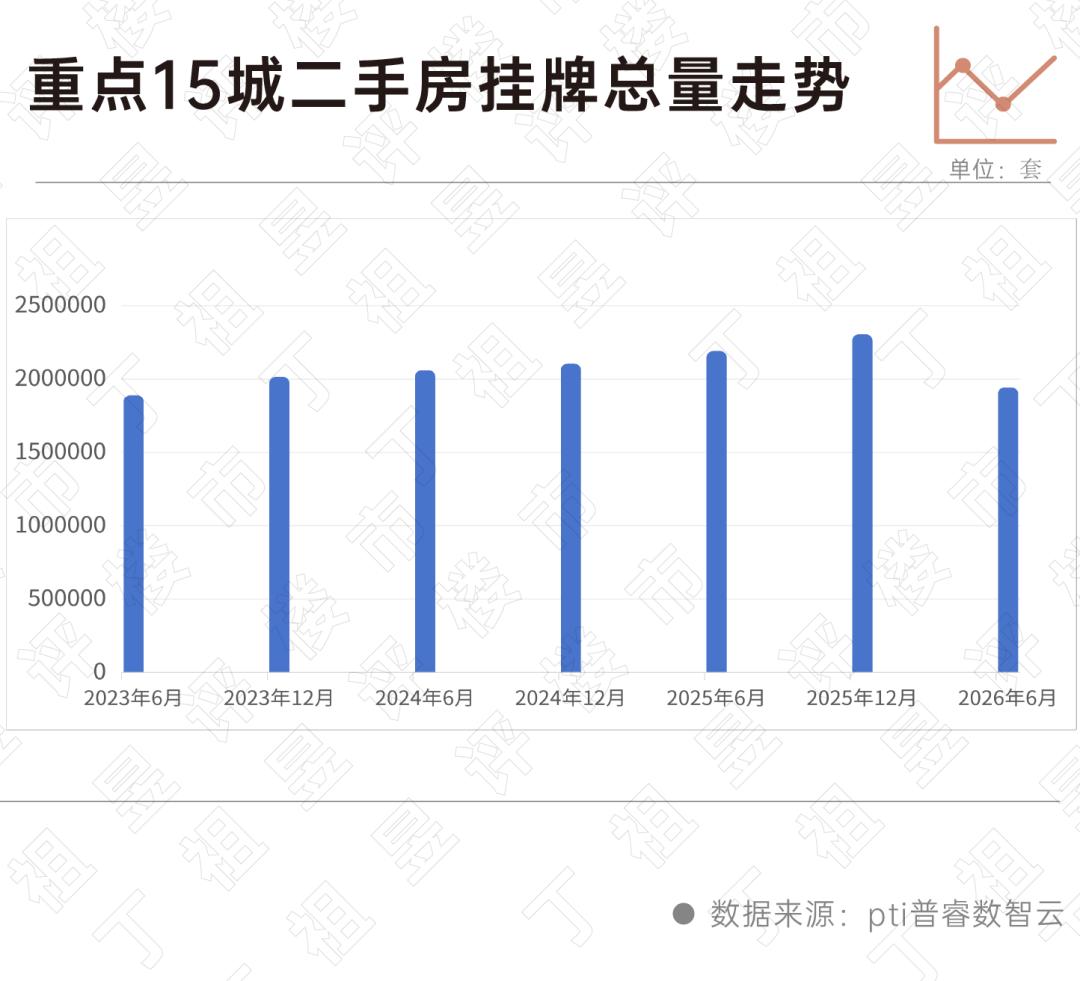
Looking at a longer time horizon, we tracked the half-year data changes across these 15 cities. Since the first half of 2024, the total listed inventory of second-hand homes had been continuously rising, until the first half of 2026, when the listed scale saw its first notable decline.
01
We compiled listing data from 15 key cities including Beijing, Shanghai, Guangzhou, Shenzhen and Hangzhou, excluding non-residential properties, and arrived at a figure: The total number of listed second-hand homes across the 15 cities in June 2026 reached 1.9 million units.
The supply scale of the second-hand housing market remains substantial.
Over the past two years, what changes have taken place in the listed second-hand home inventory data across typical cities nationwide?
By comparing the complete listing data of second-hand homes in the 15 cities over the past two years, we identified a critical trend: The volume of listed second-hand homes has been continuously declining.
Looking at specific figures, the listed scale of second-hand homes in the 15 cities still stood at 2.26 million units in December 2025, and within half a year, the listed inventory of second-hand homes decreased by 16%.
When compared to the peak total listed volume of each city, the decline even reached 20%.
As shown in the table, the listed volume of second-hand homes in the 15 cities gradually increased, peaked in December 2025, and then saw its first notable decline in June 2026.
02
What is the specific situation for individual cities?
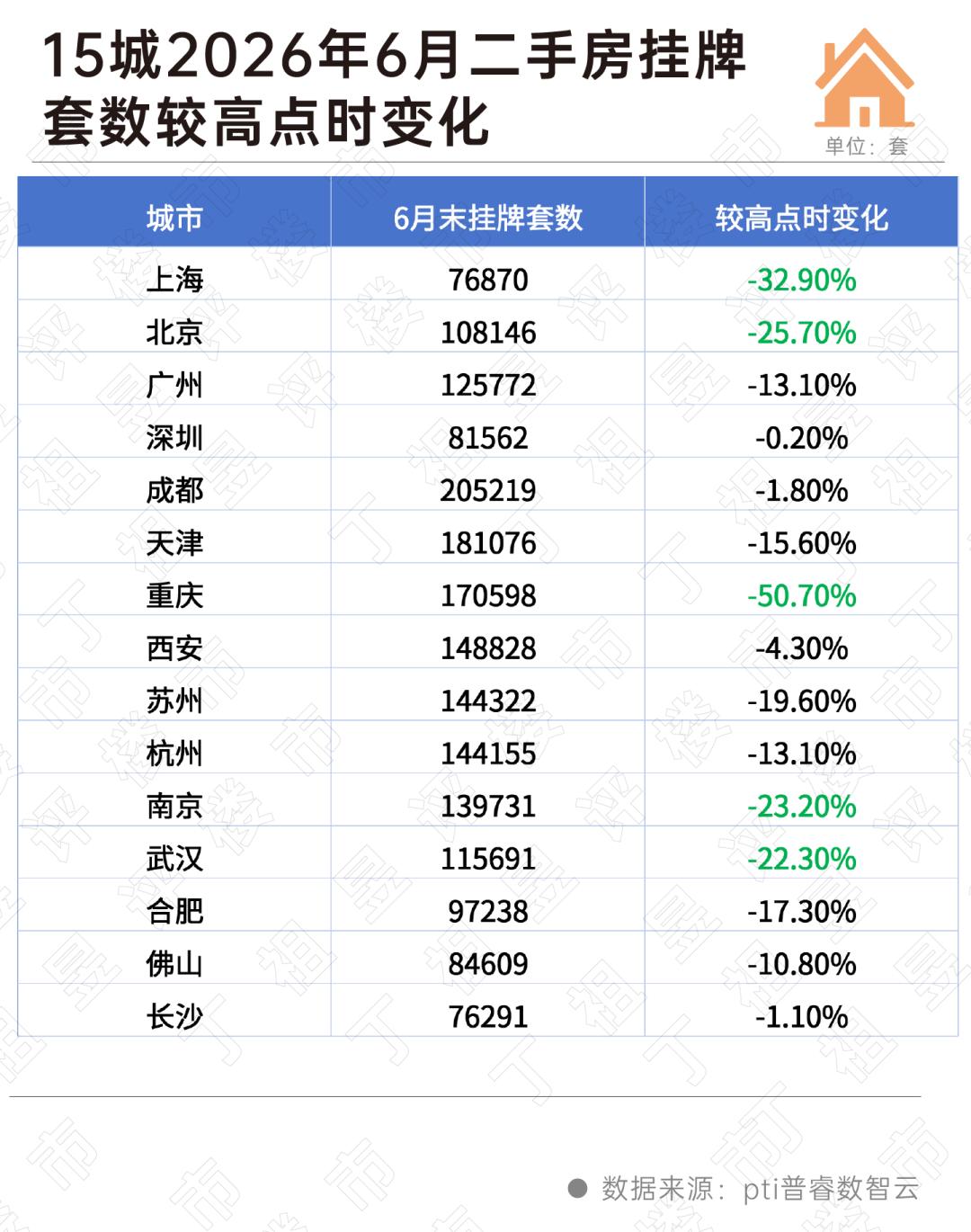
By comparing the historical peak listing volumes of the 15 cities since 2023 (these peaks were mostly concentrated in 2024 and 2025), nearly all 15 cities recorded a decline.
Take Shanghai for example, the number of listed second-hand residential units at the end of June was approximately 77,000, down 33% from its peak level.
In Beijing, Nanjing and Wuhan, the listed scale of second-hand homes also fell by more than 20% from their respective peaks.
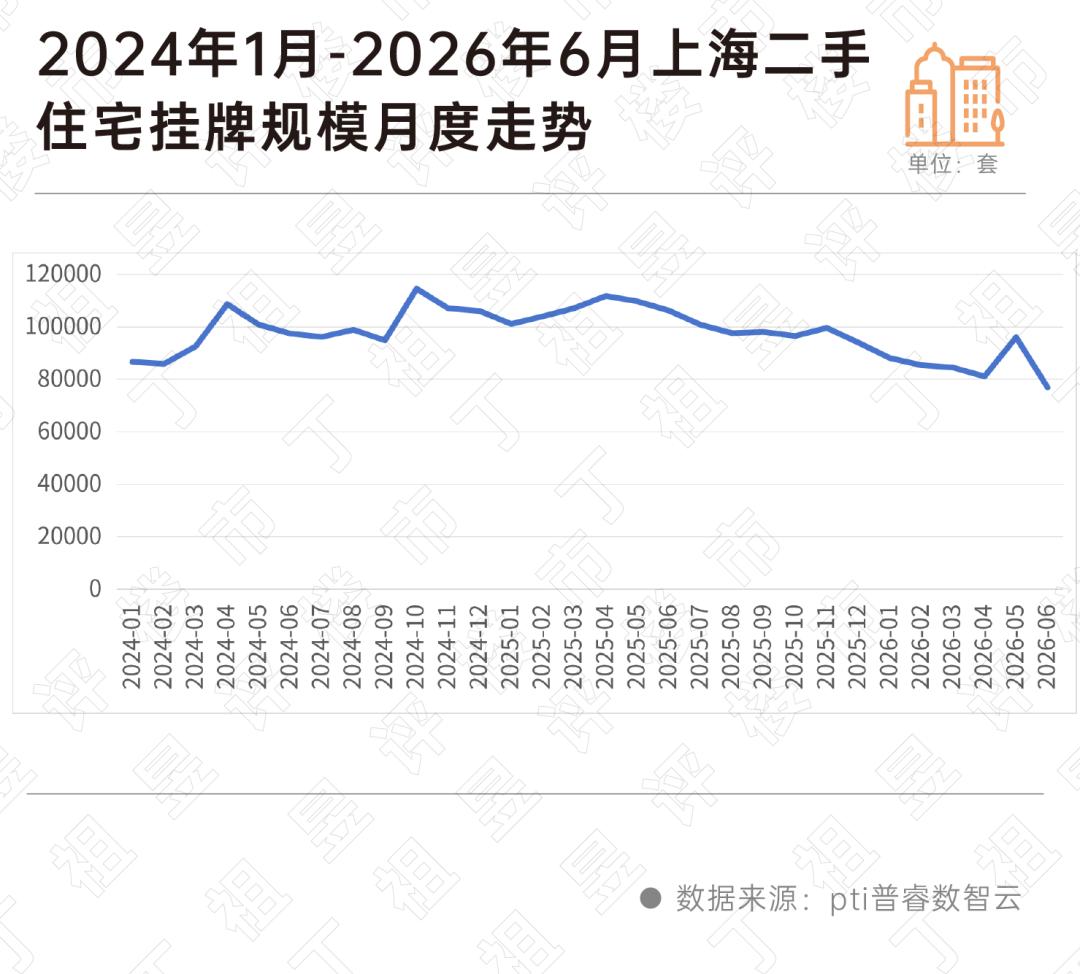
Taking Shanghai as a case study, from a monthly trend perspective, the listed volume of second-hand homes in Shanghai exceeded 110,000 units in October 2024, and remained above 100,000 units for ten consecutive months.
The implementation of the "Six Shanghai Property Policies" in August 2025 became a key inflection point. After the relaxation of purchase restrictions and credit policies, improved housing demand was unleashed, which triggered the listed second-hand home inventory to enter a downward trajectory.
At the beginning of 2026, the tax rebate policy for housing replacements was introduced, followed by further easing under the "Seven Shanghai Property Policies" in February. The stock of second-hand homes continued to decline, and by June 2026, the listed volume of second-hand homes had dropped to its lowest monthly level in nearly two years, 19,000 units fewer than the listing volume in May.
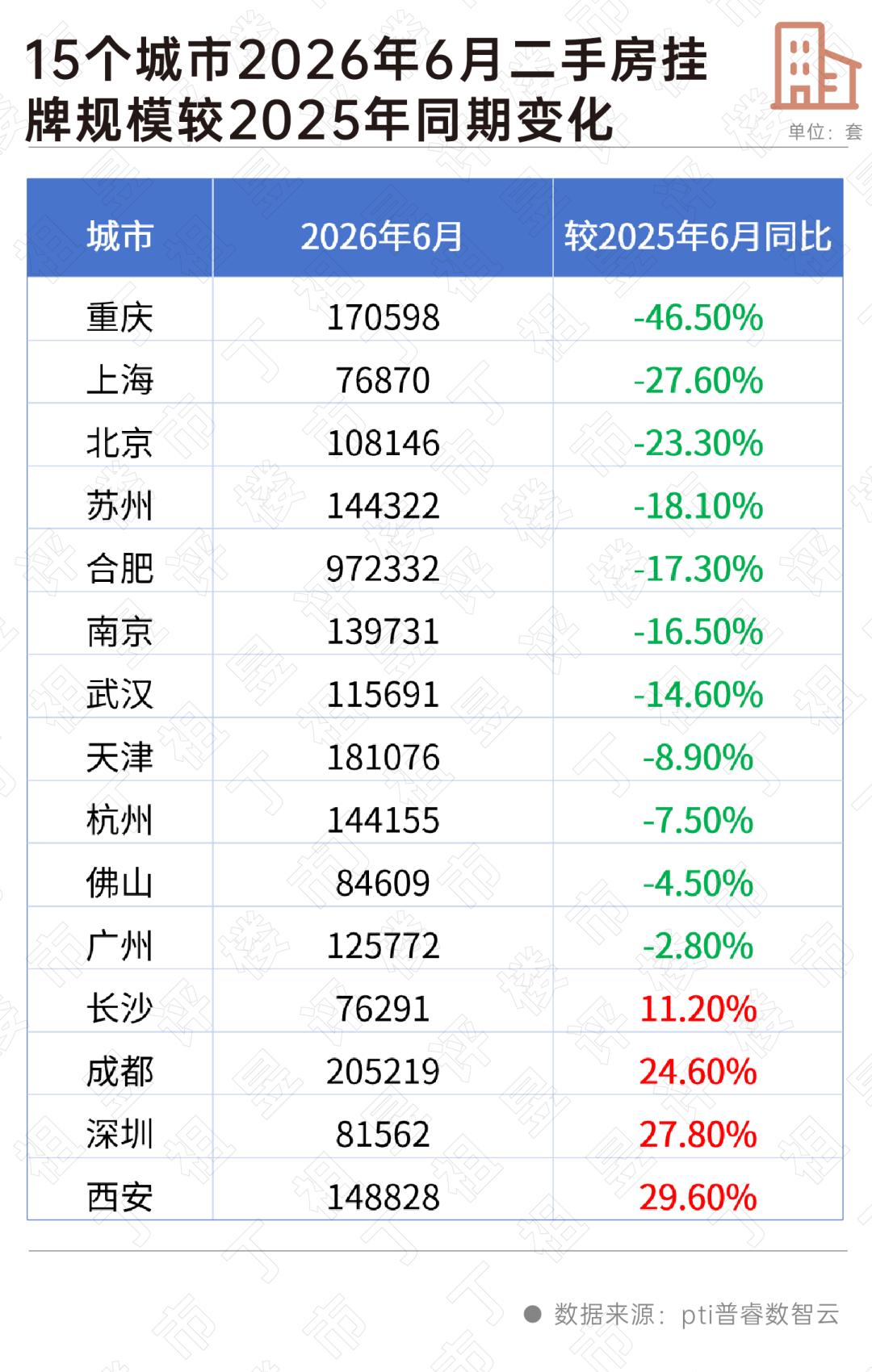
Over the past year, the listed volume of second-hand homes in most cities among the 15 has shown a fluctuating downward trend.
Shanghai, Beijing, Suzhou, Hefei, Nanjing and Wuhan all recorded a decline of over 10% in their listed second-hand home scales. In addition, Tianjin and Hangzhou also saw a decline of more than 5%.
Taking Tianjin as an example, the listed scale of second-hand homes dropped from 199,000 units last June to 181,000 units this year, with the monthly average of newly added listings decreasing from 23,600 units to 19,800 units.
Overall, the supply pressure of second-hand homes in the above-mentioned cities has been significantly alleviated, with some homeowners becoming reluctant to sell their properties, and the supply-demand relationship is gradually being restored and improved.
However, the listed volume of second-hand homes in some other cities has continued to rise over the past year.
These cities include Xi'an, Shenzhen, Chengdu and Changsha. Compared to the same period last year, the number of listed second-hand homes in Xi'an increased by nearly 30%. Shenzhen's listed second-hand residential volume reached 81,600 units in June, up about 28% year-on-year. Chengdu's listed second-hand residential inventory stood at 205,000 units, a 25% year-on-year increase.
In a nutshell: Homeowners who had been holding back on housing replacements in the early period entered the market with concentrated listings, pushing new supply to a phased high level.
Driven by the stabilized and rebounding transaction volume, seller confidence in these cities has been restored to some extent, and some previously hesitant homeowners have started listing their properties. The second-hand home transactions in Chengdu, Shenzhen, Xi'an and Changsha all recorded positive year-on-year growth in the first half of this year.
Nevertheless, in terms of incremental changes, the growth rate of new listings in these four cities has slowed down over the past half year, with the listing pressure shifting from a surge in new supply to consolidation at a high level.
03
While the total listed inventory is shrinking, the average transaction price of second-hand homes in typical cities across all regions simultaneously declined in June.
This indicates that the second-hand housing market is still trading price concessions for higher transaction volume.
However, when looking at the average listing price, divergence has emerged among different cities.
The average listing price of second-hand homes in Shenzhen, Suzhou, Wuhan, Hefei and Foshan recorded a year-on-year increase, but their corresponding average transaction prices are still declining, with a larger drop. The expectations of buyers and sellers are clearly mismatched.
Homeowners in cities like Beijing, Xi'an, Nanjing and Changsha have voluntarily lowered their listing prices, but the decline in average transaction prices is significantly higher than that of average listing prices, which shows that even after homeowners cut prices, the magnitude of price reduction still fails to meet buyers' psychological expectations, leading to weak market demand absorption and persistent downward pressure on prices.
From the perspective of changes in the price gap between average listing price and average transaction price, 11 out of the 15 cities have seen their bargaining space expand compared to the same period in 2025, with only Tianjin and Chengdu recording a slight narrowing of the price gap.
Buyers and sellers are still in a game of negotiation.
On one hand, second-hand homeowners are starting to become "reluctant to sell". For example, in Hangzhou, a second-hand homeowner told us that she owns a school-district property listed at 2.8 million yuan, while the average transaction price in her residential complex is only 2.2 million yuan. She is aware that the excessively high price has deterred potential buyers from viewing the property, but she believes the current market price is lower than her expectation, so she says "I'm not in a hurry to sell, I will only sell when the price meets my psychological target."
But the reality is that only properties with price reductions can get transacted. Data shows that Hangzhou's average second-hand home listing price in June only dipped slightly by 0.5% year-on-year, almost unchanged from last year, but the average transaction price dropped by 14.6%.
A real estate agent in Xihu District, Hangzhou, told us that there are abundant properties on the market in the local area now, so buyers have too many comparable options for the same house type, leading to a trend of fluctuating downward transaction prices. However, as low-priced properties get transacted, some properties with premium due to high-quality decoration are also starting to be sold.
The general trend of recovery in the second-hand housing market in key cities has not changed.
As the listing volume shrinks, the expectations of buyers and sellers continue to interact and compete. Most homeowners are reluctant to sell and wait-and-see, refusing to make significant price cuts, while buyers only accept transacting properties at discounted prices. Under this two-way game, trading price concessions for higher transaction volume remains the core logic for second-hand home circulation.
Nevertheless, after the concentrated transactions of low-priced properties, the market will most likely enter a new round of price game cycle, but a widespread sharp rise or fall across the board will not occur.
This article is sourced from the WeChat Official Account "Ding Zuyi Comments on the Real Estate Market", authored by the Editorial Department, and published by 36Kr with authorization.